
Last Updated on March 16, 2024 by John Campopiano
R
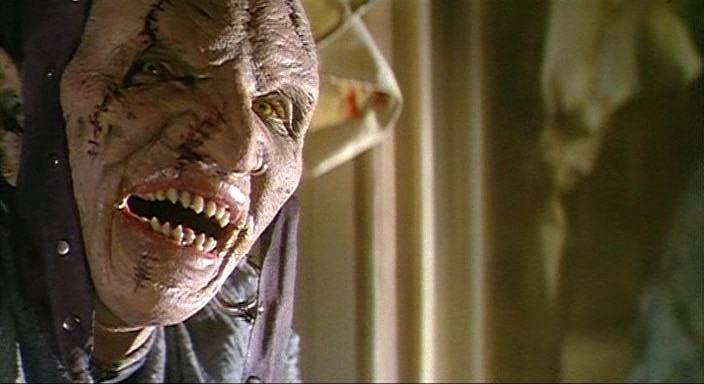
umpelstiltskin is a 1995 horror-comedy from filmmaker Mark Jones, his directorial follow-up to the financially successful Leprechaun. In the 1812 Grimm Brothers fairy-tale collection, Rumpelstiltskin demands the firstborn of a miller's daughter in exchange for spinning straw into gold. In Jones' adaptation, the film follows Rumpelstiltskin (played by Max Grodénchik) from the 1400s, where he was imprisoned in a jade figurine by a local gypsy, to 1990s Los Angeles where he has been accidentally awakened by the recently widowed Shelley Stewart (played by Kim Johnston Ulrich). The chase is on as Rumpelstiltskin pursues Shelley in order to steal her infant son, John. The cast includes comedian Tommy Blaze, Allyce Beasley, Jay Pickett, Sherman Augustus and Vera Lockwood as Matilda.
As I walked into a Star Trek convention in downtown Boston, I wasn’t quite sure what to expect as I was accustomed to horror conventions and film festivals. And while I appreciate and respect the Trek fandom, I was there to meet Max Grodénchik — known to most as Rom, the recurring character from Star Trek: Deep Space Nine. But to me, he was and will forever be Rumpelstiltskin from the 1995 horror film. I was equipped with my Rumpelstiltskin poster, as well as a laundry list of questions about the film and his experience working on it. Up to that point, I hadn’t read or seen any interviews with Max discussing the film.
Max was gracious with his time and seemed to enjoy talking shop about “Uncle Rumpel,” as the character often refers to himself in the film. We covered a lot of ground in just a few minutes: the physical demands of the role; Kevin Yagher’s makeup work; and his collaborative relationship with the director. It was clear that Max cherished playing Rumpelstiltskin, and as I was gathering my things to leave, he confessed that he would love to do a sequel.
By this point, I was intrigued and eager to talk to Mark Jones — the man who created not only Rumpelstiltskin but another cult horror classic (of sorts), Leprechaun. The conversation with Jones led us down several unexpected film- and television-related avenues, from Scooby-Doo and Shirley Temple to Dino De Laurentiis and Aaron Spelling. Oh, and of course I made sure to bring up the idea of a sequel.
FANGORIA: Before we jump into Rumpelstiltskin, it’s probably essential that we talk about your first film, Leprechaun. How did the idea for that film come about?
MARK JONES: I started my writing career in animation in the late 1970s working for Ruby-Spears Productions, the television animation production company. Joe Ruby was the creator of Scooby-Doo, and I had been writing for Scooby-Doo and other shows like Mega Man and A-Team. I had always wanted to do a Scooby-Doo-style horror movie and I was eager to direct my first feature. You can see that influence all over the place in Leprechaun, particularly in the brightly colored lights on our soundstage: blues, yellows and greens. It wasn’t drab! It was almost like a live-action Scooby-Doo. That’s definitely where my tone was. The Lucky Charms leprechaun was another idea that I had in my mind as a possible angle for a horror character. No one had done a St. Patrick’s Day horror film at that point, so I figured let’s go do one.
So coming into Leprechaun, I was coming off of writing and producing a lot of television shows in the 1980s. Back in those days, doing a low-budget horror film was often a good way to break out and get that first-time director job. Trimark Pictures (the production company) was very cautious about first-time directors and a little concerned about me stepping into that role. They actually offered me more money for the project if I didn’t direct. I said no because it wasn’t that I needed the money — I needed the credit. I just wanted to get behind the camera. Eventually, we did come to an agreement and they let me direct the film, though many of the executives were constantly on top of me and watching my every move. Ultimately, we all made it through and the film was about 98% of the original vision I had for it.
FANGO: Your work with the legendary Ruby-Spears Productions is fascinating. Transitioning to horror films wouldn’t necessarily seem like the obvious next move.
MJ: Joe Ruby was actually the one who got me into the business with shows like Turbo Team and the Mister T cartoon series. Both of those shows were Ruby-Spears productions. Fast-forward a few years after I wrote the script for Rumpelstiltskin, Joe Ruby and Ken Spears actually came on board as producers, along with my producing partner who worked with me on Leprechaun, Michael Prescott. Everything came full-circle when Joe signed on to be involved with Rumpelstiltskin!
FANGO: With your experience in cartoons and animation for kids, it’s almost as if you were trying to make a horror film for a younger audience with Leprechaun (even though the film does have its fair share of gore).
MJ: Right. With my style, I’d rather push the envelope and either go a little funny or a little over the top. I’m not sure if I would enjoy doing a straight slasher horror movie. I always like to put a little bit of color into my films, like Rumpelstiltskin riding motorcycles and smoking cigars. I think that’s just my cartoon sensibilities coming out — I just can’t take a horror movie too seriously.
When we finished Leprechaun, it went out to the ratings board where they gave it a PG-13 rating. Around that time, we also ended up cutting an R-rated version, which was really just us adding more gore. We did test screenings of both versions, and it turned out the younger audiences wanted the R-rated version — even though they couldn’t get into R-rated films! So, that’s the version we went with.
Warwick Davis, Robert Hy Gorman and Mark Jones on set.
FANGO: It seems like in the era of Leprechaun and Rumpelstiltskin, we were seeing more fairy-tale themed horror films, some of which relied on a mixture of both horror and tongue-in-cheek humor.
MJ: Leprechaun and Rumpelstiltskin, compared to the real slashers like Friday the 13th and Halloween, were popular because they were also accessible to a younger audience. I think the younger kids —10-, 11- and 12-year-olds, got a kick out of these characters. Here’s the Leprechaun driving a tricycle, killing someone with a pogo stick and telling jokes — he was a real character! We wanted to give the Leprechaun a wild personality and clearly, Warwick Davis was up for the job. We worked a lot on dialogue and trying to decide: Do we just make this a monster who doesn’t talk? Or do we build in some funny dialogue and give him a personality? The goal was to make the Leprechaun the kind of monster you’d see in Scooby-Doo — the monster of the week. I think that’s why the film has stayed around so long. It was a horror movie that younger audiences felt might have been made specifically for them.
FANGO: Is there something about the dark side of fairy tales that interests you and informs your creative approach to making horror films?
MJ: Absolutely. When I was a kid in the 1960s, I remember seeing a TV show called the Shirley Temple Theatre [also known as Shirley Temple’s Storybook]. It was a relatively obscure show that played on Sunday nights. I believe it only went for a couple of seasons. In one of the episodes, they had a Rumpelstiltskin character! They made a person up to look evil, and he spent the episode chasing after a woman’s baby, you know, the whole story. It was really creepy, and that episode has always stayed with me. So after Leprechaun, I thought, well, we’ve started the Leprechaun franchise, why not try Rumpelstiltskin? Here you’ve got a story about a little person who wants to steal your baby — that’s pretty terrifying! I said to myself, “I think I can make something into that.” And oddly enough, I ended up writing the first draft of the script for Rumpelstiltskin with Joe Ruby. He and I had stayed in touch over the years and one day I said to him, “You know, I really want to do Rumpelstiltskin,” and being a great story guy, he said to me, “Let me work on it with ya,” so that’s what we did.
FANGO: During the early to mid-1990s, did you find that there was creative and financial support from the studios for this flavor of fairy-tale horror?
MJ: When I came to Trimark Pictures in 1991, the message was essentially this: The Friday the 13th-type slashers of the ‘80s are done, and we’re just not sure if this type of horror is going to be all that popular in the ‘90s. That said, thankfully we were eventually able to make a deal to shoot Leprechaun and went ahead and made it. It came out in the U.S. in January 1993 and did really well. I think once studios saw how well Leprechaun was doing they felt, OK, maybe these films can work.
FANGO: How soon after Leprechaun did you start pursuing the Rumpelstiltskin idea?
MJ: After Leprechaun, Trimark Pictures said they wanted to make a sequel. We had always hoped for a sequel, but nobody ever expected it. I agreed to stay on and produce Leprechaun 2, but after that, I really wanted to go and try other things. So, while they started shooting Leprechaun 2, we began work on a spec script for Rumpelstiltskin. For me at the time, this seemed like the next franchise. I said to myself, “I started the Leprechaun franchise, now let me go do Rumpelstiltskin!” That’s the main reason why I ended up not directing and instead just producing Leprechaun 2. Of course, since then they’ve gone on to do a bunch of sequels, which I think is great. I remember telling them while we were doing Leprechaun 2, “Go and run with it!”
FANGO: With Leprechaun being considered a financial success, did you find that it was easier to get Rumpelstiltskin off the ground?
MJ: A friend of mine knew the president of Dino De Laurentiis’ company at that time and was aware that I had this script for a Rumpelstiltskin horror film. Because we had a little bit of heat and momentum from Leprechaun, the president said to me, “Let me read the script.” I sent it to him, and he called me a few days later on a Thursday and said, “I like it and I think Dino might want to do this.” I thought, wow, great! He said, “Dino will read it over the weekend, but we have to transfer the script into Italian first because he only reads scripts in Italian — even though he’s fluent in English, he just likes to read in Italian.” At the time, I didn’t necessarily think it was a Dino De Laurentiis picture but was still very excited by the prospect of getting Rumpelstiltskin made. It was a smaller-budget film, so I figured maybe Dino saw a way to make some money.
On Monday morning, Dino called me directly and said, “I want to meet on Tuesday.” So, I went in with Michael Prescott and had a meeting with Dino. Within the first half-hour, he said, “I want to make the movie. Let’s fund this thing.” I was thrilled and relieved because, as tough as it was to sell Leprechaun, Rumpelstiltskin ended up being rather easy. Our budget for Leprechaun was about $980,000, and Rumpelstiltskin was closer to $3,000,000, so it was three times the budget. At the time, I was expecting Dino De Laurentiis to be a tough sell.
FANGORIA: How involved was Dino De Laurentiis with the actual production of Rumpelstiltskin?
MJ: He’s such a film legend. Dino was really great to work with. He loved filmmakers and the craft, so he largely left me alone to make Rumpelstiltskin. His wife, Martha De Laurentiis, acted as liaison, which was great because she’s a producer and really understands production. Both Dino and Martha said, “You go ahead and make it” — they really just funded it. Dino would watch the dailies and send notes and memos, which was helpful. It was a great experience.
FANGO: With your bigger budget for Rumpelstiltskin, what were you hoping to do that maybe you couldn’t do on Leprechaun?
MJ: Get a bigger paycheck! [laughs] Well, more money gave us many more sets, a bigger crew and the flexibility to have elaborate and creative setups, like with the truck chase and various explosions. The extra money also allowed us to have many more shoot locations. For example, we built a graveyard in Calabasas for the final sequence of the film.
Anyway, the bigger budget really gave us more freedom in just about every category. It’s funny because you think, “Wow, we have three times the budget, this is going to be easy!” Yet we ended up wishing we had more money. But that’s always the case, right? No matter what the budget, you always wish you had more money.
It wasn't a fever dream; Ken Olandt WAS in “Leprechaun.”
FANGO: Rumpelstiltskin boasted some seasoned veterans on the crew, from composer Charles Bernstein to cinematographer, Doug Milsome.
MJ: Charles was great and did a great job scoring the film for us. As far as Doug Milsome, Dino suggested that we hire him to DP (director of photography) on Rumpelstiltskin. Doug had worked with Dino before and had shot some really big films like Full Metal Jacket and Robin Hood: Prince of Thieves. He was also camera operator and puller on classics like The Shining and Barry Lyndon. So, he was definitely a high-caliber DP for us to be working with. For me as a director, the most important person on the set is your DP because if they have your back then you can do anything. I learned a lot from Doug.
FANGO: What was the production of Rumpelstiltskin like, and did you and your team face any particular challenges?
MJ: I consider myself to be an optimistic guy, so anytime I’m on a set making a film, I’m just thinking, “This is what I’ve wanted to do since I was a kid.” So, even when things would go wrong I would say, “Guys, we’re making movies!” Unlike Leprechaun where we had around 24 days to shoot, with Rumpelstiltskin, we were afforded 32 days, so that was great.
And now that I think about it, there was an instance on Rumpelstiltskin where I may have saved some lives. There’s a big truck-chase scene in the film where the tanker truck goes over a cliff, down a hill, through a rock wall and explodes. That particular scene presented some challenges. We thought the truck would roll — we expected it to roll and tumble. All of our stunt guys and coordinators said the truck is going to roll. I said, “What if it doesn’t roll? What if it goes down straight like a bullet?” And they said, “Well if it doesn’t completely roll, the rock wall at the end of the hill will stop it.” We had about seven cameras on set that day and Doug put two of them right at the rock wall because, with our telephoto lenses, it made for a nice zoom shot. Instinctively I said, “But what if the truck breaks through the wall?” and Doug said don’t worry about it. At this point, everybody on the set was picking on me a little bit because this was only my second film. Anyway, I think you know where this story is going… [laughs]
Once all of our cameras and people were set up and ready to roll, I said to my producing partner, “You know what, Michael, I’m just not comfortable with this.” So, I stopped it and told Doug to move everything and everyone farther back. People weren’t happy with me because it was going to take time to set it up again. But I decided I had to make that call. We started filming and, of course, the truck didn’t roll and instead went over the cliff, straight down the hill and smashed through the rock wall where we almost had six crew members and our cameras. In the film, you can see the rock wall at the end of that hill. I think about that moment and still believe that you need to go with your instincts. Afterward, Doug came up to me and said, “I guess it’s probably good that we moved the cameras.”
Here’s a fun fact about that scene. Do you remember Steven Spielberg’s Duel? Well, our big truck scene with Rumpelstiltskin in the tanker chasing our main character on the dune buggy was all shot in the same locations where Spielberg shot Duel — like the roads in Acton, Calif. As we were shooting, somebody reminded me that that’s where they shot Duel. I remember seeing Duel way back on TV, so maybe subconsciously it was in the back of my mind when we wrote this sequence with Rumpelstiltskin in this black, evil truck chasing after our heroes. We hadn’t planned it on purpose, it was just a cool coincidence.
FANGO: Famed special-effects makeup technician Kevin Yagher designed the look of Rumpelstiltskin. How did Kevin get involved?
MJ: We went to Kevin Yagher because of his reputation and, specifically, because of his work on Child’s Play. I liked Kevin a lot. He had a great, creative sense for the design of the character. It was a creepy concept — exactly what I wanted. With my background in animation and writing, I always try and work closely with artists. I remember the various designs Kevin was coming up with and talking about them together. We always wanted to give Rumpelstiltskin a hunched back, for example, and incorporate touches of Quasimodo of The Hunchback of Notre Dame. Kevin was definitely the primary designer of the Rumpelstiltskin character that you see in the film. Right after Rumpelstiltskin, Kevin went on to direct Hellraiser: Bloodline.
FANGO: How was Rumpelstiltskin released back in 1995? Did it screen in theaters? Most people of my generation first discovered the film on VHS via the local mom and pop video rental stores.
MJ: It’s an interesting story because Rumpelstiltskin was supposed to go out with a big theatrical release. Dino had funded it fully and after we had a cut, he showed it to Spelling Entertainment — Aaron Spelling’s company. Paramount had given Aaron a movie division within the Paramount company. Spelling Entertainment had released a few things during those years. I believe his company did a few horror films around that same time, like Stephen King’s Thinner. Paramount ended up working with Aaron Spelling because they were interested in his television library and like all producers, Aaron was interested in developing a movie division. When Dino eventually showed Rumpelstiltskin to Aaron’s people, they bought it on the spot — and for a good amount of money. They told us they were going to go out with it in over 1,200 theaters and, like Leprechaun, wanted to make a sequel in order to try and turn Rumpelstiltskin into a franchise.
Well, after landing the deal to go theatrical around Halloween — and literally right as they were getting ready to release the film — Paramount announced they were closing the Spelling movie division. The head of the division called me and said, “Listen, they’re closing us down. Rumpelstiltskin is the one of the last films that we, contractually, have to release in theaters, but we can’t go out as big with it as we wanted.” So, what they ended up doing was a 300-print release in only a few different markets. The release was a bit of a disappointment and it was also a rude awakening for me about the business. After Leprechaun, I figured, “Wow, I’m going to do an even bigger release with Rumpelstiltskin!” but then you get smacked in the face and realize the industry’s not always that kind. From what we heard back at the time, the people who did catch Rumpelstiltskin in the theater liked it!
Needless to say, Rumpelstiltskin didn’t get the national release we all wanted. I thought it was a fun movie, and we always felt that if it had gotten a big theatrical release, it would have done better and we might have been able to make a sequel.
FANGO: And it felt like you guys intentionally set up the ending for the possibility of a sequel, no?
MJ: Yes, definitely!
FANGO: I recently saw Max Grodenchik at a Star Trek convention and spoke with him about Rumpelstiltskin. He said he’d love to do a sequel…
MJ: I think a sequel could only work with Max. I loved Max; he was great to work with. I think he had it tough on Rumpelstiltskin. He had to wear these crazy contact lenses. It was a physically taxing role: cold nights, extensive makeup and all the physical movements. It was very tough. At one point, he had issues with those contact lenses to the point that they actually scratched his eyes. We actually had to bring a doctor onto the set to look at his eyes, but even still Max wanted to wear them in order to finish the scene. He was such a trooper!
Over the years, I’ve heard that some people think we used a little person for that role. But, no, it was Max, who is a regular-sized person. He’s not all that tall, but still. For his movement, we came up with this idea that when he moved he would squat down as if his hunch was heavy. I think we actually did read some little people for the role, but Max just nailed it, both in his physicality and his acting. After he came in and read, I knew this was exactly the guy I wanted.
In retrospect, I probably had that memory of the person playing a creepy Rumpelstiltskin on the Shirley Temple TV show.
FANGO: What is the likelihood that the world may actually get a sequel to Rumpelstiltskin 25 years after the original?
MJ: Funny you should ask. I recently talked to Martha De Laurentiis [now at Universal] about wanting to do a sequel to Rumpelstiltskin. She was all for it but confirmed that the film is co-owned by Paramount, so a sequel would require getting their sign-off. But Martha was willing to try and said let’s do it. We got a hold of their legal affairs department and pitched the idea. Sadly, the response from Paramount was, “No, we don’t want to do it.” We told them, “You don’t have to put up any of the money. We just need you to sign off on the idea.” We figured it would only enhance the value of the original film that’s just sitting in their library. It’s co-ownership without the risk! The response was still, “No, we’re not interested.” Maybe Paramount felt there wouldn’t be enough interest. Anyway, if there ends up being enough buzz and talk about the prospect of a sequel, maybe things will change. Martha and I still want to do it.
FANGO: Speaking of things that maybe horror fans can expect: Will Rumpelstiltskin ever receive the Blu-ray treatment? I’m sure fans would love to see the film get a special edition release.
MJ: It’s an interesting question. I don’t know why they haven’t re-released it yet. I know Rumpelstiltskin was released on DVD years ago. It had the Republic Pictures banner on it because Paramount owned Republic and they used that banner for the releases of their smaller films. You know, it’s funny because not only did we shoot in 35mm, but we also shot in true CinemaScope. It looked beautiful. I think it’s one of very few, lower-budget horror films shot in true anamorphic widescreen. When they released the DVD, it was just standard 1.85:1, so parts of the picture were lost. It also had a VHS and laserdisc release as well. As far as Blu-ray, I would love to see Rumpelstiltskin get a 2K or 4K restoration. But God knows where the negative is… [laughs]
You know, I’ve always had a soft spot for Rumpelstiltskin and I know it has developed a little fan base over the years. I’m just happy people remember and enjoy my films. To this day, I still have people tell me about how much they loved watching Leprechaun and Rumpelstiltskin when they were kids. The fans are the reason why I make them.
John Campopiano is an archivist, filmmaker and writer from New England. His recent work includes the documentary Unearthed & Untold: The Path to Pet Sematary, the short films GEORGIE and PBS documentary The Gifts of Tony Sarg, and the upcoming documentary on Stephen King's miniseries IT, Pennywise: The Story of IT. His work has been published in Movie Maker, Scream, HorrorHound, Delirum and Diabolique magazines and on websites including iHorror, Dread Central, Bloody Disgusting, Mashable and The Wrap.
