
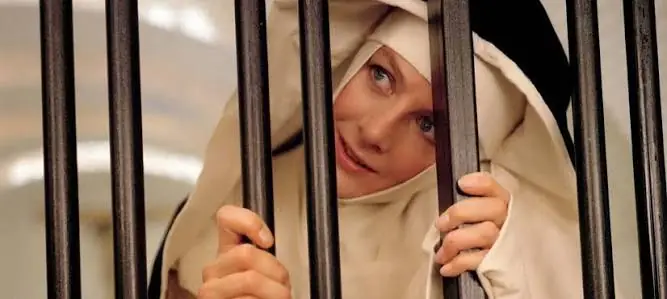
Who decides when a film is “too much”? It’s a vague, subjective line of criticism, but one that applies easily, perhaps even understandably, to describing Ken Russell's filmography. Taken together, Russell’s body of work is loud, erratic, and explosive. Amidst the visual cacophony are lofty set design, statement costuming, animated performances, and unpredictable camera work. All of these traits are apt descriptors for one of his most controversial films, The Devils.
Upon its release, The Devils drew considerable ire. Charles Champlin of the Los Angeles Times called it “a truly degenerate and despicable piece of art.” Ann Guarino from The Daily News said the film “could not be more anti-Catholic in tone or more sensationalized in tone.” Roger Ebert gave it zero stars.
Over time, however, general sentiment toward The Devils has shifted, as shown by demand for the director's cut's upcoming theatrical release. If you’re curious about this film’s journey from exploitative critical flop to erotic cult darling, you needn’t look any further than Kimberly Leszak's deep dive on the history and controversy of The Devils, published earlier this year.
With all the talk about the film’s notoriety and controversy, one wonders how much of it Russell got right. After all, the film is based on the true story of a 17th-century French convent. Both Russell and John Whiting, who adapted a play of the same name before the movie, drew on Aldous Huxley's The Devils of Loudun, a book that covers the events at the convent of Loudun and analyzes them with a then-modern eye.

Published in 1952, Huxley’s book is dense and demands that readers chew on it. It’s the kind of scholastic nutrition that tastes like it’s good for the brain. You might even forget about nuns writhing on the chapel floor when the author so often waxes philosophical about his favorite topics of enlightenment and universalism.
But for all his verbosity, Huxley does an excellent job of framing the narrative with both empathy and vital historical context. He creates a strong throughline of logic to help 20th-century readers understand how someone as trivial as a horny priest could be the catalyst of so much outrage and misery.
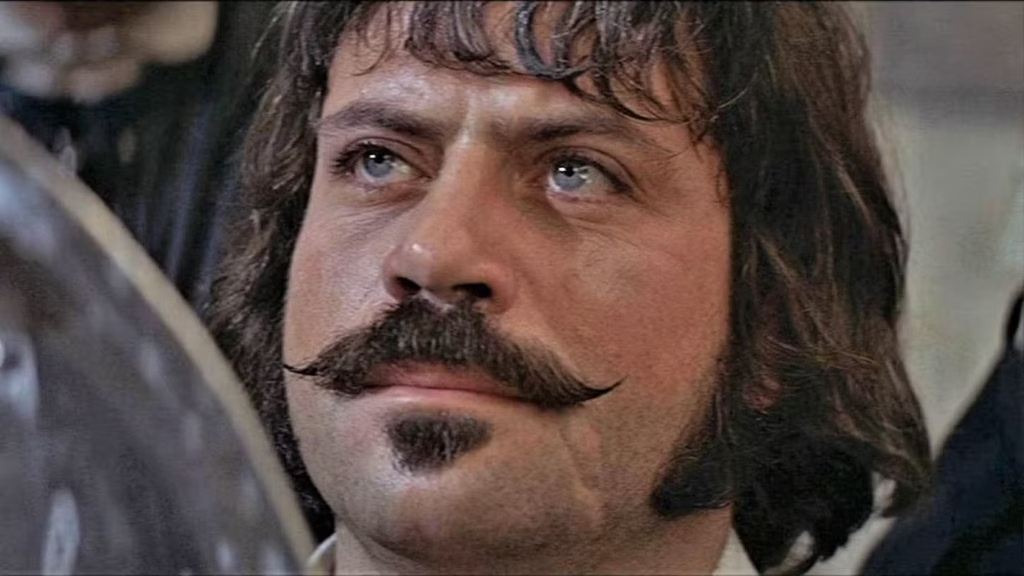
Most audiences and critics remember The Devils as a story about Urbain Grandier, the horny priest in question portrayed by Oliver Reed. However, Russell saw another key aspect of the story that Huxley also insisted on emphasizing. That is, this is not just a story about an innocent man accused of sorcery. It’s also a story about sexual repression and the demons we create to satiate those appetites when we have no other outlets. In this way, I would say yes: while Russell’s film is eccentric, debauched, and indulgent, his portrayal is still perfectly fitting given the nature of Huxley’s account.
Let’s take a closer look at the true story at the heart of The Devils, as Huxley relays it. First and foremost, Urbain Grandier was a priest whose worst provable sins stemmed from his inability to keep it in his pants for more than five minutes. With a fiery, self-righteous temper and unmistakable charisma, Grandier was an influential force to be reckoned with, especially in the small town of Loudun. Naturally, a club of die-hard haters, each offended by Grandier in some way, rose up and began plotting their vengeance.
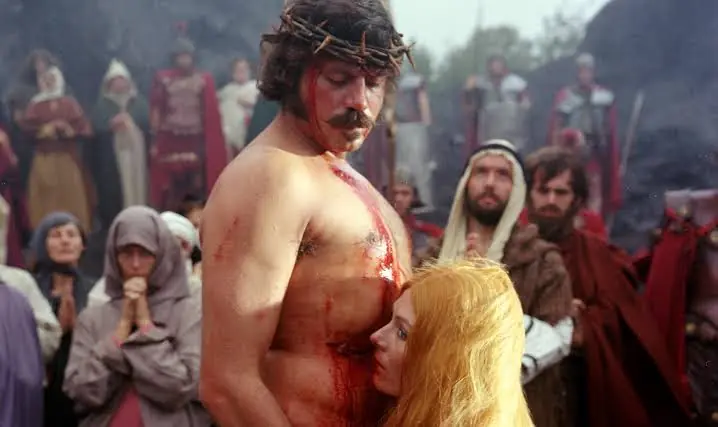
Reed plays Grandier with a commanding presence and brazen air, both thunderous and sensual. But the film also portrays Grandier as tender, empathetic, and heroic in his final moments. He boldly defends the city in the absence of a deceased governor (in reality, the governor of Loudun would outlive Grandier), and he is unflinchingly drawn to the truth, unshaken by the hypocrisy of his own indecent proclivities. The real Grandier seems to have been a nearly unrepentant sinner, one who only came to terms with his mortality and failings when facing down certain death.
Alas, had he been born in another time or place, Grandier’s sins might have earned him only exile or excommunication. But Grandier had moved at a tumultuous time to a tumultuous place. “All unknowing,” Huxley writes, “the parson was riding into the last act of a sectarian war, into the prologue to a nationalist revolution.”
Enter Jeanne des Anges, the mother superior of the Ursuline convent of Loudun, played by Vanessa Redgrave in the film. Young and restless, Jeanne was surely up to date on all the most salacious rumors concerning Grandier: his impregnation of the teenage Philippe Trincant, his affairs with local widows, and his secret marriage to Madeleine de Brou (Gemma Jones).
Even though she had never even spoken to the parson, a lusty seed was planted. “… so far as [Jeanne] was concerned,” writes Huxley, “Grandier remained merely a name — but a name of power, a name that conjured up unavoidable [fantasies], spirits familiar and unclean, a demon of curiosity, an incubus of concupiscence.”
After their previous confessor died, Jeanne invited Grandier to take the new position. When he politely declined her offer, Jeanne, like any other sexually repressed young woman in the throes of her first real rejection, crashed out. Huxley posits this as the breaking point, the humiliation that pushed Jeanne into her own hysterics.
Canon Mignon (Murray Melvin), one of Grandier’s most dedicated haters and the new confessor of the convent, saw an opportunity when Jeanne admitted to having lascivious dreams about the priest tempting her into breaking her vows — dreams which she shared in explicit detail with her fellow nuns, dreams which caught fire and infected the convent like the plague.
Maybe this wasn’t just a series of indecent dreams thought up by a horny young woman, thought Mignon. Maybe these were actually signs of possession and demonic activity! Huxley writes, “And [Mignon] confirmed the Mother Superior and her fellow visionaries in their hallucinations by assuring them that their nightly visitants were real and manifestly satanic.”
And thus began the nuns’ so-called possessions! Thus began the writhing and the obscenities, the sexual convulsions and the cursing of all things holy.
And so strode in Father Pierre Barré (Michael Gothard). While Barré was just one of several exorcists assigned to the possessed nuns of Loudun, he was by far the most bizarrely cruel of the bunch. Huxley writes, “M. Barré, Curé of Saint-Jacques in the neighboring town of Chinon, was one of those negative Christians, to whom the Devil is comparably more real and more interesting than God.”
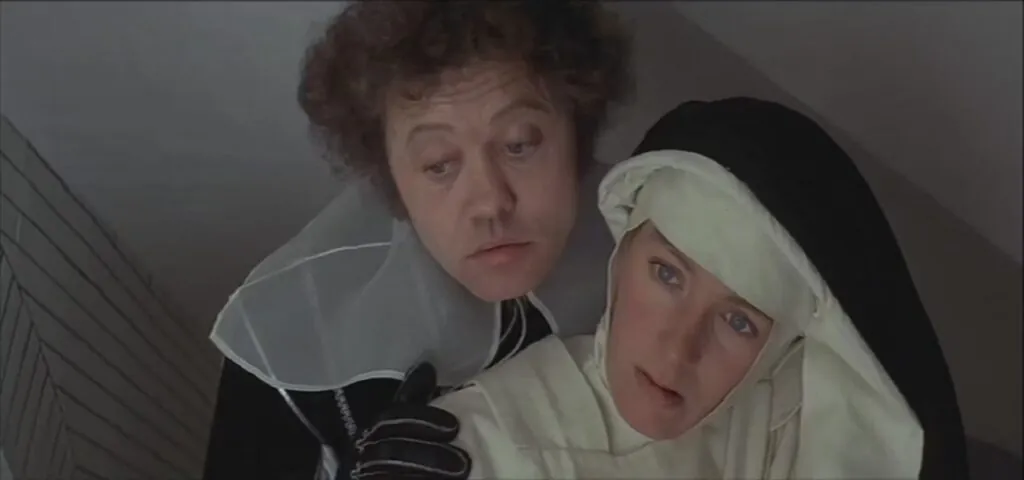
Also presiding over the witch hunt as representative to King Louis XIII was the Baron de Laubardemont (Dudley Sutton). As the king's commissioner, Laubardemont was one of the most fervent pursuers of Grandier’s downfall; the parson’s guilt would determine whether he could tear down the town’s walls.
With the Counter-Reformation in full swing, Loudun was a rare oasis for Huguenots, with half its population Catholic and the other half Protestant. With the king's blessing, Cardinal Richelieu had been given permission to combine the powers of church and state and centralize the monarchy’s power throughout France. Still fortified by walls, signifying the town’s ability to govern itself, the cardinal had his sights set on Loudun.
Grandier and the governor both favored keeping the town’s fortifications intact, as did most citizens of Loudun. Once the governor’s title of nobility was threatened, the cardinal needed only worry about one other person of influence in the town
For a film most remembered for its naked, hysterical nuns, Russell goes to great lengths to preserve the story’s historical context. Richelieu is portrayed as the calculating, conniving hand puppeteering the exorcists at Loudun. Portraying Grandier as a dark sorcerer gives Richelieu an excuse to revive the Inquisition. What better way to eliminate the Huguenot threat in France?
King Louis XIII, however, is portrayed as oblivious at best and, at worst, feeble before the cardinal's whims. The real king, on the other hand, signed the exorcists at Loudun a blank check. “Louis XIII, who was a firm and terrified believer in devils, unhesitatingly decided that something would have to be done about it,” writes Huxley.
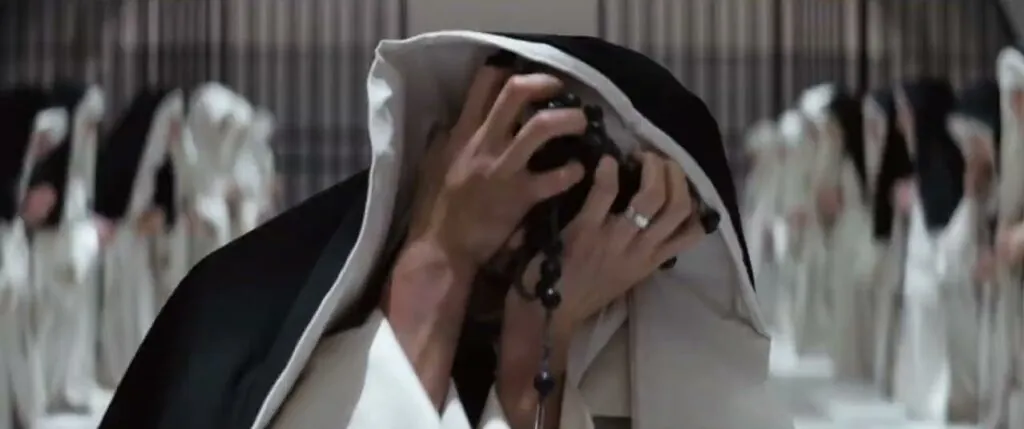
But in his stance on the realities of the cardinal’s witch hunt, Russell steps in line with Huxley, saying in no uncertain terms that the possessions of the nuns at Loudun were politically driven. And in this way, Barré and Laubardemont—and by extension, the cardinal and the king—would not accept failure. Famously, the exorcists broke the rules.
According to the Doctors of the Faculty of Paris, regarding exorcisms, “one must not for all that give any credit to his words, the devil being always a liar and the Father of Lies.” Laubardemont and his posse acknowledged these instructions and essentially said, “nu-uh,” then published some last-minute doctrine that, when the nuns at Loudun say Grandier is to blame for their possessions, they’re definitely telling the truth.
It was also Barré’s idea, sicko that he was, to move all exorcisms to public venues where crowds could enjoy the show. And enjoy it they did, for these spiritually scandalous affairs were basically free entertainment for Loudun’s citizens and occasional tourists.
Huxley theorizes that the repressed sisters at least somewhat willingly yielded to their base desires while performing the part of a demoniac. Finally, a way to express all the sexual frustrations which had been steadily simmering within them for so long!
Stalwart in his belief that the nuns were possessed by little else than nymphomania, Huxley also saw them as victims, treated as tools to be wielded by corrupt, vindictive men who were all too willing to put the nuns through hell on earth for the sake of their own agendas and, perhaps, for their own malicious entertainment. The key sentence Huxley penned which would inspire Russell’s vision was thus: “Barré had treated [Jeanne] to an experience that was the equivalent, more or less, of a rape in a public lavatory.”
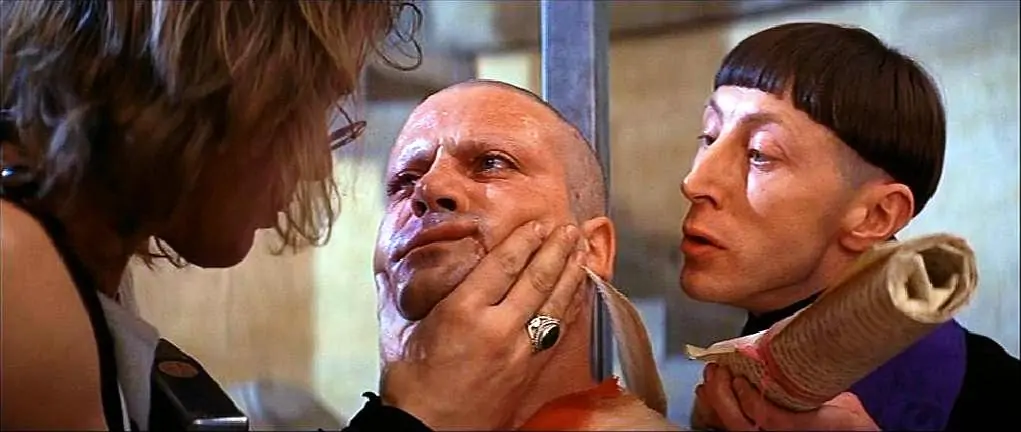
This sentence is in reference to a spontaneous colonic committed against Jeanne, wherein holy water was used to, ahem, flush out the demons living inside of her. In the film, Jeanne’s humiliation is haphazardly concealed, but the scene is still the stuff of nightmares. The surgeon carries in an absurdly large syringe, and Jeanne wails as she is “exorcised,” all before a jeering audience in the stark white expanse of the convent.
Even if the nuns surrendered to the intoxicating fantasy that they were no longer in control of their actions, that they had been given a pass to behave as wildly as they pleased, the fun faded when they realized they had fallen into the sunk-cost fallacy. Huxley writes, “Possessed, they were guiltless. Unpossessed, they would have to answer, at the Last Judgment, for blasphemy and unchastity, for lives and malice. At their feet hell yawned appallingly.”
It is difficult to communicate these internal struggles as they festered over the course of the exorcisms, which lasted months on end with rare spans of reprieve. Russell departs from the source material to convey the sisters’ lack of agency in a scene where Barré says, in no uncertain terms, that they are expected to act the part of the possessed … or else!
What follows in the film is a massive orgy of the most demonic nature, or at least what the nuns interpret as demonic. The sisters prance and scream while nude, masturbate candles, emit animal noises, and engage in a veritable fete of debauchery. This may be one of the film’s most well-known scenes. It is, to be put mildly, silly. The most modest pearl-clutchers might see the devil in this frenzy, but modern audiences would generally agree this sequence isn't so scandalous by today's standards.
But the tone of the scene should feel silly. It should feel obnoxious and too much. Because that's the exorcists' design. This scene should feel embarrassing because the lengths to which the exorcists go to incriminate a horny priest and make the king happy are, frankly, embarrassing. While Russell is known for his over-the-top stylings, this story benefits from his aesthetics. If The Devils is considered exploitative, it’s because it retells a story of exploitation.
Huxley is conservative about the dirty details of the possession, so Russell’s version may seem like an exaggeration that exploits the subject matter. But Huxley’s voice is still cheeky, casually hinting at scandalous events. For example, one of the most explicit instances of the nuns’ behavior lives entirely in a footnote. The footnote, untranslated from French, describes a nun who looks upon her fellow sister with uncontrollable lust, convinced she is Grandier, and retreats to her chamber to use her crucifix to… well, we shan’t assume. Such lewd scenes belong to other movies like The Exorcist.
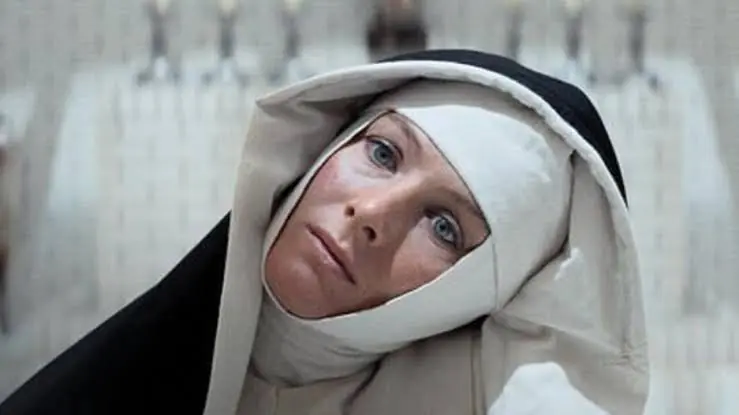
While Huxley’s book doesn’t read like an erotic thrill ride, the author understands the story's primal appeal and content all too well. “Sex mingles easily with religion,” he says, “and their blending has one of those slightly repulsive and yet exquisite and poignant flavors, which startle the palate like a revelation — of what? That, precisely, is the question.”
Over 50 years after its release, critical opinion of The Devils has changed sharply. It is now hailed as one of Russell’s best films, with some calling it his masterpiece. Its big artistic swings now create striking impressions of the sexually repressed imagination—truly one of the most unstoppable creative forces imaginable.
And freaky films like The Devils throw open the floodgates on what people think counts as “too much” and what is truly sensational. If repression and censorship are the problem, the answer is to watch something that the critics are calling “degenerate and despicable.”