
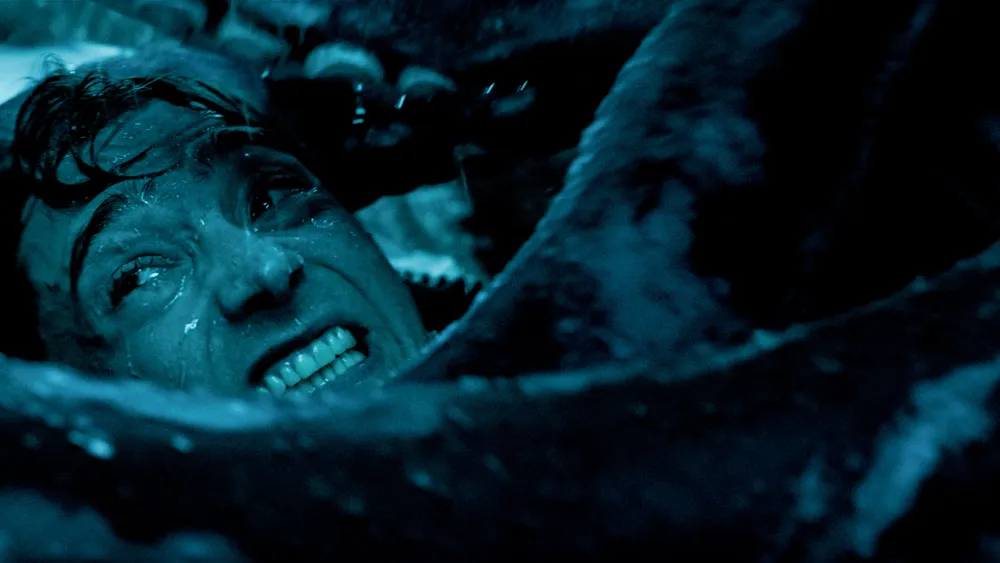
Don’t see Whalefall if (like me) you’re a father with an eight-month-old baby, or else you’ll leave the film a blubbering mess. Brian Duffield’s adaptation of Daniel Kraus’ eponymous novel ostensibly tells the story of a young scuba diver who gets swallowed by a sperm whale, but it’s really about a grieving son coming to terms with the death of his estranged father… after getting swallowed by a sperm whale.
As heartrending as it is visceral, Duffield’s puts the audience through a physical and emotional gauntlet while genre-movie punching bag Austin Abrams (Weapons, Resident Evil) serves as their troubled but resourceful onscreen stand-in.
Abrams plays Jay Gardiner, a college student reckoning with the loss of his father, seafarer and scuba diver Mitt (Josh Brolin), one year after he died by suicide by drowning rather than seek treatment for cancer. Jay’s mother Zara (Elisabeth Shue) and sisters Eva (Jane Levy) and Nan (Emily Rudd) have all begun to process their grief, but he won’t visit Mitt’s grave or read the farewell letter left behind for him. Instead, Jay decides to swim out into Monterey Bay, where he died, to retrieve his remains and hopefully gain some closure.
Although Mitt mercilessly hammered his son with advice about how to swim and survive in the ocean, leading to their estrangement, Jay initially struggles even to get out into open water against strong currents and unforgiving flora. But shortly after descending into deeper waters to look for his father’s remains, Jay witnesses a fight between a sperm whale and a giant squid, getting sucked in first by the rushing seawater and then by a flailing squid tentacle that snags his leg.

Pulled into the whale's maw, Jay is swallowed and seems destined to be digested alongside the squid, which is still fighting for its life. Desperate to escape before the oxygen in his scuba tank slowly runs out, Jay digs back through his father’s instructions, in the process beginning to make peace with a relationship that was fraught with complications.
Adapted by Duffield with Kraus’ help, the parallel lines of past and present in Whalefall echo stories like Slumdog Millionaire where harsh experiences yield important lessons. Some of these, particularly the ones elicited by Mitt’s overbearing, granular teaching, are more believable than others; the only cinematic taskmaster I can think of who's even sterner is J.K. Simmons in Whiplash, and you believe Jay retained them—even if not specifically for this unimaginable scenario.
Yet that should also tell you that Mitt’s “tough love” seemed often to cross into abuse, and fed a simmering pool of resentment in Jay that led to their falling out. Mitt is a man from a bygone era, one where preparing individuals (much less one’s own son) for life's trials demands harshness and rigor, with little room for nurturing or sensitivity. Ironically, his all-consuming passion for the sea almost feels bohemian—or at least it would if he hadn’t tried to instill it in Jay with such militaristic intensity.
To those on either end of a relationship like that (as I am), Jay’s emotional journey will likely resonate deeply. But the further the story progresses, the more the film risks overstating some of those ideas or even being cloying; there’s something undeniably affecting about a young man dreaming that he’s communicating with his late father while facing his own potential death, but there’s a thin line between hallucinations brought on by nitrogen narcosis and a narrative deus ex machina.

But Duffield mounts the tension of Jay’s circumstances so effectively that overstating some of the story’s emotional beats feels forgivable. Very long stretches of the film involve Jay navigating his way through slimy and constrictive chambers in a whale’s digestive system, and their dramatic power cannot be overstated.
Duffield has grown substantially as a filmmaker since making his sci-fi horror film No One Will Save You, and he really excels in this film at mapping out exactly where Jay is inside this leviathan. The character’s uncertainty becomes the audience’s anxiety, and lends Jay’s plight thrilling, claustrophobic urgency.
He also creates mesmerizing imagery as the whale fights back against the tenacious snack that’s making its way out of his belly. He’s greatly aided by the Academy Award-winning editing of frequent Ridley Scott collaborator Pietro Scalia (Black Hawk Down) and a lush, evocative score by Joseph Trapanese, applying some of the notes that made his contributions to TRON: Legacy stand up against the work of his marquee counterparts Daft Punk.
It’s hard to describe a film like this as a strict two-hander, but Abrams and Brolin both carry the weight of the story, even if the elder actor doesn’t get anywhere near the (literal) belly of this beast. Brolin is so ferocious and skilled as Mitt that we understand why Jay fears, admires, and hates him all at once.
But the lanky Abrams continues to distinguish himself in role after role — nothing quite as splashy as one of his generational counterparts, Timothée Chalamet, but each with an understated power that makes him stand out even as it fits immersively in the story that’s being told. In this unlikely situation, Jay is finally realizing the intentions of his father after resenting his tactics, and you feel him experience that profound epiphany without tacitly forgiving every past instance of mistreatment.
The film balances story beats and emotional ones as skillfully as any other released this year, creating an on-screen experience that likely feels like no other. I won’t suggest that Whalefall is a movie that you need to see with your father to appreciate it, but it may nonetheless inspire you to call him afterward. Duffield has delivered something here that’s really special, and it reminds audiences that in the right hands, spectacle and sentimentality can feed each other instead of fighting for their attention.