
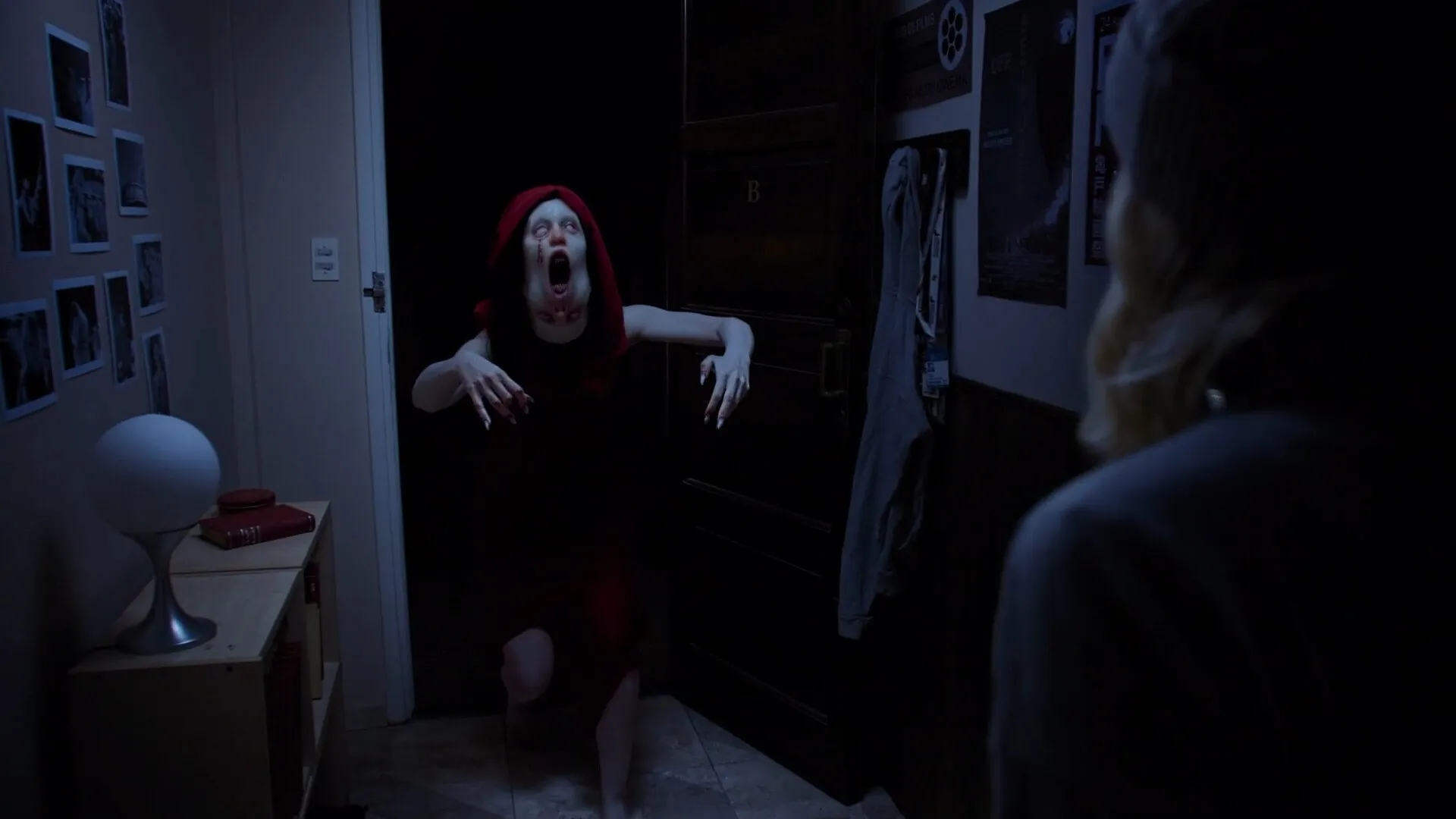
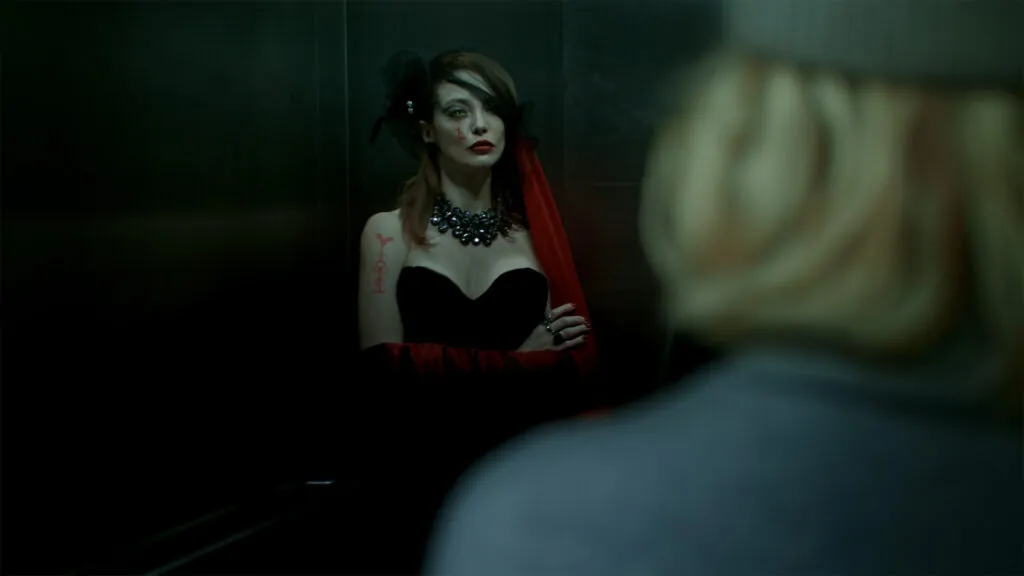
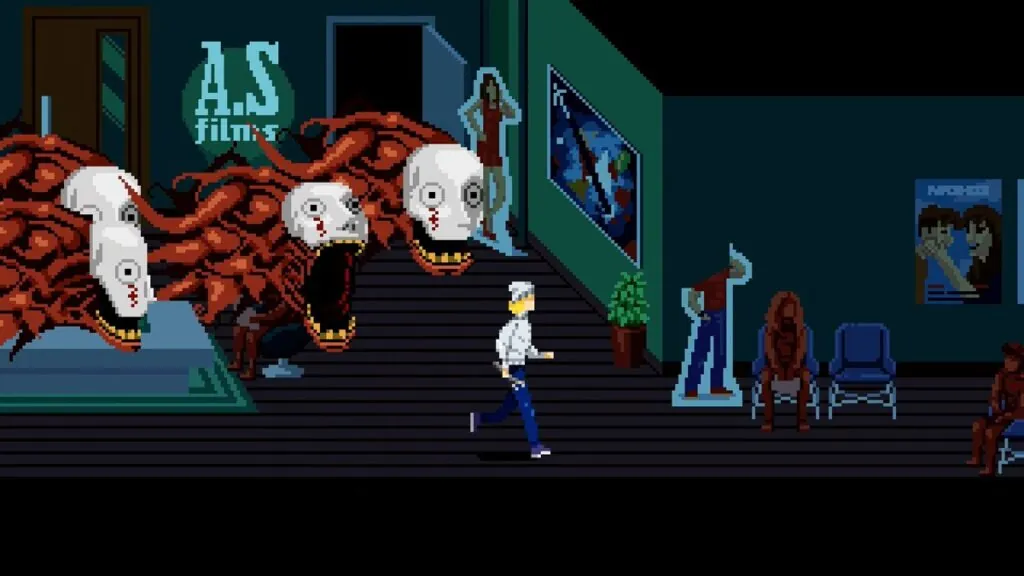
Andrés Borghi and his team of special effects mad scientists have created a video game unlike anything you’ve seen before, even in the horror genre. Tenebris Somnia follows Julia (Clara Kovacic), a young woman who has been having disturbing nightmares about her ex-boyfriend, Iván. Worried, she visits his apartment, but cannot find him anywhere. Instead, she comes across strange occult symbols, signs of a struggle, and vicious monsters. What makes Tenebris Somnia so unique, however, is how it shifts between pixelated gameplay and its live-action cutscenes.
Known for his visual effects work on Demián Rugna’s When Evil Lurks, Andrés Borghi serves as the director for Tenebris Somnia. But in both film and video games, this is far from Andrés’s first rodeo.
“I had made a game called The Black Heart a long time ago when I was 18,” Borghi says on his experience in game development. “I did it all by myself. It was seven years of work, and it was a lot of work. So, in my head, the idea was I could not make another game because it was a lot of work,” he tells FANGORIA.
Then came FAITH: The Unholy Trinity, an indie horror game divided into three chapters, designed and developed by Airdorf Games. Faith broke the mold in many ways and went viral in the horror video game space. Borghi says this was a turning point. “I saw that it had two styles: it had the Atari style [gameplay] and the rotoscoped animations.”
With his filmmaking experience, Borghi saw an opportunity to make a different kind of video game, one that harkens back to the full-motion video era of the 1990s, but with a more realized visual presence. He recruited local Argentine talent and assembled a crew to bring the vision to life.
One of the special effects artists he brought on was Marcos Berta, another veteran of Rugna’s films, who worked on both When Evil Lurks and Terrified. Berta even holds on to keepsakes from the movies he works on. “I have a little museum of the props and special effects I worked on in other movies,” Berta says proudly, while explaining that the child corpse prop from Terrified is lurking somewhere in his house. “We worked together many times,” Borghi says about Berta. This also includes The Virgin of Quarry Lake, Argentina’s entry for Best International Feature Film for the 99th Academy Awards.
And so Borghi’s team was assembled, and the monster mash began. Filming took place in various locations, from studios and apartments to trains and cathedrals. The nightmares follow Julia through real and fantastical places as she unravels Iván’s occult fascinations. Monsters of all stripes stalk her, each as distinct as the last.
The monster who has become the demented poster child for the game is a two-faced creature, whose mouth yawns open to reveal sharpened teeth. Berta explains this monster started with a live cast of the actress’s face. “We made two copies of the head, cut it in half, and made a copy with plasticine. And then we started sculpting the heads.” The “skin” around the front of the mask is loose so the mouth can open and close with a scissor mechanism that’s attached to the back. But because it’s reinforced with plaster, the mask was heavy and had to be Velcroed to the stunt actress’s head. Now it rests comfortably at the back of Borghi’s office.

The game also uses candles and candle wax as a common motif throughout the story. Wax seals adorn the door to Iván’s office, candles act as keys between locations, and large crimson wax effigies stand in macabre poses that mimic Julia and Iván’s life together.
These wax figures feature prominently in the cutscenes. Borghi says they are mannequins coated in a mix of plasticine and wax. But as the story goes on, these wax figures become more frequent, which posed a problem for Borghi and his team. “In later stages… it was too expensive to do it that way,” says Borghi. “So we started experimenting with weird shit.” They used cheap weatherproofing materials to coat props, then painted them red.
Discussions like these truly embrace the inherent romanticism and punk rock spirit of filmmaking. Coincidentally, the game’s protagonists are also filmmakers, having worked on a short film together before they broke up. Inside Iván’s office are posters for Possession, Night of the Living Dead, and Persona. The story itself holds echoes of Hellraiser and even Eternal Sunshine of the Spotless Mind.
But Tenebris Somnia is still a video game, and Borghi’s inspirations are just as recognizable as the movies in Iván’s posters. “There’s a reason why Resident Evil is king,” Borghi says, discussing how much he analyzed the original 1996 game. “I studied the whole thing to see how you progress from one room to the other, how you expand the map, always returning to the original place, but expanding through items.”
Another big influence was the unique point-and-click survival horror game, Clock Tower, originally released for the Super Famicom in 1995. Julia’s pixel sprite is measured and modeled after Clock Tower’s protagonist, whose design was inspired by Jennifer Connelly’s performance in Phenomena.
Finally, in terms of story, Tenebris Somnia takes a page out of Silent Hill’s book. “From Silent Hill 2, I took the idea that you have to have a strong hook at the beginning,” says Borghi. “You know, in Silent Hill 2, my wife sent me a letter and told me to go see her in Silent Hill, but she has been dead for three years. That's it. You're in. You have to see what the fuck is going on.”
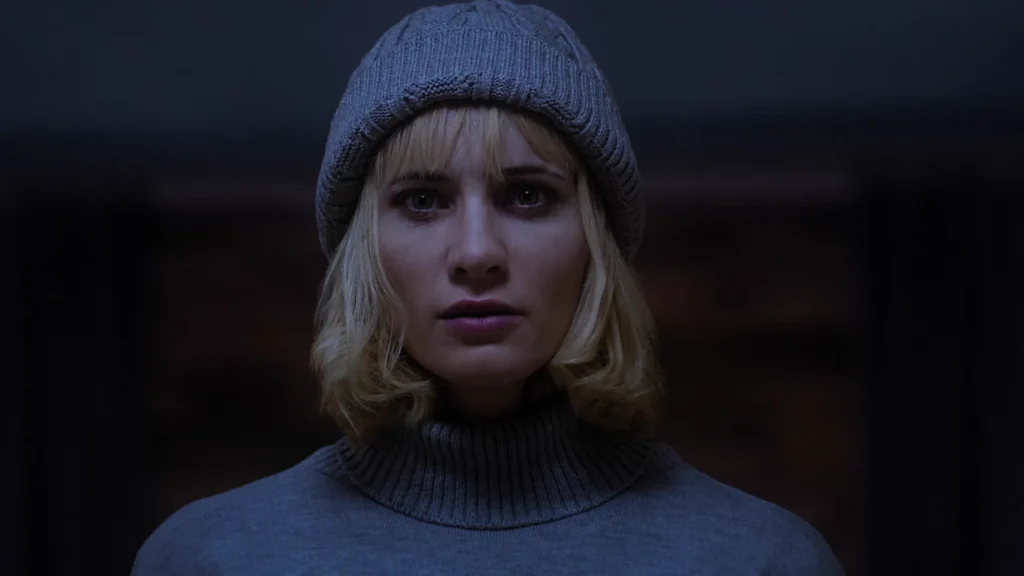
With Borghi, Berta, and their crew at the helm, they spared no effort in making Tenebris Somnia. The game’s marketing emphasizes that what players and audiences are seeing is by no means AI slop! But it also isn’t entirely practical effects either. “I see many videos of people saying, ‘this is not AI, this is fully practical effects,'” Borghi says. “And I feel like my heart breaks because, I mean, practicals are great, but it's like any movie you see today that has a monster or has any special effects is a combination of both.”
Even during production for When Evil Lurks, where Berta and four others had to puppet a single dummy, Borghi used VFX to create subtler movements and enhance the illusion. But in this way, special effects artists, both practical and visual, share a common enemy: generative AI. “So, just for the record, every movie has a marriage between special effects and VFX,” says Borghi. “They always work together like a team. There's no such thing as a competition between them both.” That is already far more than anyone can say for generative AI.
The crew’s work on the game and its cutscenes eventually caught the eye of Mason Smith, also known as Airdorf Games. As the game gained publicity, Smith joined the project as executive producer, and New Blood Interactive became the game’s publisher. Truly a match made in heaven… or hell, given the context.
Everything has come full circle, and Tenebris Somnia is now available to purchase and play on PC (Steam / Steam Deck), Nintendo Switch, Nintendo Switch 2, PlayStation 5, and Xbox Series X/S. Horror video game enthusiasts will appreciate this experience, and horror movie fanatics have just as much to be excited about, and just as much reason to jump in.