
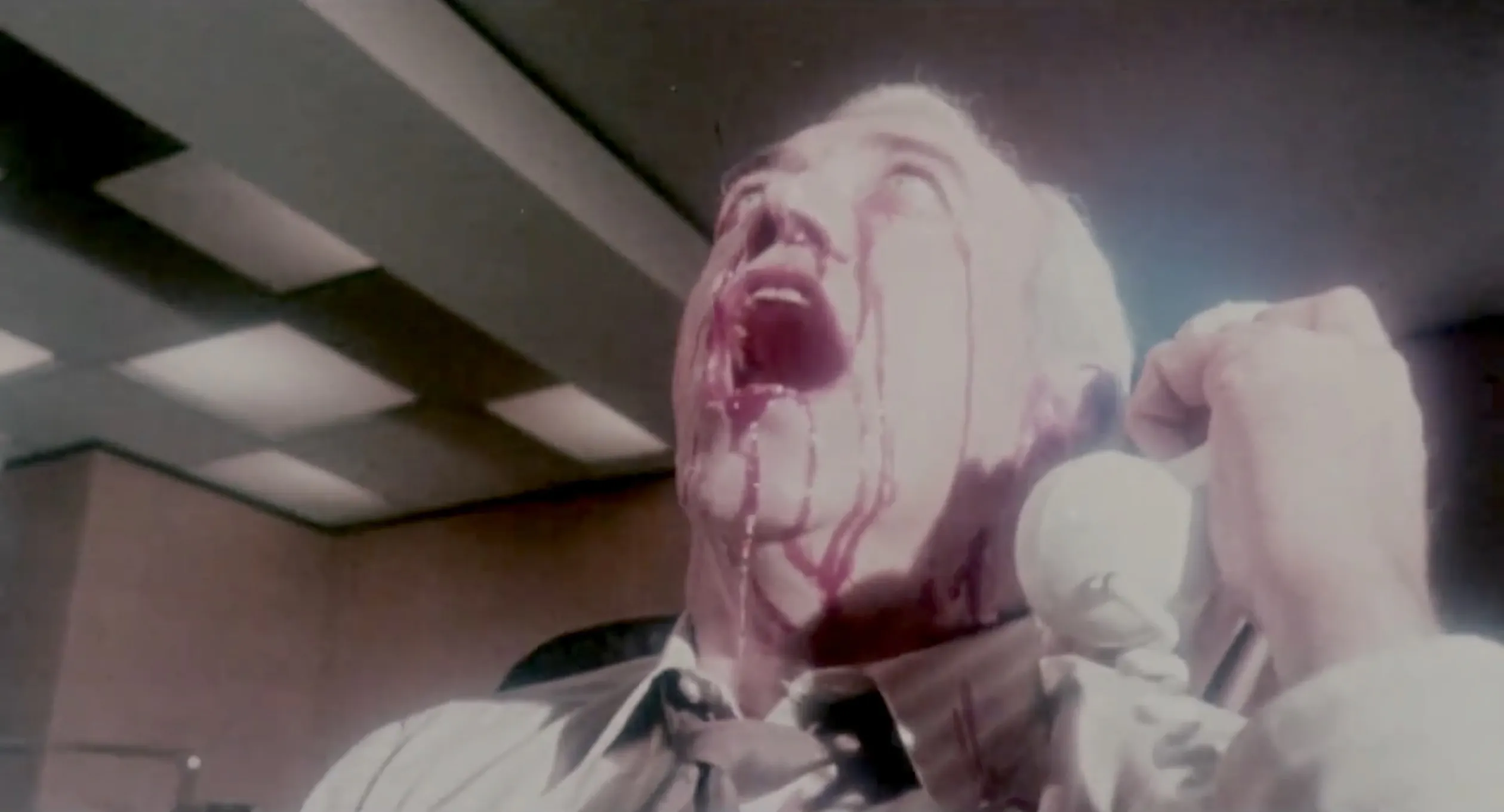
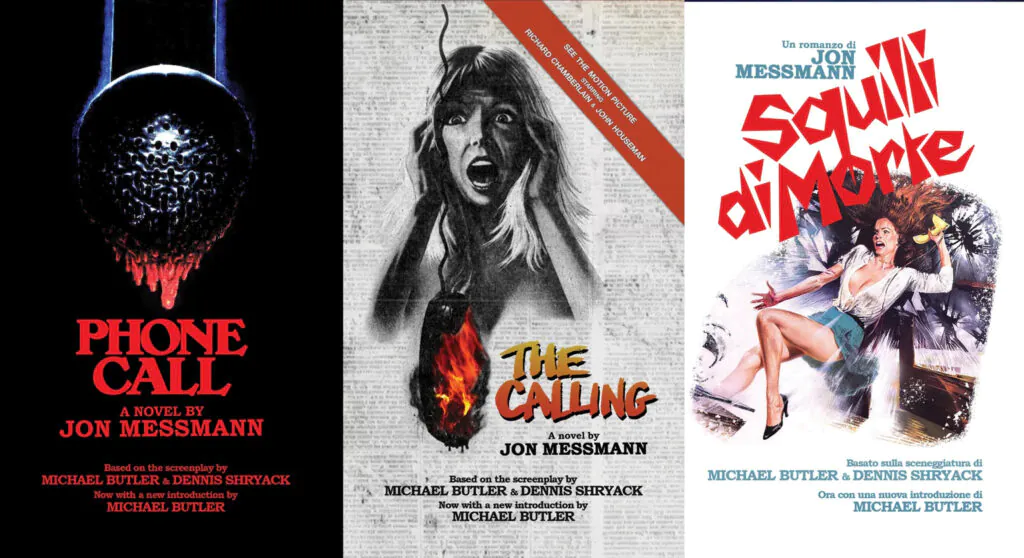
In 1982, a techno-chiller about a madman zapping people with lethal electric jolts over the telephone, starring Richard Chamberlain and John Houseman, went through three titles in rapid succession. Filmed as Bells, the Michael Anderson-directed film was first released in a few cities under that title by New World Pictures, then retitled The Calling a month later, and finally Murder by Phone—the title that stuck—a couple of months after that. Before all of this, Jon Messman published a novelization under the moniker Phone Call.
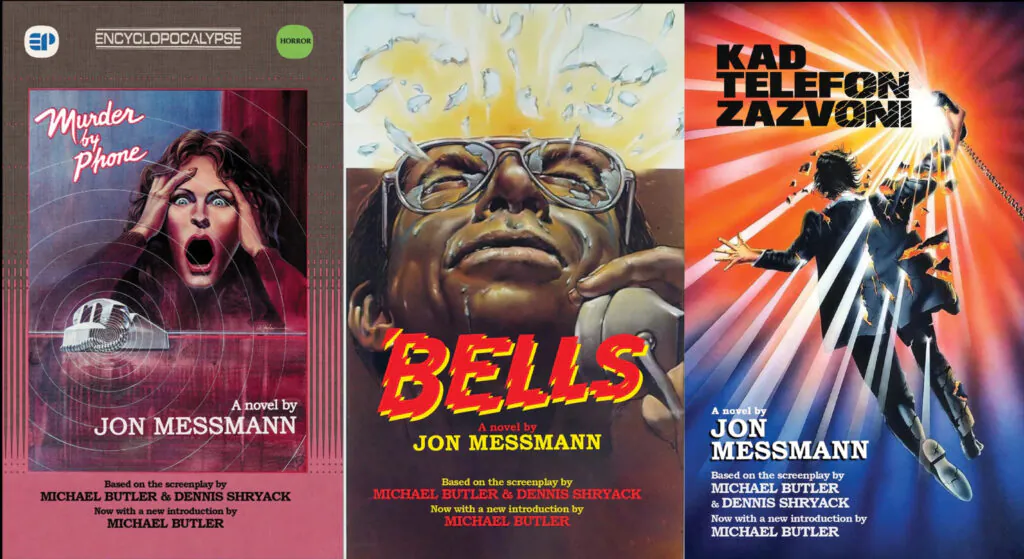
Fango spoke with Michael Butler, who was on the movie’s writing team with his writing partner, Dennis Shryack. The duo previously wrote the demonic-auto opus The Car and the Clint Eastwood vehicle The Gauntlet, and later went on to the Chuck Norris actioner Code of Silence and Eastwood’s Western Pale Rider. Now, Encyclopocalypse Publications has reissued that long-out-of-print adaptation of Murder By Phone, with no fewer than six covers representing its three theatrical titles, plus a couple of overseas posters and the original Phone Call art.
What was the inspiration behind Bells?
I’m not sure that there actually was an inspiration. It was certainly not the same kind of epiphany that resulted in The Car, you know, or Wheels, as we originally called it. We had signed a contract with First Artists to work on stuff for them for a year. We would write them an original, and they would produce it—that was part of the deal. And we didn’t know what to do. They had an inventory, and we read all of the scripts in their inventory, or at least about a dozen of them. We tried to make one of them work, and it didn’t happen.
Then Dennis had some friends [George Armondo and James Whiton] he had met as an agent. He said, “I want to bring these guys in. Let’s hear what they have to say. They have a story idea.” They came in, they pitched this idea, and Dennis said, “God, that’s just great!” He really saw it, he really understood it, he thought it was terrific. And I thought, “Oh, God, has it come to this?” And it had.
So, we bought the idea from them, or maybe we pitched it to [First Artists’] Phil Feldman first. And he said, “Sure, might as well give it a try if you’re really excited about it. We love it. We think it’s great.” And I said nothing. And, you know, Dennis was a superb technician; he was terrific at dramatic logic, mechanics, structure. But there are things you can… If you read our Wheels script now, there was a whole miniature Gauntlet in that, and the word “gauntlet” appears in the descriptive passage. Another similarity was that the protagonist in Bells sets himself up. “I am going to be the bait for the bad guy. I’m going to put my life on the line. And either I will triumph, or that crazy asshole will succeed, and I’ll die.” So that was, I think, one of his hallmarks.
The novelization, in my opinion, is considerably more interesting than the movie. I don’t think the movie is very interesting at all. But if you look at Messman’s novelization, he introduces a kind of a union confusion with the protagonist, and we are aware of the fuzzy line between good and evil. And that is, “This could be me. That could be you. Where do I land with these issues?” I thought that was quite interesting, and I’m not sure it was in our original script. I think Messman may have brought that in. But I can’t speak to that, because I don’t have a copy of the script anymore.

Who else worked on the Bells script?
John Kent Harrison came in to do a rewrite for Michael Anderson—and changed it considerably, actually. He took out one of the female characters. And I’m sure that Richard [Chamberlain] had a creative role in the changes that were made.
In our script, the love interest was a worker for the telephone company. She was an ingenue, OK? In the film, she’s a sophisticate. You know, she’s a patrician. She’s a successful media person. She’s an intellectual. And that was a pretty fundamental difference. But none of the changes that John Kent Harrison made to the script, or added to the script, were sufficient for an arbitration. It’s not as if he wanted to push for first credit. He did not. So it is what it is. He gets second credit, and he deserved it.
That film has been hard to find; it has yet to surface on DVD or Blu-ray. Do you have any idea why it’s become kind of a lost film?
Well, I don’t think it’s very good. Am I allowed to say that? I think Michael Anderson phoned it in, so to speak. I mean, he’s done some good work, but this just wasn’t it. And Richard doing [Beat poet] Gary Snyder, with the beard and the mustache and the hairdo, just doesn’t work for me. And he fired me later from another job. Maybe he remembered me, I don’t know. But I think it was in 1983 when I was hired to develop a two-hour Casanova for ABC, and we wrote a two-hour version and then a three-hour version. Then ABC got Chamberlain to star and gave it to him, and he just didn’t like the approach, and he wrote a five-page letter saying, “This doesn’t work for me. This doesn’t work for me. This doesn’t work for me.”
My approach was Jungian, his was Freudian, and never the twain shall meet. And so I answered his letter with my own five-page letter: “These are my thoughts about this. These are my thoughts about that.” And he fired me and hired George MacDonald Fraser to do it his way. There was an arbitration, and… I’m sure that I cut my own throat when I committed the nature of my fundamental disagreement with Richard’s approach to paper.
So what the arbitrators got was, “George MacDonald Fraser has converted a fundamental Jungian story into a much deeper Freudian story, blah blah blah…” And the committee agreed. That was the nature of the big change, but a number of my scenes—some of which were invented, some of which were in Casanova’s diaries—remained. So I was unhappy about that. It’s the only time that I’ve lost a credit based on an arbitration.
The Michael Butler Collection is available through Encyclopocalypse.
