
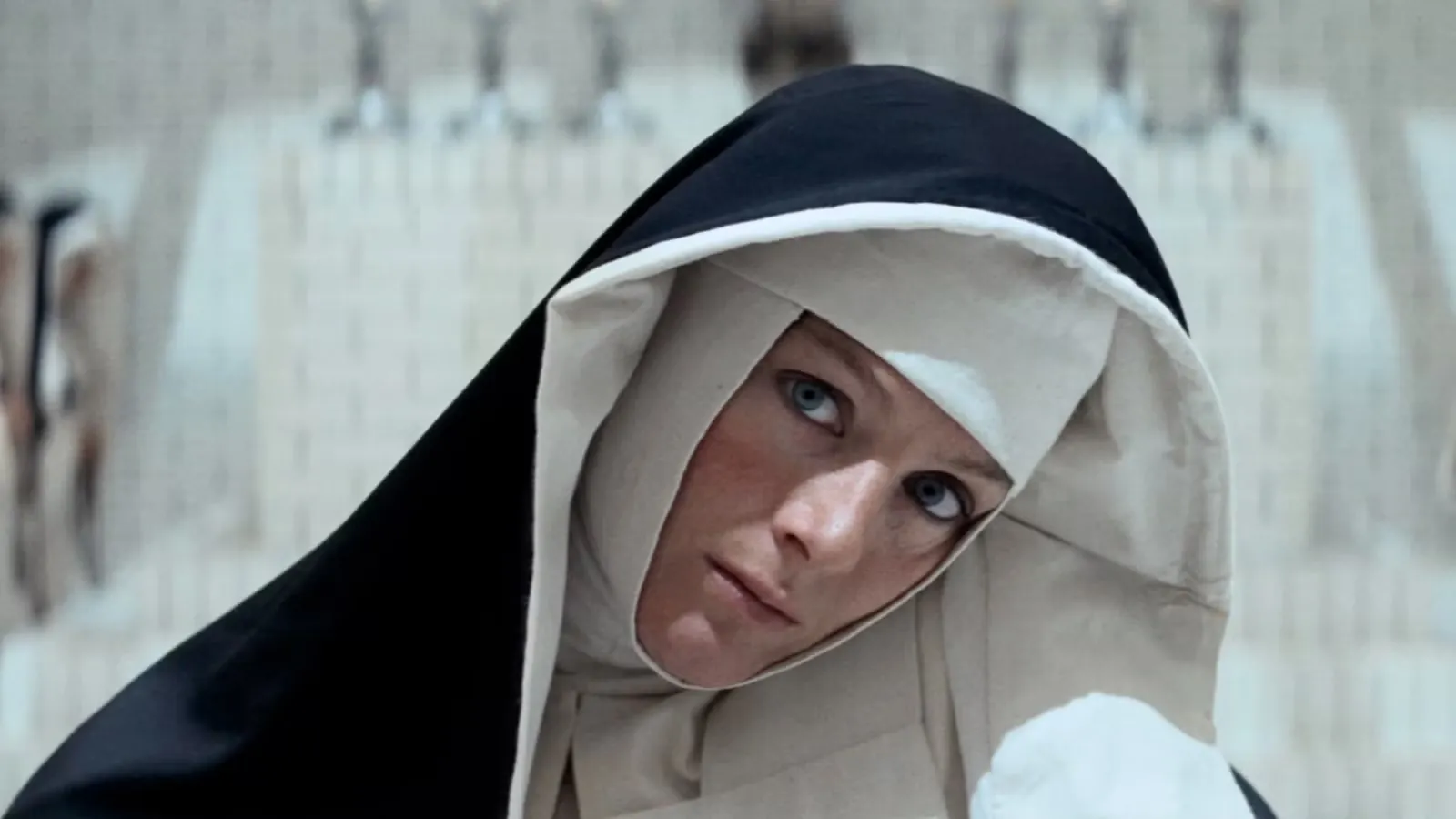
A film whose legacy is almost mythic in proportions, the director’s cut of Ken Russell’s The Devils arrives in theaters 55 years after its controversial, heavily edited original release. Its timing could not be better. In an era of unrelenting tribalism, social media hysteria, and hyperbolic discourse, Russell’s story of a 17th-century Catholic priest targeted by power-hungry politicians positively vibrates with contemporary relevance. Even if its bona fides as full-fledged horror feel mostly circumstantial, the late Oliver Reed gives a, ahem, God-tier performance opposite a mesmerizing Vanessa Redgrave while Russell examines the limits of true divinity in a world occupied by man.
Reed (The Brood) plays Urbain Grandier, head priest and de facto leader of the fortified town of Loudun, where Catholics and Huguenots live side by side peacefully after years of war. Charismatic but fiercely devout, Grandier seduces Philippe Trincant (Georgina Hale), who agrees to teach Latin, but encourages her to tell her father, Louis (John Woodvine, An American Werewolf in London), of their affair after she becomes pregnant. But when he secretly marries Madeleine de Brou (Gemma Jones), the news enrages Sister Jeanne des Anges (Redgrave), the hunchbacked abbess of a local convent who is sexually obsessed with Grandier.
Meanwhile, Baron Jean de Laubardemont (Dudley Sutton) arrives to demolish Loudon’s protective walls on behalf of power-hungry Cardinal Richelieu (Christopher Logue), but Grandier rebukes and humiliates him. When Jeanne accuses Grandier of performing witchcraft to possess her, Laubardemont seizes upon the scandal to try and unseat him, enlisting Father Pierre Barre (Michael Gothard, Lifeforce) to vilify and punish the priest via a series of public “exorcisms” of his supposedly evil influence. Laubardemont’s accusations (and Barre’s spectacle) eventually sway public opinion against him, forcing the priest to decide between upholding the values of his role or confessing to crimes he didn’t commit in the hopes of avoiding a death sentence.

Many versions of The Devils have been released over the years, yielding to pressure from conservative and religious groups or the censorship standards of various countries. Suffice it to say that the director’s cut is not only definitive, but superior to the one released on platforms like the Criterion Channel — not because it’s more scandalous or explicit (though it is those things), but because its narrative is much clearer and more focused.
Each new development follows the previous one rather than jumping around to explore the lives (or perhaps worlds) of different characters, and as a result it’s easier to follow and a more intense experience. Russell’s opening cut sets the stage in France, where Louis XIII is a self-absorbed dilettante, and Richelieu tries to incite fear of uprisings to fortify his position at the king’s court.
Grandier, rather than seeming like another self-serving public figure, is a man of the cloth who overindulges his authority, but he is fiercely committed to his responsibilities as both spiritual leader and steward of the peaceful community he’s helped build in Loudon. With both simple common sense and high-minded piety, he acknowledges and embraces the juxtapositions between a higher calling and the weaknesses of human desire.
Extraordinarily, Grandier never meets Sister Jeanne des Anges except in her fantasies, one of the greatest examples of “living in someone’s head rent-free” I’ve ever seen portrayed on film. Effectively, Jeanne develops a parasocial relationship with a public figure because he stirs sexual feelings in her that she’d never felt before, or perhaps repressed, and feels betrayed by his betrothal to someone else (interestingly, whom she does meet).

What she fails to consider are the repercussions she’ll face of an accusation of sexual impropriety, even via possession; “believing accusers” in 1634 France meant that victims were subjected to as much dehumanizing treatment, almost all of it medically dubious, as their perpetrators. Yet Grandier defiance of Laubardemont — not just a refusal to capitulate to brute strength, but more personally, a challenge to his authority — led what might have been a provincial scandal into a historic confrontation between the King of France and the Catholic Church.
It probably helps to be Catholic to fully appreciate the religious context of these true events, but speaking personally as a nonbeliever, it isn’t necessary; Grandier is a man who possesses firmly held, even resolute beliefs and finds them tested when he’s chosen as a scapegoat — first by a vengeful and likely mentally unwell nun, and then by unscrupulous minions advancing Richelieu’s power grab.
Laubardemont is a petty go-between whose vitriol gets exacerbated by Grandier's public defiance, and he brings in Barre, a man whose job is to fan conspiratorial flames and declare heresy by any means necessary. The escalation is dramatic but oddly believable: each interrogation of Jeanne, her fellow nuns, and other Loudon townspeople carries the threat, sometimes explicit, that if their statements aren’t true, the punishment will be far worse than intended for Grandier.
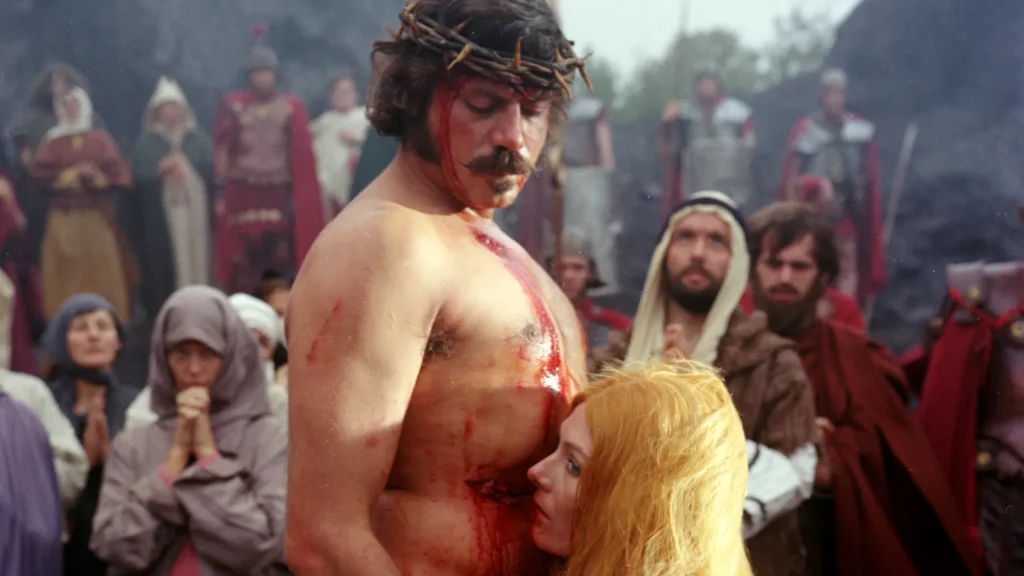
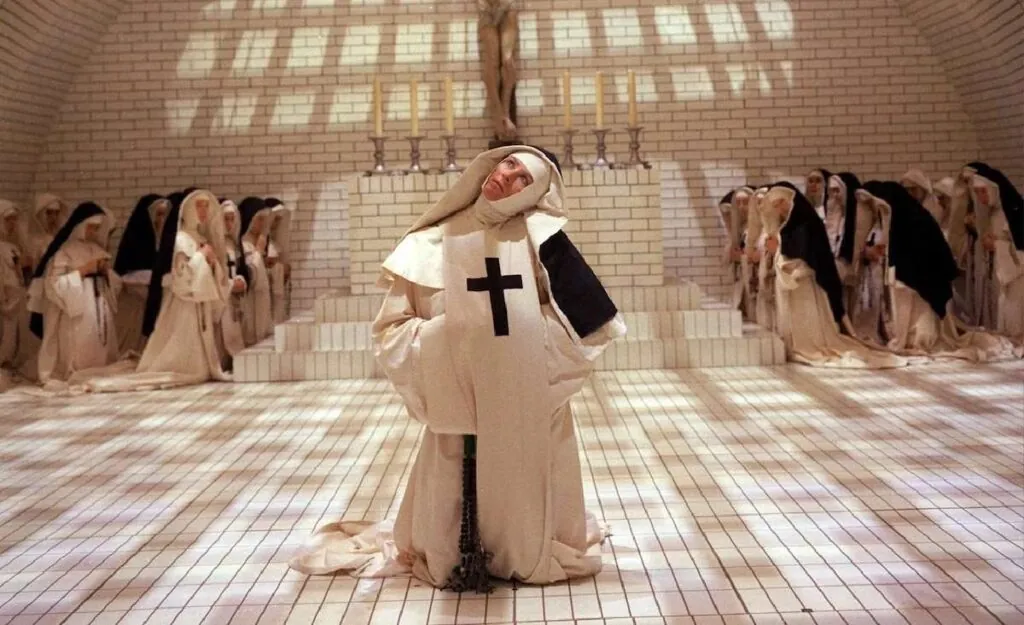
Barre’s menacing pursuit leads to the film’s most infamous scene, the “Rape of Christ,” in which the nuns strip their clothing off, tear down a crucifix, and defile Jesus as evidence of the depravity injected into them by Grandier's witchcraft. Scenes like this are more powerful than the controversy they generate because they serve a real purpose: they expose how religion gets exploited to manipulate believers and serve the self-interested.
Jeanne eventually recants her claims against Grandier, but the wheels in motion are too big and moving too quickly to slow for anything resembling “the truth”; Laubardemont barely waits until the trial is over to demolish the walls of Loudon, enabling Richelieu to steamroll the city and take control. Even after Grandier is found guilty and sentenced to public execution, Jeanne’s desires for him continue unabated; the nunnery, meanwhile, is irreversibly corrupted.
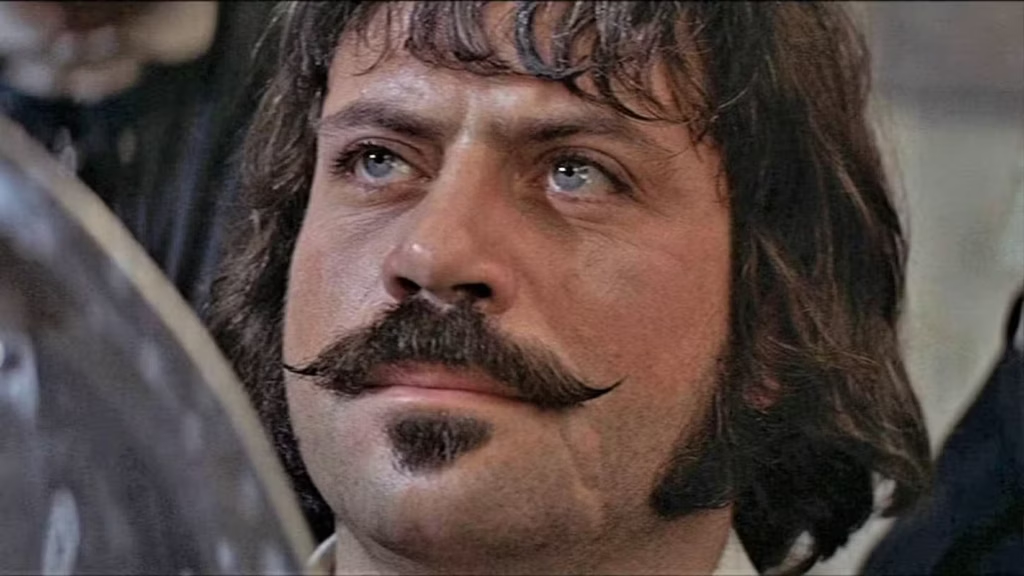
Reed plays Grandier with such thunderous but charismatic authority that the audience likes him instantly as a philandering, seemingly lousy priest, even before they discover the strength and conviction of his beliefs (not to mention that he is an innocent man). He was always an actor with tremendous screen presence, but few films successfully utilized that in the service of tragic feelings more than here.
Redgrave, meanwhile, manages to be alternately flinty and deeply sad; there’s much wrong with the poor young woman that has nothing to do with her disfigurement, and the actress never courts sympathy even when Jeanne’s desperate vulnerability, and her shame at condemning an innocent man, draws it out of viewers.
To call Russell’s films an acquired taste is perhaps an understatement; they possess a maximalism that may be familiar to acolytes of directors like Fellini, but will likely prove bracing to many modern cinephiles. The director’s cut of The Devils shows Russell at his most excessive, but also his most precise; every scene fits and flows together to create a believable portrait of the sociopolitical climate, if not the actual landscape, of 17th-century France. But more than that, it targets the friction point between the intentions and values of a belief system and the people who know them well enough to manipulate them for their own ends.
At the more restrictive time The Devils originally came out, Russell’s film was condemned as exploitative, but this version underscores its true purpose — to alert people to what that word really means and, rather than luxuriate in it, help them avoid it.