
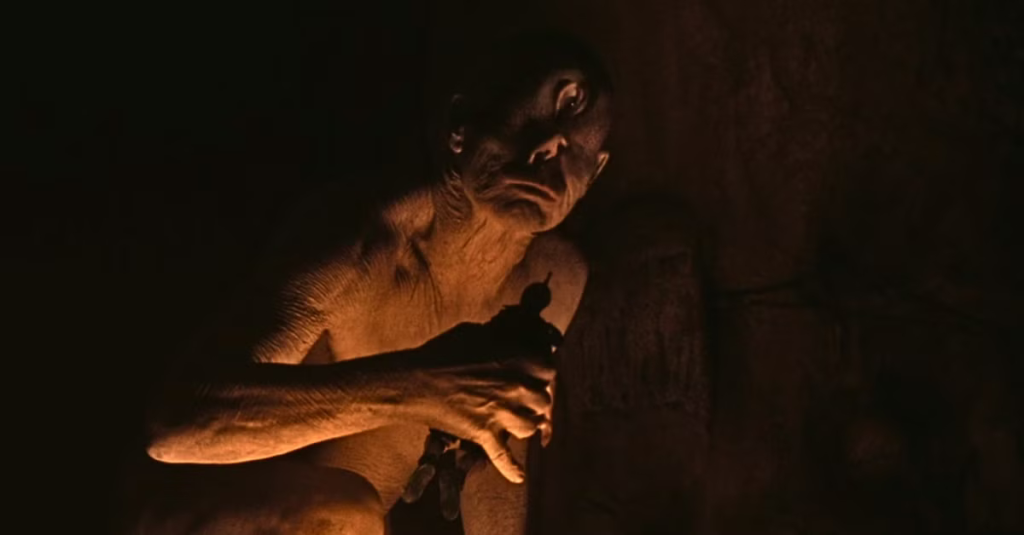
It’s a film that has it all: monsters, witches, cannibals, bloodthirsty killers, zombies, vengeful gods, and a literal journey to hell and back. The Odyssey is a sweeping adventure that uses — or given its historic status, perhaps forms the foundation of — the vocabulary of FANGORIA’s bread and butter to tell its story. In an era where the definition of horror feels broader and more inclusive than ever, early screening reactions have championed it as Christopher Nolan’s first foray into the genre. Overlapping viscerally and thematically whether or not it formally qualifies, The Odyssey delivers plenty of crimson-stained carnage for audiences drawn more to dread and terror than typical blockbuster thrills.
Nolan, of course, is drawing from one of the oldest surviving works of literature, so most or all of its scariest or most disturbing sequences were conceived centuries ago. (Even so, this is probably a good time to warn the reader that spoilers will follow.) The filmmaker’s careerlong aptitude for creating a grounded reality, even in fantastical situations, began in The Prestige, a film that uses a story about magicians to chronicle a dazzling (and tragic) science experiment. He approaches The Odyssey with the same clear eye as in the past, even as Homer’s storytelling — initially passed along orally — embellishes Odysseus’ (Matt Damon) journey home after triumphing during the Trojan War with the horror-adjacent details listed above. Somehow, Nolan’s “fact-based” approach makes them even more intense on screen.

Blame it on Odysseus’ fearlessness (or maybe stupidity), but the first such sequence occurs when he and his men land on an island after spotting a grazing sheep. Hoping to acquire much-needed sustenance, his landing party chases the animal into a cave. But their excitement at discovering its healthy flock are dashed when their shepherd returns: Polyphemus (Bill Irwin), a lumbering cyclops who cuts off their escape by rolling a boulder in front of the cave’s entrance. Their misgivings about their fate are exacerbated when Polyphemus eats two among their ranks and settles in for a nap.
Working with cinematographer Hoyte van Hoytema (who also worked with Jordan Peele on Nope), Nolan shows viewers just enough of the cyclops for him to feel truly terrifying, yet without making him a “villain.” As monstrous as his behavior may be, he is simply surviving; after Odysseus’ men discover that Polyphemus can speak, they briefly consider trying to broker peace. Odysseus correctly observes that they’re too insignificant for him to reason with: “Would you reason with ants?” he asks. When they finally manage to escape, Odysseus provokes Polyphemus, prompting him to chase them down to their ship. Even in the daylight, Nolan again frequently obscures the creature, retaining his mystique even as the filmmaker extends him the empathy of an untamed animal.
After later landing on another island, Odysseus and his men are ambushed by the Laestrygonians, savage armor-wearing giants who in Homer’s original story are cannibals. On screen, they seem more interested in smashing their mortal counterparts than eating them, but their attack is no less terrifying as the forest seems to kettle the landing party and leave them vulnerable to the Laestrygonians’ brutal strength. As with Polyphemus, it’s hard for horror fans not to think of the tall man in It Follows, or any of a number of creatures that go bump (often in the dark). The survivors escape to the shores of Aeaea where they encounter the witch Circe, whose initial terror at their arrival proves deceptive; her subsequent generosity in serving them a much-needed meal turns out to be a ruse to turn them into pigs. Nolan treats this transformation graphically, molding their flesh like clay, one at a time. If Black Phillip asks if the family in The Witch would like to live deliciously, Circe makes doubly sure that her victims taste delicious.
In the resolution of Odysseus’ encounter with Circe, he learns that the only way for him to return home to Ithaca is by passing through Oceanus, which leads to Hades. Nolan’s imagery here is mesmerizing — black ash to the horizon, illuminated only by Odysseus’ sacrificial flame. But when his fallen soldiers appear, holding him to account for failing to protect them, the desolate landscape populates quickly with an army of the dead. Among them is Sinon (Elliot Page), the son of Odysseus’ cousin, who he sacrifices to protect the deceptive gift of the Trojan horse. These are, perhaps obviously, not the zombies of George Romero’s imagination, but they ultimately move like those of Zack Snyder’s, driving Odysseus and his men out of Hades towards their next trial.
Navigating the route of Tiresias (James Remar), one of the ghostly spirits advising the remaining survivors of Odysseus’ crew, they encounter the Sirens, and soon after, the whirlpool Charybdis and its counterpart Scylla. To draw from recent films, Scylla recalls the animated, inhospitable landscape of Genna from Predator: Badlands, a tentacled monster that reaches out from a cliffside home resembling a hornet’s nest. But its enormity and disembodied power acts as another force of nature to challenge the group on their journey back to Ithaca.
Odysseus’ subsequent obstacles, admittedly, fall more into the category of an action movie a la The Raid than to a horror film. As fiendish and calculating as are suitors like Antinous (a delightfully slimy Robert Pattinson), their efforts reflect decidedly more mortal threats than any of the otherworldly forces that he and his men encounter in their travels. Even so, their placement at the end of Homer’s epic poem suggests that the Greek poet understood well that the greatest dangers emerge from the evil within men’s hearts. Of course, that may not be as immediately scary as a giant one-eyed monster, or a horde of undead soldiers chasing the living across a literally hellish landscape. But once again, The Odyssey has it all, from the mundane to the sublime, and Nolan’s canvas is broad and ambitious to contain those many frightening multitudes.