

Movies about killer sharks are a 50-year tradition — probably longer, but since Jaws was released in the summer of 1975, few remember many that came before then. Given Steven Spielberg’s historic accomplishment, both artistically and commercially, it’s an understatement to say that a modern director of such a picture stands on the shoulders of giants. Perhaps that’s why Jeff Wadlow, the director of the upcoming The Devil’s Mouth, extracted inspiration from a different venerated film about dangerous animals.
“A bigger inspiration for me was Grizzly Man,” Wadlow tells FANGORIA. He says the 2005 Werner Herzog documentary inspired him less cinematically than it did thematically. “One of the major themes is that if you don't respect nature, no matter how much you love it, you'll lose your life really quickly.”
Starring Kathryn Newton, Lana Condor and Nico Hiraga, The Devil’s Mouth follows a group of American tourists visiting Thailand who become unexpectedly trapped in an underwater cave with a bull shark. Notwithstanding Herzog’s inspiration, Wadlow admits that he also looked back at Spielberg’s classic as a jumping off point for the kinds of thrills he hoped to provide audiences, even as he married its choices to more contemporary cinematic references. “I wanted to take the idea that Spielberg offered in his opening scene where the girl's getting jerked around and take that to the next level,” he explains. “And what I said to my stunt coordinator, Alan D'Antoni, was I want [a certain] character's death to be more violent than the bear attack in The Revenant.”

Jaws was famously rated PG, while The Revenant was rated R (for the bear attack, and much more). Wadlow was obligated to deliver a PG-13 film. “And honestly, I'm kind of an expert at getting a hard PG-13,” he insists. “The rating should never come before the audience's enjoyment of the movie, obviously, but I also like constraints. So when you're trying to make a movie that's really scary about an animal that's hunting and eating your characters, but you can't show as much as you would probably see in real life, you have to be clever.” Once again, lessons learned by his forebears gave Wadlow an advantage.
“What's so great about the shark subgenre is it's scarier when you show less,” he says. “It's that whole thing that Spielberg said — ‘you shoot the water and it's way scarier.’ So I show less, and the movie is scarier as a result.”
Many of the challenges Spielberg faced led from his decision to shoot on the open sea — not a great place for the literal mechanics of a fake shark, much less in getting the right weather conditions to achieve the look the then-young filmmaker wanted. From its opening credits to its sweeping final shot, The Devil’s Mouth was shot where it was set (“except for one half day where we picked up a couple of closeups,” Wadlow confesses). Thailand makes for a deceptively beautiful location for such a deadly story. “My philosophy with the movie was I wanted to start really big and then get smaller, smaller, smaller,” the director says.
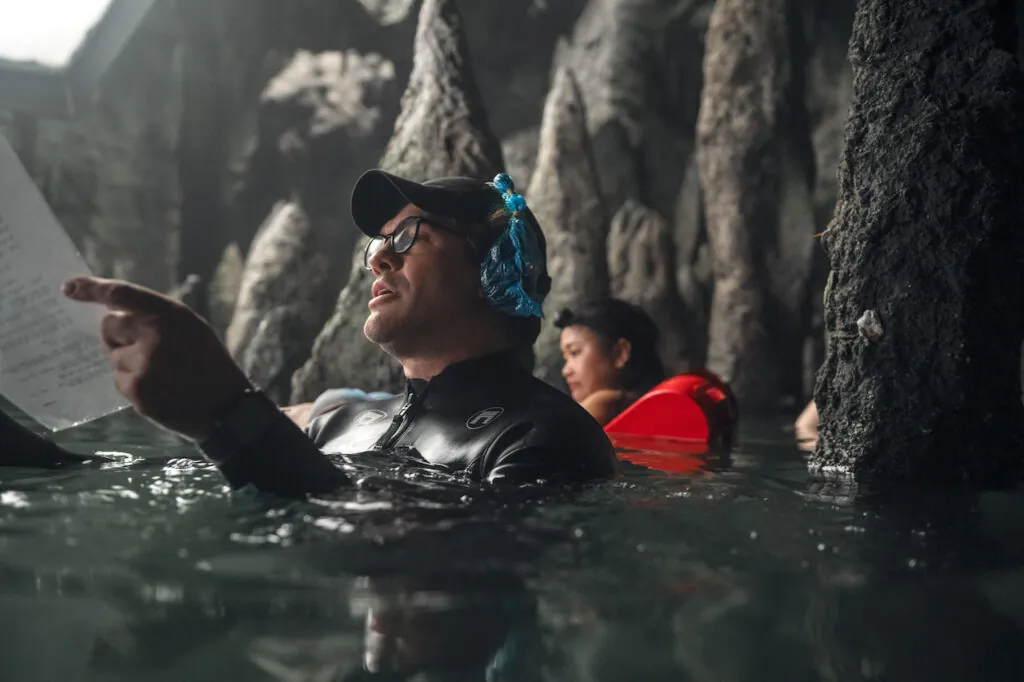
Working in real caves proved to be a dangerous prospect (“everything is slippery and there's jagged edges and it's just hard to get into them”), so he ended up taking his actors to a massive cave in the northern part of the country for one part of their entry into the system of tunnels in which their characters get trapped, then to Krabi in the south, “where they have these cave systems and real cave divers train.” But once the characters pass through the entrance of the film’s namesake atrium, Wadlow shrewdly decided to work smarter, not harder.


“Now we're on a soundstage. And even though we had 13 caves in the movie, I only had three sets,” he reveals. “And some of those sets had to double for the same cave.” Like Spielberg and the filmmakers who ventured into these same cinematic waters, Wadlow employed improvisation and resourcefulness in order to create a sufficiently expansive canvas to tell his story. “Literally [the characters] would swim off this one set and swim back into the same set, and I don't think you can tell when you watch the movie.”
As for the beast itself, Wadlow similarly employed movie magic to make his man-eater perform, although he genuflected to practical trickery during the design process. “I found this one picture of a bull shark that looked like it had these rippling muscles around its neck — if it was a human, it would have giant [trapezius muscles],” he says. “So my production designer, Alec Hammond, who's a genius, built a life-sized, 17-foot-long shark that I had put in my office. And the reason why I did this is when we were rehearsing or prepping or having meetings, I wanted people to look at it and be like, ‘Don't ever forget how big this thing is.’”
He indicates that the production explored animatronic moments for when the shark breaches and it's close to the actors. “But we asked, do we want to have a real head? And ultimately, the answer just became, no, it's not going to look as good. So the shark was like 98% CG.”
Even so, The Devil’s Mouth maintains tension through pacing and careful framing that makes its digital monster feel real. Wadlow’s ultimate goal, he says, was to create intensity but not necessarily verisimilitude. “I wanted the movie to feel credible that this could really happen, so we have enough shark science in the script that you buy it,” he says. “Now, if we showed the movie to a shark expert, would they find things that sharks probably don't do? I'm sure. But it's not a nature documentary at the end of the day.
“You want that veil of credibility, but I don't feel that I need to defend it on Shark Week in front of an expert.”
Watch this exclusive clip fromThe Devil’s Mouth, which premieres on Prime Video July 29th.