
Last Updated on March 16, 2024 by Michael Gingold
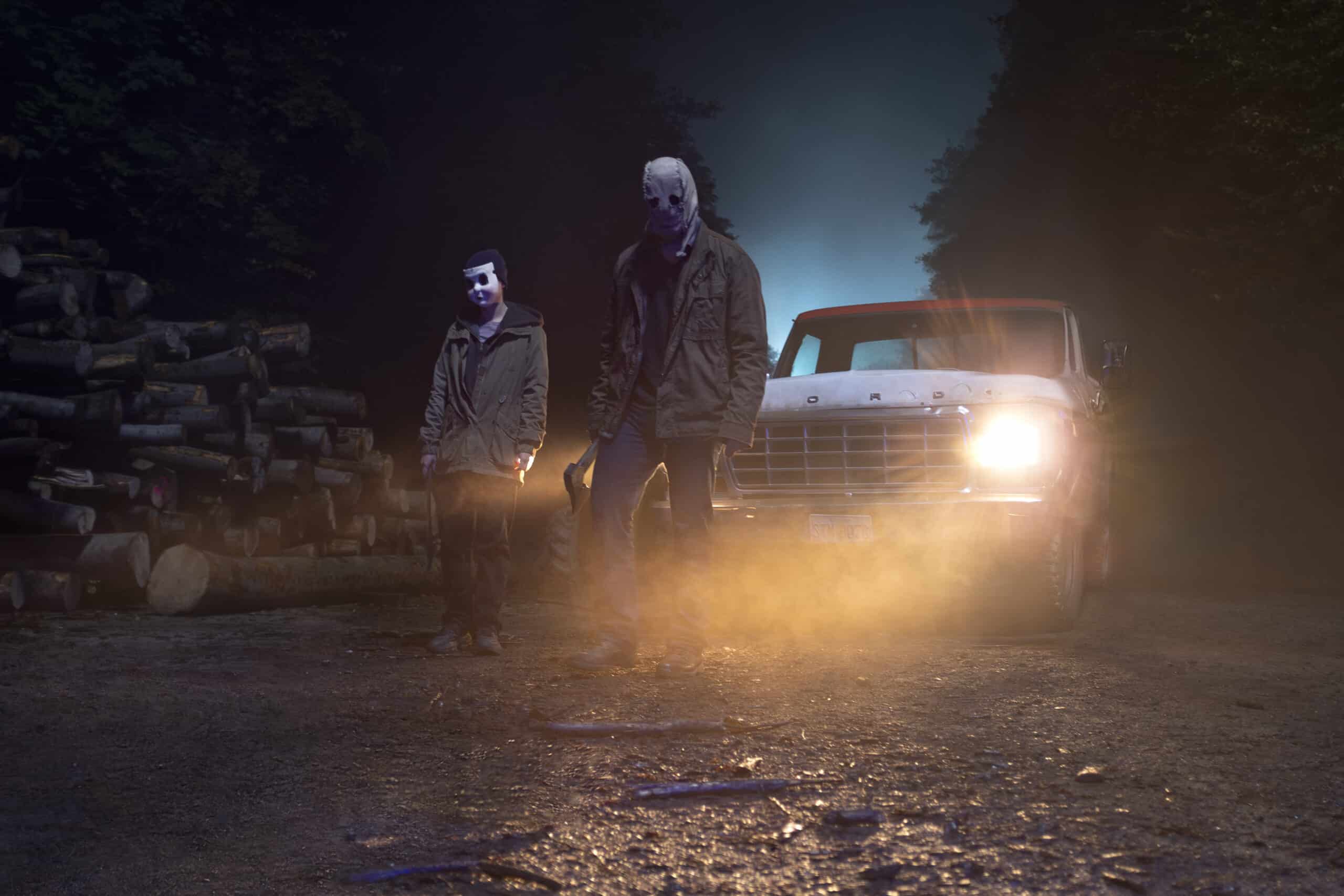
The trio of murderous masked strangers is back—and this time, they’re really not going away. In an adventurous move, the filmmaking team rebooting Bryan Bertino’s 2008 hit The Strangers (which was followed by 2018’s The Strangers: Prey at Night) shot a complete trilogy of new movies, set for release by Lionsgate in 2024. At the helm is Renny Harlin, whose credits range from Die Hard II and Cliffhanger to fright fare like Prison, A Nightmare on Elm Street 4: The Dream Master and Deep Blue Sea, and the films star Riverdale’s Madelaine Petsch as ongoing heroine Maya.
In Chapter 1 of the triptych, Maya and her fiancé Ryan (Froy Gutierrez) are road-tripping to Portland, Oregon, where she’ll be starting a new job, when they stop at an isolated vacation rental in the woods. There, they are besieged by a trio of mysterious marauders who seem to be motiveless—but whose purpose and origins will be explained as The Strangers Trilogy goes on. FANGORIA spoke to Harlin and producer Courtney Solomon the day after their panel promoting the movies at New York Comic-Con—and that night, Harlin headed off to begin helming Deep Water, his return to killer-shark thrills 24 years after Deep Blue Sea.
What was the inspiration behind doing this as a three-movie epic with a 280-page script, as opposed to starting with one film?
Courtney Solomon: Total and absolute insanity [laughs]! The inspiration was a friend of mine, who’s more of a financial producer than a creative producer, somehow came across the Strangers rights, called me up and said, “You’ve done so many horror movies; what do we do with this? Do you have an idea or a take on something we could do?” Their thought was that there should be just be a third movie, which would be something like the strangers and a family on a boat, or whatever.
Renny Harlin: The strangers at an airport.
CS: Yeah, the Die Hard II version! They were also thinking a remake could work. So I thought about it, and came back to them and said, “You know, it’s hard to remake the original Strangers. It’s been fifteen years, which is not that long, and it’s got a real place in horror history and a lot of fans, and I’m not sure we want to do that.” It’s a tough thing when you remake movies, especially movies people like. So I had the idea to tell a much bigger story, but in order to do that, we had to go back and reboot the original, so we could start in the same place. That felt like a truer way to bring it to a new audience. That’s what I told Renny when I first talked to him, that we should be true to the existing audience and not upset them, but actually give them more and answer the questions that have existed for years since the original Strangers.
That’s how it turned into a 280-page script. I worked with the writers to put it together; first, it was a very, very detailed treatment, and then we expanded it into the screenplay and eventually chopped that into three pieces just to keep our heads straight.
Who are your writers?
CS: Alan R. Cohen and Alan Freedland. These guys have always wanted to do horror, but they’re actually comedy writers, believe it or not. They wrote Due Date, for example, and we’ve worked together on an adult animated show called The Freak Brothers, with Woody Harrelson and Pete Davidson and Tiffany Haddish and all these great people. We’ve been doing that show for years, and they kept bugging me about, “We want to do horror.” So we worked on the Strangers Trilogy script together, and it was a lot of fun. We also wanted to get it quickly to a point where we could budget it, schedule it and start making it, and TV writers are very fast!
RH: As you were telling that story, I realized again what a genius idea that was, and what a Herculean undertaking it was. Studios usually have a hard enough time making sequels, because they can’t figure out what to do, and then it takes forever to do it. But to do three movies at the same time is incredible. When I got the script from Courtney, I wasn’t sure at first what I was looking at. It was this file that was 280 pages long, and I read it in one sitting, which only took about twelve and a half hours. Then I called Courtney and said, “What is this? It’s amazing.” And it crystalized for me that he wanted to make three movies and shoot them at the same time, which I thought was genius.
I love the original Strangers, and this answers so many of those questions people have had for fifteen years, and then takes the story far beyond that. Like Courtney said, they’re not traditional sequels at all, but really a continuation of the same story—an expansion of it. I don’t know how we did it, and I’ll be the first to admit that the project took on its own form as we started making it. The third partner was Madelaine Petsch; she really became our partner in crime, and as we were shooting the movies, we kind of became part of that world ourselves, and the story was telling us where it needed to go instead of the script telling us what to shoot. So we were rewriting the movies every day as we went forward.

For example, the ending of the third film became completely different from what it was on the page. The script’s ending was great, but once we got to know Madelaine and the characters intimately as filming progressed, it was like a dormant being that came alive, and once it was awake, it started telling us where it wanted to go, and the process became very organic.
One of the powerful things about the first movie is that you don’t really know what the Strangers’ motivation is, which makes them all the scarier. How did you sustain that in the new trilogy while also answering those questions and revealing some of their secrets?
CS: That’s a really good question. The first of our films is a reboot of the original, so you don’t get any more information about them there than you did in the original. You’re sort of in the same place as far as information on who the strangers are, and the mystery of them, by the end of our first movie. We stuck with that, because if we didn’t, we wouldn’t have been true to the original Strangers at all. In the second one, you get a little bit more information, but you’re still really not much further ahead.
Now, when we get to the third one, we show you their actual origin. We take you back to where they started from. But then we take you further, and show you what they became. So the last film is very much about who the strangers are, though it’s kept in the same vein as the original, and by the end of the third one, we create new questions for you, just like the original left you at the end.
Shooting any movie out of sequence poses its own challenges, so how was it filming three movies out of order, and sustaining the through-line for each?
RH: It was definitely the challenge of a lifetime for all of us, because we literally could be shooting a scene for the third movie on Monday morning, the first movie Monday afternoon, and the second one Tuesday morning. So we had to have all of our thinking and planning done very, very carefully. That applied to me, and very much to the actors and crew as well—the production design, the makeup effects, the director of photography. Everybody had to know at every moment where we were, what had happened before, what was going to happen next. We also had a visual language that we designed, starting from one place in the first movie, developing it into something different in the second, and even more so in the third.
We very much see the movie from Maya’s point of view. It’s really her story, and we wanted the audience to identify with her, know what she knows and see what she sees. More than anything, I would say for the actors, especially Madelaine, it was an incredible challenge to go from one emotional state to something completely different in a matter of half an hour. I can’t imagine any other actor doing what Madelaine did. When Courtney and I found her, we felt like we’d struck gold, but we didn’t realize we’d struck a gold mine until we were shooting with her. We knew she was talented, intelligent, funny, analytical, determined, all those things before we started, but as we got into shooting the scenes, we discovered the emotional depth that she had, and the genius she had that made the movies what they are.
As you were alternating shooting the three films, did you bring a different visual style and aesthetic to each one?
RH: Yes, definitely. You can absolutely tell, if you’re watching a clip from one of the movies, which one you are in just from the lighting and shooting approach. As we’ve said, the first movie is more like a reboot of the original; we have our take on it, but you can definitely identify it as the original film. Then we go somewhere else in the second one, and further in the third. I like to say that the movies get more epic as we go, which doesn’t necessarily mean that they get bigger in terms of the events and so on, but psychologically they get more epic, and visually, the experience becomes more epic.
Does the first film have the same limited number of characters as the original, or do we meet more new people there?
CS: Well, in the first one, they’re on a road trip and stop in a small town in Oregon, and they end up at what we call the Gresis House, which is sort of the Strangers’ house, if you will, which is where they have to stay overnight. In this small town of literally less than 500 people, as we come into it, you do initially get to meet some of them. And then, as the movies progress, you meet more of those people. The original Strangers was set primarily in one house and around the grounds, and our first movie is similar, and then it expands to this big area of woods that becomes like a jail cell for the remainder of the trilogy, and it’s hard to get out of there.
How did you find the right actors to play the strangers?
CS: That was interesting. We were auditioning to see what people could do with a mask on. We would put, say, the scarecrow mask on them, and tell them, “Do this scene, where the scarecrow is doing this, that and the other thing,” which was Renny’s sort of weird director way of figuring out who could act under the mask, and if they were able to create a character without ever being able to speak or actually show their faces. We didn’t want to cast stuntpeople because they would just overexaggerate everything; that’s what stuntpeople generally do. But somebody who could stand there, cock their head a certain way or look very deliberately at you, and you almost feel what they’re feeling through the mask—that’s how we picked those actors.
Renny, what can you tell us about Deep Water at this point?
RH: I can tell you that we start shooting on Monday [of this week], so tonight I’m flying back to New Zealand. I have Sir Ben Kingsley and Aaron Eckhart in two of the lead roles, but it is an ensemble cast, and it’s basically the story of an airliner on its way from Los Angeles to Shanghai that has to crash-land in the middle of the ocean and ends up on a reef. And just when those lucky ones who are able to survive think that things are going to be OK, they realize that the tide is rising and the reef is surrounded by sharks.
I actually don’t call this a shark film, though; I call it a disaster drama. The sharks are part of it, the plane crash is part of it, and it’s really kind of a throwback to 1970s disaster movies, where it’s a very interesting cast of characters under very intense circumstances who have to survive together, and sharks are part of that environment.