
Last Updated on July 14, 2024 by FANGORIA Staff
“I learned to recognise the thorough and primitive duality of man; I saw that, of the two natures that contended in the field of my consciousness, even if I could rightly be said to be either, it was only because I was radically both.”[1] ― Robert Louis Stevenson, The Strange Case of Dr. Jekyll and Mr. Hyde, 1886
As a nod to folklore, classic literature, and Universal horror, Stan Lee and Jack Kirby’s original incarnation of Hulk wasn’t green but a grey-skinned goliath [2]. It is, therefore, no surprise that the iconic superhero was initially pitched as a horror comic, modeled on Boris Karloff’s portrayal of the monster from James Whale’s Frankenstein (1931) and injected with the split personality of Jekyll and Hyde [3]. On the cover of The Incredible Hulk issue #1 (May 1962), Stevenson’s words are echoed ― “THE STRANGEST MAN OF ALL TIME!! … IS HE MAN OR MONSTER… OR IS HE BOTH?” ― highlighting one of many monstrous characters from the Marvel library. Both the Thing and Hulk, for example, are tormented heroes as much as tormented creatures; their formative years during the early 1960s were not only shaped by the end of the Atomic Age and Cold War era, but also censorship.
In 1948, psychiatrist Frederic Wertham began to write and speak out on the detrimental effects comic books were beginning to have on children; his argument culminating with the publication of the book, Seduction of the Innocent, published in 1954. Having made a considerable impact with his views, Wertham became an expert witness and appeared before the Senate Subcommittee on Juvenile Delinquency. EC Comics publisher, William Gaines ― Tales From The Crypt, The Vault of Horror (1950-1955) ― was brought to question, and, in the aftermath, the Comics Code Authority was developed [4]. Violent images and keywords such as “terror” were banned along with entire concepts ― zombies, werewolves, vampires ― destroying everything Gaines relied on for his titles. Therefore, despite sharing uncanny origins, superheroes often avoided embracing the horror genre fully, leaning more heavily towards pop culture and avoiding a pulp heritage.
Dual Nature and Dark Passengers
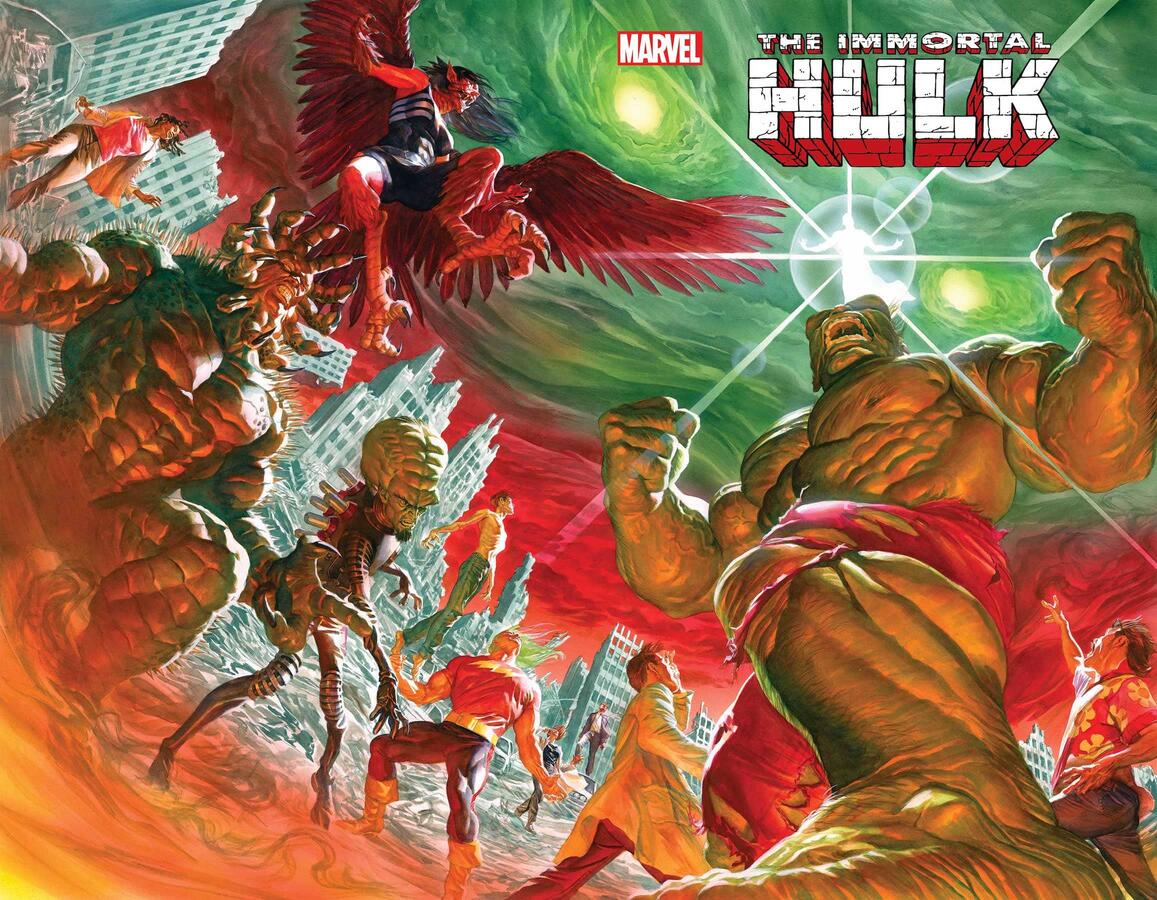
Al Ewing and Joe Bennett’s reshaping of the Hulk is as unapologetic of its influences as Lee and Kirby were back in the day, having presented a modern interpretation of the ego and duality; a key characteristic of the superhero persona. Building on writer Peter David’s definitive twelve-year run, Al Ewing’s take with The Immortal Hulk (2018-2021) is to constantly remind us that the title has always been a horror comic at its core. However, there are psychological undertones that expose current themes such as mental illness, issues that have become more apparent over the years as we found out Bruce’s abusive father, Brian Banner [5], triggered his dissociative identity disorder (DID) [6].
After Bruce Banner’s death in Civil War II (2016) and subsequent resurrection, The Immortal Hulk series returns to the persona known as the Devil Hulk. Created by writer Paul Jenkins in The Incredible Hulk Vol. 2 (April 2000), Devil Hulk is in complete control of the rage and has a clear notion of justice. Therefore he never appears when Banner is angry. Instead, like a true monster, he only appears at night. The duality here is in Banner believing this Hulk is a caged demonic personality; an inhuman creature he fears will be the end of the world. Indeed, in Jenkins’ run, Devil Hulk was a sly and devious reptilian creature. This side of him is Banner’s ultimate safety switch that takes control of his rage and guilt rather than become a fearful, satanic projection of another alter ego. In truth Ewing, with artist Joe Bennett, delivers a more traditional looking (and misunderstood) Devil Hulk who protects Banner and, in turn, the world. Quite polarizing from the Savage Hulk that sees humans (and Gods) as puny.
Through a deep dive into DID, Banner’s relationship to the monster inside him goes way beyond duality and carries a variety of dark passengers. Unlike Jekyll and Hyde, Banner’s torment is about learning to coexist as the man and monster work together in an effort to do some good. Often this is in his mind, but now it is on another plane of existence where he is able to face his fears and, in seeing them manifest, attempt to understand the power he has and how to control or allow himself to be controlled for the right reasons.
Moore than an Imitation
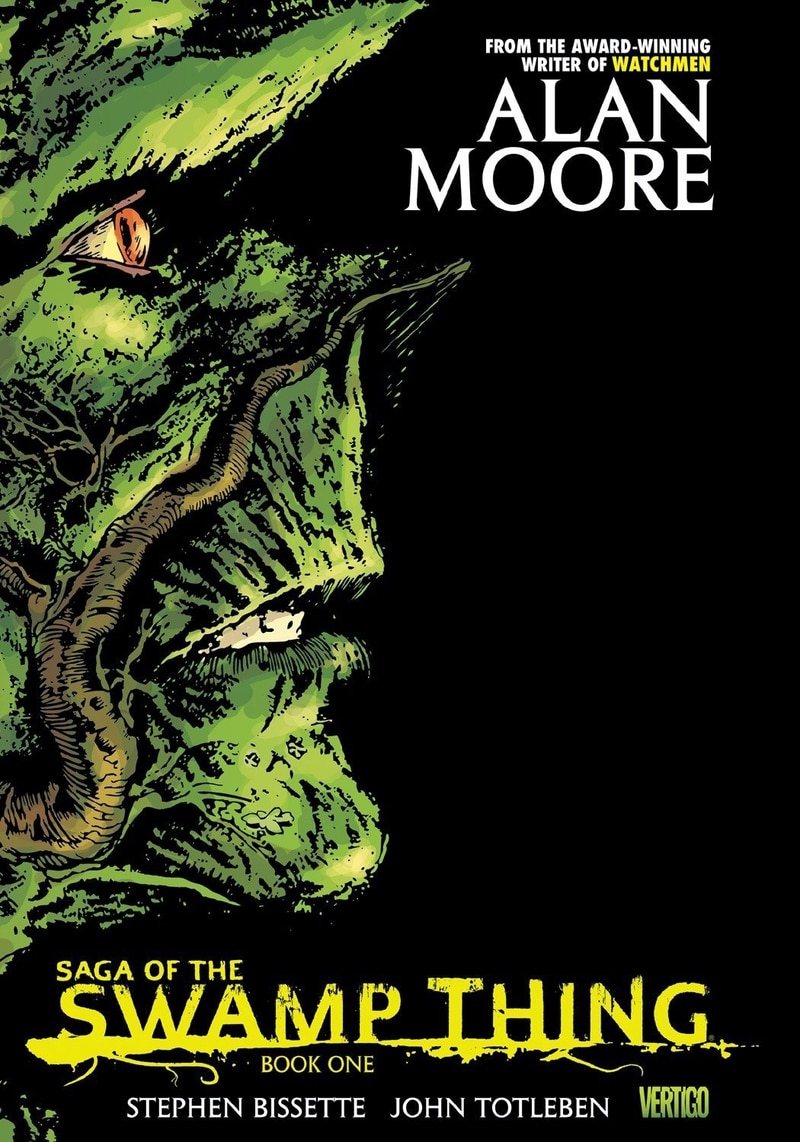
Ewing and Bennett’s resurrection of Bruce Banner is less of a Ben Grimm heavy hitter, more grim Hulk reduced to a skeleton of his former self. Although the Thing makes a brief appearance, John Carpenter’s The Thing (1982) and Alan Moore’s own reinvention of DC’s elemental, Swamp Thing, share a greater connection. With the latter influence in mind, a Hulkverse is opened by a metaphysical barrier known as the Green Door ― an extra-dimensional space more than reminiscent of The Green and Parliament of Trees ― and is a crucial element in what (literally) reshapes the Hulk mythos. This ‘Below-Place’ is the bottom layer of the Multiverse, below the deepest layer of Hell, and the key to Banner’s rebirth and newest superpower.
Issue #8, “His Hideous Heart,” is a turning point in this evolution. As an obvious love letter to “The Anatomy Lesson” (The Saga of the Swamp Thing, issue #21) [7], Hulk is dismembered and remains conscious as he watches his further dissection. Each body part is contained in large glass jars until he breaks free by clicking the fingers of his severed hand. An amorphous green mass pulls together before changing back into Banner; a gruesome Thing-like transformation that becomes a trademark of the series [8].
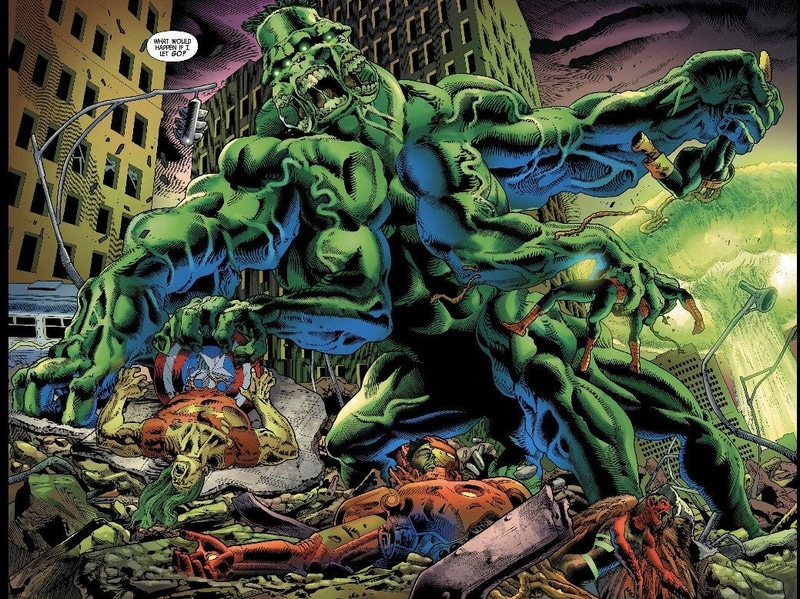
As the story builds, we are not just introduced to other Hulks that reside in Banner’s dormant personalities but also other ‘gamma mutates’ with their powerful slant. These supporting characters ― those who have come in contact with gamma radiation over the years ― begin to show their immortal powers, transforming in horrific ways through the Below Place. Rick Jones manifests as a gamma ghost while Betty Ross has become an amalgamation of two previous forms, Red She-Hulk and Harpy. Love is painful, as the Red Harpy tears Hulk’s heart out and devours it. Further gross-out moments splatter the pages in homage to our favorite movies. Absorbing Man splits apart, reminiscent of the T-1000’s demise in Terminator 2: Judgment Day (1991), albeit more bloody and visceral, and The Abomination becomes a weird living suit of armor with Facehugger features, interlocking fingers covering the entire head as it spews toxic vomit. In issue #39, “The Stars Move Still,” The Leader becomes a vessel for the One Below All and morphs into a Cronenbergian nightmare as he swallows Brian Banner. In the same issue, Bruce’s hollowed upper torso grows from the demonized corpse of Devil Hulk, blinded by tendrils that grow into a surreal brain-like tree.
Torn flesh replaces torn shirts. Page-turning jump scares lead to full-on body horror, rendered lavishly but efficiently, aided further by the spattering of different art styles that are intertwined throughout key moments of each issue. From Bennett’s EC-inspired rendering to the sublime, painterly sequences (from a variety of guest artists) reminiscent of European publications, such as the original Métal Hurlant. It has it all, making it one of the most interesting sources to tap into for a fresh entry into the MCU, once the rights are relinquished for another solo outing. For now, Hulk simply remains a Universal monster.
Green Screen
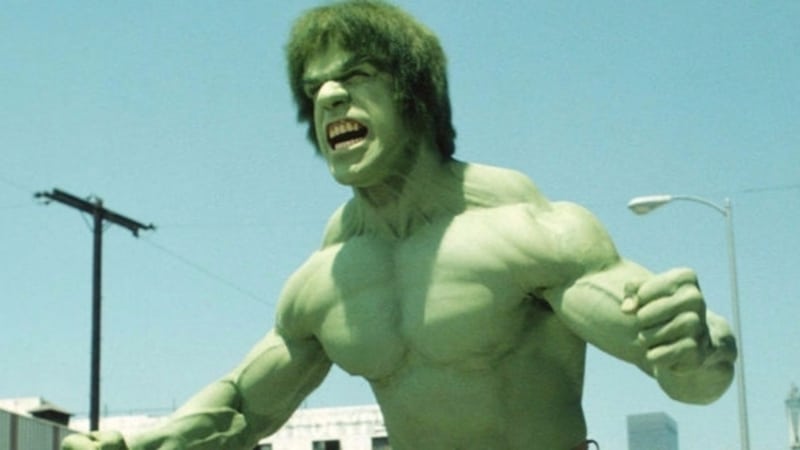
Aside from Bill Bixby’s fugitive and a painted Lou Ferrigno bursting onto television in 1978, big-screen efforts have failed to set the box office alight. Ang Lee’s Hulk (2003) — portrayed by Eric Bana and the director himself in mocap — lost its audience by taking the intellectual approach. Delving deeper into Banner’s damaged psyche and experimenting with multiple screens aping comic book panels, Lee at least seemed to have a grasp of the source material, showing us the trauma and abuse the gamma explosion unleashed. Closer in tone to the TV series, with Bruce Banner (Ed Norton) on the run[9], The Incredible Hulk (2008) introduced the MCU’s Savage Hulk. Once transformed he becomes a blunt instrument, an almost unstoppable force before learning to coexist with his alter ego as Professor Hulk (Mark Ruffalo) in Avengers: Endgame (2019). As a destructive monster, there is barely any room to display heroism, which is what makes the character so endearing, as Banner loses control rather than ‘taming the beast’.
Hulkish characters and ‘things’ have been adapted before. Wes Craven’s Swamp Thing (1982) and Troma Entertainment’s The Toxic Avenger (1984) are two of the earliest onscreen amalgamations of the superhero and horror genres. Tapping into Len Wein and Bernie Wrightson’s early run on the comic book series, Wes Craven’s version of Swamp Thing leans more towards the gothic than American gothic where, similar to the Hulk, the DC character is akin to the Universal monsters; a perfect mash-up of Frankenstein’s experiment and the Creature from the Black Lagoon (1954). Unfortunately, the film left Craven in financial ruin, A Nightmare on Elm Street (1984) — dreamed up on the set of Swamp Thing — eventually saving his career. Several years after the release of the adaptation, Alan Moore’s exploration of the character delivered a profound level of depth tapping into Eco-horror and a cosmic scope that took Swamp Thing and his (questionable) alter ego, Alec Holland, far away from the borders of the bayou. From an elemental perspective, Moore’s stories still remain incredibly dense and have only been touched upon in the excellent but ill-fated 2019 TV series.
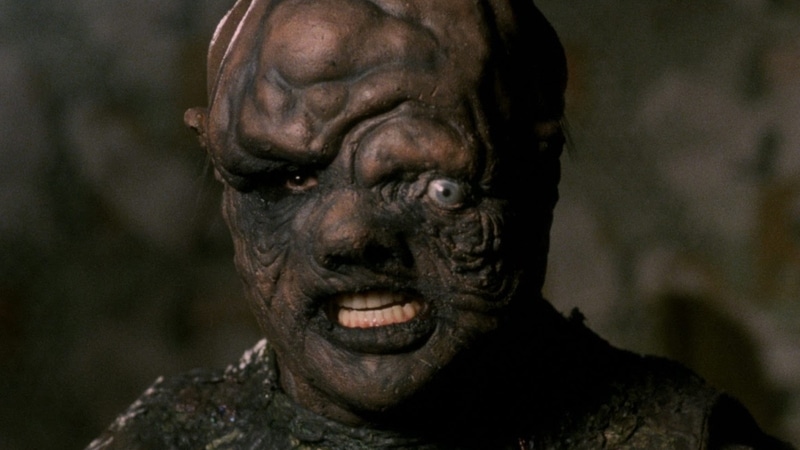
The Toxic Avenger was released the same year Kevin Eastman and Peter Laird’s Teenage Mutant Ninja Turtles first appeared on the page in 1984. Directed by Troma’s founders, Lloyd Kaufman and Michael Herz, the film spawned sequels, stage musicals, and the insanity of a kid’s cartoon show. Kaufman would shamelessly lower the bar; delivering lowbrow satire and commentary; building on exploitation cinema that had run rampant through the grindhouse cinema and midnight screenings of the ’70s. With his tongue firmly in his cheek, vomit-induced gore exploded amongst gratuitous sex, nudity, and a tasteless sense of humor; downplayed by cartoonish sound effects that stuck its middle finger up at the corporate and political attitudes of the time. Dated? Absolutely. But an unmistakable Tromatic signature.
This signature has even managed to permeate the MCU via Troma alumni, James Gunn’s unique throwaway aesthetic in Guardians of the Galaxy (2014), and DC adaptation, The Suicide Squad (2021); Gunn ― along with his brothers, Brian and Mark on writing duties ― also producing the anti-Superman movie, Brightburn (2019). But it is in the ’90s throwback Psycho Goreman (2020) these cult influences are felt the most. One moment PG reaches cosmic heights; the next brings us crashing back to earth with its disposable schlock and monstrous heart.
Although the gothic influence is merely makeup to other staple adaptations ― such as Batman (1989), The Crow (1994), Spawn (1997), and Hellboy (2004) ― onscreen superhero horror has had various successes and failures, rarely embracing the full impact and entertainment value of horror. The true beginnings of onscreen Marvel heroes drew first blood with Blade in 1999, but it is with Evil Dead director, Sam Raimi who not only brought the superhero movies to new heights with Spider-Man in 2002 but had had also tipped a fedora to Universal horror with Darkman (1990) over a decade earlier. Perfectly bridging the gap between the genres, Liam Neeson’s hero is the (phantom) operatic vigilante and mad scientist who takes out mobsters in bombastic fashion. We are in safe hands with Raimi bringing his unique vision and legacy to the first MCU horror, Doctor Strange and the Multiverse of Madness (2022) next year.
The End of All Things
Ewing and Bennett have opened up a multitude of possibilities to be explored in the MCU now they have blown the lid off Pandora’s box. Although we are yet to see Hulk at his full potential onscreen, with Raimi and the Marvel Multiverse now in the mix it brings us a step closer to potentially tapping into the Below-Place and a bold direction for Bruce Banner and his monstrous ego to take shape on the big screen. This recent story has been less about the Universal monster — both the Karloff influence and studio ownership — and, instead, about ‘universal fears’. The immortal arc has perfectly balanced the internal Jungian influence with the vast external cosmic horror we have grown familiar with through the works of H.P. Lovecraft and his fear of the unknown. Banner’s ‘Beyond’ (his immortality) manifests through the Green Door where he struggles to contemplate his life and death; threatened by the nightmarish presence that represents the ultimate evil of the Marvel Universe.
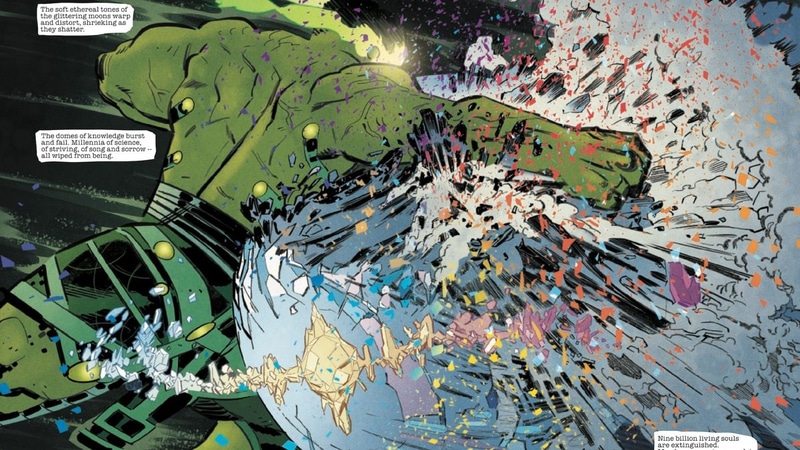
As we approach the final issue of The Immortal Hulk, we all wonder if there is any hope left at all. In The Immortal Hulk issue #25, “Breaker of Worlds”, we are witness to the end of all things. Hulk, alone in the cosmos, punches out nine billion living souls and tears the last star from the sky before another amorphous form of the One Below All reveals itself amongst the remains of a familiar, headless green body lost in an endless nightmare. What if… this is the inevitable conclusion to the series? Who knows; in a multiverse of infinite possibilities… anything is possible.
Immortal Hulk #50 is now available.
