
Last Updated on April 8, 2025 by Angel Melanson
We’ve all taken a nap in the middle of the day, the intention being a quick twenty or thirty minute rest, and woken up in the middle of the night, wide awake. Think of the disorientation that comes with a loss of time, the instability of adjusting to the sudden darkness. Think of your wobbly grasp on reality, even if it only lasts for a few seconds. Now imagine how uncomfortable that feeling is but that’s your baseline. All day, every day. That’s an approximation of an extremely rare neurological disorder called dyschronometria. It’s also the medical condition at the center of gonzo neo-noir horror, Gazer.
Directed by Ryan J. Sloan in his feature debut, and co-written by its star Ariella Mastroianni, Gazer follows Frankie, a mother in a race against time (literally) as she becomes embroiled in a murder-mystery. After the death of her husband, she’s struggling to make ends meet and without custody of her daughter, both a result of her suffering from dyschronometria. One night while attending a support group for grief, she meets a mysterious woman who tells her she’ll pay her to simply drive a car to the Meadowlands. It’s an in-and-out job, should be a piece of cake, easy money. It is, of course, never that simple, and before she knows it, Frankie is caught up in something far beyond what she signed up for. With her condition worsening, seemingly by the hour, Frankie descends into the criminal underworld to uncover just what the hell she’s found herself in. With one stone unturned, five more pile up as she struggles to discern what time of day it is, let alone which day at all.
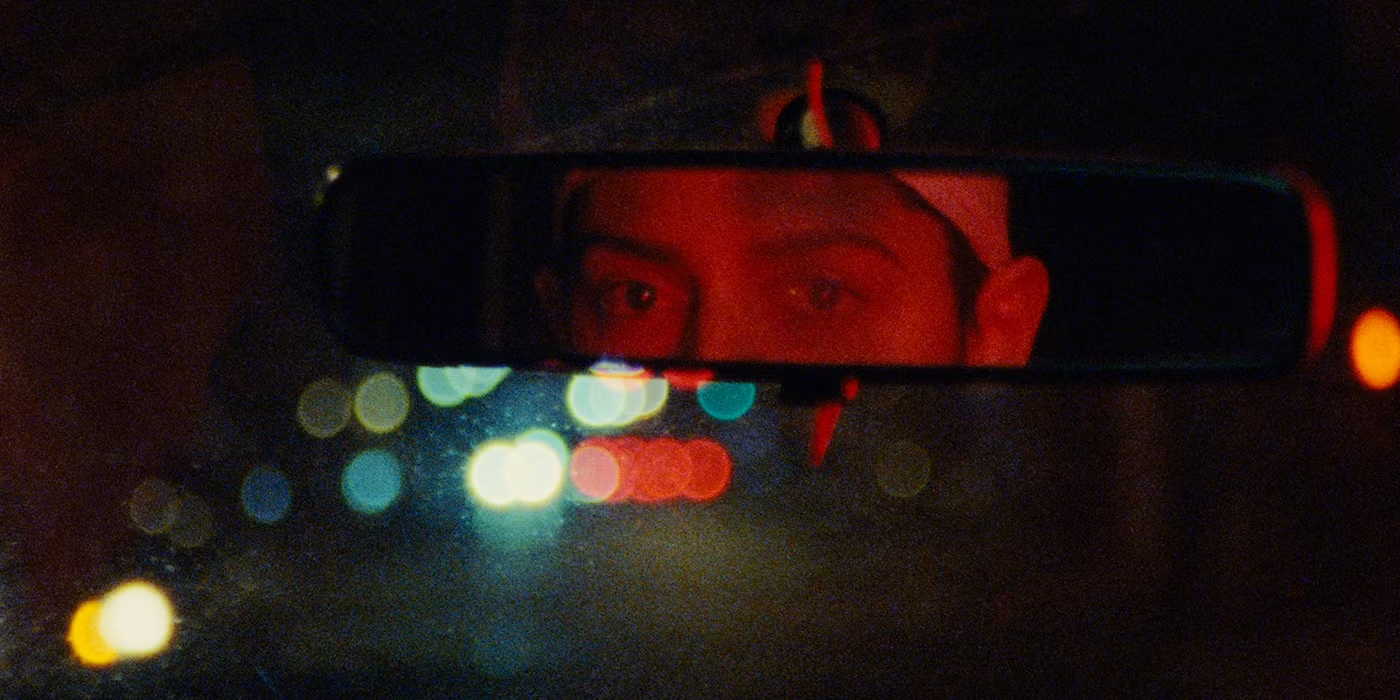
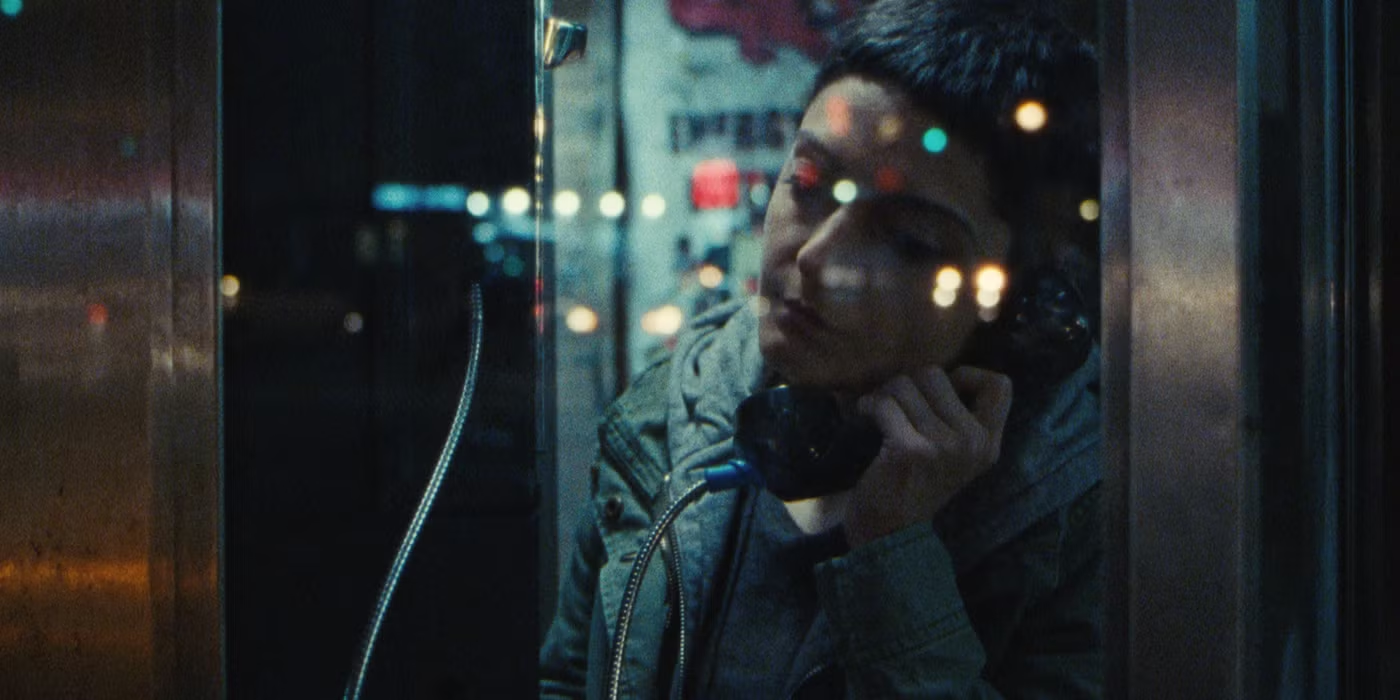
Gazer wears its inspirations well, notably another memory-loss detective thriller, Memento, but what excites you from the outset is that it’s so clearly its own animal. Shot in hazy, largely handheld 16mm, you’re immediately inside Frankie’s head with her. Helped by narration, a device baked into the story as she listens to both instructions from her past self and things her daughter has said to her as ways to center herself in the moment, Gazer unfolds like all the best noir. The addition of her illness makes her an unreliable narrator, shady characters morphing into trustworthy leads and vice versa. Steady ground is at the end of a long, dark hallway that Frankie, and you, can’t seem to reach. Sloan captures what it’s like to lose perception of time in a fractured, hallucinatory way. Daylight has this sickening fluorescent tilt to it because your brain never adjusts to it. Nights are inky black, figures disappearing into voids. Add to that some wild nightmare sequences filled with sickening imagery and you’ve got a thrilling blend of genre, one moving to its own jazzy beat.
Ahead of its theatrical rollout, Sloan and Mastroianni sat down with FANGORIA for a long and spirited chat about their influences, conveying loss of time on screen, the film’s accidental real-world parallels and so much more.
This is a bit of an immediate digression but for ten years I worked the graveyard shift as a janitor. I don't suffer from dyschronometria but coming home every morning, when it's super bright, waking up when it's dark out, it always felt like I was experiencing a sense of time loss. I’ve seen so few films nail that feeling so specifically. Just drifting like an out-of-time ghost. All that is to say, where did this idea come from? What made you circle in on this affliction?
Ariella Mastroianni: Well, I just want to kind of build upon your point. It is true that outside of Frankie's condition, we do play with this sense of loss of time in other ways. You know, Frankie's daughter, when she's listening to her on the cassette tapes. That is a specific moment in time. And, like you said, Frankie exists in the world as a ghost, you know, she's doing these night shifts. She's trying to find structure, but it is so unstructured. She's fully in survival mode and she is actively losing time. Thank you for kind of bringing focus to that.
Absolutely. I would come home and my partner would be asleep and when I would wake up, she'd be gone at work and I would just be like, ‘man, this is so weird.’ It does feel like you're missing time. Like things are moving without you. It was all so relatable to me.
AM: Also too, I mean, there's a moment in Frankie's voiceover,I forget the line preceding it, but she says, ‘A life lived in no specific order’, you know? I love that part of the monologue, but it's true, you know, especially as Frankie's recounting the things in her past that are haunting her, those moments are living with her presently as well. So it's like, what is this notion of time in that kind of emotional landscape?
I had never heard of this condition before, so I didn't realize it was real until after I watched the movie. Did the idea for this film come from this condition? Or did it start as something else?
Ryan J. Sloan: No, it really began with a deep dive into the films that we loved and that we were interested in. During the pandemic, when this whole adventure began, Ariella was furloughed from her job at Angelika Film Center in New York. And I was continuing to work as an essential worker, as an electrician in a prison working similar graveyard hours as you. It was a very strange time filled with paranoia, as everyone remembers. So we started diving into these films that we grew up with: Polanski's Chinatown, Coppola’s The Conversation, Vertigo, Invasion of the Body Snatchers, etc, etc.
We'd been talking about doing this [making a film] for all of our lives, and time had literally just been slipping away. We're getting older and older. Things are not very good right now. You know, it’s a now or never kind of thing. So that was the genesis of getting into this. We were lucky that Ariella was simultaneously reading Oliver Sach’s ‘The Man Who Mistook His Wife For a Hat’, which is all about ataxia. Dyschronometria wasn’t there, you know, but Vertigo obviously has a condition attached to it. Memento has a condition attached to it. A lot of these films have someone struggling with some type of ailment. And Ariella was like, ‘I wonder if there's like a time perception disorder, ’cause that would work really well on film.’ So we found this rare brain condition and that sent us off to the races.
AM: Yeah. We realized that a lot of the films that we loved shared a narrative structure called the ‘Spiral Structure.’ So that was already kind of a thing and once we discovered that, it really rounded us in terms of the direction we wanted to go. We were already kind of brainstorming a narrative that would follow that structure after we made that discovery. And then yeah, when we came across that condition – it was all kind of happening simultaneously.
Another influence for us was Paul Schrader and his ‘God's Lonely Man’ archetype (Taxi Driver, Light Sleeper). The way he uses voiceover narration and writing in a journal, you know. When we were thinking about how Frankie dealt with her condition, we figured that it would be helpful to her to record self-guided tapes.
RJS: Do something analog.
You hit on something that I was gonna ask a little later, but let’s discuss it. Frankie is very much of a piece with a Schrader protagonist except she's a Woman in the Room with a Tape Recorder, instead of Man in the Room With a Journal. I find it fascinating in terms of performance. When you're performing those scenes, where you're kind of investigating things and you're listening to your own recordings, were you doing that on set to kind and reacting to your own voice?
AM: Yes, Ryan sent me off and had me record myself. It was an important part of not just the character development for me as an actor, but also as writers to see how it would work practically. Actually doing it was very helpful on set. I think there were times where I was listening and then other times where I was not, because we had such limited film that I wanted to make sure that I met the cues, there was no room for error. So the cues had to be very specific. Yeah, it was a combination, but I wouldn’t always listen to it.
This was shot on 16mm and it looks incredible. It adds so much to the hazy, dreamy quality to the movie where you're being haunted by the loss of time. Can you talk about that?
RJS: I grew up with film. I mean, we all did in a way and the films we referenced were shot on film. So when I think about a movie and the way it should look, I’m always picturing it on film. Every film that I do, I want to shoot on film. So, I figured since this was our first film, if I could prove that it can be done on a low budget, then I would be allowed to do it again and again and again. We were also very cognizant that this gritty world that we were creating for Frankie lent itself to that 16 millimeter look. We decided to basically have different looks throughout the film. In the outside world where it's a little more manic, we took the approach of Aronofsky’s The Wrestler, and we shot handheld following Frankie. Then when we were in Frankie's apartment, it was still handheld, but the camera didn’t move. It didn’t pan, it didn’t tilt. It stayed still on Frankie until the last time she’s in her apartment when her home was no longer safe. Then when we're in the nightmare sequences, we actually pushed the film, which gave it more of an ’80s grindhouse look. All of that is shot on Steadicam to create this symmetrical, off-putting effect. We had very specific targets with everything. I just feel this film would look silly digitally, you know?
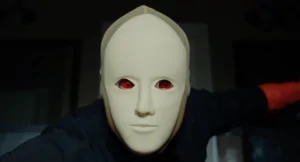
Let’s talk about those dream sequences. There's a great moment that’s clearly calling to mind Videodrome where Frankie attaches this disgusting, fleshy cube to her stomach.
AM: The Flesh Box! <laughs>
Yeah! Loved that. What, outside of Cronenberg, were you drawing from with those brief flashes?
AM: The development of the dream sequences is one of my favorite things to talk about, because when we were initially working on the film, we had envisioned those as flashbacks as like real, lived flashbacks. And then at some point, we started to think about them in a sort of dream space.
RJS: We were using language like ‘this is, this is horrifying. This is a nightmare. What a nightmare.’
AM: Yeah. We started to pay attention to how we were describing them. ‘This is horrific’ is how we started to refer to Frankie’s haunted past, and then we took note of the language we were using, and we were like, ‘wait a second.’ If this is what it feels like for Frankie, if this is a nightmare, we should present it as such. The audience needs to have a window into what is haunting her, into her psyche. She is at the same time reliving and discovering these moments and interpreting these moments. So once we kind of paid attention to that, we could have a lot of fun. Then in terms of all of the body horror, there is nothing more physical than the death of her husband and the birth of her daughter. Truly. Birth and Death. I mean, that is the most physical, right? So what better way to represent that than to really have something physical?
I’m so into how no matter how surreal the movie gets, at its surface, it's still noir. The jazzy score, Frankie’s slipping people twenties for tips, she’s shadowing suspects. How important was it for you to keep those old school tropes?
RJS: These movies are still so much a part of my life. We just saw Blue Velvet after David Lynch passed away and watching that and Lost Highway, I love that a lot of these older films weren't afraid to like mix genres. We’re living in a time now where these tech companies that are running studios, that are running streamers and so on, are telling us, ‘you need to make this movie and it needs to fit in this box. You need to make that movie, and it needs to fit in that box. It needs to fit in this category and that category. Our algorithm says that if we put so and so in this movie, and we write this part here that it will sell X, Y, and Z.’
I think that we just need to get back to taking these old genres, mixing them and mashing them a little bit. Taking the tropes and, again, going back to Schrader, his lonely man writing in a journal, Frankie recording cassette tapes for her daughter for after she's gone. Using that and finding a way to bridge the gap, getting a little creative and taking something from elsewhere. I mean, studios do it all the time. They love that shit. Take something old and make it new. You know, that's their whole M.O.
AM: I think we’re also just motivated by what we wanted to see. The Meadowlands sequence, the warehouse sequence, the under the bed sequence. I mean, there's so many sequences where we were like, ‘yeah, this is the shit we love.’ And every time we got excited by an idea, we just went with it because that was the most genuine place it could come from. We weren't doing it to satisfy anything else other than to make us really pumped in the theater. <laughs>
So this may be a little dicey, but this does deal with a murder being caused by, let’s say a reaction to Big Pharma and the insurance industry. And I couldn't help but think of, you know, Luigi. <laughs> This was obviously written and shot well before that but I feel like there's definitely a mood right now where no matter where you fall ideologically, it feels like the one thing we can all agree on is everyone’s pissed off at our corporate overlords. How much of that was on your mind when you were writing this?
RJS: Noir is built on the struggle, the American struggle, right? It's obviously inspired by German Expressionism, black and white, long shadows, etc. But in America, noir is all about the fight against the man and what that fight is doing to the smaller people. And it’s like, man, I’m 35 years old. I haven'’ had health insurance since I was 27. I have no idea what's going on inside my body. Anytime I go to the doctor, I get fucked. <laughs>
Oh, yeah. I’ll never forget, when I didn’t have health insurance, in my early twenties, I had a bad back problem. I went to the ER, wasn’t touched, was talked to for five minutes and got a bill for $2,000. And so watching this, I’m like, man! You know, I kinda get it! <laughs>
RJS: I come from a working class background as an electrician. I also work with people that might be illegal. They’re just like you and me. They deserve all things. They’re working their asses off to survive, you know? I think more than anything, I want to make movies for those people. People that are on the outskirts of society that are struggling but that also need movies. They also want to be seen, they want to be represented. They want to be able to be like, ‘yeah, I fucking get that.’
AM: I mean, one of my favorite things in the film is Frankie gets involved over $3,000. Which might not seem like a lot to people, but when we were trying to determine a price, we were like, ‘wait, what would we do for three grand right now?’ I mean, I do not have three grand.
I’d do a whole hell of a lot for three grand.
AM: Yeah! <laughs> But you're right. We really wanted to make a film about the underdog, the people who reminded us of us.
Ariella, your performance is remarkable. It’s so insular, you almost shrink yourself within the frame. Can you talk a bit about how you approached playing Frankie and her physicality?
AM: Frankie’s physical life was so important for us to develop because of how we were shooting it as well. We were only able to shoot over a period of two and a half years, only on weekends at a time. So how do you create a character and a performance that’s consistent? I don't always approach it in this way, but we decided that if we were to kind of shape Frankie’s physical language and develop a strong visual language for her, that would really ground me on set while so many other things were happening. What I also love so much about this character is she has this violent, chaotic inner life that she’s carrying with her. How do you carry that? I feel like once we started to really ask those questions, the shape of that weight started to evolve. She wants to exist as a ghost. She is a voyeur. So how, how do you simultaneously live with this chaotic inner life and exist in the world without wanting to be seen? And I feel like that was really what shaped Frankie.
I love that as we get further into the film, as she becomes more active in her investigation, she wants to be seen. She becomes more physically present. Her voice is stronger, her presence is larger. She’s determined to get to her daughter. She's determined to find out what happened to Paige. I love that arc.
It’s a perfect ‘show, don't tell’ character arc. Shifting a bit, I don’t typically read through the press notes too much. I don’t want to influence myself or my questions. But out of all your inspirations, the one that drew my eye the most was Lee Chang-dong’s Burning. What is it that you love so much about that one?
RJS: Oh, man. All right. So, we’ve watched that film many, many times. Lee Chang-dong is one of our favorite filmmakers. What we did when we watched it was, we went beat by beat, literally, like, minute by minute in a notebook. And wrote out everything that’s happening in that film to try to understand its structure. Every time we return to that film, we learn something new. There’s something to always pull away from it.
AM: It’s still rich, every time.
RJS: There's a question of, wait, is any of this happening post-him writing? What's going on between the father and the son? And, the anger that’s passed down generationally? All of these questions just keep being asked. We were just so inspired by the character of Jong-su.
AM: He was a big reference for Frankie.
RJS: Even Hae-mi who goes missing, wondering what her motive was. Did she go missing? Did she just fuck off to wherever? <laughs>
AM: Because she said she always wanted to disappear. She had plastic surgery! God, it’s so good.
RJS: It’s such a fucking rich film. It really rewired our brains about what was possible when writing our film.
It’s so refreshing to talk with people who do this but also have a real, passionate love for breaking it down. It’s nice when it’s not just us critics. <laughs> This is a genuine independent movie. What do you make of this whole independent landscape right now? How surreal was it to go from what you guys were doing, shooting this scrappy, little movie to all of a sudden you’re in Cannes?
AM: We're just movie lovers. I would say that throughout this process, we didn’t have any classical or formal training, but we were film students. I have an acting teacher who used to always say, ‘You can come to class and I can teach you technique, but I can’t teach you appetite.’ I would say that that's true, you know, me working at the Angelika and Ryan pulling apart cameras since he was young, it’s all just a curiosity and love. A love for film. That’s the thing that motivated us the most, more than anything.
RJS: And there’s definitely imposter syndrome. I mean, especially at Cannes, you know? There's so many people you talk to and they’re like, ‘oh, have you seen this movie and that movie and that movie?’ And it's like, ‘no.’ <laughs> But it’s like, I have seen this movie [Gazer] , and I think that movie’s just as fucking cool. So fuck you.<laughs>
This interview has been edited for length and clarity. Gazer opens this Friday.