
Last Updated on July 14, 2024 by FANGORIA Staff
“There’s a subtext here that whispers powerful messages about boundless American energy and that energy’s darker side: a grasping, stop-at-nothing hunger for money and power.” — Suck on This by Stephen King, introduction to American Vampire: Volume One
Take a detour via Route 666 and you will find the American vampire… unless it finds you first. Don’t expect anything sophisticated — there’s no carafe of wine, horse-drawn carriages, or castles here to haunt — only cheap motel bungalows and a blacked-out RV. Not only is it on the fringes of society they smell your blood; here the vampires move in next door; lost boys (and girls) grow fangs, and, if you’re (un)lucky, a pale interviewee will share their (extended) life story with you. There’s no old-school Lee or Lugosi — no blood red eyes or hissy fits in this territory — just a Universal / Hammer to the head. From opening the casket in Stephen King’s Salem’s Lot to Stephenie Meyer driving the final nail in the coffin, the best examples of these modern versions are reinventions that set out to break the rules. And breaking rules is director Kathryn Bigelow’s specialty.
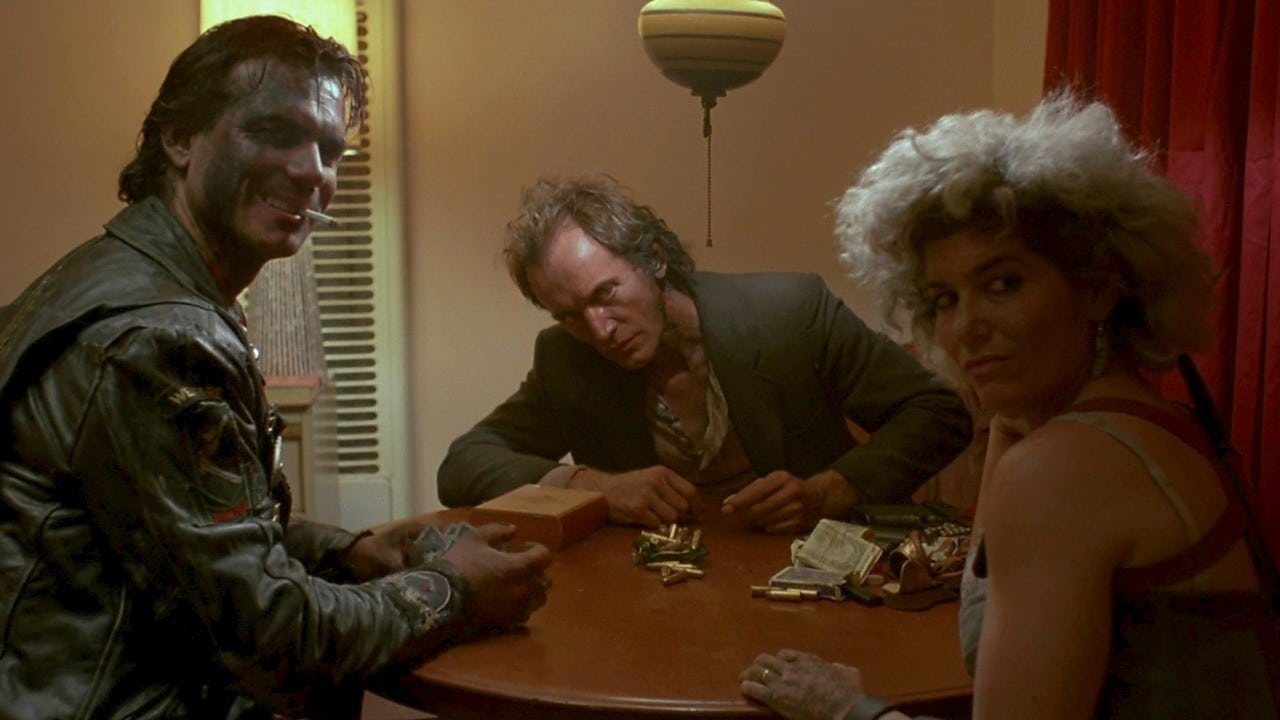
With her stake in the heartland of America, her debut as a solo director saw her redefine the vampire with 1987's Near Dark. Co-written with Eric Red, who had already tapped into a definitive urban legend with The Hitchhiker the year before, Bigelow and Red’s approach to the story was to explore the Western via horror… with some nourish undertones. Traditional mythology was set ablaze — discarding the gothic, supernatural, and any religious paraphernalia — to reduce exposition and create a more grounded story on the “grave” consequence of love and attraction. The result: a film that is romantic but not romanticized. Here, gunslingers shoot from the mouth with “finger-lickin' good” dialogue that presents a motley crew of undead outlaws who inhabit a moody mercurial meditation on America soaked in piss and blood, dirt, and grime. The open frontier is just about visible through the brutality and urban decay; a world so grounded, that the V-word is never uttered once throughout this Western Horror.
Bigelow’s unique approach in exploring the hybrid is all over her early work. Influenced by her conceptual background as a collaborative artist in the avant-garde group Art & Language during the early to late ‘70s where her paintings and performances shaped her visual aesthetic in a similar way an RCA and advertising background shaped Ridley Scott’s efficient vision. The transition from artist to filmmaker can be seen when she collaborated with fringe producer Monty Montgomery to co-direct The Loveless; a biker-noir laced with Edward Hopper hues and isolated framing. The result was something decidedly vampish.
In contrast, the James Cameron connections are all over Near Dark. Not only was Bigelow briefly married to Cameron but the film also shares Lance Henriksen, Bill Paxton, and Jenette Goldstein, who had all performed together in Aliens the year before. Along with The Terminator cinematographer Adam Greenberg, a similar, relentless tone is set; emphasized all the more by the third act’s truck sequence. Clearly, it was crucial that Bigelow found her feet building this “intact family” with her cast and crew, a major key to her early success.
Released two months after The Lost Boys (or The Goonies: reVamped), Joel Schumacher’s film, despite similarly utilizing the themes of family and the outsider, Near Dark embraces tradition and is closer in tone to Tom Holland’s 1985 film Fright Night. What sets Near Dark apart from these films is what Bigelow manages to tap into. The urban poverty left behind in the wake of Wall Street’s excess — the notion that the underclass was literally bleeding the system — couldn’t be more ironic based on the corruption of the social elite during the Reagan Era. Near Dark shows family struggles; each of the characters trapped within their own small part of the past; nomadic anarchists on the fringes of society; their social structure threatened as an outsider brought into the fold. Any other filmmaker would have remade Dracula at the top of his Trump Tower; instead, we have washed out nightwalkers feasting on anyone who happens to cross their path. Bigelow’s vampires embody poverty. They are not quite the AIDS metaphor but they do resemble homeless alcoholics and crack addicts… or any other social disease. Blood is the drug they’re thinkin’ of.
These metaphors and observations presented in Near Dark are completely grounded in what is known as “the accursed share,” an influential theory from French writer and philosopher, George Bataille, of which his original 1949 publication, La Part Maudite, was a huge influence on Bigelow’s early musings. Bataille believed that an organism’s growth is limited and that wasting this energy is a “luxury.” Excess, destined for waste. The vampire — even the (home-grown) mosquito in the opening scene — sums this up in a single shot.
Modern versions of these creatures are more a by-product of counterculture and popular culture. As with Romero’s zombies, they become a commodity — literally “made in America” — his own reinvention in 1978's Martin taking the vampire apart entirely and, metaphysically, built on further in Michael O’Shea’s The Transfiguration. Romero illustrated a dispossessed, undead society leftover from the Vietnam War and Watergate; traumatic themes that still resonate in today’s society. In Near Dark, central outlaws Jesse (Henriksen), Severen (Paxton), Diamondback (Goldstein), Homer (Joshua Miller), and Mae (Jenny Wright) illustrate a fear of the social decline of the white man in the heart of America. There is a comeuppance to the aftermath of the Vietnam War and it hides in the shadows. The aftermath for Jesse has lasted over a century; hinted at when our central protagonist, Caleb (Adrian Pasdar), asks him, “How old are you?” in which he replies, “Let’s put it this way: I fought for the South.” Caleb presses, “South?” The history and mythology built in this single moment perfectly understated by Jesse with a wry smile, “We lost.”
These monsters are all the more terrifying because of how human they are; Henriksen and Paxton in particular literally chewing the scenery; one world-weary the other in “shit-kicker heaven.” Bigelow paints the characters with a condition; an affliction that allows the audience to fill in the gaps with their own knowledge of pre-existing lore. Trapped in time they can’t evolve — this is a way of life in which they have grown little and changed less — therefore unwilling to transform. Yet, at the center is Caleb and Mae’s reckless abandon — a teenage lust and rebellion that harkens back to James Dean’s swagger and attitude — a mortal life worth living. These lovers are the last of the innocent; a cowboy and a pixie; a bright light amongst the darkness who must learn that there is virtue in a beginning, a middle, and an end.
Bigelow may be the ex-wife of James Cameron and the lost sister of Ridley and Tony Scott but a Ripleyesque stature and own artistic background have helped her navigate and survive in a male-dominated industry. She has made a name in directing strong male protagonists, yet her female characters more than stand up on their own. As an only child herself, Bigelow’s women are often loners such as Lori Petty’s orphaned surfer in Point Break and Jessica Chastain’s intelligence analyst in Zero Dark Thirty. But then there is also the empowerment of Jamie Lee Curtis’ rookie cop in Blue Steel. All of these women, much like Bigelow, navigate the world of men by themselves. As a film director, she stands tall through her work — her attraction to violence transparent — seemingly turned on by watching and controlling “male fantasies.” Having the power to do so is a compelling part of her personality and, in turn, her filmmaking; yet, Bigelow, still today, remains a matriarch who nurtures ideas while encouraging empowerment amongst her actors whether male or female.
Looking back on some dustier examples there was very little room for the matriarch in horror movies or westerns — Joan Crawford’s Vienna in Nicholas Ray’s glorious Johnny Guitar (1954) a rare exception. Such oddities are explored in more detail via my three-part Diabolique series on “Weird Westerns” that highlights how — as with American filmmaking itself — this blood-let mythology is shaped by that vast open space where man and monster collide, “…the late 1950s were to usher in all manner of genre crossovers with teenagers vs. aliens or turning into werewolves.” Amongst the cacophony drive-ins and delinquency, Universal Pictures’ put their stakes back in vampire territory with the 1959 horror Western Curse of the Undead. Director Edward Dein set the film apart from most releases of the time; returning to the original European roots and folklore, instead of harkening back to Universal’s classic filmography. With Hammer’s fresh retake on Dracula released the previous year — aside from the cinematic trope of transforming into a bat — the outlaw vampire, Drake, has a curse rooted in the mortal sin of suicide. It is here that the American vampire takes hold and burns tradition in the face of the hero Preacher; where he can walk by day as well as prey by night. Curse of the Undead still remains an earnest film of the period and is certainly a crucial entry into the melding of genres.’ Dein’s film is a genuinely solid horror, at times, closer in tone to Joseph H. Lewis’ superb 1958 idiosyncratic western, Terror in a Texas Town, and never falls into the cheap ‘Shockorama’ 1966 double bills of Billy the Kid vs. Dracula and Jesse James Meets Frankenstein’s Daughter.
In the vein of such pulp roots and B-movie horror of yesteryear, it would be a curse not to mention the DC comic book series, American Vampire (2010-present); co-created by writer Scott Snyder and artist Rafael Albuquerque. Story-wise, everything is thrown in the meat grinder, providing an epic sweep of the nation where each story arc is set in a different decade from the Old West onwards. In the first five issues a backup origin tale of the ruthless bloodsucker, Skinner Sweet — the first of a new breed who can walk in the sun — is written by Stephen King who, based on Snyder’s detailed outline, sunk his teeth into a comic book script for the first time. The series is a terrifying and breathtaking journey — via Hollywood and the film industry; the building of the Hoover Dam; WWII; rockabilly bikers and the Space Race — all the while exposing a corrupt underbelly that spills the guts of U.S. history out onto the asphalt.
Back to more modern examples of film — whether it is David Bowie aging rapidly in Tony Scott’s The Hunger, or a month of Alaskan darkness in 30 Days of Night — horror is rejuvenated because the undead have learned to adapt to their surroundings; visionary filmmakers changing rules based on environment and social circumstances. “Both Kathryn Bigelow’s Near Dark (1987) and Robert Rodriguez’s From Dusk Till Dawn (1996) harken back to the revisionist approach to filmmaking born out of New Hollywood. However, what elevates these two films, in particular, is their ability to fool the audience into thinking they are watching something else entirely. The forgotten remnants of society, Rodriguez (via Quentin Tarantino’s script) presents a violent crime caper until the Gecko brothers take refuge in a sinister strip joint and Salma Hayek shows off her snake. Both films are modern neo-Westerns but the core elements and archetypes remain with anti-heroes, outlaws, and showdowns drenched in blood and gore.”
In genre filmmaking, artistry is often overlooked and the fact that Bigelow’s credibility as an auteur filmmaker was ever questioned, is as ridiculous as being the only female director to have ever won a golden statue. Her eye is one of constant action and never loses sight of where to place the camera. She contemplates. She navigates. She negotiates. Whether defusing bombs or performing a blood transfusion her work is measured, precise, and executed like a stake through the heart. This is a woman who continues to inspire, one who walks home alone… armed to the teeth.
In recent years we have seen 2014's A Girl Walks Home Alone at Night, an American debut feature by English-born Iranian-American film director Ana Lily Amirpour. Taking the concept east it pitches the first Iranian vampire western and, much like her mixed heritage, she shows how hybrid filmmaking works best for a 21st-century audience. While sharing a similar tone to Jim Jarmusch’s work — most notably 2013's Only Lovers Left Alive — as with the majority of female filmmakers, Amirpour has a lot to thank Bigelow for.
Near Dark has survived because it avoids cliché and through those choices made, Bigelow is responsible for the definitive American vampire movie. It may not have the teeth but it more than has the bite.
