
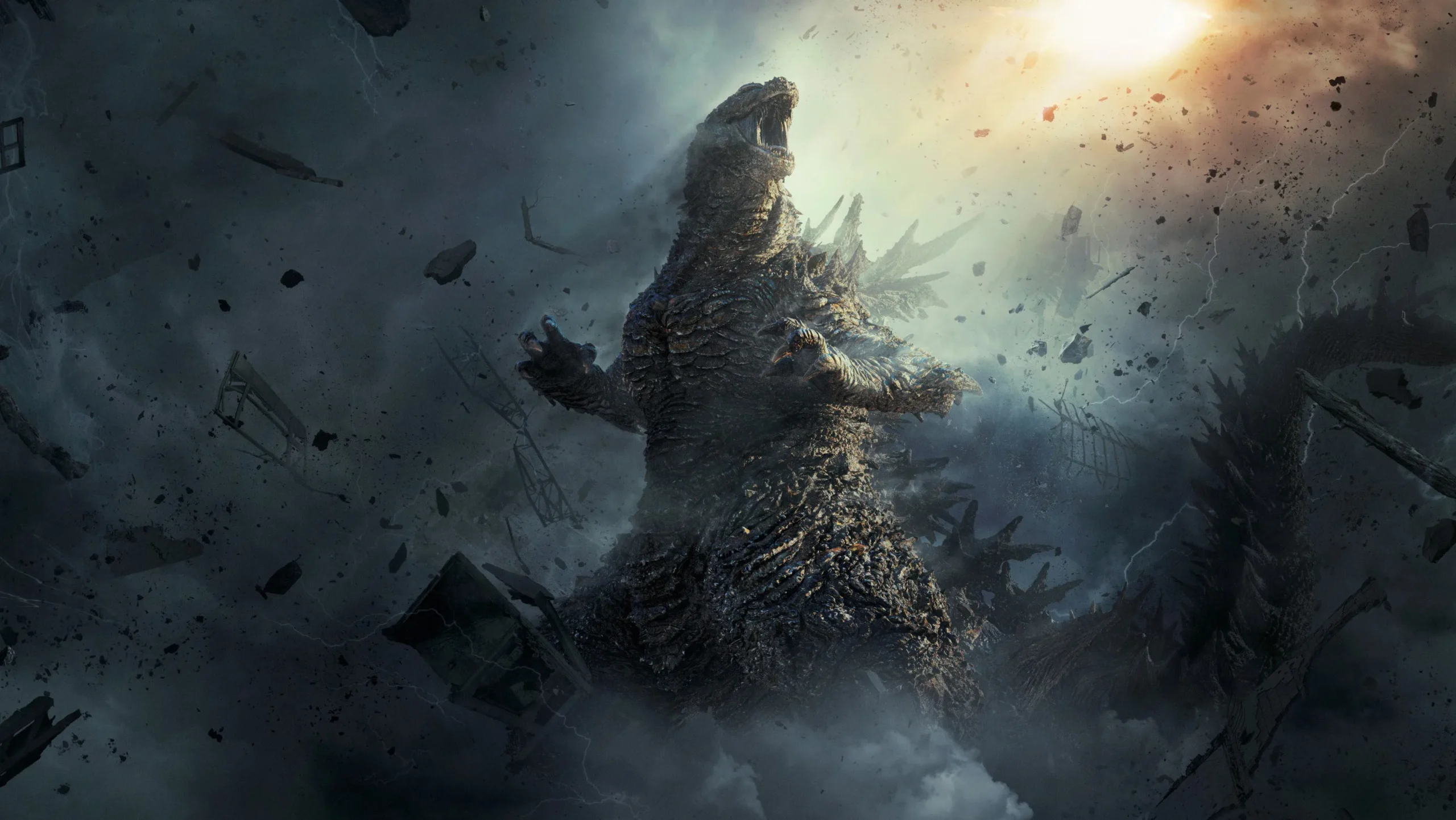
There’s something wonderful about sitting in New York City’s prestigious Alice Tully Hall during the venerable New York Film Festival and seeing the words “Anti-Ghidorah Command Post” on the giant screen. Takashi Yamazaki’s Godzilla Minus One catapulted the kaiju genre to a new level of respectability (and Oscar-worthiness) three years ago, and the writer/director’s sequel, Godzilla Minus Zero (which world-premiered at the fest over the weekend and plays there again this Wednesday), will disappoint none of its admirers. While the film (releasing commercially in North America on November 6) may not make grown men cry the way its predecessor did, Minus Zero is nonetheless a moving and rousing entertainment of sometimes astonishing spectacle.
The above reference to Ghidorah, by the way, is not a spoiler, as the Toho favorite appears in Godzilla Minus Zero’s very first scene. More specifically, a one-headed variation does; like 1991’s Godzilla vs. King Ghidorah, Yamazaki’s film retcons the triple-domed destroyer’s origins. It’s 1949, two years after the events of Minus One, when the flying dragon decimates Matsumoto City. This is a job for the Large-Scale Disaster Response Bureau, led by Kenji Noda (Hidetaka Yoshioka), who helped lead the efforts to stop Godzilla in the previous film.
A newcomer to his team is Makoto Aoyama (Masami Nagasawa), a meteorologist who believes that studying weather patterns could be key to tracking and stopping monstrous attacks. She’s also seeking redemption, as her prior warnings about a typhoon that wreaked enormous havoc were suppressed by the Japanese government, which was anxious about panicking a public already dealing with post-WWII jitters.

The shadows of both that conflict and Godzilla’s previous destruction fall long over Minus Zero’s characters, adding resonance and tying them to the Big G’s past identity as a metaphor for the atomic destruction of Hiroshima and Nagasaki. One character even directly flashes back to the devastation in the former city, with unflinching depictions of graphic casualties that, more than any of the monster mayhem, likely earned the movie its R rating. That past trauma, and its resurgence in the movie’s present with Ghidorah's arrival, motivates all the protagonists, including its two returning leads.
Kōichi Shikishima (Ryunosuke Kamiki), the former kamikaze pilot who found redemption by taking on Godzilla, is trying to live a normal domestic life with Noriko (Minami Hamabe), whom he has married, and their adopted little daughter, Akiko (Sae Nagatani). Noriko wears an eyepatch as a reminder of her own injuries from Godzilla’s rampage and is understandably anxious about Kōichi getting involved in combating the new monstrous threat. However, circumstances—which Yamazaki dramatically and astutely weaves together with the personal and science-fiction sides of the scenario—will lead both of them directly into the fray, keeping the stakes relatable amid the large-scale action.
One of the best of these sequences is one of the earliest, in which soldiers take to the air to engage in a vertiginously thrilling dogfight with Ghidorah. Here and throughout Godzilla Minus Zero, the visual effects overseen by Yamazaki are stunning, bestowing a kind of predatory grace upon Ghidorah when he’s airborne and a true city-crushing weight to him and Godzilla on the ground.
Once he’s achieved three-headed status, the rechristened King Ghidorah reveals a couple of tricks he never demonstrated in his previous films, adding to the sense of surprise Yamazaki achieves more than 70 years into the Godzilla franchise. At the same time, he throws in little homages to his forebears; there’s a secondary character named Honda (named for Toho legend Ishirō Honda), and the first attack by the three-headed King Ghidorah contains a specific visual shout-out to the titan’s first feature, Ghidorah, the Three-Headed Monster, back in 1964 (in which his first target was also Matsumoto City).
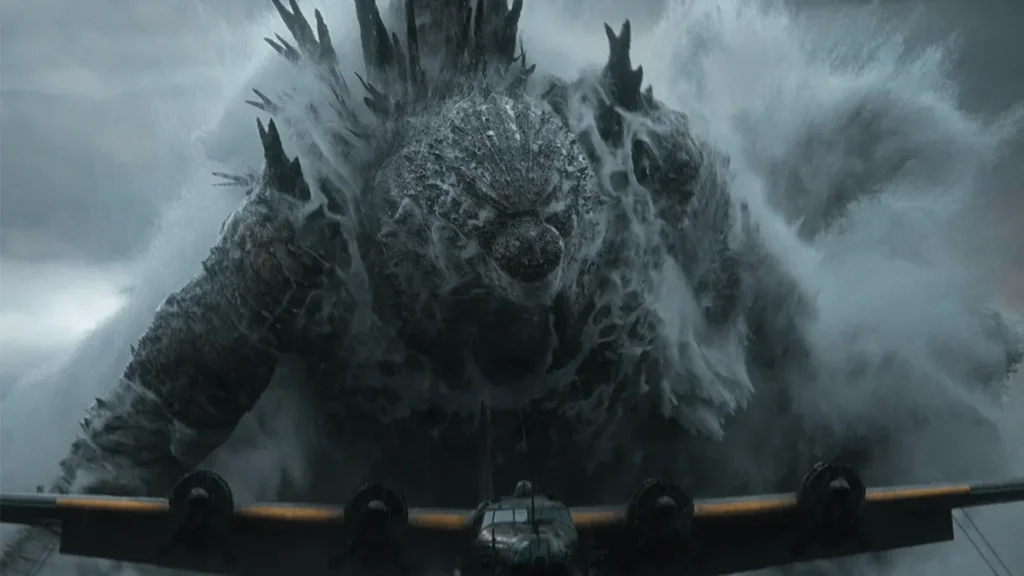
If you’ve surmised from this review so far that the triple-threat creature has more presence in Godzilla Minus Zero than its title kaiju… well, you’d be right. Before the final act, the Big G appears in only a couple of scenes, but Yamazaki makes them count, and the human drama is engrossing enough to keep us occupied between the monster mashing.
Part of what makes the movie, like Minus One, work so well is that everyone’s motivations and behavior are tied so closely to their experiences with the gigantic threats. This includes Professor Murakami (Min Tanaka), whose own psychological scarring leads to a scene in which Godzilla goes on a field trip fans have been waiting years for.
The performances throughout are rich and evocative of the various tragedies that have befallen the characters, and the tough decisions they have to make in the face of the new danger become truly wrenching. The exceptions are the turns by some briefly seen Americans, who are just as stiff as the U.S. Army guys in the ’91 King Ghidorah. (If I read the credits right, Kong: Skull Island director Jordan Vogt-Roberts is in there somewhere.)
Echoing that film, there’s a bit of dubiousness toward America expressed in Godzilla Minus Zero, in which the U.S. is willing to lend military hardware but not manpower to combat the kaiju threat. (“This is so like them,” one character responds.)
Any political statement in Godzilla Minus Zero is just occasional subtext, though. It’s a grand monster extravaganza first and foremost, with a long, awe-inspiring climactic set piece, while also assuring us we truly care about the humans scurrying around underfoot. Like Minus One, it fulfills all the requirements of its genre and then some, and then goes further to elevate the form to true art.
For more kaiju goodness, Godzilla Minus Zero appears on the newsstand cover of FANGORIA #33.
