

Bloody Tennis, the latest addition to the growing “sports horror” subgenre, is Challengers by way of Yellowjackets if the resulting film watched Suspiria until its eyes bled.
Under the best circumstances, sports should represent discipline, perseverance, precision, and the human body's triumph over its perceived limitations. But at the highest levels, that pursuit of perfection can become something truly insidious. Something inherently horrifying exists in the world of elite athletics, and I say this as a former world champion competitive baton twirler (I'm serious).
At a certain level, pain is normalized as “progress,” bodies are objectified as tools, failure is branded to our flesh as shame, and suffering becomes a necessary hazard of the trade. Tennis, with its immaculate courts, designer uniforms, private academies, and fetishistic emphasis on tradition, is the perfect breeding ground for horror.
The film follows Sophie (Sandra Guldberg Kampp), a tennis wunderkind from Detroit who gets admitted to an elite, isolated tennis academy in Southern Europe. Over six weeks, Sophie and five other young women are thrust into an aggressive training regime under the watchful eyes of Mary and Coach Stavkos for a chance to compete at Wimbledon.
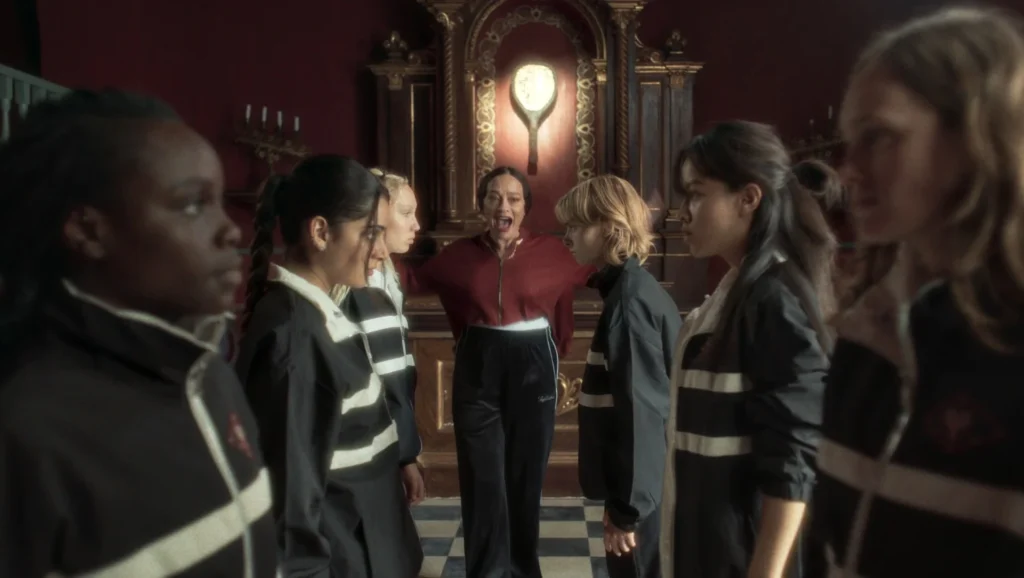
Given the actors’ actual tennis skills, the premise of Bloody Tennis would have been far more believable if the girls were competing for a tennis scholarship rather than a spot at the world's oldest and most prestigious tennis tournament, but this minor quibble is a mild distraction from the very real horror at the heart of the story.
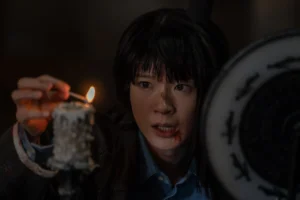
The Suspiria comparisons are inevitable, as the Mary Tyrone Tennis Academy operates not unlike the Tanz Akademie (aka the Markos Dance Academy), and shares a similar pacing. Mary acts with the cold authority of a cult leader while Coach Stavkos pushes the girls to punishing physical limits that often cross the line into straight-up abuse. And at every turn, the girls don’t just take the ritualistic conditioning — they welcome it.
I’ve spent years in therapy discussing my own warped relationship with the agony I put myself through in my younger years in pursuit of a gold medal, so when I watched these girls surrender themselves in an attempt to touch greatness, I couldn’t blame them for ignoring every obvious red flag. The machine of elite athleticism is designed to strip away individuality and rebuild each body according to an increasingly disturbing ideal.
The real-world history of women's elite athletics is full of uncomfortable examples of institutions putting performance above athletes' physical and psychological well-being. Gymnasts have been expected to compete through serious injuries; female athletes have spoken openly about eating disorders and extreme weight-control practices; and young competitors have endured coaching cultures in which humiliation, pain, and relentless conditioning were treated as necessary ingredients for success.
Tennis has its own history of players confronting extraordinary physical demands, from chronic injuries and overtraining to the relentless expectation that an athlete's body remain both a high-performance machine and an aesthetically pleasing object.

Not to mention the blatant racism and queerphobia on display, which Bloody Tennis does comment on from time to time. The most frightening thing about elite sports isn't necessarily the violence itself, but the way brutality can become normalized when everyone around you insists that it is necessary.

Sophie is the center of Bloody Tennis, but the other women— namely Bana (Tracy Gotoas)—are just as important because the film understands that elite competition breeds a complicated kind of solidarity: they compete with one another while also being trapped in the same system. Ambition can feel isolating, but surviving this world requires recognizing that everyone else is suffering too.
Tennis is a sport of immaculate surfaces and controlled movements, and the entire culture surrounding elite competition is obsessed with control. So naturally, Bloody Tennis wants to fucking destroy it, and that's where the film's witchy undertones become particularly effective. The academy begins to feel like a coven has taken the language of elite athletics and turned it into a religious practice, reinforced by the film’s Euro-horror and giallo visual language.
This movie understands that the body itself is the battleground, and the psychosexual sapphic urges that emerge as a result of a shared mutual fixation are a rite of passage. Bone cracking, blood, bodily fluids, animal violence, cannibalistic imagery, and some wonderfully disgusting practical effects turn the physical toll of athletic training into outright anatomical nightmare fuel, and these women are encouraged to sacrifice their bodies in pursuit of an ideal that may not even be attainable.
“Competitive athletics are bad, actually” is a tired, played-out criticism, and it fails to interrogate the logic that extraordinary achievement demands exploitation — especially for women. We desperately need more sports horror, but we need sports horror like Bloody Tennis that understands why athletics are already such a fruitful backdrop for horror.