Twin Peaks is a miracle that somehow made it to network TV. The celebrated series follows the creeping horror, searing dread, and soap opera-adjacent comedy underlying daily life in a Pacific Northwest town. It was a show that brought an unprecedented cinematic quality to the story of a community shaken by the murder of Laura Palmer.
“We told the truth about life as we understood it, and we did it in a way that appealed to the mythological need in all of us for stories that make sense of the world around us, not just to fill in between the commercials,” says Mark Frost, who created the series with acclaimed director David Lynch.
“This was the subversive idea that we tried to bring to television, and they were resistant. It made them anxious and at times furious. And ultimately, ABC couldn't wait to get us off the air. But we snuck in, and we wedged the door open, and I believe we opened the floodgates for everybody.”
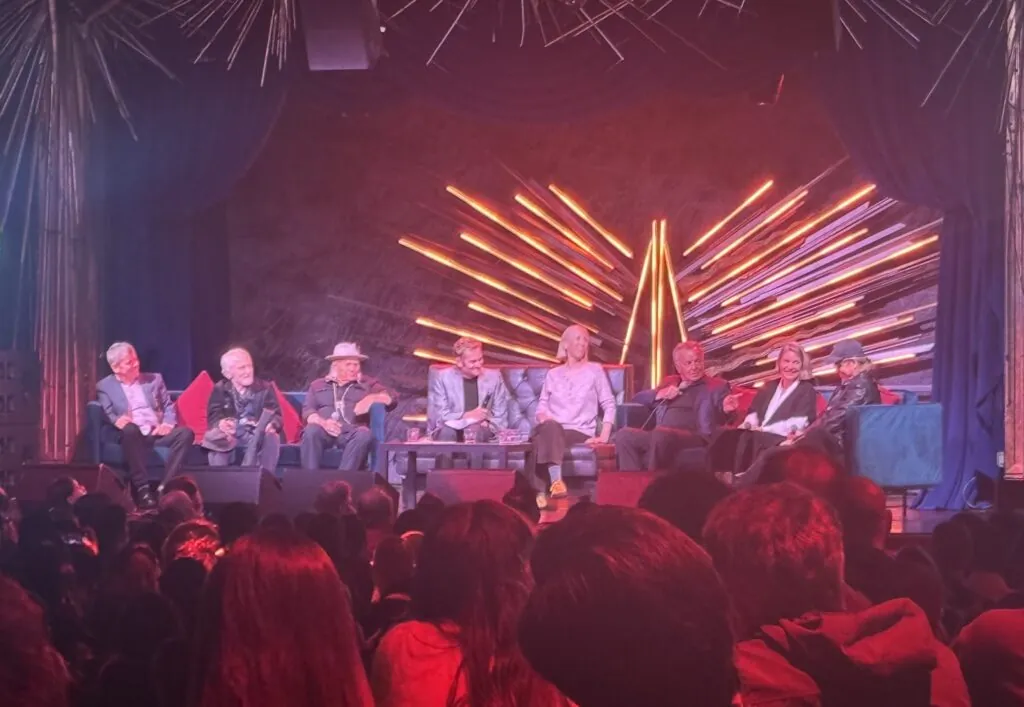
Frost and Lynch created a show that made television not just an event, but a reckoning—one that created space for other TV greats like The X-Files, The Sopranos, and Breaking Bad. Frost reflected on the influential series, which debuted in 1990, as well as the 2017 Showtime revival Twin Peaks: The Return at “Twin Peaks: Conversation with the Stars” in New York Sept. 21. The touring event, which features talks with cast members and creatives behind the show, launched last year in the wake of Lynch’s death.
Before he died, Lynch, 78, had planned to join fans remotely at the same events for the show’s 35th anniversary. Frost’s debut on the circuit alongside cast members like Sheryl Lee — Laura Palmer herself — and other Twin Peaks creatives brought another dimension to behind-the-scenes narratives.
Frost said the dark trajectory of the show, and the identity of Laura’s killer, was a natural evolution of the truth he and Lynch sought to illuminate. “When it finally came down to it, the story we were telling was the terrible, tragic, doomed Palmer family, and so it was kind of foretold that this is where it had to end up, and that's not a pleasant place to go, and neither of us particularly wanted to go there.”
The writer and producer traces a line directly from the murder of Laura Palmer and the horrors of Twin Peaks to what is happening in the United States and its government today. “This was a subject that America had neglected,” Frost said. He continued:
“Violence against women is an extraordinary epidemic, not just now but throughout history. Witness the current administration and its bellicose attitude towards vulnerable people of any kind, especially women, and you see how thin the veneer of civilization truly is on a surprisingly and disappointing number of people who walk around with us. So let's hope it's a reminder that there’s a way to be civilized humans and to have respectful relationships with each other, and now we have fairly abundant evidence in the last 10 years of how not to do that. So I hate to make this political, but in six weeks, why don't we express our feelings?”
Frost’s nod to midterm elections on November 3 came after he recalled how he and Lynch came up with Twin Peaks. The series concept bubbled up in the ’80s after Frost and Lynch wrote a script for a movie about Marilyn Monroe and the Kennedys that never got made. They’d have lunch nearly every day at Du-par’s in Studio City, Los Angeles. That’s where Lynch sketched a map for the unnamed town that would become Twin Peaks on the back of a restaurant placemat. They looked at the two mountains in the image and came up with the name.
Lynch and Frost envisioned a dead body found near water. Frost, who spent part of his childhood in upstate New York, remembered the 1908 unsolved murder of 20-year-old Hazel Drew in Sand Lake, New York. “I said, ‘Let’s kill the homecoming queen, and then whatever happens from there is gold,’” Frost said. They created up to 40 characters and detailed how they were interconnected. “Right in the middle was that poor dead girl by the side of the lake,” Frost said. “Everybody in some way was connected to her. She was the hub around which we populated the town.”
-
"We thought the network would freak out."

The cast and creatives of TWIN PEAKS: Conversations with the Stars. (Credit: Ben Jackson) Frost addressed what was perhaps the most important decision in Twin Peaks history: Figuring out the answer to “who killed Laura Palmer?”
It was a question that held just about everyone in suspense, from Queen Elizabeth II to Mikhail Gorbachev, the last president of the Soviet Union (who Frost once met in an elevator). Lynch and Frost didn’t want to reveal the killer, but pressure from ABC executives forced their hand.
“We considered everybody a suspect when we got to town,” said Frost, 72. Well, almost everyone.
“You never thought the Hawk did it, though,” said Michael Horse, who played Deputy Hawk in the show. A round of applause for the “least guilty man in Twin Peaks.”
(Attention, 35-year-old spoiler alert!) Ray Wise, who played Laura’s father Leland Palmer, was also at the New York event. He said he’ll never forget Lynch's big reveal.
“Ray, it’s you. It’s always been you,” he told the actor. Horrified to think he’d be his daughter’s killer — having his own 2-year-old daughter at the time — Wise actually considered refusing to do it. “Then I thought ‘Well, they’ll sue the hell out of me,’” he said.
Wise was only comforted by Lynch’s description of Leland’s death: his character would see a bright light, and Laura would be there, welcoming and forgiving him.
While it was “always” Leland, Frost said he and Lynch didn’t settle on Laura’s killer until not long before the series had to reveal it. That reveal came with the murder of Laura’s brunette cousin Maddy Ferguson, also played by Sheryl Lee. The murder, shown in gory detail in the second season of the show, shows Leland being inhabited by the killer Bob, played by Frank Silva. To safeguard the planned Leland scene, they filmed several versions, including one where Great Northern Hotel boss Ben Horne (Richard Beymer) is the killer.
“We didn't decide until we had to decide, so that we could live with the question for as long as possible,” Frost said. “I think it was that week. Actually, we finally made the decision, and we locked the door, and the two of us sat and looked at each other and said, ‘Are we going to be OK doing this?’ Because it was heavy. Nothing like this had ever been on American TV before, and we thought the network would freak out. That part actually made us happy. But it made the most sense, given where we had been. We kind of let the accumulated experience of having made the show up to that point tell us. And when we had that heart-to-heart, we said sadly, it has to be Leland. We didn't want to do it.”
“You didn’t want to say goodbye to me, did you?” Wise said.
“No, I’ve regretted it ever since,” Frost said.
“But you know what? It made beautiful sense,” the actor replied. “It did.”
Laura in the Red Room and Carrie on the road with Cooper.

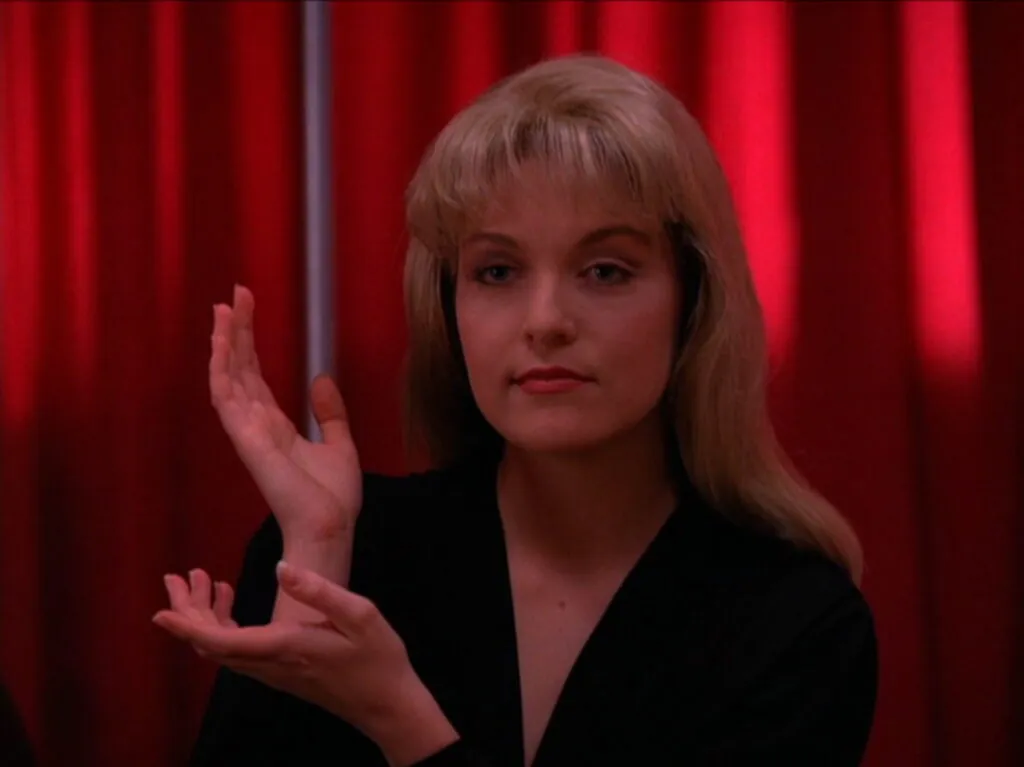
Sheryl Lee as Laura Palmer on TWIN PEAKS. (Credit: ABC) Recurring images from “Twin Peaks” make their own beautiful sense: the wind moving through the trees, sending traffic lights swaying in the night. The owls who are not what they seem. The warm glow of the Double R diner, with its “damn fine” coffee and cherry pie.
And, of course, the Red Room, home to characters who spoke backward, in reverse. Lee, who played Laura, remembered those scenes requiring special care.
“Any day that I knew I was going to enter into that Red Room, I knew that I had to sort of go through a different preparation creatively,” she said. “I mean, no matter what, when I was working with David, I had to set my mind aside. But even more so, working into the Red Room, because it's not just saying lines backwards, right? It's the whole through-line, the whole story, the emotional journey backward, and also just the unusual physicality and the sort of human, not-human.
“I always remember what I would do the day before is I would stand outside at night. I would wait until it was really, really dark, and I would just spend time outside at night in the quiet. And I felt that somehow that was the best way for me to sort of anchor into whatever was gonna happen, because I usually might even have a little bit of a script, but there were always surprises in there. So it just was kind of like a surrender. A total, total surrender.”
Lee also filmed the series’ final scenes as Carrie Page in The Return with Kyle MacLachlan’s Agent Dale Cooper. “Those types of scenes were some of my favorites because they were so spacious, and those were the scenes that felt like traveling through time and traveling through lifetimes,” she said.
Lynch directed all 18 episodes of The Return.
“The thing that David did, in my experience, was he could say a lot or he could say nothing but he could almost imbue you with this emotion. He could just look and if I could stay open and receptive, I could sense where he was kind of leading me,” Lee said. “And so, even in the moments where he would be specific, there was always this, just, opening to that feeling and that spaciousness and that freedom that he held that space for. But I loved doing that car scene because also it was the end of something, and I was aware. I didn't know the extent of the end, but I was aware of endings.”
For 25 years, the second season of Twin Peaks was the final season until The Return. ABC famously canceled the show after the second season, leaving fans to ponder over the stunning final episode from 1991 until the revival in 2017. Lynch’s 1992 prequel film Twin Peaks: Fire Walk With Me offered a devastating picture of Laura’s life before her death. But Agent Cooper's fate — trapped in the Red Room while his Bob-infested doppelganger ran amok — remained unknown.
In the first season finale, the FBI agent is shot in his hotel room by an unseen person. On set, that person was Frost. “There's actually an outtake somewhere floating around where it's revealed,” Frost said. He did the honors since (another slight 35-year-old spoiler) Joan Chen, who played Josie Packard, wasn’t there that day to shoot Cooper.
“I always wanted to shoot Kyle, and yeah, that was fun,” he said. At the time, the pilot had not aired yet.
“We had no idea whether we were going to be picked up or not,” Frost said. “So the notion of that episode was to create so many cliffhangers that they couldn't possibly not bring us back. The outrage would be so extraordinary that there would be pitchforks and torches … and it seemed to work.”
By season two, ABC executives “were immune to pitchforks and torches,” he said. Lynch had nicknames for many people he worked with in film and TV. MacLachlan, who starred in Lynch’s Dune and Blue Velvet before Twin Peaks, was “Kale.” Laura Dern, MacLachlan’s Blue Velvet co-star who played Diane in The Return, was “Tidbit.” Frost? “Mack.”
When it came time to seriously consider The Return, Mack and David hadn’t screened the original series finale in almost 25 years. In that episode, Laura and Agent Cooper are in the Red Room when she tells him, “I’ll see you again in 25 years.”
Frost said that watching the scene at Lynch’s home, the series creators “kind of nodded, and it was on.”
"Are we making this, or are we in it?"

Harry Goaz as Deputy Andy Brennan in TWIN PEAKS: THE RETURN (Credit: Credit: Suzanne Tenner/SHOWTIME) Cinematographer Peter Deming also joined Frost and the cast at the Twin Peaks event. He worked on The Return as well as the Lynch films Lost Highway and Mulholland Drive and ABC’s short-lived 1992 Lynch-Frost series On the Air.
Deming was one of the few people who actually got to read the full script for The Return, which was 600 pages at the time. It was presented in 18 parts for TV, but, “They wrote it like a big movie,” he said — a story that was almost impossible to read and digest in several sittings.
He remembered filming one particular scene where Lynch was dissatisfied with the set. It was the quintessential example of how Lynch worked — he had to have everything just right, and somehow, in the magic of the moment, they pulled it off.
“When you're working with David, pretty much every project, there's always a day or two you sort of look around at the rest of the crew and are like, ‘Are we making this, or are we in it?’” Deming said.
“We were in the old North Forest, north of Seattle … There was supposed to be a golden pond in the middle of the forest, and we got there, and David was very unhappy with the construction of said pond, and so he started sending people to the hardware store … Lunch came, and we had not shot a thing ‘cause David was doing it by himself. And so we came back from lunch, and we had now half a day to shoot a whole day. And the crew is just like, ‘What is going on?’”
Deming continued, “And we managed to do it, and I think the scene is really interesting because towards the end of the day we got this incredible light coming through this forest, and we're shooting so quickly that we were able to take advantage of that. We finished the day, we got everything, and you just were going in your car, like shaking your head, like, ‘What happened?’”
Sabrina S. Sutherland, executive producer of The Return, started as a production coordinator on the second season of Twin Peaks. “David would bring up always, ‘Hey, let's try this. I’m thinking, let's see if we can do this.’ Always experimenting, always wanting to add stuff to an already tight day of a lot of stuff,” she said. “But you did it, right? Everybody just would chip in and do it, and you did it.”
Sutherland remembered when Jake Wardle, who played the green-gloved Freddie Sykes, hit the camera and broke the lens during the final showdown with killer Bob, who appears in orb form in a crowded scene at the Twin Peaks sheriff’s office.
“That green glove was really powerful,” Frost said. So was the green forest.
“A lot of my Native filmmakers and painter friends of mine are big fans of Lynch’s work because, like us, he understood that the dream world is just as real as the awake world, and that the forest is a living entity,” Horse said. “It's a scientific fact that the forest communicates with itself and mycelium and the animals, and it will communicate with you if you listen… It was one of the main characters in all of Twin Peaks. That was one of the big draws of it.” He continued:
“I live in the forest now (in Minnesota), and I'm sitting looking out my window. And about a couple of weeks ago, I realized that the Log Lady (Margaret Lanterman, played by Catherine E. Coulson) was Mother Nature. She wasn't just a person with a piece of wood. She was all of nature, telling all of us as human beings, ‘You’d better straighten out, or things are going to come down on you.’”
Speaking of natural occurrences, Horse worked with MacLachlan and Michael Ontkean, who played Sheriff Harry S. Truman in the original series. “Ontkean was a vegetarian,” the actor recalled.
“He had some of the worst gas ever. He wouldn't even acknowledge it. So we're about ready to go into (Jacques Renault’s) cabin, and it's Ontkean and Kyle and me. He just lets it go. Kyle turns around; his eyes are watering … They went ‘action.’ When we went through that door, that's the look that you saw. That's a true story.”
A child of TV meets a singular vision.
David Patrick Kelly as Jerry Horne in TWIN PEAKS: THE RETURN. (Credit: SHOWTIME) The Twin Peaks fan event brought a surprise: David Patrick Kelly, who played Jerry Horne, the brother of Ben Horne in the original show and The Return. “It was the first time in an investigation show on television where you remember the name of the victim, and it's about the effect of one human life on a community,” he said.
Kelly provided half of the evening’s musical accompaniment, breaking out a Russian balalaika to strum and hum part of Angelo Badalamenti’s famous Twin Peaks theme after Wise sang the 1943 tune “Mairzy Doats” and “Getting to Know You” from The King and I in perfect Leland Palmer fashion.
Frost explained the origin of a newly white-haired Leland’s “Mairzy Doats” interlude, which had Ben and Jerry Horne dancing on the floor and a desk in Twin Peaks.
“My parents used to sing that song every freaking night,” he said. “It drove my brother and I crazy. They were both ’40s theater kids, and we would look at them like they had two heads. We said ‘what are they doing? There they go again.’ They would have a couple of highballs, and suddenly they're dancing and doing ‘mairzy doats’ and ‘dozy doats,’ and we would just flee the room. So this was my tribute to a forgotten era.”
Frost said Twin Peaks was possible because he and Lynch brought their respective backgrounds in TV and art to the show.
“I was more a child of television than David was,” Frost said. “My dad (Warren Frost, who played Doc Hayward on Twin Peaks had been the stage manager on Philco Playhouse, if anybody remembers what that was in the golden age of TV. I had been a child of (The Twilight Zone creator) Rod Serling and (Star Trek creator) Gene Roddenberry.”
“David had an intuitive, instinctive understanding of truth and art and life, that was the way he lived his life. That was what his life was dedicated to, and he had a singular kind of way of expressing himself that will never be replicated because he won't be replicated. And I think it was the marriage of these two disciplines that somehow created the alchemy that gave us what this was.”
More than a year after Lynch’s death, Frost remembered his creative partner through the potent legacy of Twin Peaks. “I was forever grateful for having known him and loved him like a brother, and this was what we came up with,” he said. “We hoped we would build something that would last. And I'm guessing that we're gettin’ pretty close to the point where that might’ve happened.”