Back in March, my youngest, Elephant*, caught a stomach bug. Stomach bugs, for those who neither have toddlers nor toddler-adjacent children, constitute the punishment of an entire circle of Hell all by themselves; your kid is sick, they can’t keep down food, and nonetheless, they will tell you, their parent, with agonizing sincerity, that they’re hungry.
You can do nothing. You are powerless. It sucks. The blessing, at least, is that stomach bugs tend to last about a day, maybe two, before they dissipate. Elephants lasted about a week, seasoned by the suggestion of remission before turning back on her double.
A memory of this incident is now crystallized in my brain forever. She was lying in my bed after eating tacos at dinner; then, without warning for either of us, she threw up all over the sheets, the floor, and the adorable oversized sweater I’d just bought for her. Unsurprisingly, she was in tears. As much from the pain and shock of vomiting as from the disappointment of dirtying her new sweater.
That made two of us. I wanted to cry. Parents tend not to enjoy seeing their little ones suffer. We don’t like feeling impotent, either, and there’s nothing quite like a virus to drive home the reality that we’re in control of exactly fuck all when it comes to what germs our kids shake hands with out in the big wide world.
It’s coming up on a year and a half since my mother passed away, but in the moment, with my hands in the air admitting abject defeat in the face of one of life’s dick moves, I found myself reaching for my phone, because if anyone, anybody, could have rescued Elephant and me right then and there, it would’ve been her. Bill Watterson knew what’s up: Moms know how to fix everything just right, whether they’re nurse practitioners, midwives, or both, or neither.
But as soon as the thought entered my mind, it left, and I snapped into action. I cleaned up Elephant. I put her in new clothes. I stripped the bed, fitted new sheets around the mattress and pillows, then blasted every single room in my apartment with a fucking cumulonimbus of cleaning sprays and vinegar solution. (Not to my avail. I’d already caught the bug from Elephant. Silver lining: I lost a few pounds in the deal.)
I can’t imagine Damian McCarthy had scenarios like these in mind when writing and filming Hokum, his latest feature, in which he bakes his neuroses into Irish folklore and storytelling traditions. The movie isn’t about the sudden gut-punch realization that our parents were winging it, and that adulthood is ultimately about coming to terms with how little our youth prepares us for real life. It’s about, chiefly but not only, skepticism as self-harm for an age where grifters insist on doing one’s own research at the expense of expert opinions.
Warning: Hokum spoilers below.
Ignore people who know better than you at your peril, or do yourself a favor, listen, and survive. But it’s also about a severely damaged man shaped by a life lived sans his mother’s influence, and what carrying guilt for 40 years does to a person’s disposition–not, in other words, a film in conversation with the mechanics of parenting.
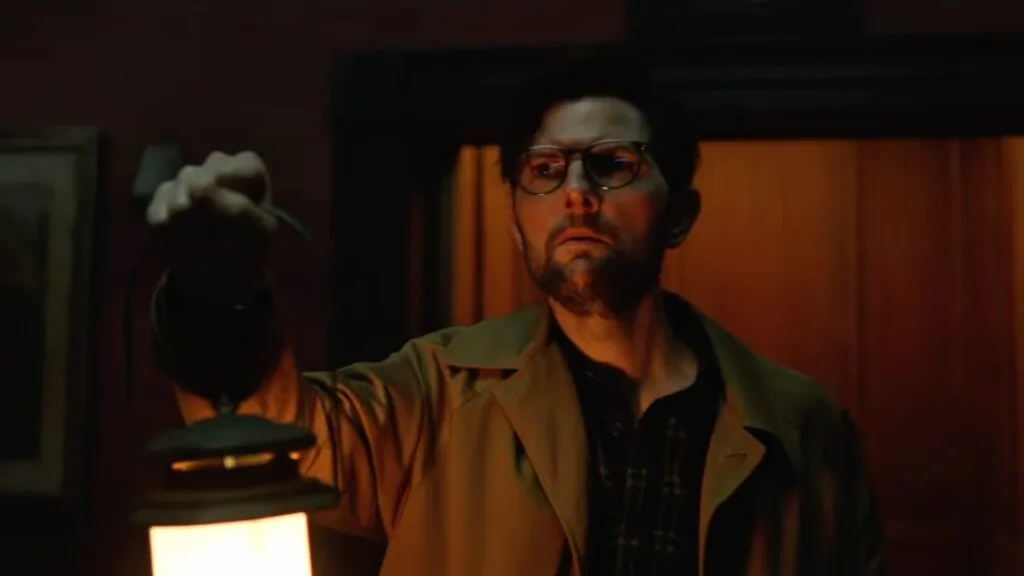
But Hokum, founded as it is on its lead’s relationship with his late mother, Delia (Mallory Adams), naturally provoked an emotional response from me as I continue to grapple with Mom’s death. Granted, I’m not Ohm Bauman (Adam Scott), McCarthy’s protagonist, a misanthropic asshole and famous novelist, who sojourns to Ireland to spread his parents’ ashes at the remote hotel where they once honeymooned, then manages to piss off the witch that dwells in its basement after making enemies out of the hotel’s staff.


Ohm spins a yarn to one of those staff members, Fiona (Florence Ordesh), about the day an anonymous stranger shot Delia dead before his eyes. But he lies by omission; the stranger, we learn in a second-act flashback, was Ohm, and the shooting a terrible accident. Rather than heed his parents’ warnings not to play with his dad’s pistol, he treated it like a curio. The gun went off unexpectedly, as guns are expected to do, and Delia paid for it with her life.
My guilt isn’t so extraordinary as Ohm’s; it’s the workaday kind everybody feels when a loved one passes. It’s normal to regret not having spent more time with your friends and family once they’re gone.
But regret and guilt are powerful forces, so innocent though I am in the matter of my mom’s death, I’ve wrestled with both emotions for the last 18 months all the same — not because of anything I did, but because of what I didn’t do.
I didn’t see her before she died. I had concepts of a plan to visit her bedside, sure, but boy, Death gives not even a solitary fuck about mortal plans, which rarely if ever jibe with his own. It’s for this reason that within Hokum, I found relief from my shame via Ohm’s supernatural ordeal.
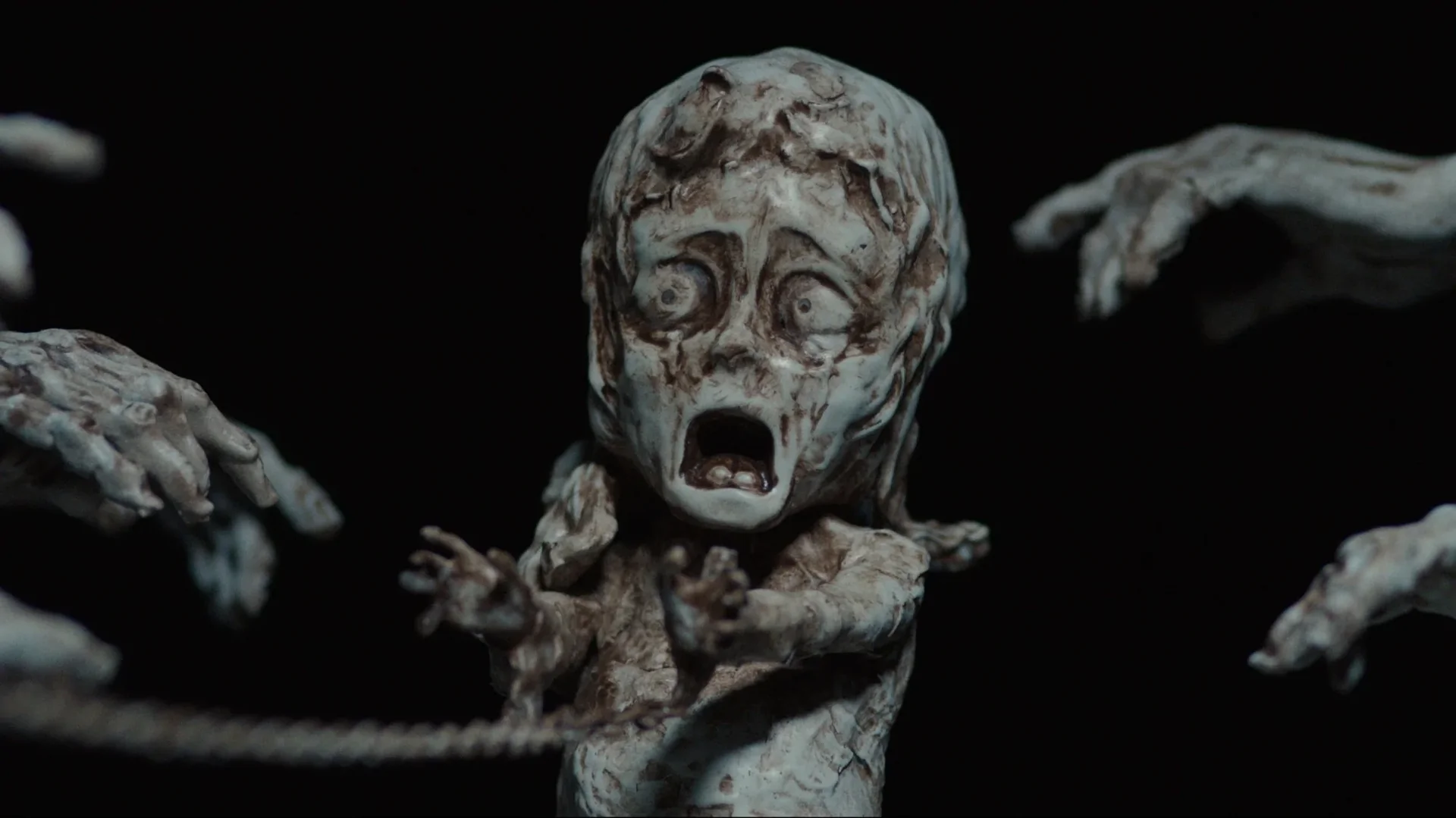
Paying off foreshadowing in the film’s early going, Ohm ends up chained in what passes as the story’s underworld in the climax; the leering, cackling witch he was warned about but didn’t care enough to believe in has him shackled, just after he’s come around on the idea that Ireland’s folk tales aren’t parables but field reports.
Not for the first time in the plot, he is visited by Delia’s ghost, frequently deployed by McCarthy for jump scares in his unsparing fashion. (The guy loves showing his audiences empty rooms as a sleight of hand, only for a figure to appear from thin air where none stood before mere seconds before.)
But there beneath the earth, in the hotel’s bowels, Delia appears to Ohm for mercy’s sake. She holds him. He cries. He apologizes and tells her that the gunshot was an accident. She, in turn accepts the apology. Suddenly, the darkness doesn’t seem so dark: Ohm is forgiven.
More than that, he’s lucky. Not a one of us who’ve buried the people who matter most to us ever gets the chance to say what went unsaid before their passing. In Hokum, that miracle happens not once, but twice.
Delia has her exchange with Ohm, and Fiona gives the final word on her own death as well. Partway through the film, Fiona goes missing; not long after, Ohm and Mal (Peter Coonan), the hotel’s oily manager, discover her body in the honeymoon suite’s dumbwaiter.
It’d be a mystery for certain had Fiona not kept Ohm’s tape recorder, which he left at the bar after having one too many whiskeys the night before Halloween, and used it to document her last hours alive.
She’d had an affair with Mal, resulting in her pregnancy. Mal, being a family man, couldn’t let word get out. Whether McCarthy meant to echo that motif in Hokum is a mystery, though given that it recurs in variations in his two other superb features, Caveat and Oddity, it’s a good bet he had an intention here.
That intention doesn’t extend to grief therapy for me, Andy Crump. Hokum isn’t a counseling session for the bereft. It’s a fucking haunted hotel film that, like all of his films, shares DNA with the work of his countrymen in the horror racket, but occupies a curated neighborhood in Irish genre cinema that’s wholly his own.
No one makes horror films like McCarthy’s. Impeccably made with an eye for composition, where we’re forced to examine every corner of the screen for the skeletons, spirits, and haunts lurking at its edges. Like Caveat and Oddity before it, Hokum is terrifying, and cuts its terror with screwy gallows humor that’s as fundamental to Irishness as localized hair-raisers.
Just about every town in Ireland has its very own campfire story about the banshee loitering in the disused farmhouse down the way, or the redcaps that claim the misty copse by the outskirts as their stomping ground.
But that thrumming sense of national identity, and that sweat-soaked dread, are a shell to coat Ohm’s guilt, and Ohm’s guilt is the trigger for mine. I wish I’d gone to see Mom at the hospital two days before, the day before she died. I wish I could have talked with her one last time, even if she wasn’t in a condition to respond.
I wish that when my girls are hurt or sick, I could call her for reassurance, to hear that I’m catastrophizing, even if that ultimately means all I can do is towel Elephant off, dress her in PJs, and comfort her. I wish that, like Ohm, I could have just one more minute with her now, to tell her I’m sorry I wasn’t at her bedside when I should’ve been. I’d do anything for such a gift. I’d even ride a rickety dumbwaiter all the way to Hell and back.
Hokum is in theaters now, you can find Oddity and Caveat streaming on Shudder.
*I probably don’t need to spell this out, but “Elephant” is not, in fact, her real name.