

Irish writer/director Damian McCarthy excels at creating a world of dread and fully immersing his audience in the mounting terror. McCarthy’s last film, Oddity, was my personal biggest surprise of 2024, and with Hokum, the director proves he is certainly one to watch. This marks the third feature from the writer/director, and while the stories are all original, certain themes remain prevalent across McCarthy’s work. So, do Caveat, Oddity, and Hokum exist within the same universe?
Yes, but don’t expect an Avengers-style multiverse crossover. “I do think they exist in the same universe, but I don't think you need to have seen one to enjoy the others,” McCarthy clarified.
The director noted his films contain “Just little nods. One movie references another, maybe in a small way. In Hokum, the couple checking into the hotel they're only seen for a moment. That's the couple from Caveat that end up killing each other. I like those actors. Just thought it'd be fun to come back and do that.”
But that’s not the only Easter egg astute fans of McCarthy’s work will find in Hokum. “The desk bell from Oddity pops up. It's just little nods to one film, kind of referencing another,” the director explained. “But I think when I get to the end of a script, it's trying to kill as many characters as possible so that there's no chance of a sequel. It's not hinting towards any kind of endgame or anything.”
This isn’t a spoiler, anyone who has seen any promotional material for Hokum will have noticed a monstrous rabbit-like creature. McCarthy fans will likely point out that this is not the director’s first use of rabbit-centric imagery in his horror films. So what exactly is the deal with the rabbits?
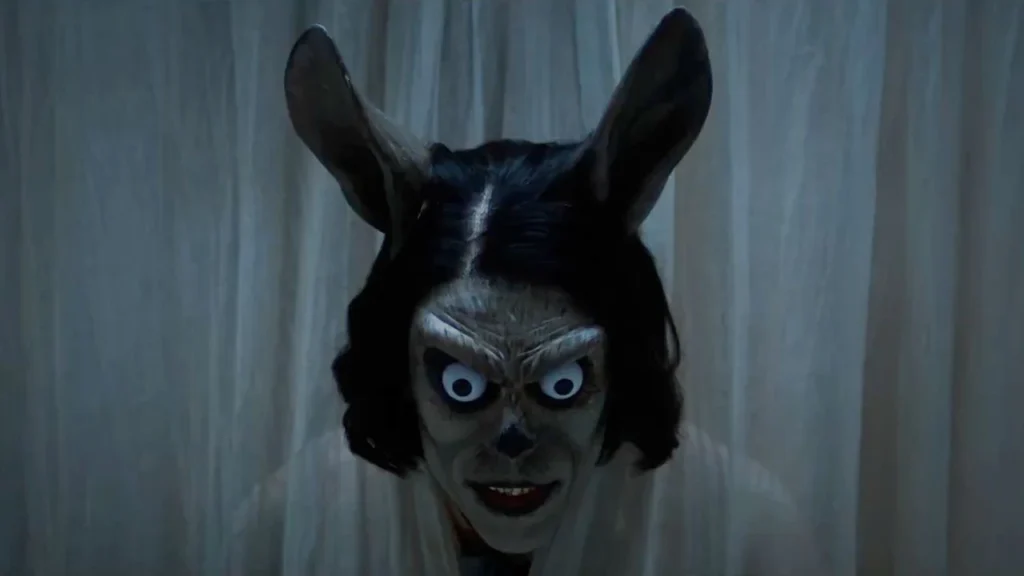
“It's probably just the image I find interesting, but I'm sure that began with childhood watching Watership Down, which frightened me as a child,” McCarthy shared. “And then as a film student, things like Donnie Darko, Sexy Beast, Harvey. I think that had this kind of rabbit as an image. Alice in Wonderland, all the versions of that, which always seemed to have a little bit of horror, shot through a horror lens in a way. Yeah. I think it just keeps coming back into the stories. I don't know why.”
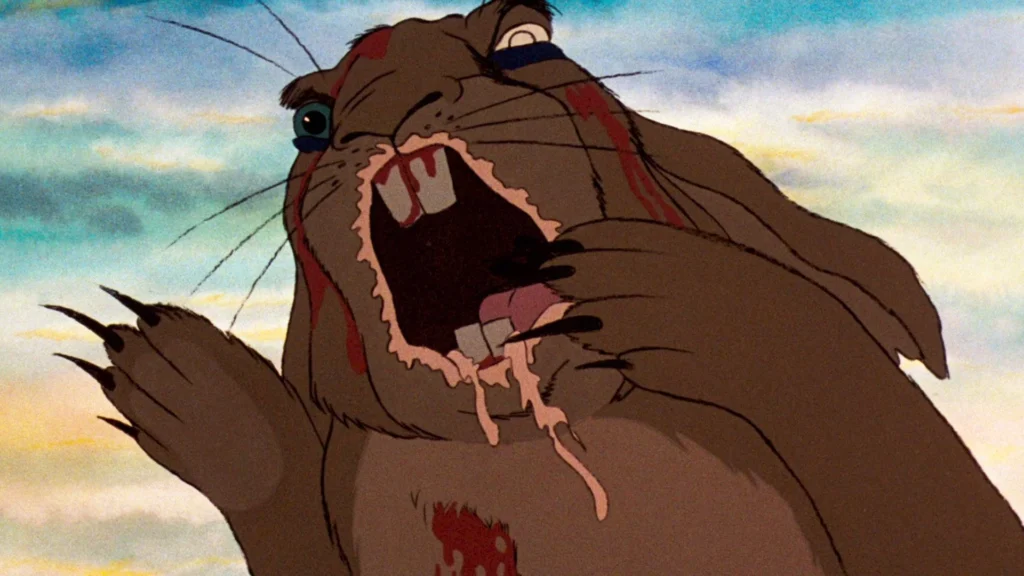
For those who were spared, Watership Down is a horrifying children’s movie that goes dark as hell (more on that here). McCarthy admitted, “I think that did some damage. That was the one.”
Hokum star Adam Scott spends most of the film trapped in this very creepy hotel and is understandably pretty horrified, while managing to bring nuance and layers to his performance as he navigates the different horrors he’s experiencing within its walls. Scott shared that a major help in leveling up the terror was having “the luxury of being able to shoot in order, for the most part.”
“Once we were sort of in the room, we had about three weeks where it was just me in the honeymoon suite, and we were able to shoot in order, so we were able to take these builds and go up to a certain peak and then go back down into investigation mode and then back up to these frightened moments. I was able to sort of map it out with Damian, so we weren't either repeating something, hitting a certain peak too early, or staying in one state for too long, because it was important that we feel the different levels of where the story's going.”
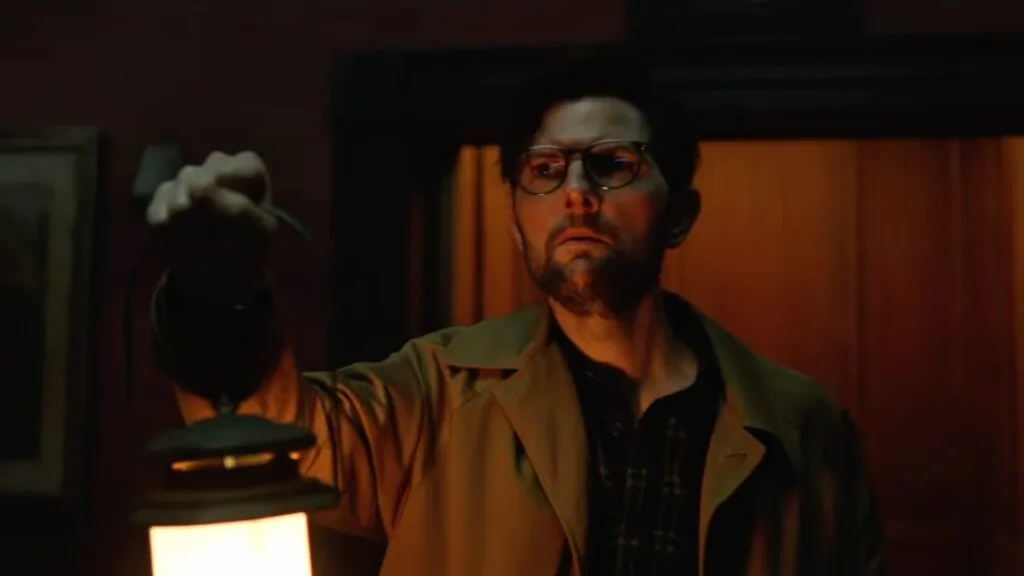
I love a clever horror movie character. It’s borderline offensive in this day and age to watch a character continuously make the absolute worst choices solely for the purpose of not writing the writer into a corner. Give me a clever character who can figure shit out, draw on their lived experiences, and apply them to the situation the way an actual human would. It’s as though McCarthy heard my plea. Scott’s character, Ohm, is an author. He’s not winning any congeniality contests, but he is one clever, resourceful guy, and I can appreciate that.
“That was one of the challenges with the script for sure, because with horror films, you do want the characters to make dumb decisions,” McCarthy explained. “It's like, ‘Oh, there's a noise over there. I'll go investigate it.’ I think even in Hokum, one of the challenges was that this character can just leave. He's left. He's in his car. He's about to get out of there. It's always trying to justify why he would stay. Why would he continue to get into a situation that's clearly going to get worse and worse? He's in a horror movie. That's the balance because it's still a horror film, and people want him to do bad things even though you're probably shouting at the screen. ‘Well, don't go up to the honeymoon suite. That's such a bad idea. Everybody's been telling you, ‘Don't,’ and up he goes. But it has to be earned and has to be kind of justified why it's happening.”
Ohm’s actions are very much justified in this case. He has a reason to stay, and to further add to the believability of his character, he never believes he’s in any real danger. “It's clear that he does not believe in any sort of hocus pocus,” McCarthy explained. “So he's going to go up and check to see if she's up there, but he can fall asleep on the bed because he's not afraid of a witch or a ghost or something. It's ridiculous, which I think is also key to him going up there and staying.”
Aside from horrifying rabbits, another running theme in McCarthy’s work is the blending of real-world, ripped-from-the-headlines type crime with supernatural elements. In McCarthy’s movies, man is always the worst monster, capable of murder and other terrible things. But these murderous humans exist against a backdrop of a world where the supernatural is very real.
When it comes to blending real-world crime with the supernatural, the director said, “It's just about trying to have that satisfying ending where somebody who's a cowardly character like Mal in this, he's such a bad guy, it would be more satisfying to see him punished. I try to do that with all my scripts, as opposed to just seeing our hero escape something supernatural. I like to have them both punish that bad guy, but also have the good guy get away if it's earned.”
A supernatural punishment for a very bad character is satisfying in ways our real-life justice system simply cannot compete with. Scott plays a very logical, skeptical, and grounded character in a world where supernatural elements may be at play. At least, everyone around him seems to think so.
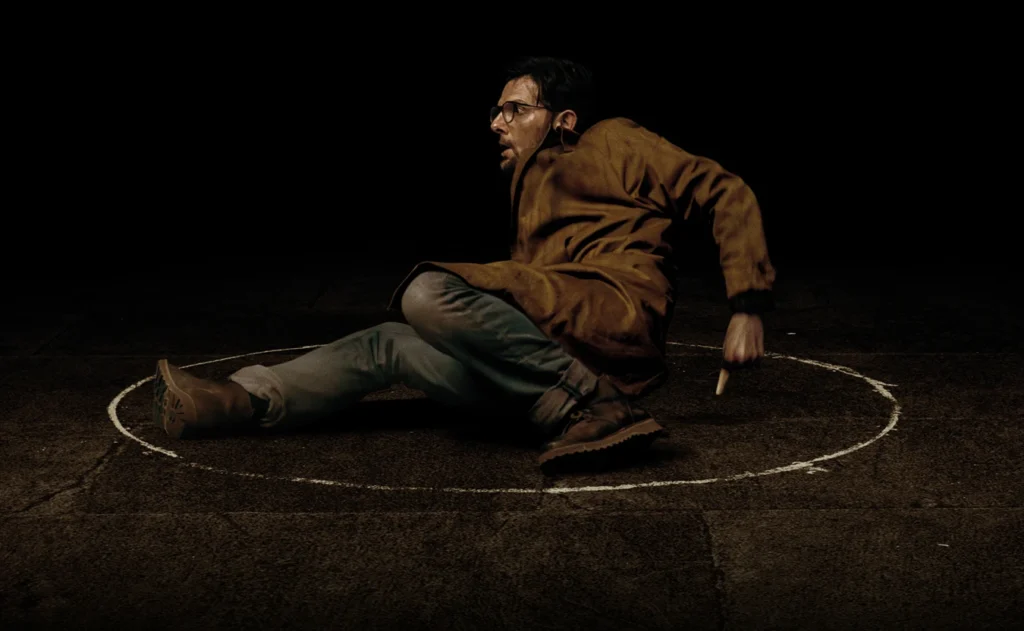
“The key to any great horror film is that there's a way in for the audience and that way in has to be that it feels like a real-world way in, that this is a reality that we can see and relate to,” Scott explained.
“Another key and another thing I loved about Damian's script was the levity, the fact that it has a sense of humor about it. One of the things I love about watching this movie with an audience is that everybody's having a good time, and there are laughs along the way. I remember when I saw Raiders of the Lost Ark for the first time, I got to a phone to call my mom. I was like eight years old, trying to explain to her what I just saw, and I remember saying, ‘It was so funny,’ and that is what kind of carried the audience through, and then all this other incredible stuff happened, but we were also really living and dying with the characters because they made us laugh.”
Scott is no stranger to making audiences laugh, though he’s done his fair share of horror as well. McCarthy has proven adept at striking fear into the hearts of audiences, two sides of the same coin. But what emotion does this duo find the most difficult and satisfying to elicit from an audience?
“I'm usually trying to chase nervous laughter more than an out-and-out laugh,” McCarthy shared. “You're kind of trying to let the audience know something's definitely about to happen. You just don't know when. I'm going to try to catch you. When they know that, they know what you're up to, and they start that nervous laughter. I think that's the best sound in the world.”
“I think the kind of comedy that comes through in the film is just to let the audience know that it's there to be entertained. When you get to work with somebody like Adam, who just has natural comedic chops, even though it's still being played very seriously, those snarky remarks, the way he would interact with other characters. All of that just kind of lends itself to a little bit of comedy anyway, and just tries to make it more entertaining.”
Scott’s snarky remarks are delivered with such sassy vitriol, and yet I couldn’t help but enjoy him as a character. “I'm so glad because when we're doing it, the fear is that the audience will just not be on board, no matter what, because he's such an asshole,” Scott shared. “But I think Damian wrote a character that is this way for a good reason. At least the door is a quarter open for the audience to kind of be invited in while he's behaving badly.”
When it comes to great films about writers and the writing process, McCarthy cites an all-time classic: “I guess the obvious one is The Shining. It's the isolated character going crazy. Although I guess the only thing with that, with the film version at least, is that he seems crazy from the start. He's already quite passive-aggressive and dying to get up to that mountain. It's a good character to have because writers, by their nature, do spend so much time in their heads, and there's a lot of isolation with that. It's a character that works well then in a story like this.”
Hokum is in theaters May 1.
