

On the front desk of the Proper Hotel in Austin, Texas sits a vintage service bell. Not your standard-issue chime, its yoke and hammer are uncommonly ornate. The staff tells me it’s two hundred years old, though its exact provenance is unknown. If you’ve seen Oddity, you’ll understand why I had to ding the bell. No ghosts appear, but Damian McCarthy does, gliding in at a brisk pace, making time for an interview between meetings with financiers about his next project. Hokum premiered three days prior and it’s been the talk of SXSW, enough to warrant a coveted Buzz Screening at week’s end.
His tense, moody debut feature Caveat (2021) was followed by his cult hit Oddity (2024). McCarthy’s new film, Hokum, starring Adam Scott, opens today in the US. Scott plays Ohm Bauman, an acerbic American author come to Ireland in hopes of finding closure for his difficult relationship with his late mom and dad. While staying at the inn where his parents honeymooned decades prior, one of the staff goes missing. As Bauman joins the search, he’s drawn deeper into the inn’s murky history, and the terrifying depths of its interior.
McCarthy sat with Fango to discuss Hokum, Irish horror cinema, and his stubbornly hands-on approach to filmmaking.

How do you feel about the response to Hokum on opening night?
It was amazing. I couldn't be happier with it because you do make these things in a little bit of a bubble, where you're working with your crew and your actors and your producers, and you have no idea how a film is going to be received at all. And certainly nobody ever sets out to make a bad film and everybody making a film is there with the best intentions. And by the time you finish it you think, Yeah, this is good, or maybe you have a feeling it's gonna work. But like every filmmaker who's ever shown their film for the first time and it plays well, there's a massive sense of relief. People are laughing and screaming and gasping at the right places. I feel very grateful it played as well as it did.
I caught Steven Spielberg’s SXSW keynote a few days ago. The moderator asked, At what point in the production of Jaws did you know the film was going to work? And Spielberg says he doesn’t know if a film works until it's in theaters and people watch it. The crowd responds or it doesn't. It sells tickets or it doesn't. If Spielberg doesn’t know… It's like William Goldman’s adage about what makes movies successful: nobody knows anything.
Yeah, I believe it. I made my first feature film Caveat on a tiny budget, and it took forever to get that film made just because I was doing so many jobs myself – editing and sound designing… By the time I got to the end of that movie, I was only finishing that film out of an obligation to the financers who'd given us a little bit of funding, and also because I do believe if you start something you should finish it. That's the only reason. I had lost all faith in that movie ever finding an audience, of ever even finding a distributor or being seen by anybody. It felt like I was finishing a home movie. But I don't think it's really a reflection of the film, only how I was feeling about the movie at the time, because it had been so difficult that it was hard to think anybody was going to like it. But it found an audience, and, of course, it led to me being here.
Was the crowd's reaction at the premiere instructive? Did you find people laughing or shrieking at places you weren't expecting?
I have this thing where if I can get through the first ten minutes of the movie, you get a really good sense if it's going to work or not. If your first few gags in the film land, you get a sense that people are settling into the movie. And then there's always surprises. There's always something that somebody finds funnier than I thought it would be. One of the characters might say something, and then you go, oh, people actually laughed at that a lot, that's great. Reactions to the death of a character or a shocking twist. You hope there's going to be some kind of audible reaction, something vocal that you can hear, whether it's a gasp or a shriek or something. That's always very surprising. It felt like every place we wanted to hear a reaction, we heard a reaction, so you can't ask for more of that.
We see in your shorts and features certain recurring motifs: creepy toys, rabbits, giant eyeballs, creepy toy rabbits with giant eyeballs, the portentous ringing or dinging of a bell, dilapidated homes and lodgings. The thread seems to be everyday objects and places that take on menacing dimensions or an ominous tone, or seem vaguely threatening simply by virtue of their anachronism. You've mentioned you’re a fan of antique shops.
Yeah. You see the stuff and you have no idea where it came from, all this old stuff. Like, was it mass produced at some stage? Is it really only one of a kind? This was probably somebody's prized possession at some stage. It's just all of these things, they were once loved and cherished, and what's the story behind them? You've absolutely no idea. All of this stuff is haunted. Maybe not in the literal sense, but it absolutely has history and story. I guess because I like spooky stuff and horror movies, I like to ask, What if there really is something attached to all of these items? And from a visual point of view, they just look very interesting. I like that pattern of editing where you can cut to these close-ups, inserting them into a scene that gives them a life and makes them a spectator, possibly an antagonist in some way related to whatever's happening in the scene. I guess it's just an odd taste I have.
There are a number of small, very creepy figurines in Hokum, in particular, some children with terrified expressions. Was Paul McDonnell the designer?
That’s all Paul. He made the wooden man in Oddity. I loved working with Paul. So, yeah, it was just a way to work with Paul again. As I was developing the script, and because we had a little bit more budget and we had those resources and because I knew Paul can do anything now, it just freed me up to write something. I have an idea what it looks like, and I can do my own little sketches, and then just start going back and forth to Paul, and he'll bring it home, he'll make something cool. Yeah, the haunted clock, the figurines and the diorama, all of those things play a big part in the storytelling and the visuals, and that's Paul.
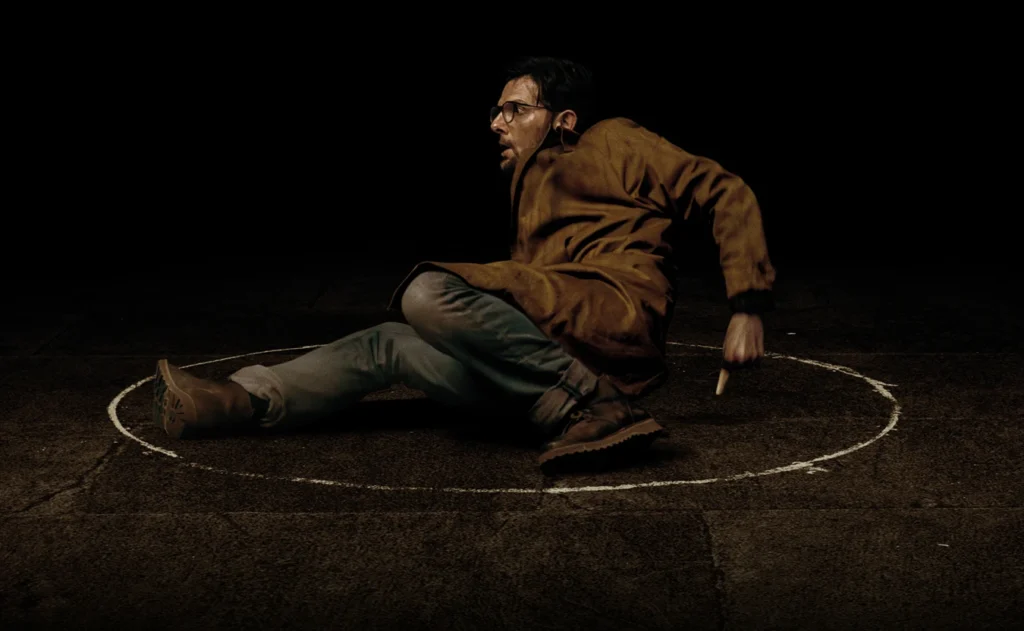
I noticed that your shorts don’t have dialogue. Most of them are black and white or very muted colors. Was that a storytelling exercise? Or are you also extracting some elements, like dialogue and color, to make other elements really pop?
There's probably a couple of reasons for it. As a younger filmmaker with absolutely no resources, none of those films had any kind of a budget apart from whatever few hundred euros I could put into them. They would mainly have been made with non-professional actors like friends or roommates at the time or somebody that just had an interesting look. I know that I can shape performance with an edit. All of those actors in the short films did great work, but for some of them, they had natural talent to be in front of the camera, but maybe no aspirations at all to be actors. It was me kind of shoving them in front of the camera and saying, I need somebody to be in there and you look cool. That's probably one of the reasons to take out all the dialogue. The other reason was just to see if I could tell a story silently because that's what film should be – trying to work without dialogue to see if I can tell this thing strictly with image. It would also help the films to travel. I've been to so many other European countries, where those films have traveled great and they've been very popular. There's no language barrier with the shorts, and that was quite important. It absolutely helped me in my career because the short films… I don't know if they open a door, but they certainly unlock it. And muting the colors, even going to black and white, hides the fact that you have no budget. “He Dies at the End” – my first short film that worked (I’d made lots before that, but they were terrible movies) – was shot in color and it just looked so cheap, it looked terrible. But as soon as I flicked it to black and white, I was like, oh, this hides everything. This is hiding all of our sins, and now it looks a little bit more professional. One of my friends from college, Seamus Hegarty, shot it, and he's a very talented guy. It was just our limitations of having no art director or production designer. I was all of those roles, and it was pretty much just decorating the guy's desk. Yeah, it's a good one for no-budget filming. Switch things to black and white and suddenly it just takes on a more artistic look, you know?
It sure does. Your shorts can be seen as exercises in building and sustaining suspense that takes the viewer off guard, leaving them completely vulnerable to a jump scare with a grotesque image. Who do you look to as your cinematic mentor for suspense?
It's the Mount Rushmore of horror movies: John Carpenter, Sam Raimi, Wes Craven. It's Steven Spielberg, obviously, with Jaws. Those old masters would be my guys, the way they craft their jump scares, their buildup of suspense. I still study that stuff.
If you've got a couple of hours free, what's the first film you're most likely to put on to rewatch, that you still learn from?
I don't think a month has gone by in fifteen or twenty years where I haven't watched The Thing. It's just always on. I have it on Blu-ray, but then I bought it on YouTube so wherever I go, it’s on my phone. I just love that movie. And They Live. I'm really bad for just rewatching a film again and again. And if I haven't seen a film in a while, and I put it on, I'll rediscover it, and suddenly it's my new obsession again. I've recently rediscovered Kubrick's The Killing. And in the week that I watched it, I watched it, like, two or three more times. And I try to watch as much new stuff as I can, but I'd be crazy when it comes to rewatching movies obsessively, trying to find new things in them.
You have a knack for putting characters in a position where they have to open a door, where they have to put their hand through the hole in the wall. And they do, and it's terrifying, and audiences completely go along with it. But you give characters sufficient motivation to do so. For example, in Caveat, the only way the man's going to escape is by grabbing a key through a hole in the wall.
It's such a cheap gag. It's just like, uh, clearly don't put your hand in that hole. Of course, don't go down to the basement. Horror films work because it's people making bad decisions and, yeah, it's just the fun of it. It's like, Oh, for God's sake, don't do that. But, also, absolutely do that. I want you to do that, that silly thing, because that's the fun of it.
Caveat, as you mentioned, was made on a shoestring budget. I imagine your budgets for Oddity and now Hokum have been incrementally and significantly larger, and I'm sure that money enables a lot of things, but does it also come with different kinds of challenges, maybe even constraints?
My approach is exactly the same. My preparation for Hokum is no different than my preparation for Caveat. I still storyboard every single shot in the film. I never get complacent or lazy, like – oh, now I've got a bigger team, amazing people surrounding me with loads more experience than I have. No, my process is absolutely the same, and I never want that to change. I'd be too anxious anyway to show up and not know where to put the camera or not have thought it through. Being here at SXSW, one of the interesting things has been that, when Caveat was being made, maybe a handful of people would have heard of anything I’d done – film festival goers or maybe some people that saw one of my shorts. There was zero pressure or expectation on it. Then with Oddity there was a little bit of a cult following from Caveat. They were curious: Oh, I saw that movie. I wonder what he did with a little bit of a bigger budget. I'm always shocked that people have seen anything I've done. But when [SXSW festival programmer] Peter Hall introduced Hokum, he said, Oh, Damian was here two years ago with Oddity, and I was surprised it got such a loud cheer and applause. And even being around here I’m meeting so many random people saying, Oh, I saw Oddity and I loved it. So if it comes with any kind of pressure, it's just the fact that you don't want to disappoint people. It's the first time I've actually made something where there is anticipation. And that's because of the amazing producers we have, and, of course, it's Adam Scott. There's so many eyes on it now. Not that it's pressure, it's fantastic, but still, it's a weird feeling. But what filmmaker doesn't have that? They hope their film doesn't disappoint people.
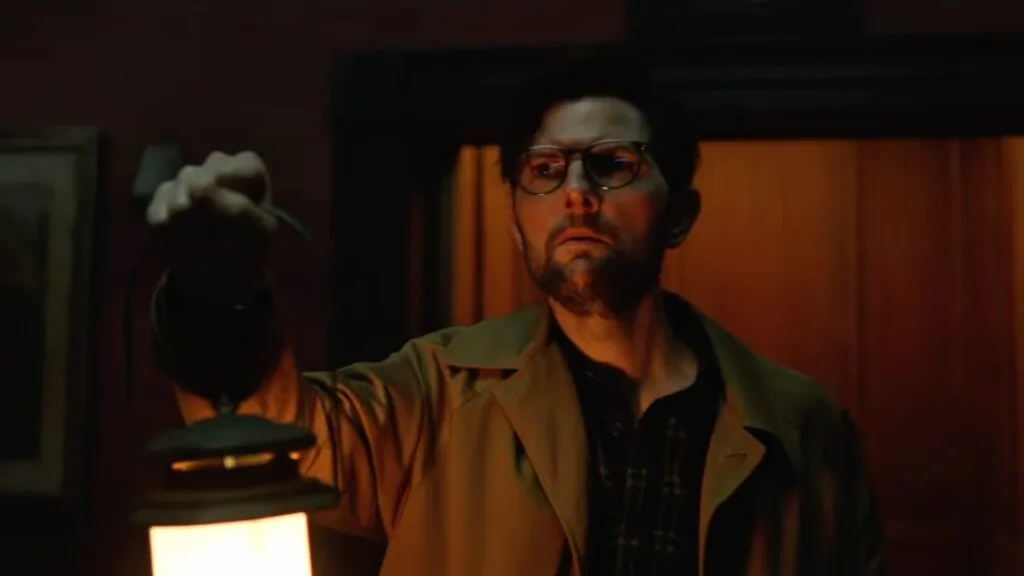
Adam Scott, of course, is no stranger to horror. He was in Krampus and The Monkey. He's even in a Hellraiser film. How did Adam get interested in your project?
My agents had gotten the script to Adam, and, obviously, I'm a fan of Adam’s, like everybody. He's such a wonderful actor, and just a really nice guy on top of it. He’s a big film fan as well, and a music fan, and all the stuff all of us like to talk about. So they had gotten him the script, and he liked the script, and he'd seen Oddity, and he liked Oddity. And I got the chance to talk to him. But I had no idea that he would do this. I mean, he was in Severance, and he was doing all this great stuff. And I thought, oh, he wants, for whatever reason, just to meet up. But I never for a second thought he would do the film. Even though I was at home talking to my girlfriend, and to my agency, saying he'd be really good, because the character is somewhat unlikable, but you're still kind of on his side and Adam's good at that. His characters can be a bit rogue, and you're still really on his side. So I thought he'd be great. But he has told the story as well that he was interested in doing [Hokum], but he thought that I thought he was wrong for it, which was never the case. So we both wanted to work together, but I was reluctant to say to him straight out, I would really like you to do this, would you be interested? I think we even finished the call with me saying, Well, if you ever want to come to Ireland to make a movie, I'm writing all the time, and he was like, Yeah, that would be great. And then we ended the call and it was only afterwards we actually realized we wanted to work together. But again, that's my own lack of confidence.
Your sound design is meticulous. In your films, it's not just accentuation for visuals, it really is a band of storytelling. Adam Scott's character is named Ohm, an uncommon first name, at least in the States. And in this old inn, we keep hearing the sound of wind groaning through the eaves and the crawlspaces, or maybe it's a ghost, because at one point it sounds a lot like it's crying Ooooohm.
Yeah. The sound by Steve Fanagan, with Joseph Bishara’s score, is extremely layered. There are voices and an incredible amount of stuff going on inside there for people to hopefully hear – maybe not up front, but certainly on some level they're hearing it. At least they think they heard it, which is what we hoped for.
You take one particularly big swing in Hokum, and it's the framing scenes. They're set in a wholly unexpected locale, with characters we don't anticipate seeing in a film set in contemporary Ireland. But they perfectly depict Bauman’s inner demons.
Damian: It was always the idea. It's almost like, instead of wearing my writer’s hat – even though those bookends are exactly what the character, a writer, is trying to express himself – the opening and close of the movie feel very much like something that interests me when my director’s hat is on. It's an interesting way to convey what's going on inside him visually. And the character's alcoholism, and the way he talks about his father, and the fact that the [framing scenes’ protagonist] is played by Austin Emilio, who is American? All of that is intentional. He's clearly writing about his relationship with his father and they're trying to break the bottle, which is the alcoholism. It is taking a swing, and I'm sure some people will really like that, and some people will go, I would rather you stayed completely within the confines of the story. For me, it would have felt like a missed opportunity because Bauman’s a writer. Whatever he's writing, you have to show that, and why not show it in a beautiful, interesting way? I hope people get something out of that. That one in particular feels like something that's going to be rewarded on repeat viewings. If you look at what he's writing on the screen at the start, if you're paying attention, it's right there. It's there in soft focus, but it's legible. You would just hope that every film you make isn't consumed in one sitting, that viewers can come back and dive in for a bit more. Like the way we're talking about other films that we always revisit to see, Oh, there's something else in this that I hadn't picked up on before. Don't want to just make a film where it's watch it once, never return to it, done. Of course, if people watch it, find it entertaining and they're satisfied with it, great. But you always try to put the work in so people will come back and get something a second time.
I think about the incredible horror films and fiction coming out of Argentina in the last decade or so. Demian Rugna's films Terrified and When Evil Lurks. Books from authors like Mariana Enriquez and Agustina Bazterrica. They all grew up during Argentina's Dirty War, a period of government corruption and brutal repression from 1976 to 1983. I wonder if the same dynamic is at work with Irish horror creators who grew up during The Troubles, from the 1960s up to 1998. Names that come to mind include Lee Cronin, Liam Gavin, Ivan Kavanaugh, and yourself. Ireland has given us some of the most compelling horror films of the last 15 years. Do you think there's anything to that?
I do. A lot of Irish cinema I would have grown up watching – because there weren’t many films being made – would have been looking at our history, trying to deal with the country's trauma through film, through those stories. I've spoken to actors and to other filmmakers about this. There has been something changing – not that we’ve resolved those things or put it past us – but that maybe my generation of filmmakers are starting to tell stories that aren't trying to deal with any of those types of issues, and, like American cinema, are just trying to make movies, just trying to make stories that interest us.
Who are the rising directors in Ireland we should keep an eye on?
They're all pretty much established at this stage. Lee Cronin, obviously. Kate Dolan. Lorcan Finnegan made my favorite film of the last few years, Vivarium. Ciarán Foy is making really good stuff.
That's exciting. Oddity had a very limited theatrical release in the US. How are you feeling about Hokum’s much broader release?
Neon are putting the film out. They're excellent to work with. I find their marketing and their whole release, and just the people in that company, are a pleasure, full of great ideas, imagination, and all the stuff you want, just as a film fan. And, of course, more importantly as a filmmaker because they're your guys that are releasing it. I feel in very safe hands.
