
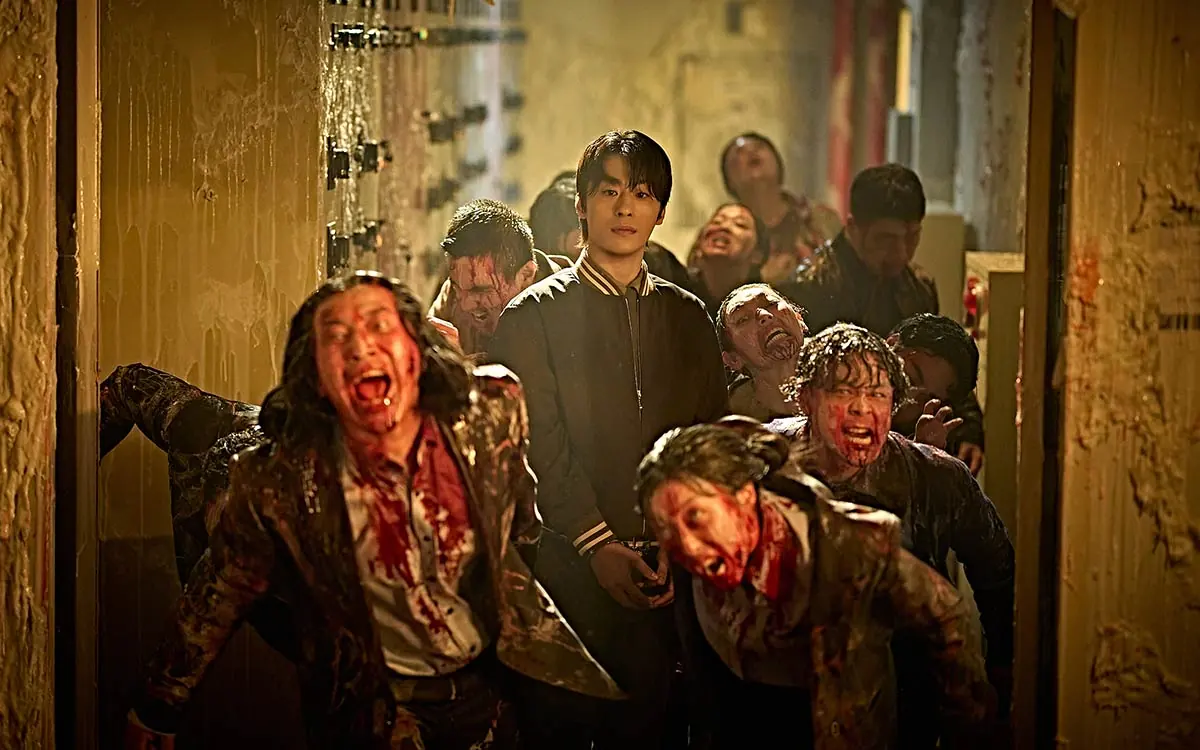
When it comes to horror's most ubiquitous creepy characters, zombies are up there with vampires and werewolves as a staple of the genre since time immemorial, so much so that it's getting harder and harder to keep the rotters fresh. Back in 2016, Yeon Sang-ho managed to do just that with Train to Busan, the high-speed thrill ride that delivered horror and heartbreak in equal measure. Now, Yeon is back with Colony, which could well be the defining zombie movie of the brain rot era.
Starring My Sassy Girl’s Gianna Jun (in her first film role in a decade), Colony centers on survivors trapped in a Seoul high rise as a viral outbreak rages, one that turns people into part of an ever-involving infected hive mind that might be closer to humanity than we'd care to admit. Ahead of Colony‘s release in theaters on August 28 via Well Go USA, FANGORIA sat down with Yeon and interpreter Elena C. to talk about the goop, gore, and the germaneness of the genre he keeps coming back to.
“Ever since the zombie genre’s father George A. Romero made Night of the Living Dead, the genre has been optimized to visualize onscreen the feelings and hidden fears of people at that given time,” Yeon explains when asked what it is about zombies he finds so compelling. “Times change, but we still all have our own fears in contemporary society, and the zombie genre remains a fresh way to express that.”
When it comes to contemporary fears, few pose as much of a threat to those of us with functional frontal lobes as the continued and ever-increasing influence of the Internet over politics, culture, and society, with one particularly dangerous offshoot of the world wide web continually making headlines for all the wrong reasons.
“After I finished Season 2 of [Netflix dark fantasy series] Hellbound with my co-writer Choi Gyu-seok, we started discussing the danger of collective thinking in our modern society,” Yeon tells us regarding the influences behind Colony, ” We also discussed the rapid development of information exchange through social networking and AI, which is developing at breakneck speed.”
Sure enough, Colony doesn't exactly shy away from hinting at a connection between AI users and mindless slathering beasts, particularly evident at the onset of their evolution when the zombies are unable to tell the difference between human beings and cardboard stand-ins. As Yeon puts it: “AI started by mimicking and imitating what humans do; now, it’s gone in a weird direction.”
Like much of the post-28 Days Later cohort of zombie movies (including Train to Busan itself) Colony depicts its infected with breakneck brutality rather than slow, Romero-style shufflers. Nailing the physicality was key for Yeon, who contacted many modern dance troupes and asked them to create “something different, something avant garde”. In our previous interview in the latest issue of FANGORIA, Yeon recalls instructing the actors to “move like ten distinct fingers playing the piano”, highlighting their individuality as beings despite all working together as a single organism towards the same goal of assimilation.
Yeon's background in animation, not only as a director, but as a fan too, is a clear influence on the frenetic, dynamic action sequences brought to life by Colony‘s zombies. “Before making animations, I watched so many animations, especially the dark, cyberpunk Japanimation of the '90s,” he explains. “Watching these served as my formative years as a creator, and that affects how I make my films. The animation in those films has a lot of live-action style elements, and so they served as the root of my filmmaking.”
It's been ten years since the release of Train to Busan (yes, you're old), with Colony‘s themes reflecting a shift away from the desperate plea for unity that makes up the emotional heart of the former, and more towards the uncomfortable suggestion that we may all be now far too connected. In Yeon's words: “Train to Busan depicted what Korea was like at that time. Colony, therefore, represents Korea’s present.”
Reflecting on the film a decade later, Yeon wonders, as many creatives do, how different it would look with a few more stacks of cash behind it. “Train to Busan was advertised as a blockbuster,” he reminds, “but we actually only had a medium budget. Throughout the process, there was not enough money, so we had to come up with a lot of creative ideas and solutions. Cinematic aesthetics can be created through insufficiency in production, budget, and materials.”
As for the reported English-language Train to Busan remake? Yeon stresses that he's not involved in the project. He does, however, note that his film's lead character, emotionally absent father Seok-woo (Gong Yoo) shares striking similarities with Tom Cruise's deadbeat dad in Spielberg's War of the Worlds. Could Cruise be on the call sheet for the upcoming Last Train to New York? He's no stranger to hanging off the back of a locomotive, after all.
Catch Colony exclusively in theaters on August 28.