
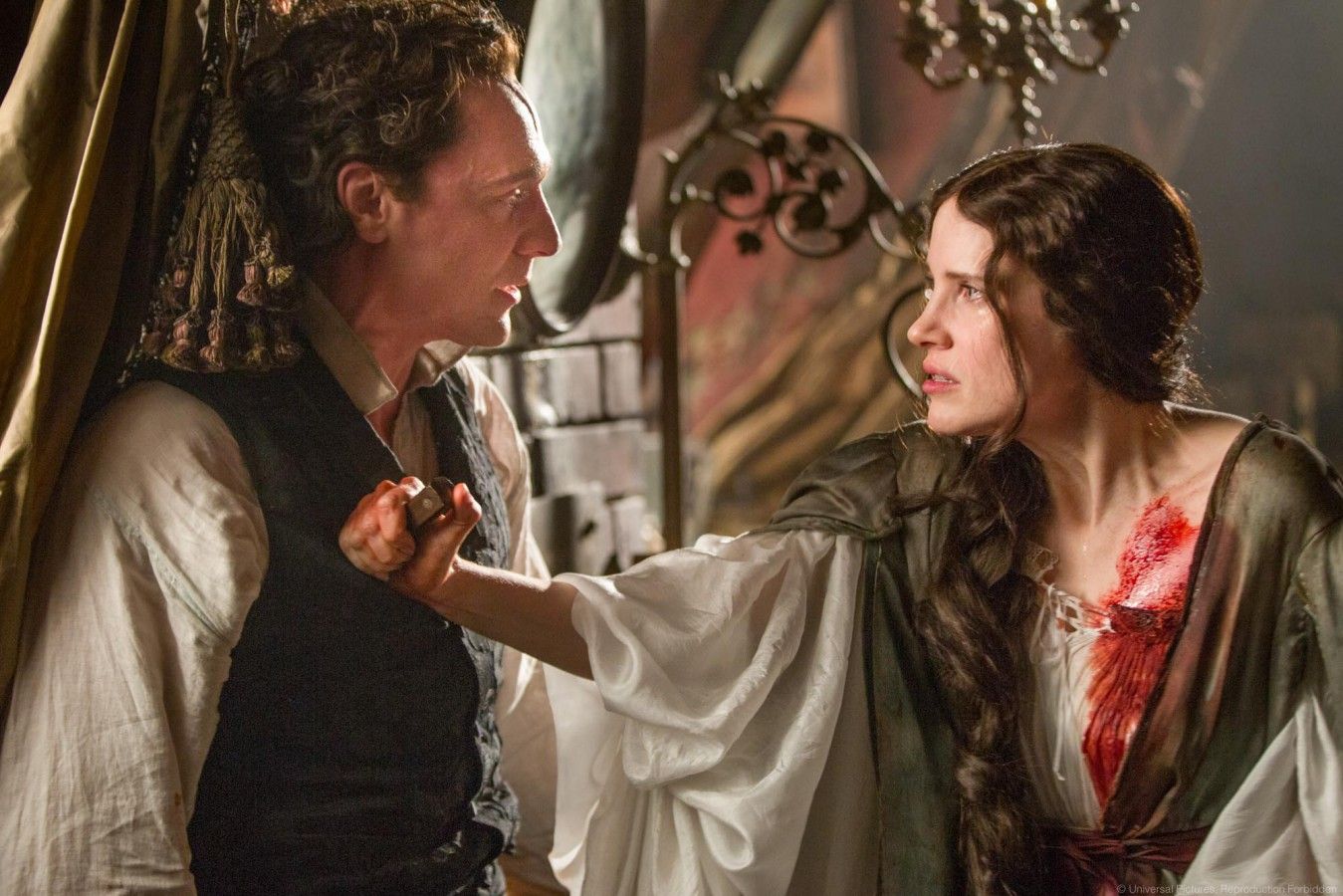
Last Updated on March 16, 2024 by Lea Anderson
If there is any truth human beings can collectively agree upon, it’s the inextricable relationship between romance and horror. Or, as Georges Bataille writes in Literature and Evil, “love seems to be the truth of death, just as death is the truth of love.” Diverge as we might in the how and the why of it all, what life inevitably teaches us is that love, romance, desire, fulfillment- their seeking and their loss- are tensions that always rub up against longing, grief, hunger, terror; those core themes that make up the lifeblood of the horror genre. As such, romance and horror essentially co-create each other and for this reason, fluidity has and will always exist between these genres and modalities in storytelling, just as it is in life.
My favorite episode of Sex and the City has always been “The Freak Show,” which sees Carrie preoccupied with the ever-relevant question, “are all men freaks?” Concerned with the petty and not-so-petty horrors of dating, the episode explores the dis-ease and vulnerability of being exposed to and discovering the undesirable in someone you hope to desire, and worse, having them discover the undesirable in you. At the end of the episode, Carrie tears her Fling Of The Week’s apartment apart in a manic quest for evidence of “something freaky,” only to be confronted with the freak in herself: “the frightening woman whose fear ate her sanity.”
Rarely is the series so honest about the fallibility of its narrator, and though this particular iteration of “freakiness”- fear eating one’s sanity, self-sabotage- is presented with a levity that makes relating to it feel safe to viewers, it’s actually the movement that tends to precede most occasions of real-life horror.
Romance is the magic ingredient that activates the potion from which the monstrous emerges. It inspires monstrosity. Justifies it. Spins gore into gold. Our oldest and most enduring works- particularly those canonical to the West- are stories about heroes and the monsters they must slay in order to win their Beloved’s affection, constructed to be synonymous with redemption. While we may be quick to assume the Beloved as a damsel or princess, it can also be (and signify) a family, tribe, nation-state, or god.
Consider Ovid’s Metamorphoses, Beowulf, Dante’s Inferno, “Troylus and Zellandine” from Le Roman de Perceforest, many of Shakespeare’s most famous works (The Tempest, The Taming of the Shrew), Charles Perrault’s Histoires ou contes du temps passé, and Grimm’s Fairy Tales, all of which see romance tip into horror, and all of which have been modernized and mass (re)produced by the film industry in the twentieth and twenty-first centuries. So prevalent are the narrative movements in these stories that they’ve birthed entire subgenres. What is The Invisible Man (2020) if not a contemporary rendition of “Bluebeard”?
What we romanticize determines what we imbue with power: how we create the desirable and, simultaneously, the undesirable. But further, it’s how we determine care. How we legitimize (or delegitimize) violence. Consider Helen of Troy, whose mythic beauty was said to have given rise to the Trojan War. Or Harriet Beecher Stowe, whose nineteenth-century novel, Uncle Tom’s Cabin offered a romanticized reimagining of race relations in America that once led Abraham Lincoln to credit her with starting the Civil War.
It’s precisely because a romantic lens perceives the world (or at least a person, a place, a time) through rose-colored glasses that the Gothic emerges out of and alongside it. In Darkly: Black History and America’s Gothic Soul, Leila Taylor describes the Gothic as “a necrotic romanticism”; not just horror, but the specific horror produced by sentimentality, by nostalgia, and their adjacent resistance to reason. The Gothic heroines of the eighteenth and nineteenth centuries- arguably the prototype for the Final Girls of the ’70s and ‘80s- all demonstrate an initial idealization of the world born primarily of their race and class status (these characters are almost always white and wealthy) that then comes into conflict when said class status is threatened, typically by their husbands and other male relatives.
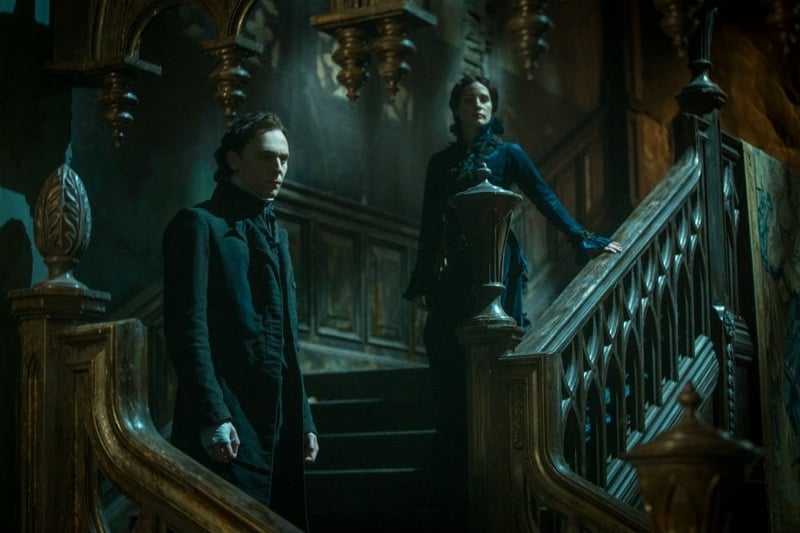
Guillermo del Toro pays homage to such stories (like Wilkie Collins’ The Woman In White) with his 2015 ode to Gothic romance, Crimson Peak, which locates the horror of romance exactly where it lives: at the intersections of the personal and political. If “the monster polices the borders of the possible,” as Jeffrey Jerome Cohen theorizes, this includes the constitutional borders of the romantic and desirable.
Following the sudden death of her wealthy father, Edith (an American) is whisked away to England by handsome suitor Thomas Sharpe and his overbearing sister, Lucille. Upon their return to the family’s decaying manor, ghastly secrets are unveiled. The film encapsulates the most essential themes and aesthetics of the British Gothic: menacing ghosts, a haunted estate, the tensions of lost and threatened wealth, nostalgia for the past, and of course, incest. As Lucille says of her and her brother’s relationship, “it is a monstrous love and it makes monsters of us all.”
As is always the case in del Toro’s work, the obvious monsters are rarely the story’s most frightening entities. Lucille’s monstrousness stems from the trespass of her role within the family structure as she collapses the boundaries between sibling, mother, father, and wife, while compelling Thomas to perform the roles of child and husband. She has so thoroughly embraced these prescriptive roles that she herself becomes a threat to the system’s very survival.
That Lucille’s love for her family transgresses the limits of acceptable relations is what makes her a monster in the body of the text. In turn, the film and the storytelling tradition it’s a part of using these characters to illustrate the inevitable consequences of puritanical devotion to in-group homogeneity. “If only we could all escape from this house of incest,” Anais Nin laments, “where we only love ourselves in the other.” For what is the pathologizing and rejection of difference, of transformation, but a commitment to incest and decay?
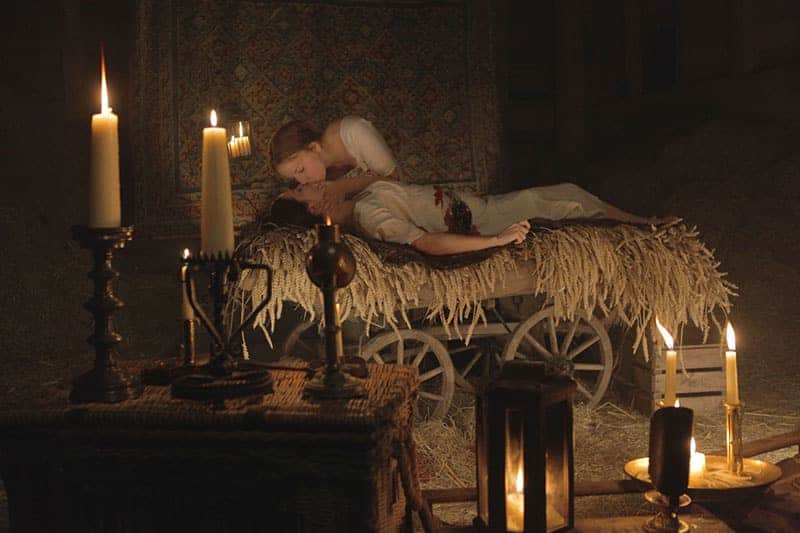
This notion of “monstrous love” is as central to horror as it is to the Gothic. Because “the monster polices the borders of the possible,” they represent the base infrastructure around which society and culture are constructed: what Jack Halberstam calls “the technology of monsters.” The most significant vampire narratives of the nineteenth century- “The Black Vampyre” (1819), “The Vampyre” (1819), Carmilla (1872), Dracula (1897)- are all romances interrupted by a monster who delineates acceptable forms of hunger, desire, and longing from those that are unacceptable; criteria that tend to fall along the lines of class, race, nationality, sexuality, and ability.
The post-Code monster movies of the early to mid-twentieth century continue this tradition wherein encounters with the monstrous function as bonding exercises for the cishet white Subjects to assert superiority and dominance through their mutual rejection of some form of monstrous Other (what Eve Sedgwick calls “homosocial bonding”/”homosocial desire”). In Horror Noire: Blacks in American Horror Films From 1890’s to Present, Dr. Robin R. Means Coleman describes 1954’s Creature From The Black Lagoon as “an obviously metaphorically raced, anti-miscegenation film”; “a story in which the White male researchers are driven to destroy the Gill Man, as opposed to even studying it, because it has committed the ultimate sin of having eyes for a White woman.”
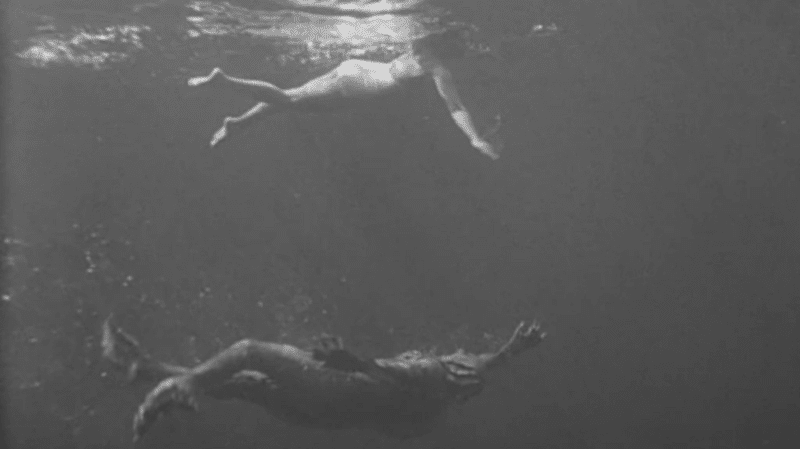
The Gill-Man is what Cohen calls a “monster of prohibition,” one who dwells in the murky waters beyond the “official geography” of segregated space. His aestheticization as an “obviously raced” monster serves to deromanticize and pathologize interracial desire as something akin to bestiality, the goal being to eliminate its possibility. As such, Blackness is coded to embody an existential threat to the sanctified white body-populace, represented in the film by Kay: the beautiful, unobtainable white woman whose associated desirability stations her at the top of a romantic pedestal constructed by white supremacy. She is who the hero(es) must work to save through the annihilation of the monster, and so we see how perceived desire first initiates violence, then how romance serves to justify it.
Nevertheless, because these tensions are always in flux, such framing also renders the Gill-Man a truly sympathetic monster, much like Frankenstein’s Creature, Prince Mamuwalde from Blacula, Edward Scissorhands, and the Nightbreed of Clive Barker’s imagination. The tragedy of these monsters complicates- and oftentimes, completely subverts- the clearly drawn moral binary of “good guys” and “bad guys.” But if the monsters can be heroes and damsels, and the heroes and damsels can be monsters, how do you discern who is who? Is such discernment even possible?
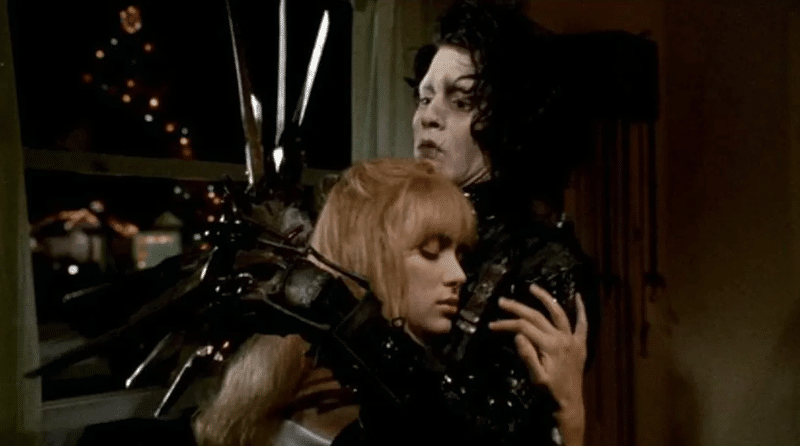
Though applied to fiction, such questions mirror the banal terror of real life. Can you ever really know another human being? And scarier yet, is it possible to ever really know yourself?
Joe Goldberg of Netflix’s You terrifies because he is a monster built from these very questions. A shapeshifter who never shifts shape, Joe is simply a man in love with being in love, with performing the Hero. He is Main Character Syndrome taken to its most violent extreme; an unreliable narrator on par with Humbert Humbert and Patrick Bateman, armed with intractable faith in his own steadfast logic: “Sometimes we do bad things for the people we love. It doesn’t mean it’s right, it means love is more important.”
Joe is a serial killer. If you date men, your worst nightmare. The lengths he’ll go to for what he thinks is love are undeniably horrific. Yet, he challenges some of literature’s greatest unreliable narrators precisely because he’s a monster actually capable of discerning victims from fellow monsters—which is to say nothing of his backstory. The tragedy of Joe Goldberg is that love drives his entire existence, and yet he is incapable of ever actually experiencing it. The cage is a perfect metaphor for what it is to be looked at and listened to so closely, yet somehow not seen or heard at all. Which is to say, what it is to be romanticized into objectification, to be imprisoned in the cage of someone else’s imagination. It’s compelling thus that such monstrosity is also precisely what makes the character attractive to certain viewers.
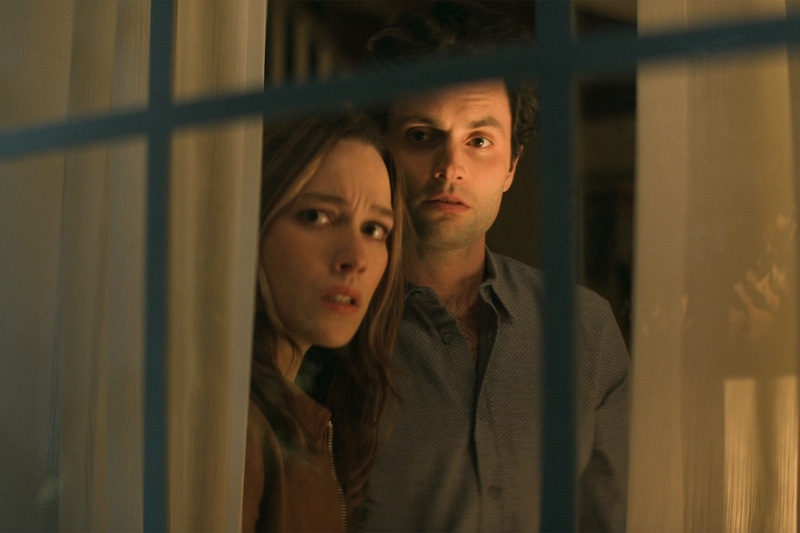
Cohen calls “fear of the monster…really a type of desire.” Because they are delineated as forbidden, the monster can become a deeply alluring, eroticized figure on whose body “fantasies of aggression, domination, and inversion are allowed safe expression in a clearly delimited and permanently liminal space.” This is part of the social function horror storytelling serves. Fiction provides that “clearly delimited space” where such fantasies can be safely explored, and true as this is of horror, it’s equally true of romance.
In practice, little distinction exists between many romantic fantasies and fantasies of violence. Romanticizing the monster thus plays in that messy, psychosexual space that can be extraordinarily generative, extraordinarily destructive, and oftentimes both simultaneously. There are limits to the safety of this expression, however, as Cohen recognizes. “Escapist delight gives way to horror only when the monster threatens to overstep these boundaries.”
Fetish is what’s born of taboo; what emerges when the undesirable is desirable or the reverse, where the desirable is experienced as undesirable. If we understand monstrosity as a narrative, aesthetic, and sociopolitical tool, what does it mean for a given white Subject to desire “the body of the monster” as a container where “fantasies of aggression, domination, and inversion are allowed safe expression”? What questions does this raise about the departures between romance, desire, flesh, fantasy, power, and monstrosity as currencies within libidinal economies? And further, what questions does it raise about the objectification and fetishization involved in the act of being romanticized? Desirability is oftentimes mistaken for power, though these things are not the same.
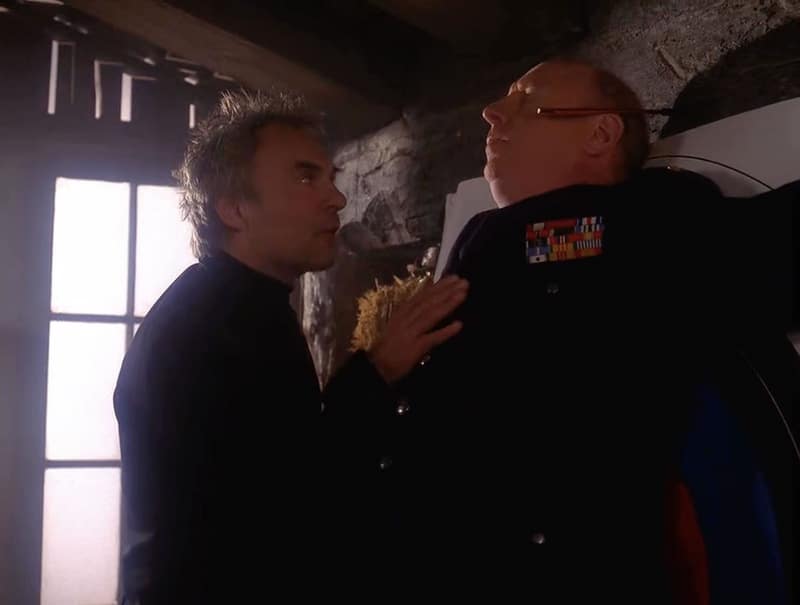
Joe Goldberg “[has] to believe love conquers all.” A cliche that throws glitter over a throne of corpses. Toward the end of the series run of Twin Peaks, Windom Earle asks Major Briggs, “what do you fear most…in the world?” to which Briggs responds, “The possibility that love is not enough.” When read together, Joe’s insistence that love conquers all- and his murderous nature when confronted with its absence- is ultimately a demonstration of the very fear Briggs articulates, where romance is both the source and remedy of terror.
In All About Love, bell hooks writes, “The practice of love offers no place of safety. We risk loss, hurt, pain. We risk being acted upon by forces outside our control.” Love in any form at some point necessitates an act of surrender to said “forces”—if not to the Beloved as Other, then the Beloved as Self. Nothing terrifies as much as such surrender, and nothing could be more romantic.
