
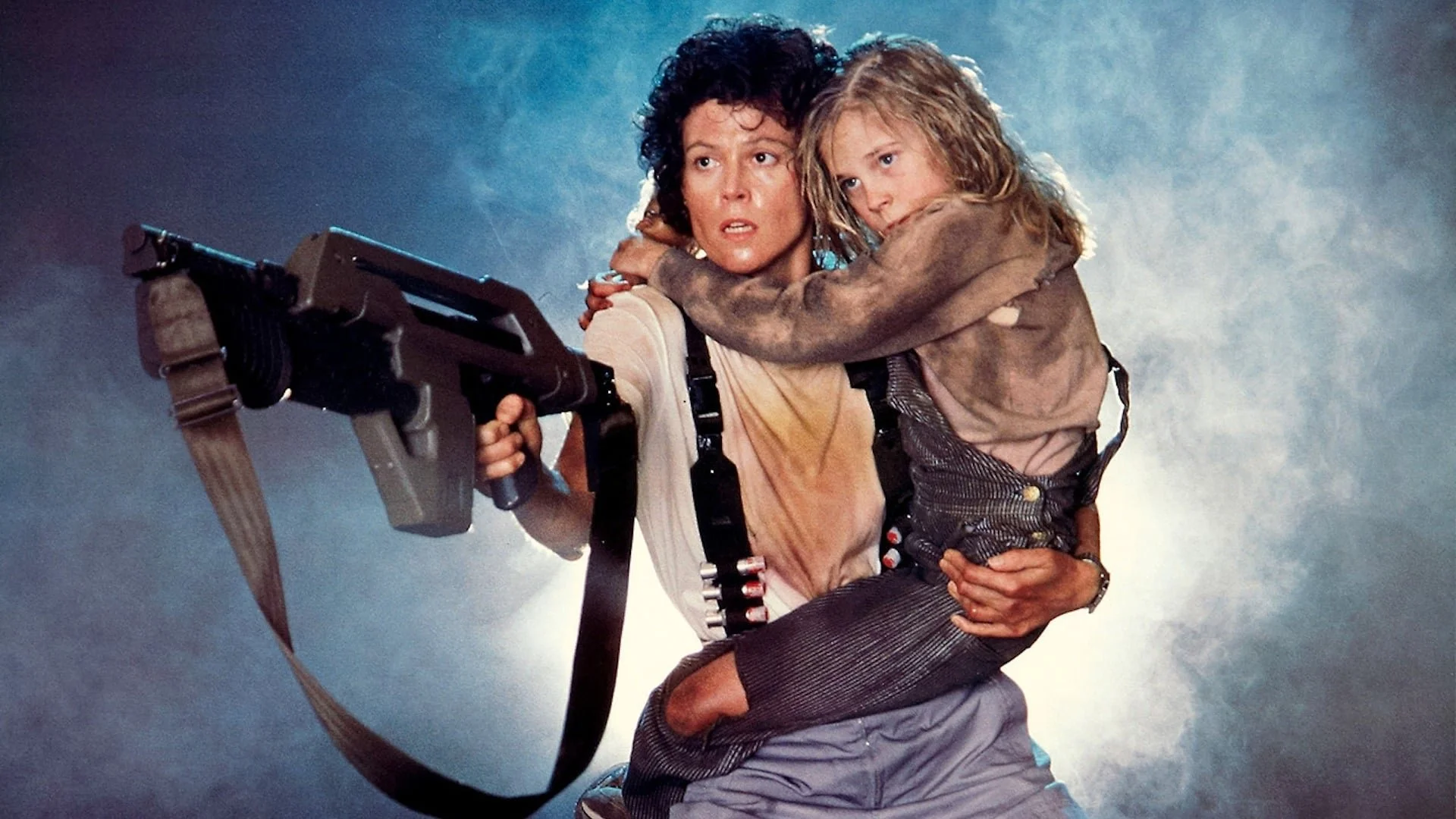
It turns out the legend of Aliens’ pitch meeting is true. When director James Cameron met studio execs to discuss a proposed sequel to Ridley Scott’s 1979 space-shocker, he flipped his script upside down and wrote ‘ALIEN’ on the back, before adding an ‘S’ with two vertical lines running through, turning it into a dollar sign. “Maybe it was just Pavlovian conditioning when they saw the $,” he reflected years later, “Or maybe it was the confidence I projected. But they said yes.”
Today it feels like a no-brainer. As one of the foremost figures in blockbuster entertainment, Cameron is behind not one but three of the top grossing films of all time (Avatar still holds the top spot, with first sequel The Way of Water at no. 3 and Titanic at no. 5). But in the mid ‘80s – with only The Terminator and Piranha Part Two: The Spawning to his name – his reputation had yet to be established. All that was about to change, however, when he delivered arguably the greatest horror sequel ever made.
“Get out there and face this thing”
Set 57 years after the events of the first film, Aliens picks up with Ripley (Sigourney Weaver) waking from hypersleep after she’s rescued by a Weyland Yutani salvage crew. Early scenes show her being grilled by corporate suits about why she detonated the Nostromo and dealing with PTSD flashbacks. It’s only when she learns that LV-426 – the planet where her crew originally encountered the xenomorph – is now colonized and their radios have gone dead that she agrees to go back.

For Cameron, this provided Ripley with a “cathartic, psychological reason” for why she would return, comparable to the way US soldiers did multiple tours in Vietnam: she wanted to face her demons. So when she asks company man Burke (Paul Reiser) for assurances that “you’re going out there to destroy them,” she’s not just looking to confirm his intentions towards the xenos, but also hoping that this mission might offer her an opportunity to silence the nightmares.
“Another glorious day in the Corps!”
Comparisons with Vietnam continue when Ripley is introduced to the Colonial Marines, “very tough hombres” tasked with leading the rescue mission. Under the leadership of the inexperienced Gorman (William Hope), the squad includes such iconic characters as Hicks, Hudson and Vasquez, played by Cameron regulars Michael Biehn, Bill Paxton and Jenette Goldstein respectively.
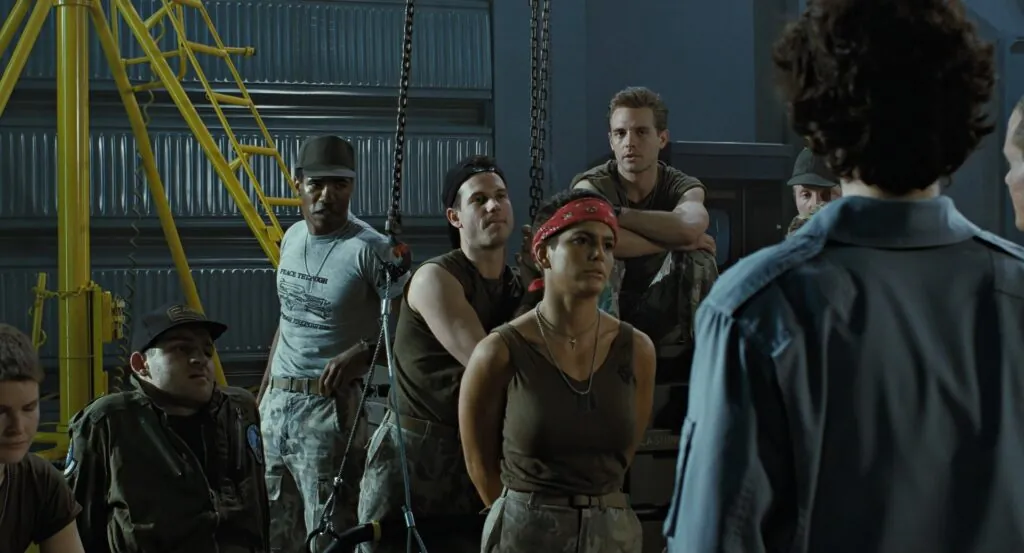
As well as offering a distinctly different flavor to the original film (the crew of the Nostromo had minimal weaponry) these heavily armed Marines offer an interesting dichotomy: on one hand this is textbook Cameron gun porn (from the M41A pulse rifle to the sentry guns from 1991’s Special Edition, the film clearly fetishes firearms) whilst on the other this “superior firepower” ultimately proves ineffective against the primal ferocity of the aliens. Again, comparisons to Vietnam abound, with Cameron describing that conflict as “almost science fictional, in the sense that it was the first real high-tech war that was waged against an extremely low-tech enemy, and lost.”
The fact too that the Marines are mainly working class is important. Similarly to Scott’s original – which dealt with working people deemed “expendable” by a huge corporation – Cameron doubles down on the class warfare by contrasting the “grunts” against the slick machinations of hyper-capitalists Weyland Yutani, personified by the slippery Burke. As Ripley quips in the third act when Burke’s treachery is exposed, “I don't know which species is worse. You don't see them fucking each other over for a goddamn percentage”.
“We're on an express elevator to hell, going down!”
Alongside such weighty themes, Aliens boasts an abundance of incredible moments. From the dropship descending over the deserted colony to the ‘blip-blip-blip’ of the Marines’ motion-trackers and the first incursion into the xenomorph’s nest, Cameron’s film runs like a military operation, precise and laser-trained on ratcheting tension to an unbearable degree. Indeed, in his 1986 review, Roger Ebert admitted he felt “wrung out” by the unremitting intensity of the experience.
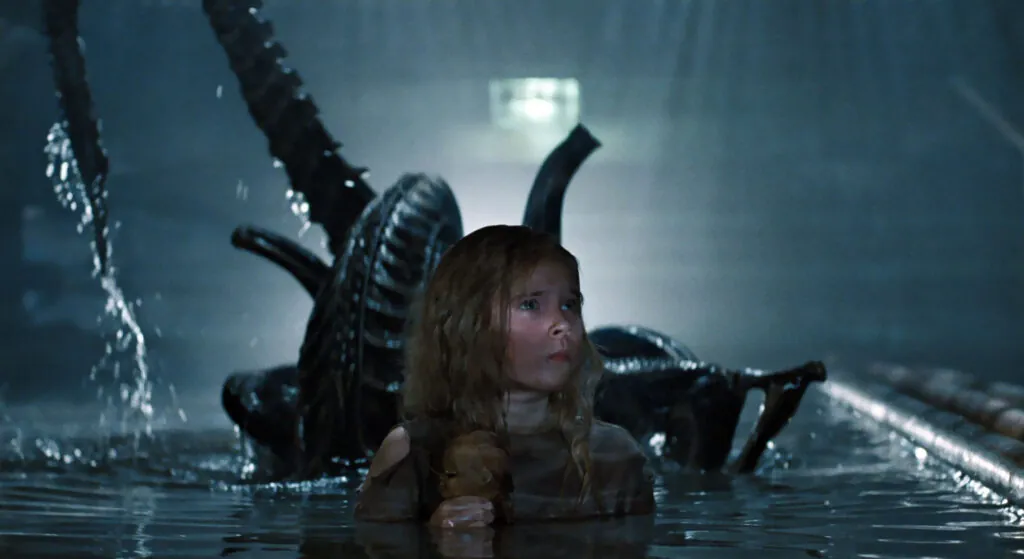
For a film focused on the alien threat, though, there remains a strong through-line of humanity, not least in the character of Newt (Carrie Henn). Ripley’s relationship with the little girl proves to be the emotional anchor on which the rest of the story turns, with a deleted scene (restored for the Special Edition) offering much needed context: Ripley’s own daughter Amanda died in the 57 years she was away, and as Newt is an orphan the pair find each other as surrogate mother and daughter, offering salvation and a second chance at family.
Following the catastrophic nest attack (“Maybe you haven't been keeping up on current events but we just got our asses kicked pal!”), it becomes clear the Marines are stranded, and a damaged cooling system means the colony’s reactor is set to blow. With the clock ticking down, android Bishop (Lance Henriksen) offers to remote pilot the second dropship to their rescue whilst the Marines lock in for a last stand against incoming waves of xenos. But with human casualties stacking up (Hudson! Burke! Vasquez! Gorman!) in the chaos, Newt literally slips between Ripley’s fingers and is captured.
“Get away from her, you bitch!”
The film’s final act is then both a climactic set-piece and a thematic summation of all the ideas set forth so far. Loading the injured Hicks into the dropship with Bishop, Ripley kits herself out before descending literally back down into her trauma and fulfilling the oddly prophetic words that Burke spoke to her at the beginning (“get out there and face this thing”). What she finds is both the distillation of her fear and a dark inversion of her own motherly identity.
The Alien Queen was designed in collaboration between Cameron and legendary effects artist Stan Winston, and is a thing of nightmarish beauty: insectoid and elegant, she sits enthroned on a pulsating egg sac like the anti-Ripley, a hell-mother brooding over her parasitic children.
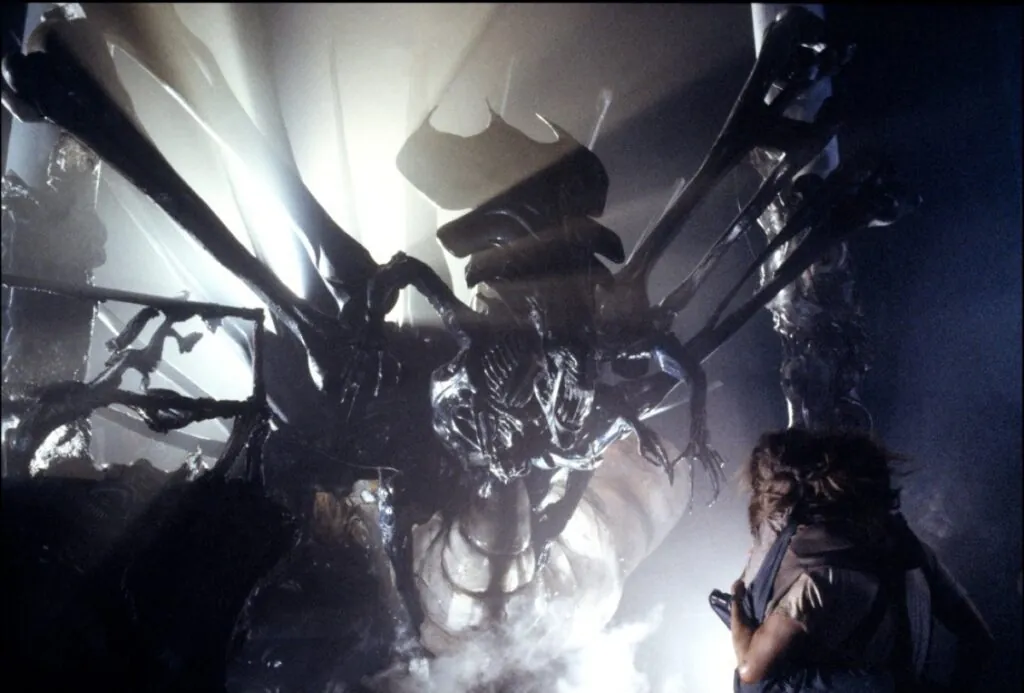
Ripley seems to almost negotiate her and Newt’s escape – threatening her with a flamethrower – before thinking better of it and torching the whole nest. And fleeing back to the surface – the enraged Queen gnashing at their heels – mother and daughter discover that Bishop has left them to die.
Throughout the film, James Horner’s score is essential, magnificent in its cathedral-filling scope and gut-churning terror, but this moment showcases perhaps his most influential piece. “Bishop’s Countdown” proved so effective it went on to feature in countless trailers for other films, and here perfectly soundtracks the moment the android comes good, piloting the dropship back to save Ripley and Newt moments before the Queen – and exploding reactor – claim their lives.
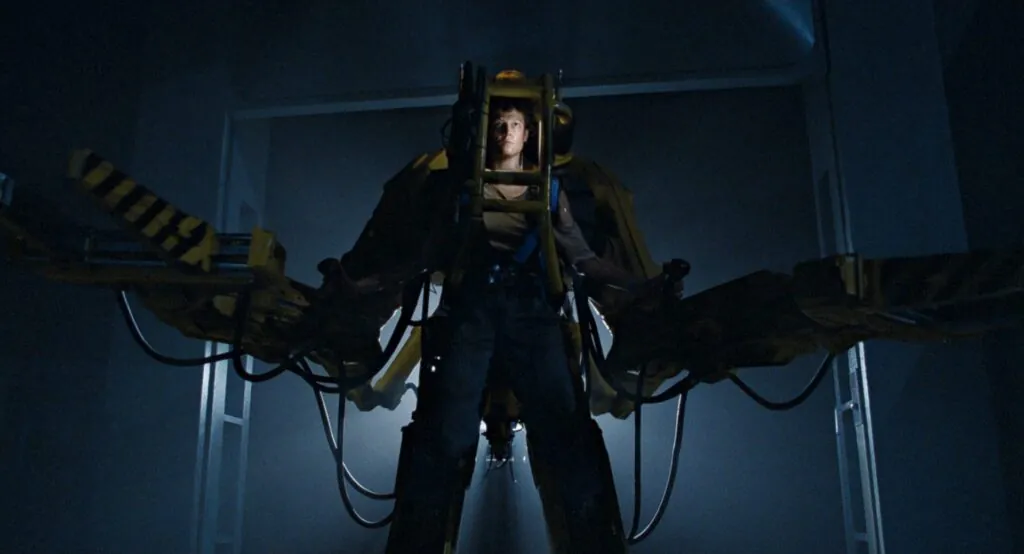
There is, of course, one final, heart-stopping moment. Back onboard the Sulaco, Ripley thanks Bishop, only for the droid to be ripped in half by the stowaway Queen. And in one last showdown, Ripley – mother and working-class hero –takes the Queen on inside the forklift-like Power Loader, blowing the bitch out the airlock.
“Game over, man! Game over!”
Endlessly quotable, exceptionally written and calibrated to shred even the steeliest of nerves, Aliens was a box office sensation and cemented Cameron’s reputation as a genre hero forever. Textually rich in ideas of trauma, recovery, motherhood and survival, it is the greatest horror sequel of all time, and quite possibly the greatest action and sci-fi sequel too. Just be careful if you watch it with the lights out, because they mostly come at night. Mostly.
