
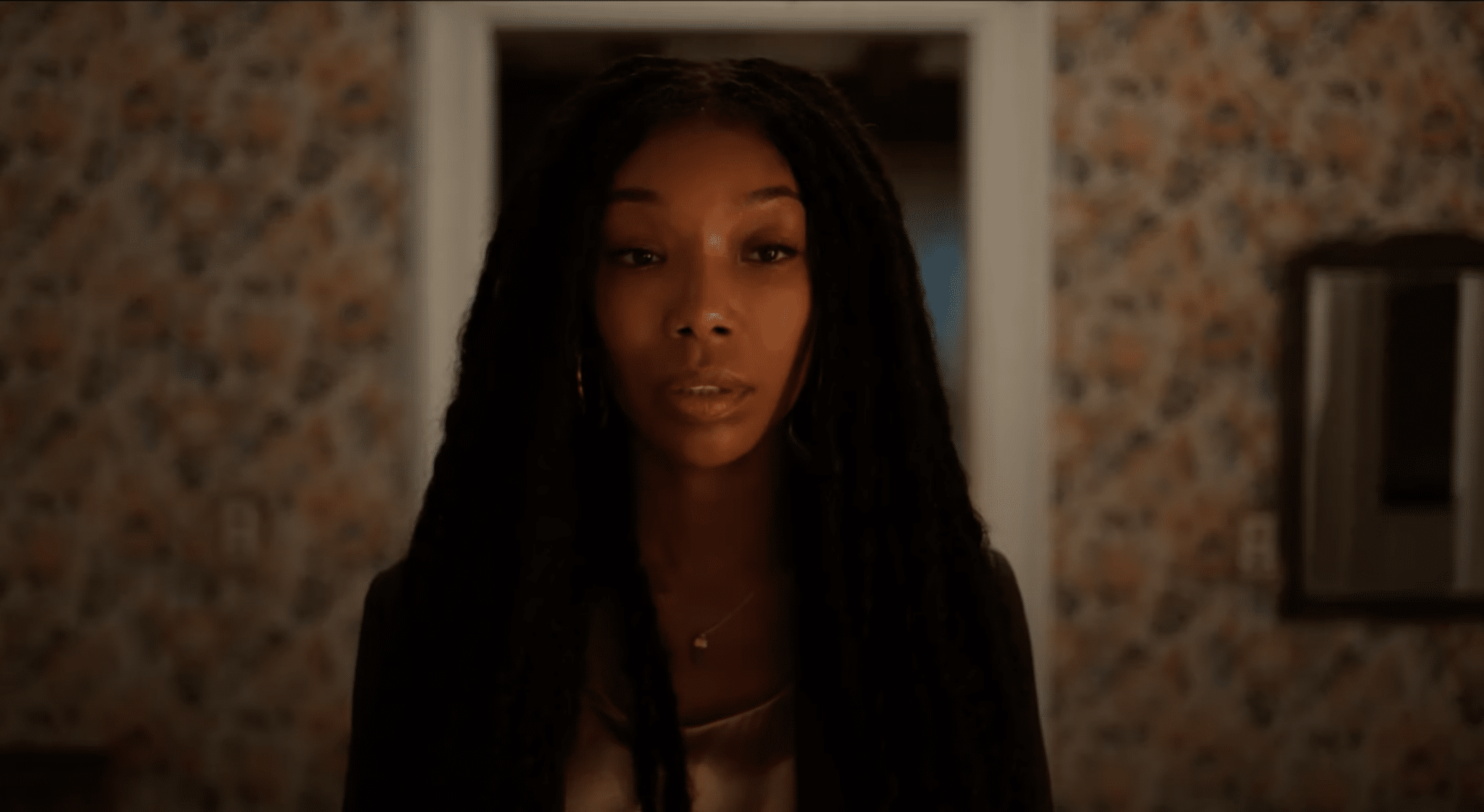
I would bet good money on the following sentiment: The Front Room is not what people are expecting. Full stop. The feature marks Brandy's return to the horror genre and the feature directorial debut of the Eggers brothers, Max and Sam. If you’re wondering whether there’s any relation to Robert Eggers of The Witch and The Northman, that’s a big yes. Max, Sam, and Robert are, in fact, brothers. The Front Room is based on a short story by Susan Hill and centers on a mother-in-law from hell. The mother-in-law in question is played by Kathryn Hunter, going head to head with Brandy as the tortured daughter-in-law.
The Eggers brothers joined us to discuss their surprising A24 debut, the dark comedic qualities, unexpected inspirations, and their phenomenal cast. Read our full interview below, and catch The Front Room in theaters September 6th.
I think that people are going to be surprised by this. They're not expecting it to be so comedic, so strange. Dare I say, so camp, and I say that in a complimentary fashion. As soon as the opening credits started — the music, the design, it very much harkens back to something very specific. Then we just progressed into absolutely batshit bonkers. When you set out to adapt the short story, did you have this tone in mind, fun campy horror? Or did that evolve as you got deeper into it?
Sam: We knew from the beginning. Campy, I appreciate you saying that as a compliment because I think it can become a word like, “oh, this is camp“ whatever that means. What Ever Happened to Baby Jane? is a big parallel for us, a big inspiration. That's what I think of when I say “camp.” Something that's so outrageous and sort of just strange…

Max: But is honest and has truth to it. You look at John Waters as well, there's a reason why it resonates. When you watch What Ever Happened to Baby Jane, and I think similar to this film, you're sort of like, am I supposed to laugh here? Am I supposed to be frightened? I'm both of those things all at once.
This is gross. It is a very weird world that they created sixty-some-odd years ago. That was a big inspiration for us in terms of exploring the themes this film talks about. Not that it hasn't been done before, but I think it hasn't been told in this way in a while in terms of the horror space. It was something that evolved, especially with performances.
We're people of the theater. Kathryn Hunter (Solange) is of the theater. Brandy has been in Chicago. Andrew Burnap is a Tony Award winner. We were blessed to do rehearsals, and there was an evolution.
Many times, Kathryn specifically was like, “this is really funny, isn't it?” Charles Busch (Psycho Beach Party) talks about “Grand Dame Guignol,” and there is this class of cinema that we are harkening back to and leaning into because it's this epic time of leading ladies who were given wild material and shined in it.
I really want to celebrate both Brandy and Kathryn. The best comedic duos have a “straight man” and somebody just going absolutely slapstick. Brandy and Kathryn play so well off of each other, they're exemplifying that. Brandy has some great little zingers and one-liners; she gets comedy, but she gets to do deadpan, and then Kathryn is just unleashed.

Were there any moments where you felt “we need to pull it back a little bit?”
Sam: It was always just, let's go. With both of them, there were surprises constantly. Even in the weirdest things we asked them to do, we were able to find truth in it. That begat the comedy because it was honest, and when you're in this situation in real life, it's often weirdly a comedy. You have the straight man, and you have the one that's just a fucking mess.
M-E-S-S, mess.
Sam: Yeah, M-E-S-S, mess. When we cast them, we didn't know they would get along and have good chemistry. But we had an instinct that they would. When we met on Zoom, the chemistry was electric in the space and on camera, and they love each other. They had so much fun with each other. Long story short, to give all credit to them, not us. If they weren't having a ball with each other, this movie wouldn't be possible. Whenever Kathryn did horrible things to Brandy, she was like, “I'm so sorry, Brandy, I'm so sorry.”
Brandy is an inspiration. Kathryn as well, just as a performer every day. Her ability to just go there in a truthful way. As Max said, it was all about her character. We truly never really had to say, “That was a bit much.” Somehow, going further was the answer to that.
Max: And Brandy bringing out who Belinda is because she's somebody in little moments and big moments. She is pushed down a lot and brings out something even more than we imagined in Belinda.

Sam: I just wanted to shout out Andrew as well. We met a lot of people for the role of Norman and they wanted to make him something that he wasn't. When we first met Andrew, what did he say?
Max: I can be active in passivity.
Sam: Yeah, the sort of person who's pulled between two forces and doesn't do anything about it but should. He knew exactly what that role required. He is really great in his sort of middleman between the two.
He does it in such a way that allows his co-stars to shine.
Sam: He said this is a great story about two mothers, two women, and I want to be a part of it and…
Max: Support them.
Sam: From day one, he was so committed to that. I wouldn't be here without him, either.
You go full psycho-biddy hag horror here. There's not a ton of that these days. We get a little bit of Ruth Gordon from Rosemary's Baby in there, but it's so much more than just riffing off that in Kathryn's performance. Did you specifically discuss any references with Kathryn for Solange?
Max: The specific reference is ironic for this question. The specific reference for Solange is our grandfather. We have recordings and lots of information that we gave to Kathryn about him. In our adaptation of Susan Hill's story, we brought it to America and made Solange religious, Southern, and conservative. Our grandfather was not Christian or conservative, but he was a Southern gentleman, and he talked exactly like her. That was the reference. I do want to say our grandfather was not like that! He talked like her, M-E-S-S is something he would say, but he was not that character.
Bette Davis in What Ever Happened to Baby Jane? was on our minds. That was always, like Sam said, a touch point. At one point, Kathryn was like, “I should have white makeup on like Baby Jane.” Actually, you know what? That goes back to your question. We did say, “That's too far.” Yeah.
In What Ever Happened to Baby Jane? you have these two women in the house going to war, not necessarily in that case for the mother of the house, but almost metaphorically. So it was always like, “okay, yes, this is Bette Davis.”
Sam: Joan Crawford.
Max: Joan Crawford is Brandy. I would say it's true that this is an unsung genre. I think now more than ever, it has had a resurgence, which is great. But I think it's something that even in that name, again, Charles Busch calls it “Grand Dame Guignol.” I think that's wonderful, it's a mouthful. But it does give the proper weight to it. It's effective and can come back and have a resurgence because there's so much truth in those films. There were many that we referenced throughout the process, trying to sort of harness that energy.
You're not just brothers, you're twin brothers. How does that play into your creative and collaborative process? I imagine that's an aid in some ways, how do you divide and approach the work?
Sam: There are some difficult days sometimes, but I guess that's why Max is laughing. I don't know how Rob [brother, Robert Eggers] does it by himself; of course, we pick his brain all the time. It's very easy to lean on somebody, especially in a crisis situation, when we're writing, jumping off ideas, trying to test things with somebody else. Having a partner like that and someone you can trust and fail in front of is very important. Growing up with our mom being a theater director, failing was a part of life, and that was an important lesson we learned. Having a partner makes the whole process easier to workshop and to put things on their feet to storyboard together. It makes the whole process easier to have someone that you trust.
Max: Yeah, trust is a great word. And again, we're lucky that we have not just each other, but working with Rob as well. We've worked together since we were five years old in theater. There's always that kind of, like Sam said, trust to fail. I don't know if people would admit this, or maybe this is just us, but the bad ideas are often the best ideas. That's where having someone willing to sort of go there is helpful, “what do you think about this?” Having the trust to do that. It is scary to collaborate, but I think, unsurprisingly, we'll often have the same idea independently and in different houses. One of us will say, “What about this?” and the other says, “Oh, I was thinking of that.”
Sam: It's definitely a twin thing. Could be a thing.
Max: It could be a twin thing. It's very helpful to be on the same page most of the time. It's rare that we disagree, but maybe that's why you were laughing.
Sam: Yeah, sometimes we titanically disagree, but as brothers are wont to do, I suppose. The process is surprisingly smooth most of the time.
Did you have any titanic disagreements on this project in particular?
Max: No, I don't think so.
Sam: We had a lot of disagreements about the layout of the house.
Max: There was one point where we'd written the script: the front room is on the left side of the house. No, it's on the right side of the house.
Sam: I always imagined it was here. And he said, “no, if we're looking at the house, it's there.” That was big. That was literally, I would say, a week-long saga of which one of us was right. He was right, eventually.
Did you guys shoot this in a haunted house? Did I hear something about this?
Sam: Yes. Basically…
Max: That's what people said. It took a long time to find the right house. Originally, we wanted to build the set, but that was very difficult, especially during COVID.
Sam: We were down to the wire, and our location scout, Justin Stowell, found this house that had been abandoned for two years. We go to this house (shout out to Boonton, New Jersey). We get there, they open the house, and it smells like mold, and it's all this crazy stuff.
Max: Basically, it looked like Bergman's The Shining, rooms with crazy colors. The front room had this blood-red carpet with black and white dancing people on the walls. It was so inspiring and we kind of wanted to use it. Of course, we couldn't. But once we saw it, we knew, “This is the house.” Then we learned that the former owner was an elderly woman who couldn't get up the stairs, spent all of her time in that front room with the dancing people, and died there. When we filmed there, our costume designer, Elizabeth Warn, said to us, “You know the woman who owned the house, Vera, is not happy. We need to sage the house.” She did that, but people still said they heard someone in the blocked-off servant's quarters upstairs.
Sam: People would come to us and say there's somebody in there, but nobody was there.
Max: Nobody was in there. Her name is Vera Liva, and there's something about that name.
Sam: Her wedding dress was left behind, so she was there.
The Front Room is in theaters September 6th. Stay tuned for our interview with The Front Room cast, Brandy and Kathryn Hunter.