

It's hard to wrap my head around the fact that Tales From The Crypt Presents Demon Knight is now 30 years old. I still vividly remember my crushed reaction arriving at the theater on opening night and learning it was sold out, settling for Dumb & Dumber instead, and having to wait until a Monday matinee to see William Sadler and Jada Pinkett save the world from Billy Zane. Having loved it, I naturally spent my allowance on the novelization (cover price: a princely $4.99!) the following weekend, but for the life of me, I cannot recall if I ever actually read it until now.
I know I at least started to read it way back then because I remembered it had the intro from the Crypt Keeper, which chalks up the opening slasher sequence fakeout (in the movie, the killer is played by an unbilled John Larroquette) to a short story ol' Crypty wrote a while back and is now embarrassed by. He then introduces the real story but returns a few times throughout the book, more or less as act breaks to offer a few of his trademark puns.
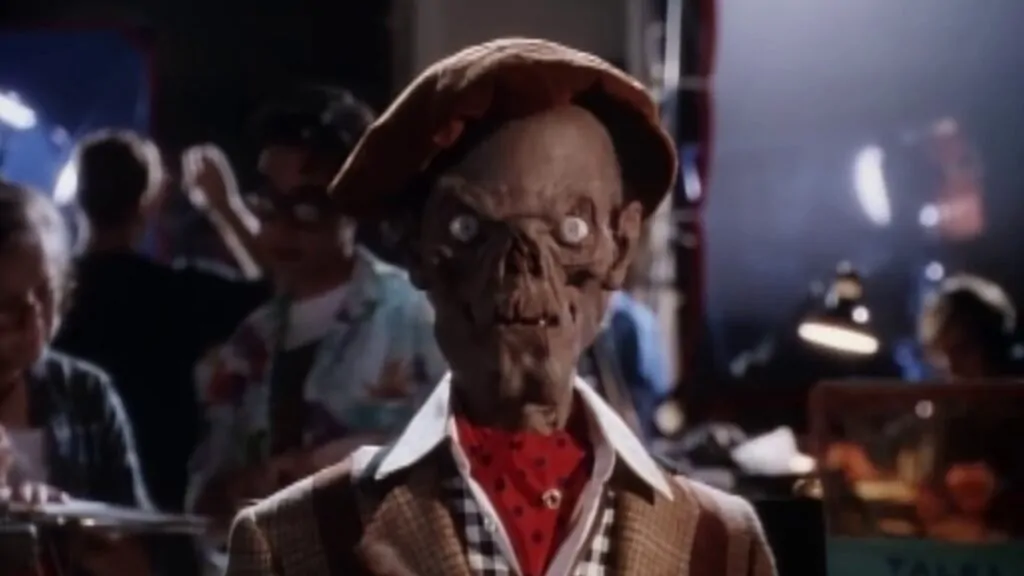
Given the other changes throughout the novel, I assume that there was a draft of Demon Knight that allowed for more appearances by the famous host, akin to the sketches that break up Mystery Science Theater 3000, but in the film itself, he only appears at the beginning and the end; a wise decision as the interruptions would kill the momentum of this incredibly fun (and surprisingly goopy for a mid-'90s studio horror release) flick.
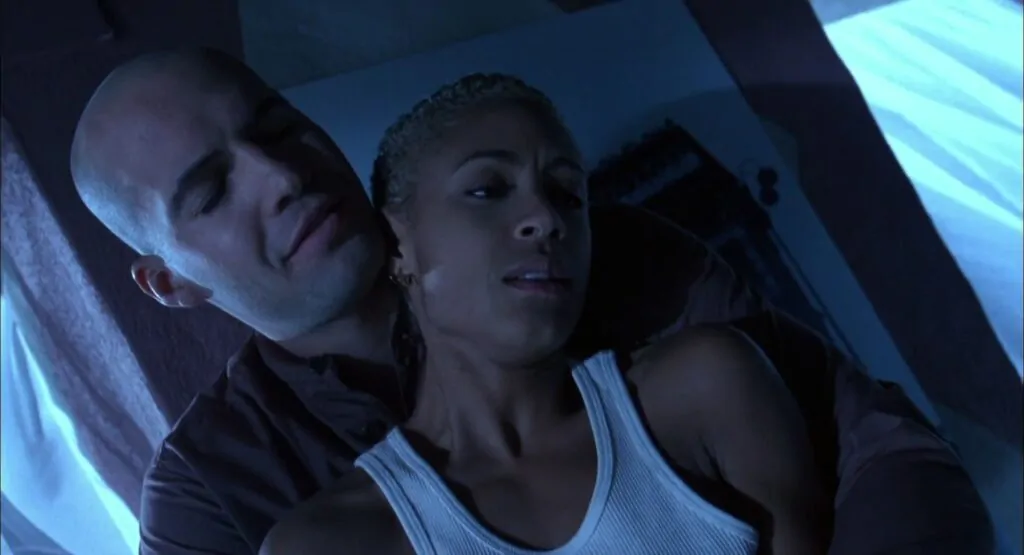
That said, the bulk of the story changes in Randall Boyll's take are pretty minor, and most fall within the movie's third act. One exception is that the character of Jeryline, played by Pinkett in one of her first lead roles, is written as white, and also has a burgeoning romance with Brayker (Sadler). Again, maybe this was present in earlier drafts and removed, but considering the 20+ year difference between the two actors that were hired, I'm glad there's nothing like it in the movie.
As for her being white here, it's actually kind of nice in a way: assuming Boyll didn't just make a mistake, it's proof that the role was written for a traditional white heroine and more forward-thinking heads prevailed. Per director Ernest Dickerson, it's the first major horror movie where a Black woman saves the world, which is a pretty nice feather to have in its cap.
As the story is obviously inspired by Night of the Living Dead (a group of strangers boarded up in an isolated house fight each other as often as the supernatural entities outside trying to get in to kill them), having a Black hero just makes more sense anyway.
The other notable difference is that while everyone dies in the same order, the deaths themselves are different. In the movie, Roach (Thomas Haden Church) hands over the key to the Salesman (Zane) and is instantly killed by a few of the demons. Here, he makes some demands, including a car, and is then crushed to death by said car after the Salesman conjures it in mid-air as a display of his powers.


The deaths of Irene and the Deputy are also slightly different. She still blows up thanks to the grenades they found in the stash of Wally the post office clerk (one of the film's few dated gags), but not with the Deputy, and she also has both of her arms when it happens (in the movie, one of them is torn off long before her demise).
Instead, the Deputy dies in one of the handful of scenes where the characters go outside in an attempt to escape. In the movie, most of the characters never leave the house except for the tunnel excursion (which goes on much longer here). In the novel, they all leave (except Brayker) shortly after the Salesman makes his evil presence known, only to retreat. The movie has a very brief version of this, where Roach leaves Cordelia outside and Wally goes to save her, but it's a much more elaborate sequence here.
Much later, the Deputy and Irene plan to make a run for it by having him go out and get his squad car started, at which point he will signal her to run for it. Unfortunately, the Salesman kills him in the car and then tricks Irene into coming out and getting into the passenger side. When she realizes her friend is dead, it's here that she sets off the grenade, albeit accidentally. The movie version, which seemingly pays homage to Gorman and Vasquez's deaths in Aliens, is maybe not as action-packed, but certainly offers a more noble death for these two likable characters.

On the other hand, the death of Willie (Dick Miller) is much less exciting here, lacking the hilarious site of Miller smacking Sadler around, but also his antler-driven demise. Instead, he gets stabbed in the eyes pretty quickly after he becomes possessed, the sort of thing you might miss entirely if you're skimming. Again, they all occur around the same time as they did in the eventual feature, but it's odd how nearly every death scene (except Roach's) plays out better on screen than in these pages.
Then, of course, there's the usual biographical stuff that is almost certainly the author's invention, as there'd be no real place to explain these things out loud in the movie. We learn a bit more about Brayker's past dealings with the Salesman, more about Willie's history and how he manages to keep himself stocked with booze (blackmail, essentially; at one point he reminisces about catching the owner of the local grocery store with an underage girl in his car, so he keeps quiet in exchange for free hooch), etc.
Boyll even tosses in a little meta joke for his fans; Jeryline reflects on seeing Darkman and liking it so much that she tracked down the novelization – guess who wrote that one? These things certainly add flavor to the page, but little of it will be on my mind the next time I watch the movie.
Hopefully, I will forget that the Salesman isn't as amusing here. Zane's performance is terrific (the actor has said it's his favorite of his work), but most of the humor is subdued or downright missing here. There's no sponge in the mouth gag, no “You fuckin' hoedown, podunk, well them there, motherfuckers!” – he's, for the most part, a straight, kind of boring villain.
Brayker comes off as the funnier character, thanks to his occasional banter with Jeryline (Boyll gets a lot of mileage out of her teasing Brayker about his outdated first name of Silas) and inner monologues about how old he is.
In fact, the only difference between this and the movie that I think is for the better is that there's no “Seven souls for seven stars!” nonsense that was never fully explained on-screen anyway. When Brayker explains everything to them here, he makes no mention of this concept, leaving the seven stars on his tattoo to stand for the seven keys that the Salesman has been tracking down to undo all of creation if he so desires (take that, Thanos).
Therefore, it's honestly a disappointing take on the material. Usually, these things tend to have a real give-or-take existence, where every change for the worse evens out with one that turned out better, but here? It's not like it's a bad story, but so many things that elevated the movie from a solid siege horror tale to an entertaining romp are absent in the novelization.
If you're interested in the movie's long road to production (the script was floating around as far back as 1987, when Tom Holland was briefly attached), then by all means, check it out to see that part of its evolution. Otherwise, the 90-minute movie is a blast and a far better use of your time.
Just skip the post-credits tease for the next movie, Dead Easy. As Tales fans know, it never actually came to be, and we got the lame Bordello of Blood instead. Ick.