
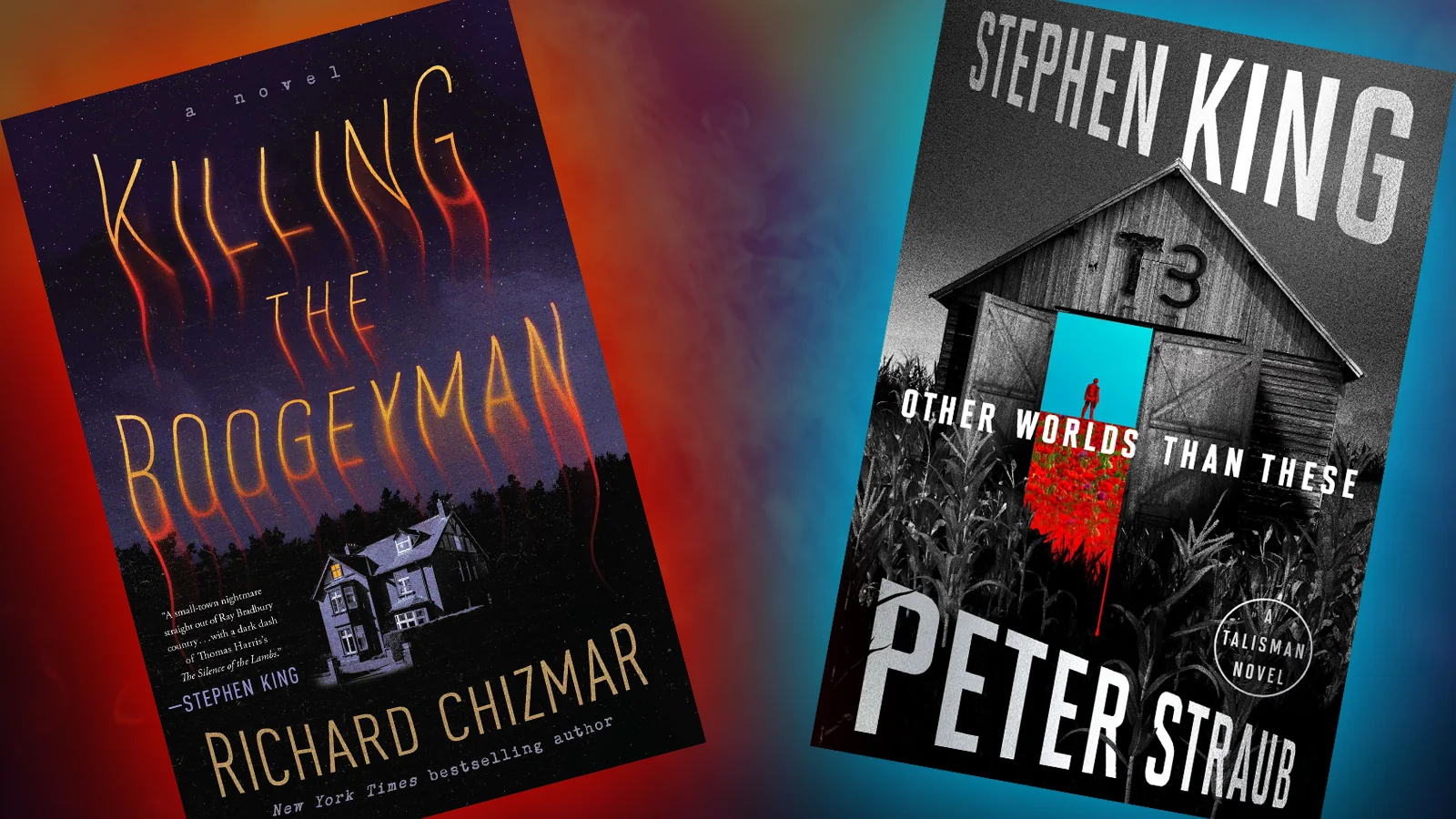
On October 6, Stephen King and Richard Chizmar — who collaborated on a trilogy about the character Gwendy Peterson — released the final installments in their other trilogies. Other Worlds Than These, co-written by King and Peter Straub, is the final book in the Jack Sawyer trilogy that began with the 1984 novel The Talisman and its 2001 sequel Black House.
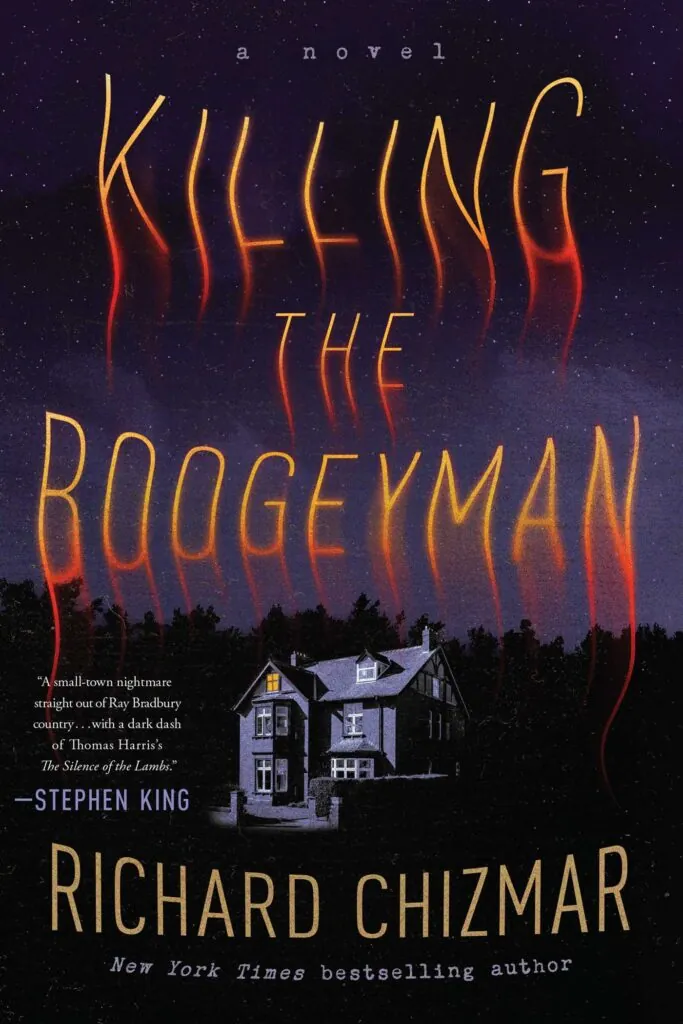
Killing the Boogeyman closes out Chizmar’s trilogy that includes Chasing the Boogeyman and Becoming the Boogeyman, about a serial killer who haunts a fictional version of the author. I recently talked with King and Chizmar about their trilogies, collaborations, and endings.
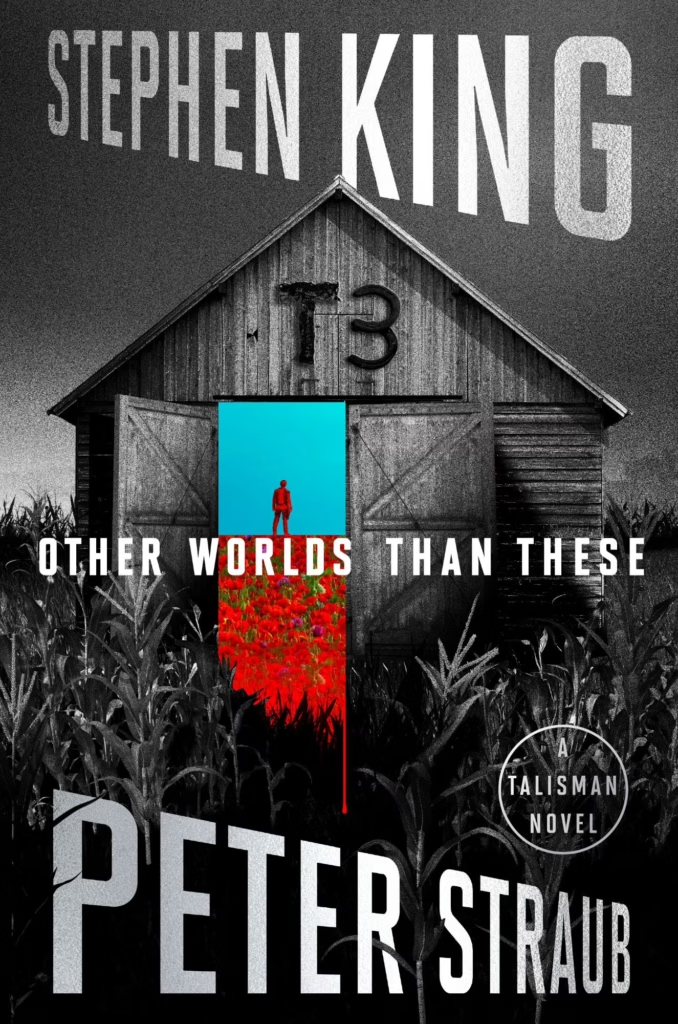
In Other Worlds Than These, we meet up with Jack Sawyer twenty-some years after we last saw him at the end of Black House. What has he been up to in the interim?
Stephen King: He’s been living in the seacoast town of Dezi, with his wife—Sophie the Good. She died in childbirth. Jack is a deeply lonely man. He eventually is forced to join with others in a group bound by fate. What I call a tet or ka-tet.
Peter Straub sent you a message several years ago with ideas for Other Worlds than These. To what extent did you feel Peter’s influence while you were writing the novel? Did you try to recreate the blended voice you two came up with when you co-wrote The Talisman and Black House?
King: I felt Peter’s presence everywhere, but most of all during the beginning chapters. There I was channeling him like a motherfucker. Magical thinking — I really wanted him to be part of it, so I pretended he was. To tell the truth, I used him as a crutch. Later, my own voice resurfaced, but in places he’s still there in style and substance.
In Other Worlds Than These, events are inspired by the spree killings of Charlie Starkweather and Caril Ann Fugate. You and Peter Straub have both talked about the impact that rampage had on you when you were younger. What do you remember about that time?
King: I kept a scrapbook of Starkweather’s spree which disturbed my mother mightily. I told her later — when I could articulate it — that I was looking for what to avoid rather than what to emulate. There was a terrifying emptiness in Charlie’s eyes. It was the colossal stupidity of people who have no empathy. I suppose part of me was attracted to Starkweather—the young man neighbors called “the redheaded peckerwood”—but mostly I was repelled. Certainly he made an impression on me.
Another influence on Other Worlds Than These are the two adaptations of the French novel Le Salaire de la Peur: The Wages of Fear and the Roy Scheider film Sorcerer. What was it about that story that appealed to you?
King: I was excited by the idea of a journey fraught with dangers. Mating that with fantasy seemed a natural thing to do, and full of creative opportunities.
A scene in Black House formalized the relationship between The Territories and Mid-World from the Dark Tower series. When you wrote The Talisman, you’d already completed the first book in that series. Did you think then that the two alternate universes were connected? How did it feel to tell a new story about Mid-World from the perspective of a different set of characters?
King: When writing The Talisman, I never thought of the Territories and Mid-World as the same place. I came to realize that while writing Black House. Peter seemed totally down with it, and why not? We needed a climax and had to explain all those missing children. That they had been press-ganged as Breakers explained a lot.
Writers spend a great deal of time talking about beginnings. What have you learned about endings, particularly the ending of a story — two stories, actually — that has occupied decades of your life?
King: Without giving anything away, I’ve always seen events as cyclic. It’s expressed in these three books (and the Dark Tower series) by people who say, “Ka is a wheel.” To me, that explains the puzzling failure of the human race to make great leaps of tech progress but little emotional progress.
Another of your collaborators, Richard Chizmar, has a trilogy-ending novel, Killing the Boogeyman, coming out on the same day as Other Worlds Than These. What do you think Richard does as a storyteller that is distinctly his — something you recognized when you first began working together and that has become more pronounced since?
King: I’m a country mouse. Rich is brilliant when it comes to describing the mores and morals of suburbia. He’s pitch-perfect as a storyteller, mostly because he’s so grounded. I think of him as early- and mid-career Spielberg. His eye sees the landscape of modern town life without any satire or editorial comment. It’s very refreshing. His genius is in the clarity of his prose.
At what point when you were writing Chasing the Boogeyman, the first book in your trilogy, did you realize that you were effectively creating a new literary genre: Fictional True Crime? Did you originally plan for it to be a standalone novel?
Richard Chizmar: To be perfectly honest, I’m not sure I ever did come to that realization…at least, not until the reviewers began pointing it out. From page one, using that narrative device felt like the only way I knew how to tell the story. I was writing about myself, my family and friends, and the town I had grown up in. I was reading a lot of true crime at the time, so I figured: why not? Let’s play it straight, toss in some photos, and see what happens.
Chasing the Boogeyman was absolutely planned as a standalone. Not a single thought of a sequel — much less a trilogy — until one day, while I was mowing my lawn, the entire first chapter of Becoming the Boogeyman came to me in a flash. It ends with a pretty spectacular reveal that directly connects to the events in the first book, so I knew right then I had to write it.
Were there readers who believed the events of the books were real? If so, how did you learn about that and how did they react when they found out it was mostly fiction?
Chizmar: When Chasing the Boogeyman was first published, I received a number of emails and messages on social media from happily surprised readers who’d totally bought in and believed it was real. Also, a few from folks who were ticked off that I had “tricked” them. Each and every one brought a smile to my face. My original plan was to try to “Blair Witch” the audience. No “Novel” printed on the cover; no disclaimer up front stating that it was a work of fiction; no afterword pulling back the curtain and revealing the truth. I even planned to plant fake news articles online and a make-believe website (dated and abandoned) dedicated to the killings so that curious readers would find more details when they Googled. But Simon & Schuster’s legal department was no fun and squashed those ideas.
How did the members of your family feel about the way they were portrayed in the series? Did they set any ground rules? Where do you draw the line between material you’re willing to fictionalize and things that remain off limits? Has that line moved over the course of the trilogy?
Chizmar: All my family and friends were tickled by the idea of appearing in a book. No ground rules or restrictions. In fact, several of my lifelong friends lobbied for larger roles and grumbled that they didn’t get a “close-up” in any of the photos. The sole dissenting voice was my wife, Kara, who is very private and prefers to remain behind-the-scenes (and who most definitely wasn’t pleased that I wrote about our actual home and property).
The line between real-life and the fictional is very thin in the Boogeyman books. I tried to be as honest and accurate as possible to my actual life. I felt I owed that to the character. But it wasn’t always easy, especially when shedding a not entirely positive light on myself in certain situations.
The books—especially Killing the Boogeyman—are filled with cameo appearances. For example, “you” receive supportive texts from your agent, editor, and a friend named Steve K. Did you have to get permission from these people to be used in this way? How easy was it to get people to pose for the photographs depicting characters in the novel?
Chizmar: Yes, although I usually asked after those bits were already written. None of them were really planned ahead of time. Fortunately, everyone was very accommodating. The photos were a blast. Almost like creating my own storyboards to progress the story. The subjects were mainly friends, although we did use a handful of actors. My partner in crime and main photographer was my oldest son, Billy.
One additional note: unlike most true crime books that feature a single photo section, I decided to run photos at the end of each chapter. I felt like these visuals would reinforce the authenticity of the storyline, and based on reader feedback, it seemed to do just that.
You seemed to be having fun with Easter eggs, too, such as a dog named Cujo, references to Pennywise, and someone who communicates via hopscotch grids and lost pet posters. To what extent do you see these books as paying homage to Stephen King, author of a classic story called The Boogeyman?
Chizmar: Stephen King is the reason I am a writer. The reason I’ve made a career of publishing and editing dark fiction. Those Easter Eggs are organic nods of gratitude to both Steve and his legion of Constant Readers (some of whom have become fans of my own work). Once again, I never plan them, but they have a stealthy way of sneaking into the stories I’m writing. We have four dogs and the oldest is named Cujo, so she was probably nearby when I mentioned her!
Killing the Boogeyman is billed as the last part of a trilogy, and the title has a certain finality to it, but homicidal villains in horror novels don’t always stay dead. Is there a world in which the Boogeyman rises again, or is Richard Chizmar’s long nightmare truly at an end?
Chizmar: There’s always that possibility. As Tommy Doyle, the terrified boy in my favorite scary movie, Halloween, says: “You can’t kill the boogeyman.”
Was there something about writing the Gwendy trilogy with Stephen King that changed the way you approach your own fiction? What are your thoughts about Other Worlds Than These as an ending to the Jack Sawyer saga?
Chizmar: Writing with Steve taught me to trust my voice…to trust that the reader wants to hear what I have to say. Sometimes, I can be too abrupt in the moment, too lean and precise, and instead of adding to the narrative drive of the story, it interrupts the flow of the language and leaves an unnecessary gap in the reader’s mind. Being able to see the choices he made in his storytelling was amazing. Like watching a magician at work.
Other Worlds Than These is a crackerjack of a story and did all the things a great novel should do: it made me smile, made me cry, frightened me, and cloaked me in wonder. I felt Peter Straub’s presence throughout. Knowing that Killing the Boogeyman hit bookstore shelves on the same day as Other Worlds Than These is truly a gift.
Other Worlds Than These and Killing the Boogeyman are both available through Simon & Schuster.
