

I’m always up for more lighthearted zombie media. Too often they’re depicted as horrific, flesh-eating monsters. I mean, they are, but a lighter tone is harder and more impressive to pull off. Even in games, tongue-in-cheek zombie franchises like Dead Island, Dead Rising, and Lollipop Chainsaw still focus on mowing them down. But what if you took the role of a zombie instead?
That’s where studio GPTRACK50 comes in with Stupid Never Dies. You play as Davy, a pathetically weak zombie who meets Julia, a frozen corpse whom he finds and immediately falls in love with. Davy has to fight through another dimension filled with nasty creatures ruled by the King of Monsters to bring her back to life. This Romeo and Juliet-inspired story is cute in a sort of juvenile way, one that feels very eerily similar to a Goichi Suda (aka Suda51) game. Coincidentally, his studio, Grasshopper Manufacture, released Romeo is a Deadman earlier this year, an action game that also reworks the star-crossed lovers trope. Stupid Never Dies is just as zany and charming.
For GPTRACK50’s debut game, Stupid Never Dies boasts some impressive production values. The art direction is sublime, and it’s bursting with color. It’s a welcome tonal shift for a genre so entrenched in darkness and foreboding. The bright color palette, street iconography, and graffiti reinforce that Stupid Never Dies isn't really a horror game, but uses zombie aesthetics in a larger monster-hierarchy context. Davy is a lowly zombie, and the monsters he faces, like vampires and werewolves, sit higher on the food chain than he does. It’s a clever implementation of the zero-to-hero narrative that makes you want to root for Davy.


Stupid Never Dies is a roguelite, meaning that you’ll fight through randomized dungeons, die, and unlock permanent progression mechanics that make future runs easier. It’s a popular genre, and Stupid Never Dies tries to stand out in the crowded field by permanently increasing your EXP multiplier after every run. From the start, you’ll end up with your percentage in the thousands. As a result, Davy levels up faster and faster each run, making him stronger more quickly. Every few levels, you can pick a perk, such as making his regular attacks more powerful or reducing the cooldown of his special attacks. These boons offer plenty of variety that makes each run feel slightly different.
Beyond the EXP multiplier, there are other ways to augment Davy. Enemies can drop parts that let him create new weapons, such as homing missiles and giant swords. His stats, like attack power, can eventually be permanently increased, creating a more holistic and satisfying progression.
Another gameplay mechanic is the Style change system, where Davy can transform into bigger monsters like a harpy or a lich to deal more damage. This helps switch up the gameplay so that it doesn’t feel stale, but it also feels quite unbalanced. During my time with the game, I found that the Werewolf (also the first one you unlock) was by far the most useful transformation, thanks to its straightforward playstyle and raw damage output. Many of the others felt too gimmicky and obtuse to use.
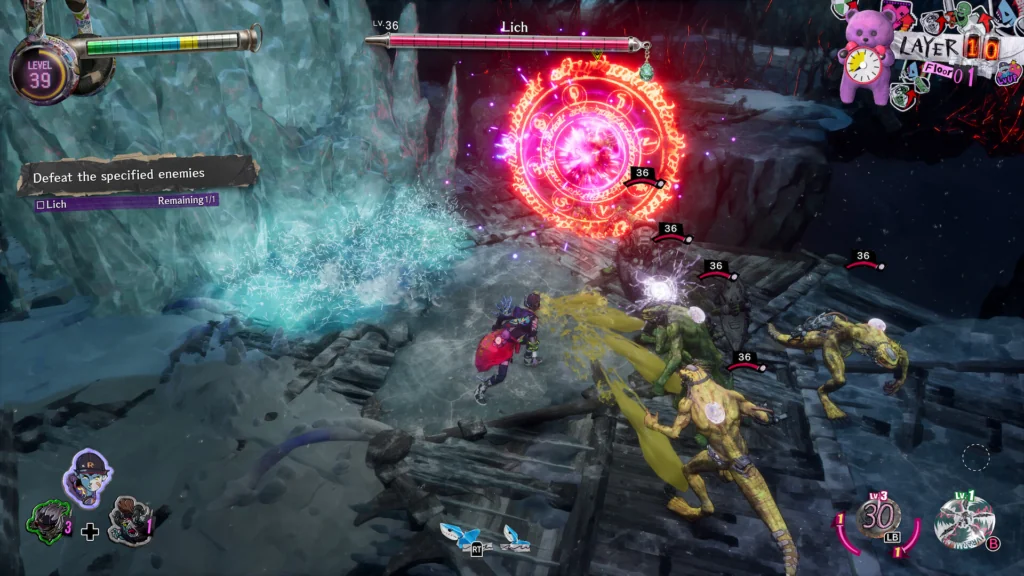
Your runs also have a time limit, but it feels arbitrary. When Davy’s time limit expires, he starts to quickly deteriorate. His health is constantly dropping, and the screen gets all warbly. It’s incredibly annoying, especially when you finally make it to a dungeon's final floor and know you don’t have enough time to take out the boss. You can also skip certain floors to beat the timer, but at the cost of losing potential level-ups and perks. Davy’s EXP multiplier offsets that loss and keeps runs from feeling too drawn out. It’s surprisingly well-paced. You can pick floors that reward you with bonus time upon completion, as well as reaching certain floors, but I wish there were more options to replenish the timer.

Though, the biggest problem I had with Stupid Never Dies was its lack of a lock-on. In a game with such chaotic combat, being able to target a problematic enemy would’ve been useful and would've saved time. In particular, harpies and rocket launcher-wielding enemies were the most frustrating. I would prioritize taking out these long-range attackers because their attacks would hit me from offscreen, leaving me vulnerable to follow-up attacks from other enemies on the ground. Aerial enemies like harpies were the most frustrating enemies to fight in the entire game. It was hard to triangulate their positions because they flew around, making me miss my attacks constantly.
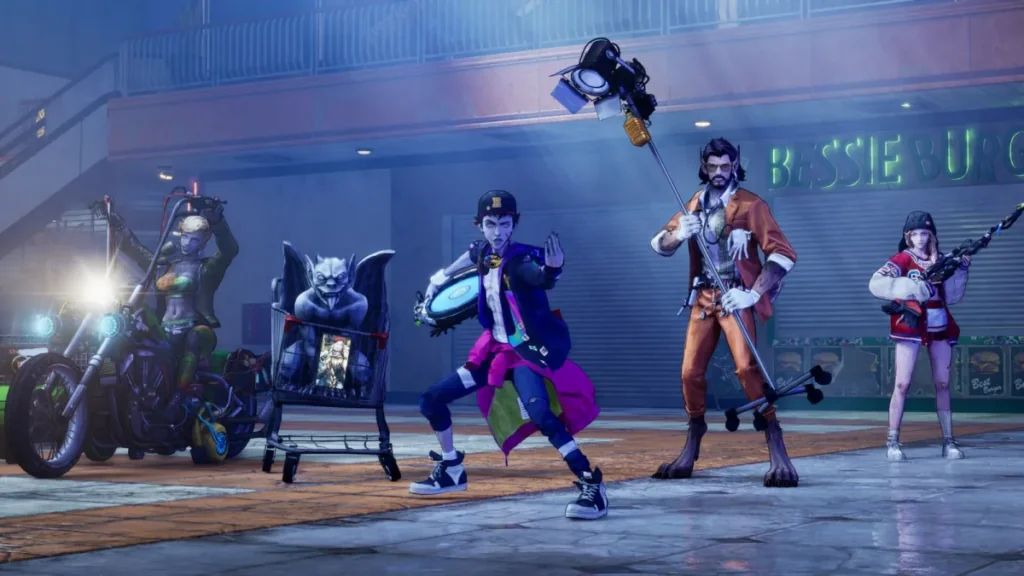
Additionally, Davy’s main healing method is biting other enemies. Without a lock-on, I kept whiffing my bites, resulting in premature death and runs cut short. The absence of a lock-on seems to be intentional, but it’s a decision that ended up backfiring. Combat as a whole often feels flimsy, and a simple lock-on would’ve gone a long way toward fixing that.
Stupid Never Dies is a decent first outing for a studio founded by veteran developers of legendary franchises like Resident Evil and Devil May Cry. It has a clear vision, an intriguing aesthetic and art direction, and a goofy yet earnest story. After all, Davy’s on his way to reach his full potential. If the gameplay were tightened up a bit, Stupid Never Dies could’ve done so too.
