
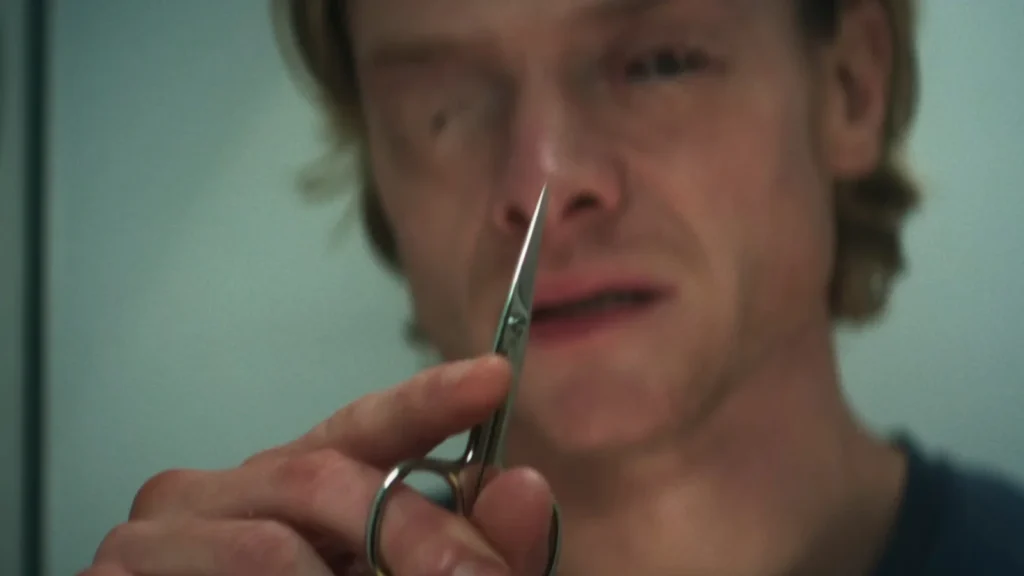
Clayface might be the year’s most shameless pastiche, cycling through elements that evoke everything from A Different Man and The Substance to The Thing, Darkman, Scarface and Carlito’s Way, to Martin Scorsese’s 1967 short film The Big Shave and Luis Buñuel’s Un Chien Andalou. That’s not even to mention the enormous shadow of Lon Chaney, the silent film actor known as “the Man of a Thousand Faces.” But then again, it seems appropriate that a movie about an actor with the power to transform himself completely should be going through a bit of an identity crisis itself.
Directed by James Watkins (The Woman in Black) from a script by Hossein Amini (Drive) and the ubiquitous Mike Flanagan (Carrie), Clayface is a body-horror film and supervillain origin story all in one. For better or worse, the result of such an endeavor is neither fish nor fowl — never quite scary enough to do more than gross out its audience, while its connection to the DC Universe feels tenuous at best (of all the films it draws from, Batman does not feel like one of them). Though he has the eponymous character's charm, Tom Rhys Harries wrestles uneasily with the challenge of balancing the film’s disparate aims, while Naomi Ackie leads a gifted supporting cast that seems to constantly debate how seriously to take the material.
Harries plays Matt Hagen, a successful actor who just received Gotham's version of an Oscar nomination for Best Actor. On the night he goes out on the town to celebrate with his childhood best friend Corey (Joshua James), Matt picks up Mia Torrez (Joana Ribiero), a more than eager young woman who happens to be the girlfriend of crime lord Markos Szabo (David Dencik). Szabo, none too pleased with Hagen, decides to exact revenge by slashing his face with a knife. But when Matt attempts to press charges, Szabo leverages his connections with the Gotham police department to escape punishment while mounting a smear campaign that ruins the actor’s career and reputation.

After losing his agent, his manager, and all of his money, Matt moves to Gotham’s slums, where even there he’s considered an outcast. But when he discovers Dr. Caitlyn Corr's (Ackie) medical research, a promising but untested treatment using nanites to help patients with degenerative illnesses, he reaches out in hopes of convincing her to try it on him.

She reluctantly agrees, setting in motion a series of unexpected changes—first when the skin of his eyelids seals over his eyes, then when his face fully transforms. As his mind and body become increasingly unstable, Matt becomes determined to avenge his irreversible losses, forcing Caitlyn to decide whether to keep helping him or activate a switch that would deactivate the nanites coursing through his body but possibly kill him in the process.
As Todd Phillips’ Joker showed, there's room for individual stories based on DC Comics characters that take a unique approach to the source material and aren’t connected to a larger cinematic universe; in other words, there is absolutely room for a Clayface origin story that’s a horror movie. The problem with Watkins’ film is that it seems reluctant to go fully in that direction, and instead follows in the footsteps of projects like The Penguin, where storytellers haven’t been given full access, only proximity to existing canon.

Unfortunately, in this case it’s become a siren song that they can’t turn far enough away from. The result is a low-budget superhero movie grafted onto a low-budget horror movie to create middlebrow entertainment — featuring some grisly stuff to be sure, but that stuff feels more obligatory than inspired.

Consequently, the film wears its cinematic influences on its sleeve in search of style it doesn’t have the confidence to develop itself. It’s impossible to watch Matt’s flesh bubble and distort and not think of Elisasue in The Substance; for body parts to split, open up and explode like in John Carpenter’s The Thing; meanwhile, in the production design, pivotal scenes take place in a club that echoes one in Brian De Palma’s Scarface, and for good measure costume designer Keith Madden puts Szabo’s girlfriend in a satin slip dress that’s the same color as Michelle Pfeiffer’s. The thrill of recognizing a reference to The Godfather Part II is severely diminished by how perfunctorily the iconic moment is recreated, but sadder still is the realization that there are no original ideas to pair it with.

Harries’ on-the-cusp status as an actor serves the character well, but A Different Man ate this film’s lunch without even knowing it was doing it, first by casting the actor’s better-known lookalike, Sebastian Stan, but also by probing ideas about beauty and identity much more deeply than this one ever does. Suffice it to say that writer-director Aaron Schimberg is telling a different story, one at least rooted in reality; importantly, Stan’s character is disfigured by neurofibromatosis rather than an act of violence.
But Schimberg uses that idea to examine how the seemingly straightforward process of transforming a person’s physicality does not repair the psychological damage that can develop from internalizing being treated as different or unattractive. Flanagan and Amini’s script tries to hammer home the fact that Matt grew up feeling insecure and inferior, and that fed his apparent talent as an actor. But even if what happens to him is plainly awful, the movie barely skims the surface of his self-image, instead lapsing into a familiar, uninspiring revenge story.

Otherwise, the supporting cast is too full of pedigreed actors with too little to do. Ackie seems to go through the motions in the love triangle that develops between Caitlyn, Matt, and John. You have to wonder what sort of payday Eddie Marsan received to play such a slimy, one-dimensional character. Dencik fails to bring interesting notes to Sazbo in the way he did Valdo Obruchev, the corrupt scientist in No Time To Die. A role like Mia Torrez could have been something more special, a gangster’s girlfriend whose infidelity feeds some part of her relationship, much less her individual identity, but the best Joana Ribiero gets is a great introduction set to an even greater Goldfrapp song.
Despite its many conspicuous influences, the best movie to return to for context after watching it is Joker. Lightning struck when that was released in 2019—and notably, it did not strike a second time when Phillips returned to the character—but you can imagine the decision-makers greenlighting anything with even a morsel of DC intellectual property to build on, hoping to create another zeitgeist-y sensation.

Somewhat tellingly, Phillips borrowed heavily from The King of Comedy and a number of other films to create his — and he was able to deliver something in the end that stands on its own. By filling the gaps between two genres with beloved but ultimately basic references, Clayface lacks a sturdy, singular, authoritative foundation, so its few charms fade before the film can form something more substantial.
Who knows, perhaps you'll feel differently. To find out for yourself, Clayface is currently playing in theaters everywhere.