

Last Updated on March 16, 2024 by Rich Johnson
“The kidnapping of children by preternatural forces is a plot device as old as ‘The Pied Piper”’ ― Tobe Hooper
Underneath the Cuesta Verde Estate, a more hidden threat is at play. Invisible. At least to begin with…
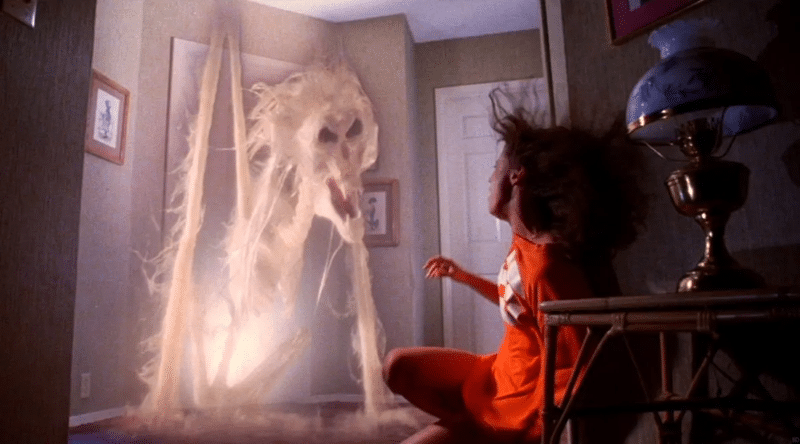
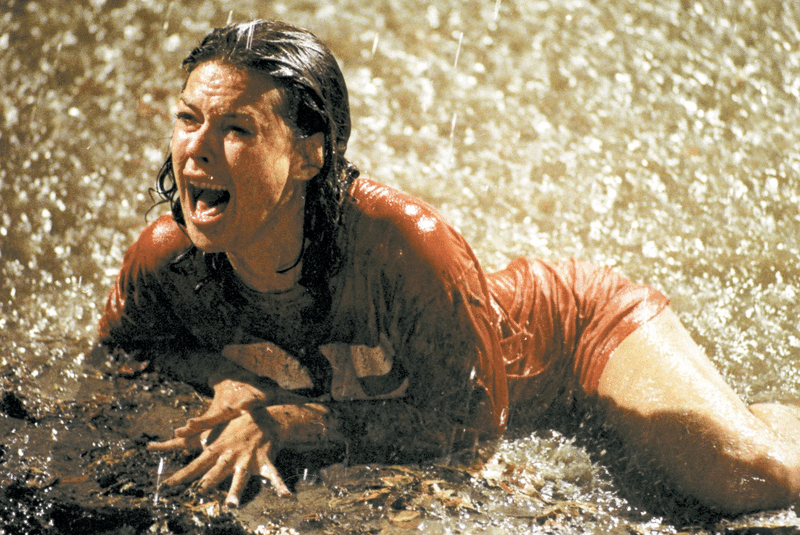
This is the first “Star-Spangled” end to a night. Everyone is asleep. That is until the five-year-old daughter awakens. Seemingly lured downstairs by unheard voices ― lit up by strobing TV static ― she proceeds to “channel” something else entirely through the television. After Jerry Goldsmith diffuses us with a sentimental cue of “The Neighborhood”, what follows is a heady mix of PG-rated terror: the portent of a dead canary, an ominous-looking tree, a possessed toy clown, crawling food, body horror, and apparitions caught on camera. In its implosive climax, the “Green Slope” becomes a bloody mudslide into a rain-filled pool of rotting corpses [1], a hint of Lovecraftian nightmares, buckets of ectoplasm, and an entire house pulled into a portal to the “other side.”
All this and Poltergeist remains one of the most feel-good gateway horror movies you will ever find. Curses [2] and controversies [3] hopefully laid to rest, this piece is more a portal to the history of celluloid ghosts, personal childhood reflections, and how the Freelings are the epitome of the “Happy Family” ― white America and the “Dream” ― as their lives turn into a Reaganomics, suburban nightmare.
Spirits of cinema
Depictions of ghosts first appeared on screen via a number of short silent films by French pioneer filmmaker Georges Méliès during the late 1890s. Le Château hanté (aka The Haunted Castle, 1897) is Méliès’ most well known of these early supernatural works. It is also credited as the first-ever horror film, showcasing vanishing furniture, skeletons, ghostly figures, and the Devil. The same year, the inventor of film editing, George Albert Smith, patented a double exposure process, having been influenced by photographer William Turner. It would make sense that his lost film, Photographing a Ghost (1898), would have made use of this effect.
![The EVENT HORIZON Sequel Is ALIENS In Hell [Exclusive]](https://www.fangoria.com/wp-content/webp-express/webp-images/doc-root/wp-content/uploads/2026/03/EventHorizon-Inferno-CoverRBG-Cropped-2-300x169.jpg.webp)
Stateside, Häxan director Benjamin Christensen’s The Haunted House (1928) arrived just before the Universal monsters placed a Hollywood spin on the Gothic with their more tangible creatures of the night. Set in Cornwall, Lewis Allen’s The Uninvited (1944) (more on this later) is a romanticized version of England and the first genuinely realistic depiction of a ghost on screen. Although relying on more restrained approaches, natural successors include Jack Clayton’s The Innocents (1961) and Robert Wise’s The Haunting (1963); a particular influence on Tobe Hooper.
Two years before Hooper’s The Texas Chain Saw Massacre, an overlooked TV movie by Steven Spielberg, also remains an early example of a rural haunting and possession. Something Evil (1972) was to Poltergeist what Duel (1971) was to Jaws (1975). It showcased both Spielberg’s Rockwellesque hallmarks of chocolate box sentiment ― affluent white family of four, even a young blonde-haired daughter ― coupled with a foreboding quality; “The land breathes like any man, indifferent as one is to another. Good and bad.” Most importantly, it predates the wave of possession and haunted house movies that followed throughout the ’70s and early ’80s with The Exorcist (1973), The Legend of Hell House (1973), The Amityville Horror (1979), The Shining (1980), The Changeling (1980), The Fog (1980), and Ghost Story (1981).
Based on Spielberg’s story ― another offshoot of his “evil ET” script, Night Skies ― writers Michael Grais and Mark Victor were hired to work with him on the script. As documented in issue #23 of FANGORIA, there are also some “plot similarities” to Richard Matheson’s Twilight Zone episode “Little Girl Lost” (1962) [4] that apparently caused some controversy. “‘It was noticed,’ says Hooper, ‘but only after the fact.’” Spielberg is also linked to Matheson’s work via Duel, but wider influences and more personal motivations exist. Where Spielberg drew from his childhood nightmares, Hooper experienced poltergeist activity soon after his father died.
Perhaps the most influential (news) story that permeated ’50s America was the haunting of the Herrmann family in 1958, which drew so much attention it became the subject of an article in Life Magazine. Again, much like the Freelings, their home was not the old haunted house but a suburban model of the American dream. Similar to parapsychologist Dr. Lesh (Beatrice Straight) and her assistants during the second act of Poltergeist, a Dr. J.B. Rhine ― director of Duke University’s Parapsychology Laboratory ― visited with his colleagues to record what happened.
Spielberg hired visual effects supervisor Richard Edlund, mechanical effects supervisor Michael Wood, and Industrial Light & Magic optical photography supervisor Bruce Nicholson (nominated for an Academy Award on the film) to capture their own ghosts on camera. Having just completed work for Spielberg on Raiders of the Lost Ark (1981), it made sense they brought the same magic; the Ark’s spectral forms a natural precursor. The three men and the rest of their team were crucial to the film’s success; the varied effects integral in ramping up the tension throughout. What starts off subtle morphs into something louder, moving somewhere between The Entity one moment and Ghostbusters the next. After the subtle TV static whispers, stacked chairs appear followed by flying objects ― the most difficult matting sequence Edlund had ever worked on ― a full-size hell-mouth, and, finally, home implosion. The latter one of the best examples of early ILM model work and practical effects before they harnessed (and mastered) CGI.
Family spirit
The Freelings are as far away from Tobe Hooper’s cannibalistic family in The Texas Chain Saw Massacre as one could travel. Less Leatherface, more peeled face; post-Vietnam anxieties are replaced with a capitalist Band-Aid and Spielberg’s Amblin vibe that still manages to provide a healthy serving of Disturbia. Despite what some may think, the collaboration of Hooper and Spielberg managed to push the film to its absolute limit when it comes to a “wholesome” movie rating. PG-13 wasn’t invented until 1984, so, in true commercialized fashion Poltergeist was originally released as a PG; the strongest example of how much the MPAA were cajoled into what was essentially an R-rated movie.
When we think of what is (perceived to be) the traditional, wholesome family, cinema often provides a romanticized version. Of course, if the characters are believable enough in the circumstances presented to them, we relate, regardless of our backgrounds. More than ever, Poltergeist is glaringly white ― a product of its time ― and a distinct contrast to 21st-century horror that provides a collective trauma through more diverse examples of supernatural narratives. These include Ring (Japan, 1998), Lake Mungo (Australia, 2008), international co-production Under the Shadow (Qatar / Jordan / UK, 2016), and haunting immigration tale, His House (UK, 2020).
Poltergeist’s nationalism ― its “united front” ― paints a picture of the family unit and the role a mother and father play. In this instance, protecting their children, which is one of the most relatable themes of all, whether from the perspective of a parent or child. The Freelings are not the satirical inversion of Charles Addams’ New Yorker cartoons, nor are they the humble Kents. They are much closer to the Brodys before them and the McFlys after, who are distinctly defined by what we deem to be “Spielbergian”; families facing insurmountable odds, whether broken or intact. Through this lens, Spielberg is the best of nostalgia; a comfort blanket for those brought up on his work ― now filmmakers themselves ― who often default to their “stranger things” and retro aesthetics.
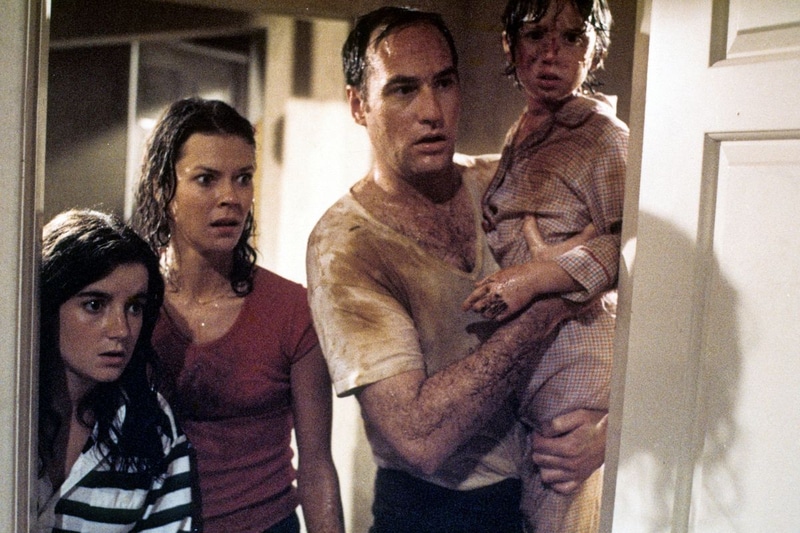
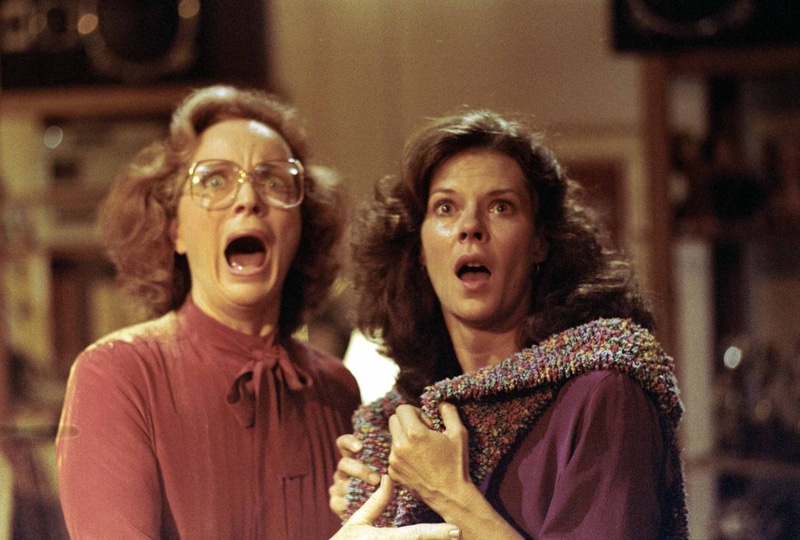
The Freeling kids ― teenager Dana (Dominique Dunne), Robbie (Oliver Robins), and Carol Anne (Heather O’Rourke) ― are at the heart of the film, but it is Jobeth Williams’ performance as their mother, Diane Freeling, that is the bedrock of the family. Mr. Incredible himself, Craig T. Nelson, plays Steve Freeling with a hint of vulnerability [5] ― cracked wide open in the sequel ― a father wrestling with insecurities and the potential failure of protecting his family against something he is (unknowingly) part of. The chemistry is perfect, an unwritten history elevating things even more during those powerful and climactic moments when they attempt to save their children from forces beyond their control.
Uninvited memories
As with most British kids of my generation raised on the fringes of a grey engineering town, America was our bubblegum shtick. It tasted “fuckin’ fantastic.” My British suburbia was a cul-de-sac, a walled-off brook at the bottom. This was the border that separated us from the safe haven of the neighborhood and the beckoning wide-open space beyond. This was our (small) frontier; farmers’ fields, old ruins, ancient footpaths, and hallows that fed the imagination; harkening back to a pre-colonial history we had no realization of. Here were the original myths, legends, and folklore; our metal detector medievalism evoking (and provoking) the classic terror of older, more Gothic ghosts.
However, despite its Americana, there is a great deal I relate to when it comes to Poltergeist. Not only was I brought up in a relatable environment with a Labrador and Retriever; at five, I was obsessed with climbing trees and getting lost. There were the worksites of the other houses being built, where I would sneak off and climb into the holes of waterlogged foundations and release the handbrakes on dumper trucks. Of course, my parents had a heart attack when they found this out. Handful that I was, these are many moments I look back on and, being a parent myself, realize more than ever how precious your child is, how much we fear losing sight of them.
My memories of home life were the perfect example of two (great) parents doing the best they could to nurture and protect. This is the epitome of what Poltergeist is about, tapping into the anxieties of both a child’s fevered (and fuelled) imagination and the fear of parents searching for a missing child. As with all good parents, The Freelings will stop at nothing to find Carol Anne. But she’s not wandered off onto some building site, open field, or park… she’s abducted and lost in another dimension entirely.
From my point of view, I’m going to paint an even more defining moment. Most of us brought up during the ’80s recall the TV sign-off routine ― our national anthem (yay patriotism) “God Save the Queen” ― ushering in midnight. The only times I recall this as a kid was if I was poorly. Anyone who suffered from croup will relate to how fucking terrifying (and painful) it was to cough up razor blades. To fix it, my parents would hold the kettle button down to steam up the room as much as possible, and, in my delirium, as the room fogged up, my tired brain (possibly doped up on medicine) focused on the apparitions. It cured the croup but fuelled the nightmares.
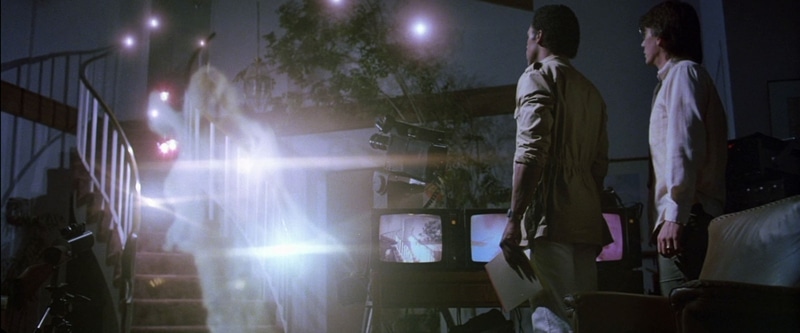
There’s also a serendipitous spirit at play that will segue into a key reference already briefly mentioned. I recall one year being poorly again. Unable to sleep, I dozed in and out of consciousness with an old black and white movie that turned out to be The Uninvited. Its spectral imagery was surprisingly effective and genuinely terrified me. My parents obviously naïve to the film’s impact. It was an easy mistake to make, in hindsight; the comedy (and tonal imbalance) is enough to fool anyone. There is also the realization that Poltergeist ― specifically visual effects supervisor Richard Edlund’s optical photography ― owes a great deal to The Uninvited.
As alluded to already, Allen’s film is often regarded as the first full-length horror to treat haunted houses and spirits seriously. The influences on Poltergeist are more than apparent, from the outstanding female apparition on the staircase (cut out for British audiences) to an old tree that is almost identical to the one that comes alive in the Freelings’ backyard. If all of this wasn’t enough proof, Diane’s third act line, “Smell that mimosa,” is an obvious nod to Spielberg’s appreciation of this supernatural classic; the flower’s scent a key device in The Uninvited that triggers the presence of a ghost. In his Criterion essay, Farran Smith Nehme describes the ghost as, “… a mist curling like opium smoke and topped by an indistinct face. (The effect is enough like the spirits that swirl through the climax of Raiders of the Lost Ark to suggest that Steven Spielberg knows this film too).” [6]
What lies beneath…
American columnist and author Bill Vaughan once said, “The suburb is a place where someone cuts down all the trees to build houses, and then names the streets after the trees.” On the Cuesta Verde Estate ― “where dreams come true” ― the developers cut down gravestones and leave the nameless bodies under your new family home. The only hint of irony; one of their employees has just moved in with his family and, before Steve learns the morbid truth, is offered an even better view across the valley. Poltergeist spoke to an audience ― mainly the aspiring white middle class ― brought up in a modern society, where the safety of these “relatable” areas was brought into question. Interviewed for issue #19 of FANGORIA at the time, co-producer Frank Marshall highlighted, “Rather than in some old house … [Steven] decided that we should do it in a setting that is normal almost to the point of abnormal.”
However, say all you want about Spielberg’s influence and Amblin vibes, a lot of the (grim) satire can be attributed to Hooper’s more liberal chainsaw history of cutting straight through the heart of America. Poltergeist, zeitgeist; the film perfectly reflected ’80s commercialism and consumerism; a result of Reagan’s “free economics” that had reverted to more conservative “traditional values.” Here, there is a constant drive for the perfect home (and lifestyle), room for a pool but a little less room for “family values.” This isn’t to say the Freelings are not a “good” example, but, if anything, they become a much stronger unit once the ghosts remind them of what really matters.
So, what appears to be just another “beautiful day in the neighborhood” [7] is merely a veneer for something more corruptive buried right under our noses. For the most part, the themes are laid on as thick as the gore; some of which have been misconstrued. There is a Mandela Effect at play, and with it, the assumption of a more ancient trope. “The concept of the Indian Burial Ground is so strong that it finds its way into places it doesn’t even belong.” [8] Yet, despite this interpretation, it remains a crucial (if somewhat distorted) element in exploring deep-rooted national guilt. Truth: America is a Native burial ground… the entire landscape an indigenous (scattered) grave. More explicitly, Poltergeist exposes capitalism for what it has become; having profited from colonialism, it is now our white ancestors we build on top of. Generations we eventually find are buried on top of the remains of an apocalyptic death cult and perhaps, outside of the film’s narrative, more ancient bones.
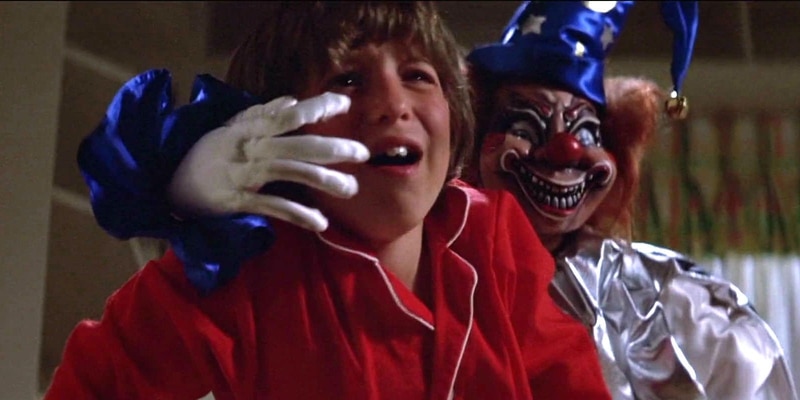
Rather than “muddy” itself too much, this is a horror movie that relies on pop culture and iconography, leaving most of its skeletons in the same closet Carol Anne disappears into. On the surface, it feeds into the childhood fears Spielberg intended ― of scary clowns and monstrous trees ― but also goes much further with its symbolism; “all-white” angelical references, a hellish portal, umbilical ropes, and the wizardry of a Dorothy-scale storm. Although primarily a fairy Godmother, there is also a child-like nature to the clairvoyant Tangina Barrons (Zelda Rubinstein). She is tender, yet brutally honest. Her bone-chilling speech addresses the Freelings’ situation head-on; the truth that their “lost child” is about to be deceived by an evil spirit, “It lies to her. It tells her things only a child can understand. It’s been using her to restrain the others. To her, it simply is another child. To us, it is The Beast.”
A distinct loss of childhood is also at the film’s core. Although tonally, this is by no means Friedkin’s The Exorcist, Spielberg’s more innocent approach still taps into theories of possession and hauntings intrinsically linked to pubescent children. The same parapsychologist who documented the Herrmann house also believed that the presence of adolescents ― specifically teenage girls ― might have attracted these “noisy spirits”, based on the nature of reported poltergeist activity. Yet, it’s not just about the “children.” Even the parents’ “activities” highlight how much Steve and Diane claw onto their adolescent (pot smoking) lifestyle as we watch them forced to grow up and take responsibility; by the end jorts and sneakers are replaced with slacks and white streaks of hair. Less fashionable but all the wiser.
Once more, with Freeling
How do you make a new house scary? You look underneath it. Poltergeist still provides a genuine supernatural threat that reveals the greed and corruption of capitalism and, in turn, its haunted homeland. The TV becomes a conduit, media as a medium. Of course, Hideo Nakata’s Ring and Kiyoshi Kurosawa’s Pulse took such concepts further; definitive J-horror exploring other ghosts in the machine via video and the internet. These haunted (red) rooms and other uncanny suburban spaces simply shift (or change channel) to their respective cultures; the rise of hauntology ― the postmodern nostalgia that is often laced with fear and dread of the unknown ― a ghost manifest.
Now, the static has been replaced with constant streaming. Maybe here there is a legacy version of a Freeling. An adult Carol Anne. She doesn’t look at any screens; simply lives her life far away from the “TV people”; the strange, quirky aunt beyond suburbia; a clairvoyant who shows us that the screen no longer speaks to us… but possesses us all.
- It is a fact that medical skeletons were used in the pool scene. Many horror movies employed this because it was cheaper than making them.
- Read into it what you will; from the murder of Dominick Dunne several months after the release of Poltergeist to Will Sampson’s passing in 1987, and the tragic death of Heather O’Rourke during the filming of Poltergeist III in February 1988.
- In FANGORIA #19 (pp.57), producer Frank Marshall stated, “It was a collaborative effort. Tobe directed it, while Steve was the guiding force.” Make sure you read Hooper’s own “personally damaging” perspective in FANGORIA #23 (pp.28). You can also listen to FANGORIA’s Vanguard of the Vault, Natasha Pascetta who summarizes further via “It Came From the Vault – Poltergeist” (2019).
- Based on his 1953 short story first published in Amazing Stories, on which Spielberg would later base his anthology TV series.
- Insecurities of fatherhood and the strength of the mother are a Spielberg trait, taken from personal childhood experience. Fathers are often portrayed as distant and/or absentee figures, as seen in the rest of his “Suburban Trilogy”; Close Encounters of the Third Kind (distant/distracted father) and ET the Extra-Terrestrial (single mother).
- Criterion “The Uninvited: Spirits by Starlight” by Farran Smith Nehme.
- “Who the hell is this guy?” The jock neighbors of Cuesta Verde are that ignorant, they have no idea who Fred McFeely (aka “Mister Rogers”).
- Most of this is down to audiences misreading the presence of Native American character, Taylor, from Poltergeist II: The Other Side who acts as a spiritual guide for Steve Freeling and Mr. Teague’s flippant reference. Atlas Obscura’s, “Why Every Horror Film of the 1980s Was Built On ‘Indian Burial Grounds’” by Dan Nosowitz (2015) is a good summary.
