

Last Updated on March 16, 2024 by Lea Anderson
Of all the monsters that lurk in the archives of horror and the Gothic, the vampire perhaps commands the most cultural allure. In case you forgot Twilight’s goofy peak-aughts search engine sequence, vampire folklore long predates the monster’s appearance in literature. Nevertheless, it pretty much goes without saying that the modern Western vampire coalesces in the body of Dracula, Bram Stoker’s 1897 novel.
Jack Halberstam calls Dracula the embodiment of “otherness itself”: “…monster and man, feminine and powerful, parasitical and wealthy; he is repulsive and fascinating, he exerts the consummate gaze but is scrutinized in all things, he lives forever but can be killed. Dracula is indeed not simply a monster but a technology of monstrosity…always also technologies of sex.”
To Halberstam, the nineteenth century Gothic novel (in this case, Dracula) is a vehicle through which authors (in this case, Stoker) merge “historically specific contours of race, class, gender, and sexuality” into the composite body of the monster (in this case, the vampire); the process through which they “produce perverse identities.” The production of Dracula’s “foreign sexuality” creates the privileged position of white Victorian “native sexuality,” and therefore the problem of “normal versus pathological sexual function” that forms the novel’s core tension. Dracula and the other vampires’ monstrosity is predicated on the threat their appetites (sexual and otherwise) pose to middle-class white Victorian power.
While the queer nature of the vampire commands much of the discourse around these monsters, I want to address the racial and national aspects of their construction.

The monster is a technology in constant motion, and Stoker’s Dracula is a prime example of what Halberstam refers to as “Gothic anti-Semitism,” which is to say, the use of the gothic to manufacture antisemitic stereotypes that “tell us nothing about Jews but everything about anti-Semitic discourse.”
Dracula’s aesthetic “appearance, his relation to money/gold, his parasitism, his degeneracy” build on a legacy of antisemitic mythologies – particularly those pertaining to blood libel – designed to racialize and essentialize Jewishness into a physiognomy that allows power to “mark the other as evil so that he can be recognized and ostracized.” The Jewish body of the antisemitic imagination was constructed as parasite, as vampire, as The Swallowing.
If any part of this method sounds familiar, it’s because the same strategy has been used to cast Black, Indigenous, queer, trans, disabled, neurodivergent, and/or other marginal subjects as prone to laziness, criminality, mental and genetic inferiority, “bad blood,” and an essential “foreignness” (a truly perverse irony) confirmed through the manipulations of medical and scientific racism, ableism and so on. It’s also part of the unique grotesquerie of Israel’s weaponization of these same technologies to justify and enact the ethnic cleansing of Palestinians, an atrocity which effectively transforms “the Jewish state” (installed and funded by US and British imperialism) into the very monster these same powers designated us to be – which doesn’t make the narrative any less antisemitic. Again, the monster is a technology in constant motion.
So, what of the Black vampire? Though nearly swallowed by the archive, the very first vampire story penned by an American author was not only written about a Black vampire, but also constructed as an abolitionist narrative nearly eight decades prior to Dracula.
Published in 1819 to an author whose identity remains inconclusive, The Black Vampyre is set in Haiti, and frames itself essentially as a revenge narrative. A slaveowner, Personne, makes repeated attempts on the life of an unnamed enslaved child who simply refuses to die. Through a series of events, the slaveowner turns up dead, both the child and Personne’s infant son gone. The pair return years later, grown, elegant, refined, described as akin to a “Moorish prince,” and he takes the hand in marriage of Personne’s widow, whom he turns on their wedding night. The narrative sees him unite the vampires and enslaved in revolt against their oppressors (unsuccessful) and also father a biracial vampire child.
![The EVENT HORIZON Sequel Is ALIENS In Hell [Exclusive]](https://www.fangoria.com/wp-content/webp-express/webp-images/doc-root/wp-content/uploads/2026/03/EventHorizon-Inferno-CoverRBG-Cropped-2-300x169.jpg.webp)
While it reflects all manner of anxieties surrounding African spiritual practices, the Haitian Revolution (concluded in 1804), and miscegenation, its most intentional commentary – similar to its English predecessor, Polidori’s The Vampyre – is to align true vampirism with the American equivalent of aristocracy: Wall Street, and all those who profited from the business of enslavement and exploitation.
A century and a half later, these same narrative movements would appear in a newer vehicle: the horror film. 1972’s Blacula sees Prince Mamuwalde cursed with vampirism after an eighteenth-century dispute with The Count regarding the slave trade. The following year, its sequel, Scream Blacula Scream! is released, and Bill Gunn reimagines the vampire mythos entirely to center anxieties about agency and addiction in Ganja and Hess. I’d also be remiss not to mention Octavia E. Butler’s 2005 novel Fledgling, which similarly reimagines the vampire with a sci-fi spin. What do the ways these narratives are reimagined, reframed or simply adapted indicate about how attitudes toward race, class, gender and sexuality intersect with the vampire’s evolution as one of our culture’s most popular monsters?
Blade
In a 2017 essay for Graveyard Shift Sisters, Tarik R. Davis reads Blade as an allegory of sorts for the now-decades of anxiety surrounding Barack Obama’s racial and national heritage. The comparison, while specific, is solid: Blade’s central conflicts all reflect the anxiety of purity logics rendered as a tool of oppression.
A human-vampire hybrid known as the “Daywalker,” Blade (Wesley Snipes) supposedly moves with “the best of both worlds,” which is more to say that his vulnerabilities aren’t immediately legible. In this world, the vampires have their own hierarchy of “pure bloods” (those born vampire) who laud power over those merely turned. Where Blade sees his vampirism as something equivalent to contaminate and curse (following the likeness of earlier Black vampires), Deacon Frost (Stephen Dorff) sees in his hybridity the opportunity to obliterate the vampire hierarchy and seize dominance over humankind through invocation of La Magra, the Blood God, said to unleash a “vampire apocalypse.” The Daywalker’s blood is, of course, the key to this invocation.
Like The Black Vampyre, Blade’s subtext points to anxieties around miscegenation or “race-mixing,” coded in the language of “half-human, half-vampire” and ideas of blood purity, blood quantum and social Darwinism – all of which make up the language of white supremacy. The apocalypse Frost desires echoes the race war fantasy often produced by the white imagination (also known as “the Great Replacement”), which perceives Blackness, Indigeneity, certain types of Jewishness and so on as an inherently contaminating presence that requires either subjugation or annihilation.
In the other direction, Blade’s views of his own vampirism mirror many of Malcolm X’s views of his mixedness, or rather, his rage toward his mother’s father whom he describes as a “raping, red-headed devil” in his Autobiography. “If I could drain away his blood that pollutes my body, and pollutes my complexion, I’d do it! Because I hate every drop of the rapist’s blood that’s in me!”
While reference is never made to Blade’s birth father, we do discover Frost is the vampire who bit his mother and infected him as a result, making Frost a father of sorts. We also learn Blade’s mother did not in fact die from the bite as he previously believed, but turned, and has been with Frost ever since. Like X, Blade holds this interconnectedness in contempt; is even referred to as “Uncle Tom” by Frost for his allegiance to the humans who fear and reject him. “What difference does it make how their world ends?” Frost asks. “Plague, war, famine. Morality doesn’t even enter into it. We’re just a function of natural selection, man. The new race.” The occasion of The Swallowing does not merely lie in the vampires’ consumption of blood, but in the threat posed by their hybridity to both the humans and pure blood vampires alike – which is to say, their hybridity threatens the very notion of purity as a privileged concept.
If we read Blade as biracial, his narrative is one that recognizes multiraciality does not inherently mean a person is light-skinned or white-passing; narratives which have an oppressively out-sized presence in the archive. Blade complicates the trope of the Tragic Mulatto, even as the character, like all superheroes, maintains an air of martyrdom. Despite his self-loathing, Blade rejects the cure developed by Karen (N’Bushe Wright) in service of what he perceives as a greater good: “There’s still a war going on, and I have a job to do.”
The film ends as he faces off with communist vampires in Moscow, a detail that, while minor, is highly indicative of Marvel’s role as a hand of the US empire. In this usage, communism is the degenerate parasite that threatens the health of global order – or rather, the interests of American power.
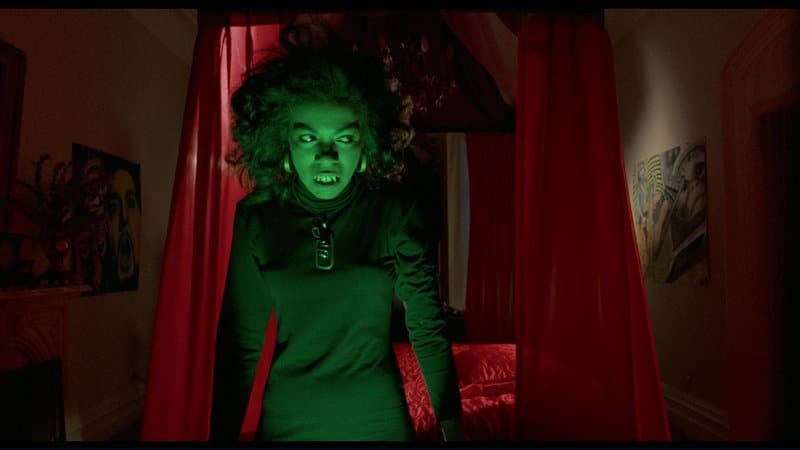
Def by Temptation
Def by Temptation is Black Horror as overt morality tale but reads closer to 1974’s Abby than, for instance, Blacula or Tales from the Hood. It also isn’t, strictly speaking, a vampire film but uses the figure of the succubus – an incarnation of the vampire – for its specificity as a feminine monster.
James Bond III writes, directs and stars as Joel, the orphaned son of a minister (Samuel L. Jackson) – and minister to be – whose parents passed in a car accident when he was a child. Grown and undergoing something of an existential and spiritual crisis, he reunites with his childhood best friend, K (Kadeem Hardison), a movie star in New York. The film concerns their individual and mutual encounters with a gorgeous succubus known only as the Temptress (Cynthia Bond), who lurks at the end of bars, chain smokes, basks in the glint of her gold-painted talon-nails, and eats duplicitous men for dinner.
Yeah, she’s a demon. But personally, I love her.
Like its spiritual predecessor, Abby, Def by Temptation is obsessed with questions of sexual propriety, deviancy and purity, which is to say, it’s an overtly Christian film. Released in 1990, it presents a fairly dualistic image of masculine cishet Black American life: the traditional and respectable embodied in Joel, contrasted against the Temptress’ other victims, all of whom lie and cheat in some capacity. K and Dougy (Bill Nunn) – a cop monitoring the Temptress as part of an X-Files-esque government operation – occupy a sort of third term: would-be victims saved by a combination of street smarts and dumb luck. The condition of Joel’s soul forms the film’s core tension, and the Temptress, the embodiment of The Swallowing that threatens it.
Not so much Eve but Lilith, the Temptress is described as existing “in every inclination toward hatred and in every tiny desire that would threaten the conscience of man, the part of man that seeks god and good. This spirit, which can only be referred to as ‘it,’ uses sexuality to hold morality hostage…to seduce the unconscious…to prey on the weak-minded…for the purpose of seducing and destroying that soul. In the game of sensual manipulation, it is unrivaled.”
A textbook representation of a Jezebel caricature, she also embodies the monstrous-feminine as a figure designed to police borders of acceptable femininity. The succubus, like the vampire, is explicitly tied to monstrous appetites and sexual behaviors. She represents one of the many demonstrations of the vampire figure as sex symbol, which ungenders her within the film’s logic (and white supremacist patriarchy’s). Her monstrosity arises not solely from her appetites, but the appetites she inspires in others. What threatens to consume Joel’s soul is not just the succubus, but the temptation she embodies: a lure away from the church.

Suicide by Sunlight
Like Blade, Suicide by Sunlight revises the “creatures of the night” aspect of the vampire mythos. In Nikyatu Jusu’s 2019 short, all Black vampires are day-walkers, protected by their melanin, the absence of which renders white vampires more “disenfranchised.” We follow Valentina (Natalie Paul), a nurse, at what appears to be a cultural moment similar to True Blood’s “coming out of the coffin,” where vampire existence has become known to the human population. She spends much of the film either caring for a little boy named Micah (Destin Khari), a patient at the hospital where she works, or trying to speak with her two daughters, Hope (Juniah Williams-West) and Faith (Madison Spicer), whose father, Langston (Motell Foster), prohibits contact between them.
A tense phone call gives us the first glimpse of their conflict. “What am I?” she asks. “What are you? Weak. Sickly. Dying in dog years. You hate the fact that I’ll outlive you and I’ll show the girls who they really are.”
When she attempts to see them, he blocks her entrance to the house, the encounter bordering on the physical. Looking her square in the eyes he threatens, “If you don’t control yourself, you’ll never see them again. I swear to god, everybody will know.”
Though not yet confirmed, the implication is that the distance is because Valentina is a vampire. His threats indicate a shame and stigma that suggest it’s not altogether safe to be “out,” so to speak. It also echoes the oft-held perception of Black women as being inherently threatening, angry, feral, and in need of control (which is to say, a perception which sees Black women as monsters). Jusu challenges and combats these perceptions about Black womanhood in the very act of centering Valentina’s perspective. As a character, she’s empathetic and devoted, impulsive, sexual, ferociously protective. Valentina may be a vampire, but she’s also aggressively human – as in, all her motivations are human motivations, namely, to protect her children.
The film sees her go to some questionable lengths, and on this note, Suicide by Sunlight follows the path laid by Gunn’s Ganja, who similarly can only locate freedom outside the prescriptive notions of binary good and evil, precisely because the binary is constructed at her exclusion. In being born Black and woman, white supremacist patriarchy perceives her as a social vampire. Valentina is forced into the impossible scenario that she deny who and what she is or lose access to her children, who – as it turns out – aren’t quite as delicate as everyone makes them seem. She represents an iteration of The Swallowing that locates divine Black femininity in embrace of the parts of ourselves others perceive as monstrous –a knowledge, freedom and futurity that is, in essence, immortal.
