People conform to social norms for the sense of belonging and safety provided by them. The world is an uncertain place, and conformity sands away much of that uncertainty. Security becomes a guarantee rather than a vagary, comfort becomes de rigueur, and fear becomes an afterthought, for what is there to fear when your existence is curated meticulously by the set of mores you’ve submitted to? At the same time, we’re so primed to embrace individuality that the thought of shedding our personalities for a collective is revolting. A slasher with a blowtorch and a hacksaw is scary-fun; an entity come to claim the “stuff” that makes us who we are is terrifying.
Horror cinema loves a conformist antagonist — Invasion of the Body Snatchers, The Faculty, Get Out, etc. —but, after a point, films about conformist ideologies themselves risk becoming too samey for their own good. Maybe it’s appropriate that a niche devoted to conformity’s harms should feel so uniform, speaking to their shared tropes and motifs. Maybe, though, new ideas are preferable to recycled ones, so it’s a relief to nestle Yûta Shimotsu's weird, unsettling work within the subgenre.
In his two features to date — 2025’s FANGORIA Chainsaw Award-nominated Best Wishes to All and, recently made available on Shudder, 2026’s New Group — Shimotsu presents visions that fittingly hew to established ideas about “conformity as the monster” while breaking from them at the same time; the lure and the costs of herd mentality contrast with unity, conformity’s kinder, gentler cousin.

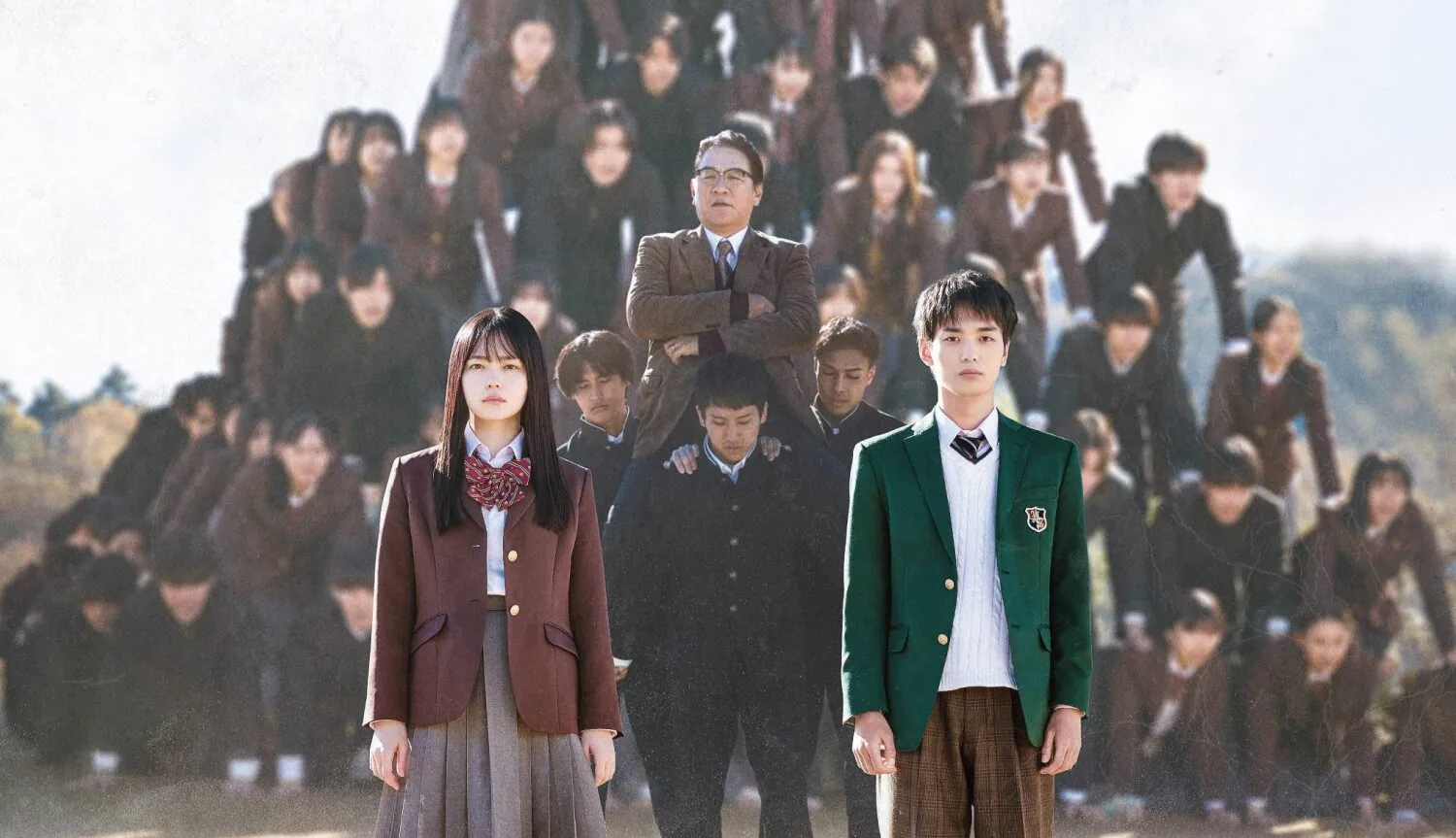
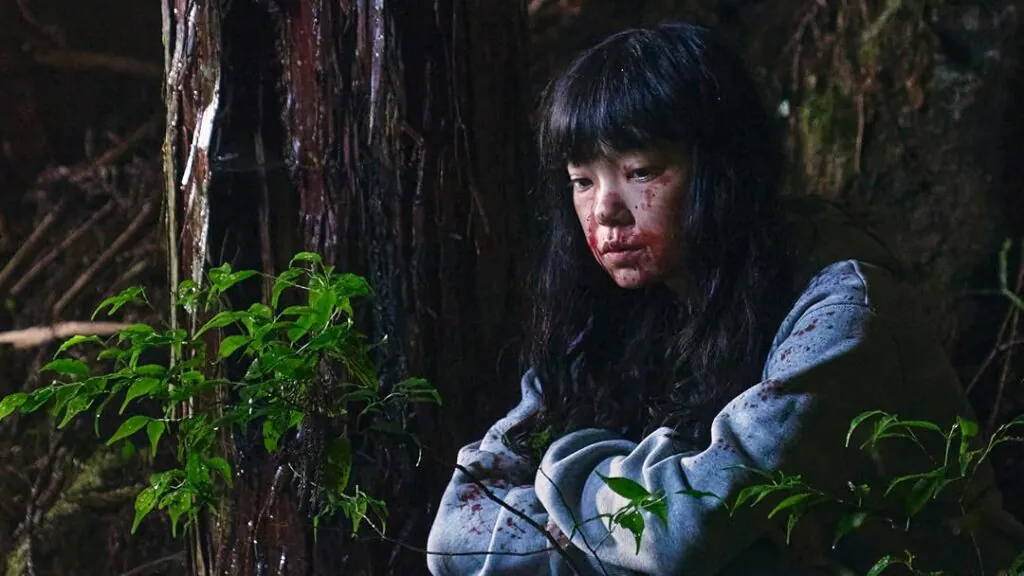
In Best Wishes to All, a young woman travels to her grandparents’ bucolic home for a family get-together. With her mother, father, and little brother a few days out from joining the festivities, she discovers that Grammy and Grampy keep a man with his eyes and mouth sewn shut, tied to a grimy mattress behind a locked door upstairs. In New Group, Ai (Anna Yamada), an outsider at her high school, and Yu (Yuzu Aoki), the new transfer student who’s too cool to care about meeting others’ expectations, bond in the face of increasingly bizarre student behavior: classmates inexplicably start forming a human pyramid, brick by biological brick, on the quad, eventually escalating to deadlier acrobatic formations.
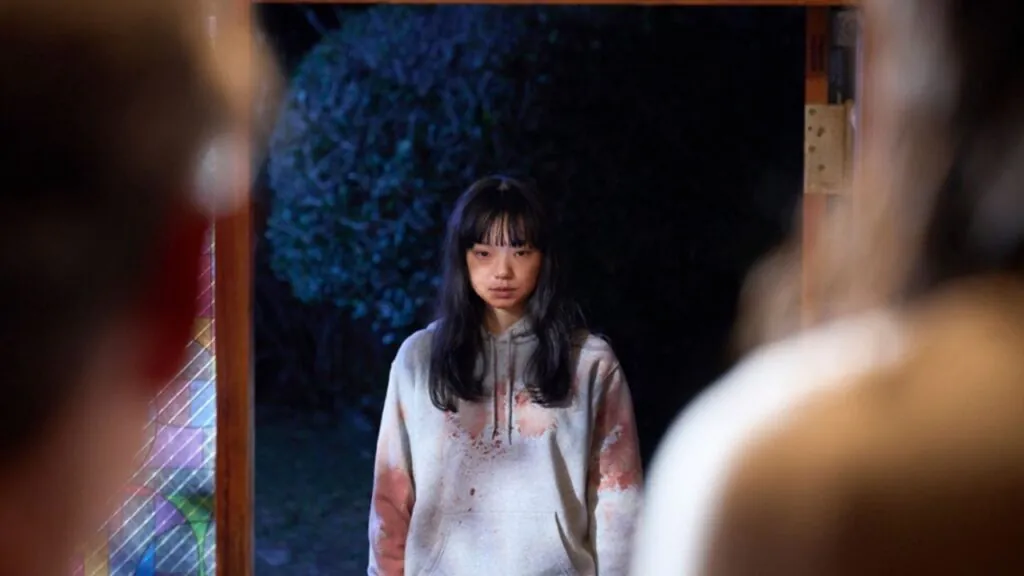
Between the two, Best Wishes to All puts forward a pronounced nihilistic face. No hope is to be found here, and no opportunity to reconcile its shocking sadism with an external moral directive. Each character, including Shimotsu’s lead, remains anonymous for the film’s duration, all the more to reinforce its argument that conformity is a smothering, inescapable entity.
Try as she might, the heroine, an idealistic nursing student, can’t convince her family of the cruelty of their actions. This, on paper, sounds like the world’s easiest layup: holding a man hostage in your house to torture him for no immediately discernible reason, like a John Doe victim in Seven, is a self-evident party foul. Those of us who aren’t octogenarian freaks like Obāchan and Ojiichan should need no explanation.
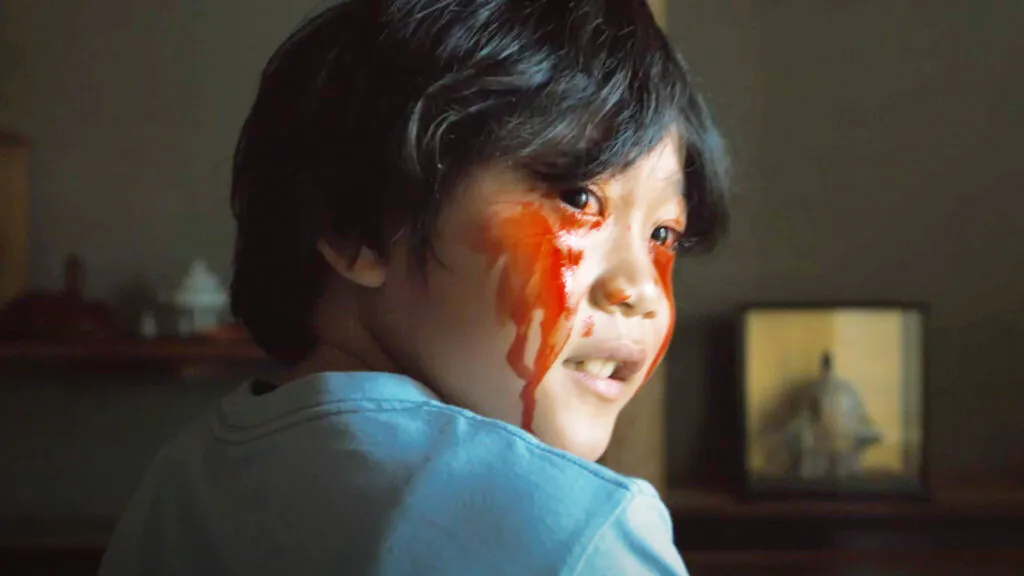
The macabre reveal in Best Wishes to All is that every household in the valley plays the masochistic host to strangers like the man upstairs, and that tormenting them yields a clear benefit for the tormentors. Life in this region is sweet. All who dwell there prosper and enjoy good health; they’re happy not in spite of the brutality they inflict on their suffering guests, but because of it.

Scapegoating has benefits, whereas the converse has detriments: the young woman’s childhood friend and potential love interest rejects his neighbors' behavior, as do his parents, and consequently they’re burdened by financial troubles and a struggling rice farm. There is no downside to the ritualized violence endorsed by Obāchan and Ojiichan, and no upside to refusing it.
In fact, disrupting that violence, as the young woman does, afflicts her family with a sort of spiritual virus, causing their good health to deteriorate at warp speed. Given her choices, she doesn’t seem to have much of one: either allow her entire family to die slow, horrible deaths, or find a new gimp for them to treat as a pin cushion.
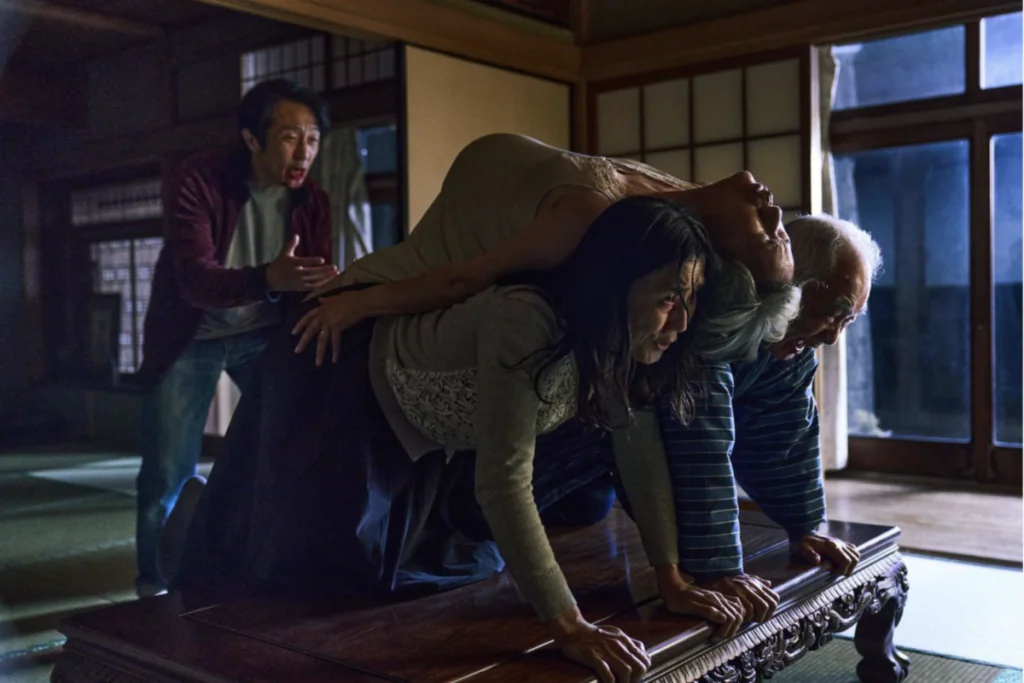
Shimotsu carries out his heroine’s impossible situation to its likeliest conclusion. Who wouldn’t choose to save their family over a stranger? (Reader, I assure you: your morals on paper do not necessarily hold up in an actual life and death crisis; you know what you stand for until a figurative gun is held to your head.)
Shimotsu specifies that question further when the friend willingly takes the place of the family’s previous victim, who dies abruptly and unceremoniously after the protagonist and the friend free him. (The lack of names makes writing about these people cumbersome, but as knocks against a movie go, this one’s trivial.) The choice of whose life to save evaporates. All the protagonist has left to decide is whether to participate in this socialized barbarism, or to go her own way; the ending, where we see which choice she makes, is suitably haunting.
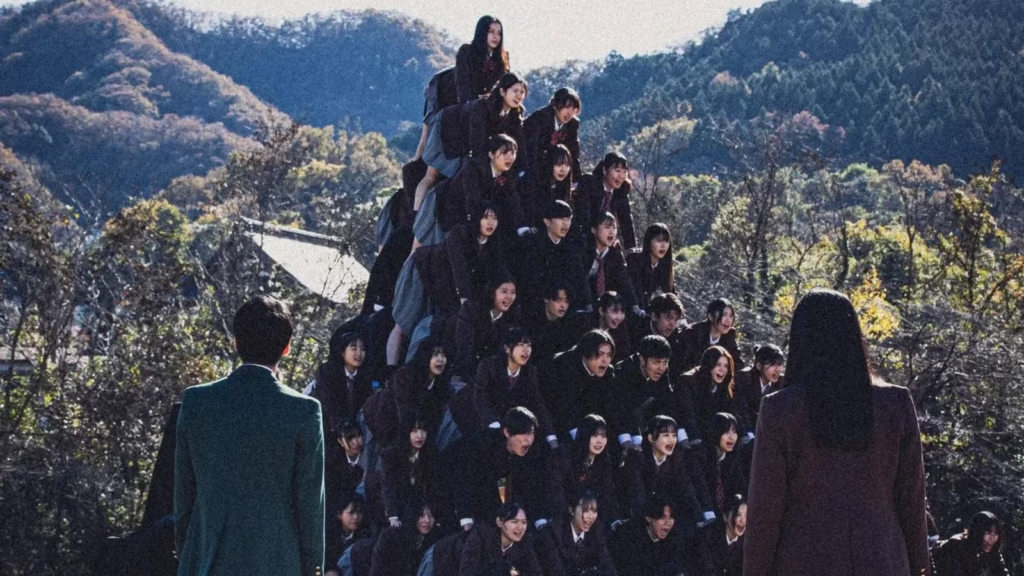
By contrast, the ending of New Group is heartening. In New Group, Ai and Yu bond amid intensifying madness at their high school. Watching peers have their humanity torn from them by a force that’s at once intangible and tied to the school’s faculty is enough to provoke hopelessness. It’s one thing to be the outcast via popularity contests, and quite another to be the outcast during a psychic extraterrestrial invasion.
Shimotsu casually fuzzies up the details of New Group’s plot to its advantage: that mystery heightens the terror at the sight of teenagers linking together into what’s best, but also inaccurately, characterized as a ball of death rolling through the school’s hallway. How do we make sense of the senseless? At least the folks in Best Wishes to All can convey their motivation. Conformity in New Group, meanwhile, self-perpetuates for self-perpetuation’s sake, which is quite frankly more conceptually frightening than a human scapegoat (which, for the record, is more conceptually disturbing).
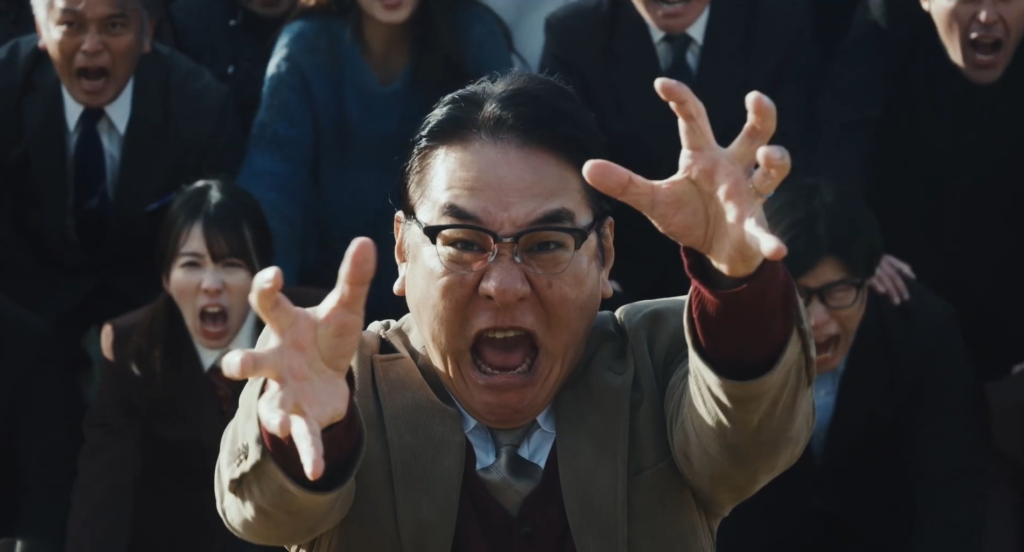
“An individual and an individual / Together become / A group,” chant the Principal (Pierre Taki) and a handful of body-snatched students about halfway through the film. The song layers on the formulation: a man and woman have a child; the child goes to school; the adults go to work; these are the groups they belong to. Regions make up countries. Countries make up the Earth. The Earth, the sun, and so on make up our solar system.
New Group maps the composition of all existence as one series of groups after another, and uses this as the Principal’s justification for reducing people to mindless drones. Divorced from his logic, the notion is actually reassuring. Each of us belongs to and contributes to a rambling list of groups: our family, friends, places of employment, constituencies, fantasy football leagues and World of Warcraft guilds, and, of course, institutions of higher learning. Awareness of societal categorizations reminds us that, in the end, we’re not literally alone in the world, though we nonetheless may feel figuratively alone.
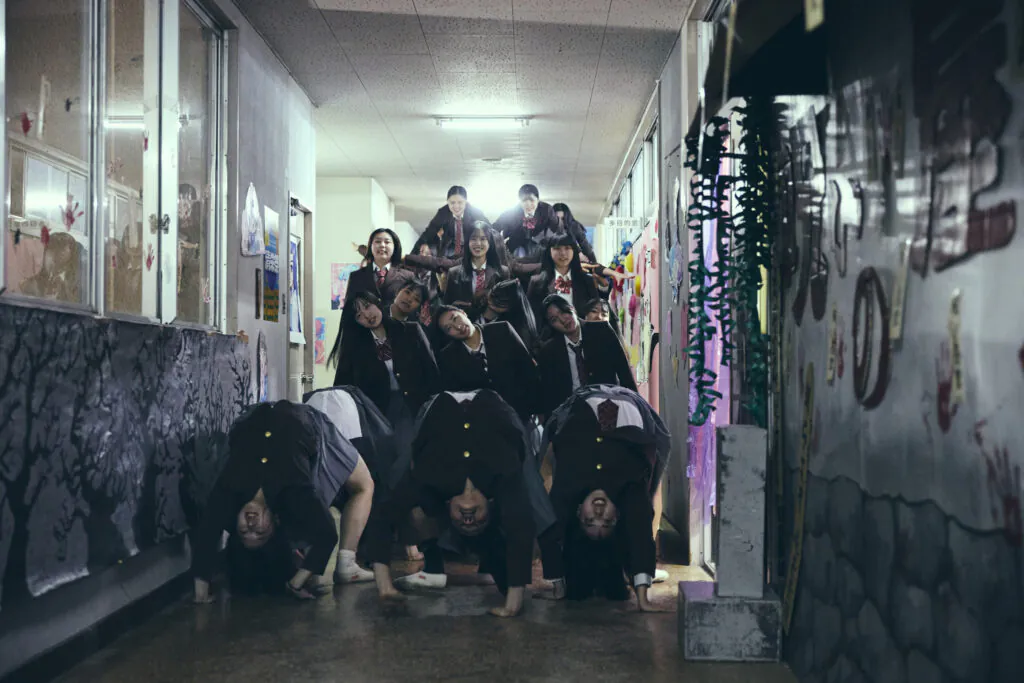
New Group takes away that uplift by making conformity the end goal. There is no upside here. Yes, all of us live in a society; no, living in a society isn’t the same as living. Here, Shimotsu expresses rigid order and obedience as a threat to happiness, anathema to conformity’s function in Best Wishes to All, where the payoff for meeting conformity’s hideous demands is bliss; the implication of New Group’s climax is that conformity is its own kind of suffering.
Ai successfully persuades Yu, many of their classmates, and her parents away from the Principal’s assembled pyramid of human bodies with an earnest plea: “I like circles, not triangles!” She asks them if their knees hurt, and implores them not to accept that pain. Through her monologue, Shimotsu cuts to faces in the pyramid, all fluttering eyes and slack jaws, like they’re slowly waking up from a bad dream, until her parents grimace as if they’ve stepped on a nail, then charge toward her for a tearful reunion. Conformity is agony compared to unity’s ecstasy.
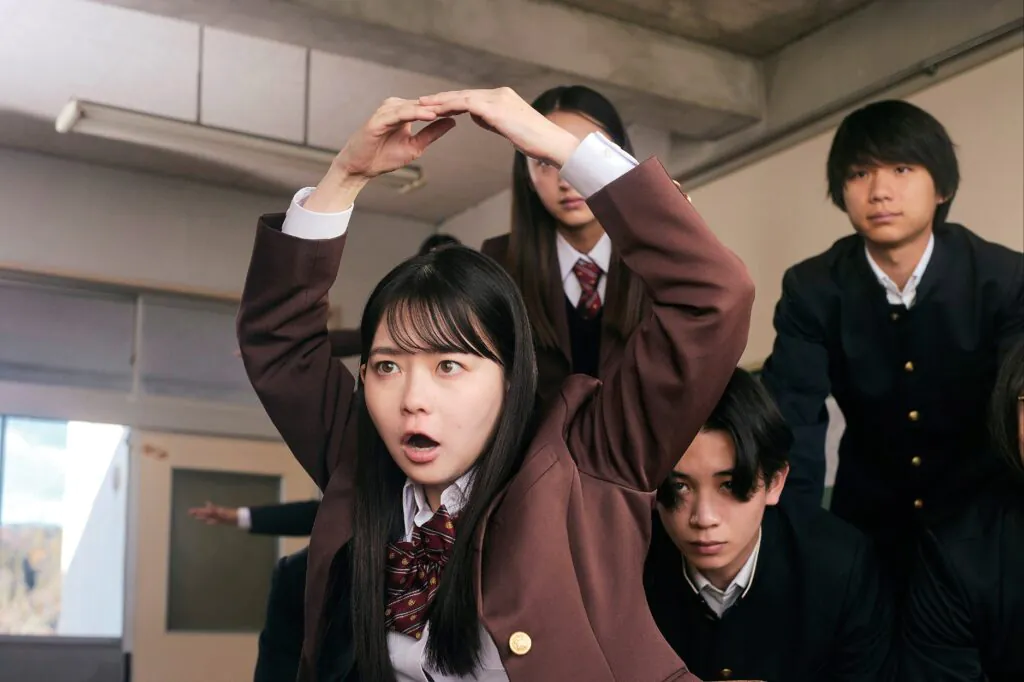
Together, Ai, Yu, and all the others who break from the Principal’s pyramid form their own shape–a ball, Ai’s tribute to her little sister, who died in a car accident Shimotsu shows us via flashback–and then go on to topple the pyramid.
Shimotsu snaps to black in New Group’s final shot as Ai stares into the camera, her fellow students forming a new shape behind her; she raises her hands over her head, forming that ball symbol again, as the backgrounded students rush toward her motionlessly. She’ll be combating appeals to authority for the rest of her life. But at least she has the power to fight back.
If the image is harrowing, it’s also encouraging: New Group tells us one can resist and overcome conformity. One can just as easily succumb to it, as Best Wishes to All tells us. And what Shimotsu tells us, with both films, is that there are more ways to think about conformity than horror has yet imagined.