
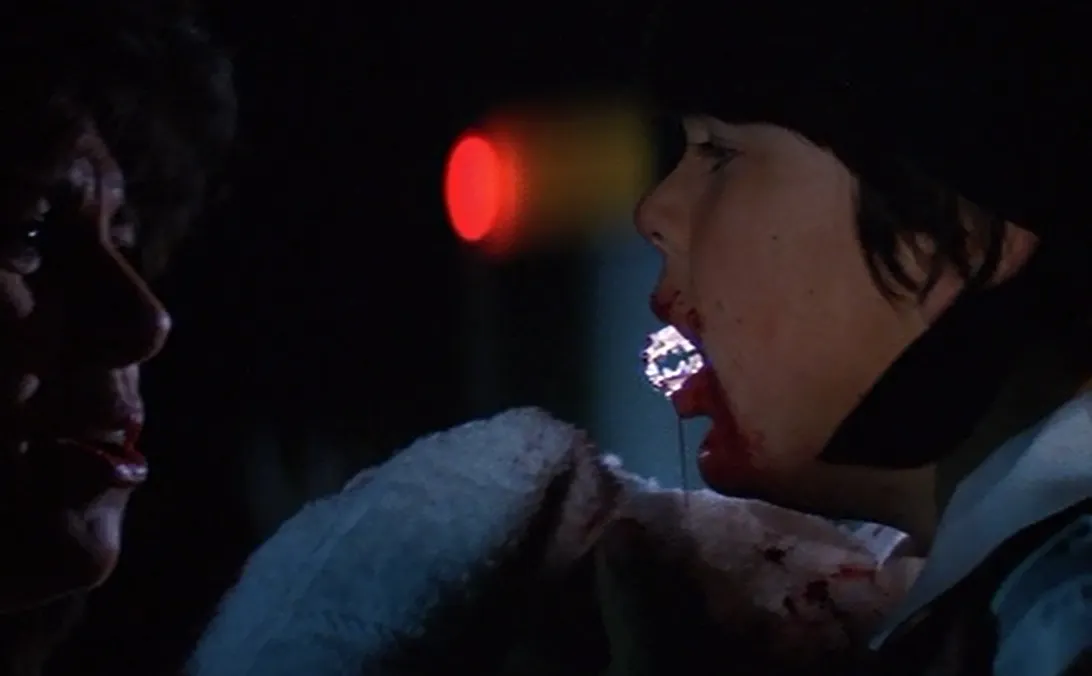
To grow up in the 1980s was to fully believe that making it to adulthood was an iffy outcome at best. The constant threat of nuclear war, an endless stream of assassination attempts on world and religious leaders, watching the Challenger blow up on live TV — it’s no wonder we were a particularly nihilistic generation.
But more than any of that stuff, it was the barrage of warnings blasted our way about how strangers wanted to harm and kill us, that cast a gloomy pall over the decade.
Child abduction. Serial killers. Satanic Panic. Grace Jones on TV, asking parents where the fuck their kids were at this hour. The 1960s “peace and love” hangover of the 1970s continued to metastasize into a very dark thing in the 1980s, and for some reason it all seemed very kid-focused.
This is not a piece of journalism, by the way; just an anecdotal reflection. But though my mom dutifully watched the TV movies about missing children and the lurid 20/20 news reports about how Satanic cults wanted your kids, this feeling that I was Not Safe really crystallized on Halloween in 1982. The Tylenol Murders had just happened in Chicago, and much like, I dunno, a president ignoring the rules of the Constitution and doing whatever he wants, it was a norm-shattering moment — something that, before it happened, simply hadn’t occurred to anyone as a possibility, and therefore something with no safeguards in place against it. Turns out you could just put poisoned medicine on a shelf, and people would buy it and take it and die. Now what?

This happened a month before Halloween, and overnight a widely accepted holiday tradition that went back to the beginning of the century suddenly seemed fucking crazy. We were informed that we couldn’t go trick-or-treating that year, that it in fact was canceled, because strangers wanted us dead. The Tylenol Murders gave us a new boogeyman, and since those crimes were never solved (a new person of interest was named last goddamn month), that boogeyman was Anyone You Don’t Know. Instead of knocking on doors like kids had done for most of the 20th century, we’d all gather at the local firehouse for adult-supervised Halloween festivities. I’m fuzzy on what those festivities entailed; I know my little brother’s ghoul makeup washed off in the water in which a hundred other kids bobbed for apples. (Stranger danger real; germ theory still a ways off in suburban New Jersey.)
I remember the ritual after that Halloween, of our parents inspecting all our candy after we came home, which seems a less severe and sensible solution to the idea that we might die if we ate some tampered treat. (But if you think I waited to get home to ingest a Reese’s or three, you’re mistaken.) Halloween aside, as author Jason Pargin points out in this Instagram post, the Tylenol Murders impacted so much of what came after — not just in consumer safety protocols, but in our culture. They’re the reason there’s tamper-proof packaging now, which means that still at-large murderer in the Chicago area is the reason so many things at the CVS are so hard to open when you get them home. It was perhaps an overcorrection, like taking our shoes off at the airport for 25 years after one dumbass tried to blow himself up, but selective and specific overcorrection has been a US tradition for a while now. (If the Chicago Tylenol murderer used a gun, I suppose the country would have done nothing in response, and medicine packaging would remain dangerously easy to open today.) Lots of the silly shit Gen X brags about being able to do “in our day” (staying out until dark, roaming the neighborhood unsupervised, the way we interacted with the outside world) kind of evaporated in the wake of the Tylenol Murders and the other scares of the decade. The way people raised their kids likely shifted as a result. Some of it is no doubt for the best, but I do feel like something has been lost. 44 years later, my neighborhood’s trick-or-treating turnout remains quite anemic, as “trunk-or-treat” parties take hold, and parents who were trained as children to never trust strangers do what they’ve been taught to keep their own kids safe.

Meanwhile, I’ll sit on my porch for another Halloween, knowing the trick-or-treat traffic will be once again be light, and knowing that the last kid will be surprised to get the entire rest of the candy bowl dumped into their bag. I’ll think about how I, despite all the warnings, never got a razor blade in my apples, never heard of anyone finding a needle in their Snickers. And I’ll think about how all the harm visited on me as a kid, and all the harm visited on the friends I know who have survived childhood harm, was done to us not by scary anonymous strangers, but by people we knew and trusted (and were taught or told to trust), and how we now live in a world where our kids are taught to mistrust a neighbor, but are more at risk of harm from the institutions and organizations that we tell them are there to keep them safe. It’s a neat trick indeed that, for all the hand-wringing, no one ever bothered teaching us how much danger didn’t come from strangers.
