
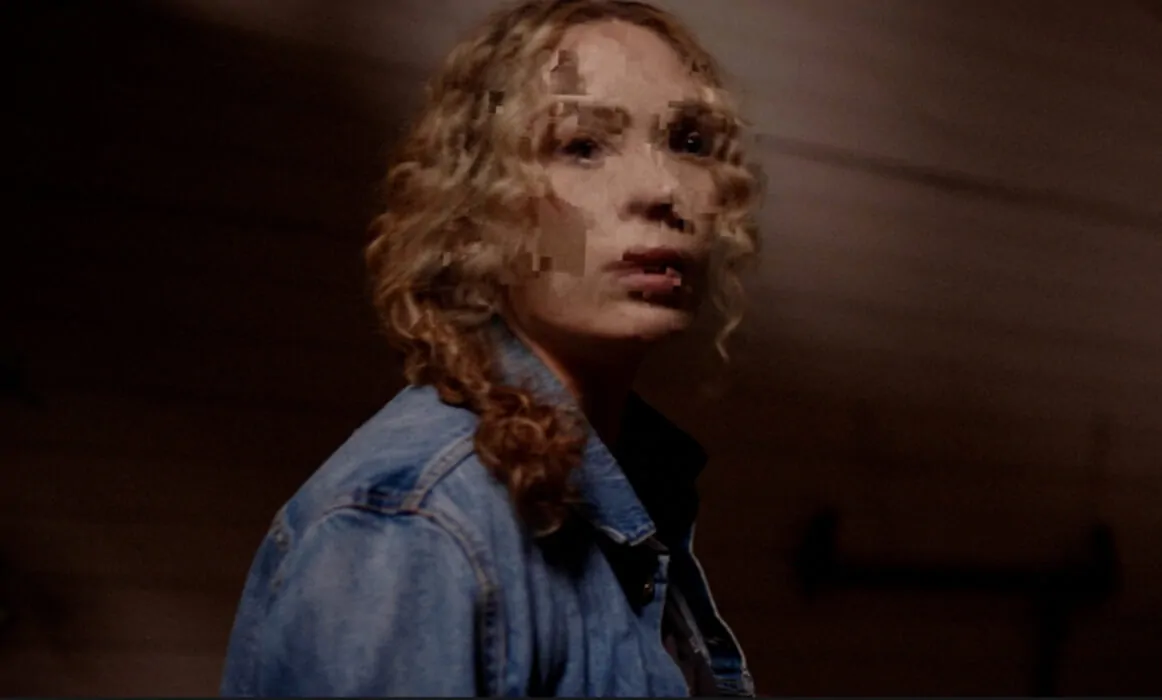
VHS may as well stand for Very Horrifically Strange when paranormal podcaster Lucas Page (William Magnuson) pops in a surveillance video. The mysterious video captured a murder that no one in Page’s Texas town remembers. His sister Lynn (Kelsey Pribilski) joins the investigation, and their story is told as a faux documentary in Man Finds Tape, opening in theaters and on VOD December 5 from Magnet Releasing/XYZ Releasing.
Fresh from its Tribeca Film Festival premiere last June, Man Finds Tape provided first-time writer/directors Peter S. Hall and Paul Gandersman the opportunity to play in a similar supernatural sandbox as their acclaimed producers, David Lawson Jr., Justin Benson and Aaron Moorhead (Resolution, Spring, The Endless). (Also onboard as a producer: Sinister/Black Phone screenwriter C. Robert Cargill.) In this exclusive interview, Hall and Gandersman discuss the impressive crew behind them, the origins of the project and their love of found footage techniques.
How did you two first come together as partners?
Paul Gandersman: “We met 15 years ago through mutual friends in the Austin [Texas] film community. I was producing Emily Hagins’ My Sucky Teen Romance, and Peter came in as a producer as well. And we both realized we had very similar interests in horror and cinema. At one point early on, I went over to Peter’s house with a Christopher Pike novel [Road to Nowhere]. The cover had a girl driving a car with a skeleton in the passenger seat. I showed Peter the cover and said, ‘We should make something like this.’ [laughs] And, he said, ‘What’s the book about?’ I’m like, ‘No, the vibe of the cover. That’s what we want.’

“And Peter wrote a really fun short film called Boyfriend Forever, but we never made it. And then we ended up producing more for Emily and some other friends, and all the while we were kicking around our own ideas while learning a lot more about film and production just by producing and supporting other people. The ideas kept going and going and going, and we made it happen.”
Paul, if you hadn’t been a documentary filmmaker from the start, would you have chosen this style to tell the Man Finds Tape story?
Gandersman: “Well, I wouldn’t. I wasn’t a documentary filmmaker from the start. I fell into it, and that’s what I’ve been doing during the day for the past decade. Peter and I had another film that we were trying to get going for a while, which eventually became our novel, The Dead Friends Society. That was our way to get the story out there. We’d still love to make that movie one day. But the idea was to come up with something that if all we had was 50 grand and a bunch of people willing to work for free, what could we do?
“And once we were talking about that, we said to ourselves, ‘What are our strengths here? What do we have that other people don’t? Or what can we do more efficiently?’ My documentary producing and editing background, we have a documentary editor, we have documentary cinematographers who I’ve worked with for years. Well, that’s a superpower in this situation.”
Peter Hall: “We very consciously conceived of the documentary thing to be, ‘What is the bottom dollar version of this that we could make if all we had was 50 grand and some friends?’ But with that as the starting point, how do we swing and aim a little bit higher? So, it got bigger. It got conceptually weirder and takes some really big swings. We ballooned it from that initial idea in—we hoped the right ways. But we also had a fallback where we could still go do the very, very DIY version of it.”
Gandersman: “We hit the right sweet spot with the right partners, the right team, to make it at the level we really hoped to.”
Hall: “We reverse engineered the story from the playground that we had built ourselves, knowing these were the parameters we were going to make the movie in: What is the story that fits into this very weird box?”
What are the real strengths of the found footage genre?
Hall: “I’m a big fan of found footage and faux documentaries. With any film, you’re going to get the audience with some measure of suspension of disbelief. But particularly with found footage, audiences are more willing to suspend disbelief because it’s like going into a haunted house where you know this is not real. I want to pretend that this is a real story. I’m to engage with these people running at me in masks and banging things on the wall and getting scared of it because it’s like a contract with the haunted house folks. For me as an audience member, that’s my favorite thing about found footage. You’re signing an extra waiver contract going into it where it’s like, ‘Yeah, we’re all gonna agree to be on the same wavelength for how this movie should be.’”
You have some amazing genre producers onboard. How did you line up Rustic Films and C. Robert and Jessica Cargill?
Gandersman: “The Cargills have been long-time friends from the Austin film community well before Sinister. It was Christmas Day 2020 during [COVID] lockdown, and the Cargills did a Zoom call with all their friends. My wife Ashley [producer Ashley Landavazo, also Man Finds Tape’s production and costume designer] and I were on the Zoom for a little bit, and then Justin Benson of Rustic Films came on. We loosely knew the Rustic guys through the film festival world, but we really knew the Cargills. So, after I got off the call, I turned to my wife and said, ‘Those Rustic guys really figured it out. They made a tiny little film and then snowballed it into the next thing and now they’re directing for Marvel.’ And then Peter met [Rustic producer] David Lawson Jr. at Fantastic Fest.
“They were incredible advisors. And then the Cargills came on. The weird full circle-ness of it was that the Cargills Christmas call that Justin was on is what kickstarted it, but the Cargills weren’t involved through us, even though we knew them. Later in the process as Rustic was putting together more of a team, they brought in the Cargills. We didn’t actually pitch it to Jess and C. Robert Cargill. It was the Rustic guys! It was a very weird full-circle moment.”
Man Finds Tape fits very comfortably in the world that Moorhead and Benson have created with their own movies. How intentional was that?
Hall: “We didn’t look at their films and create a list of, ‘OK, here’s what they do, so we’re gonna do that.’ It’s just how Paul and I came together, and then how we came together with them. It’s a lot of similar tastes. One of the things that we really liked about their films is that they’re always grounded in characters who get wrapped up in a story that is bigger than them, and they are trying to wrap their heads around strange things in the cosmos. And those kinds of stories are the stories that Paul and I like to write and create. It was very organic, how it all happened.”
Gandersman: “There’s a sequence in Man Finds Tape where we weren’t consciously trying to ape off the Rope to Nowhere sequence in The Endless, but subconsciously we were trying to generate that same feeling, that same kind of spiral into, ‘This is so much bigger than what you think it is.’ And that makes it really entertaining for an audience. They get a complete story with these hints of a bigger world.”
Hall: “We put in a very fun Easter egg reference to one of their films. It’s very subtle and might take a while for anyone except a super-fan to catch it. And we thought they wouldn’t want us to do that, but they did!”
Were you both fans of Lovecraft’s Cosmic Mythos?
Gandersman: “For me, if you can write a real enough character who’s dealing with these extraordinarily insane circumstances, if done right, Lovecraftian themes can be something really relatable. A person can view themselves in that situation and relate to it: ‘What would I do in in the face of insanity, how would I react?’ Our characters don’t react like superheroes, they act instinctively. Gut reactions, fear, that sort of thing. I find that world to be interesting to allow for that.”
Hall: “I also like modernized Lovecraft stories that you don’t realize they’re Lovecraft stories. I’m a big fan of Underwater, the Kristen Stewart movie. That started to stealthily inject Lovecraftian things along the way.”
You cast mostly local talent. Was that your intention from the start, to give back to the community?
Gandersman: “Making it in Austin was a big part of it for Rustic and David Lawson. They were really interested in beginning some production in Austin and not just being the guys that produce a movie in Austin and fly in everyone from LA. They really wanted to support the local film scene. For a movie like this to work, you can’t be staring at celebrity faces. It is a complicated puzzle to make the suspension of disbelief work. There were some actors we auditioned, and some who we knew and had worked with before. While some people in the indie film scene might have seen some of these faces, for the most part, they were unknowns, though I hate calling them that. But they’re not A-listers. With this being our first film, one of our goals was that it hopefully takes our ambitions to the next level. And also, if we had pulled it off and we got into a festival like Tribeca, which we thankfully did, then it would also be the first of that kind of film for a lot of our cast.”
Hall: “The idea was the rising-tide-lifts-all-boats theory. We wanted everyone bought in because we were all going to rise in the same way.”
Gandersman: “And everybody who we cast, we really explained to them what this was going to be about, how it’s gonna work. And everybody bought into the vision. They were so willing to add things in postproduction. There’s a major character’s death scene in the third act that was different. We needed to change it, and so we just called that actor up and we’re like, ‘Hey, what are you doing on Saturday? Do you have an hour? We need to shoot this, it’s going to be important.’ And then a week later we submitted to Tribeca with that. But if your actors haven’t really bought into the vision and ‘I’m onboard with that,’ you might get, ‘Oh, no, I can’t. I can’t take the time out. I’ll be available in two months.’ And then it’s like, boom! Now the movie’s different. We knew we needed everybody equally onboard to make it work.”
Graham Skipper is sort of a go-to guy for horror indies. He’s probably the most familiar face in the movie. What was he like to work with?
Hall: “Graham was fantastic. He came in through the Rustic crew, because Paul and I didn’t really know him. On the first day that he was on set, I was just picking his brain about Stuart Gordon. And he brings such warmth to his character; he’s one of the secret weapons of the movie. For example, there’s a moment with him that we got later during post, and we needed to record this voicemail. It’s his character struggling with his place in the story. And he gave us such raw takes right out of the gate that I was starting to get weirdly moved just doing a Zoom. Graham was great. I cannot say more nice things about him.”
Gandersman: “And he brought so much flavor to his scenes, sitting in his interview chair in the film and riffing about wet farts and the like.”
What techniques were involved with your creature FX?
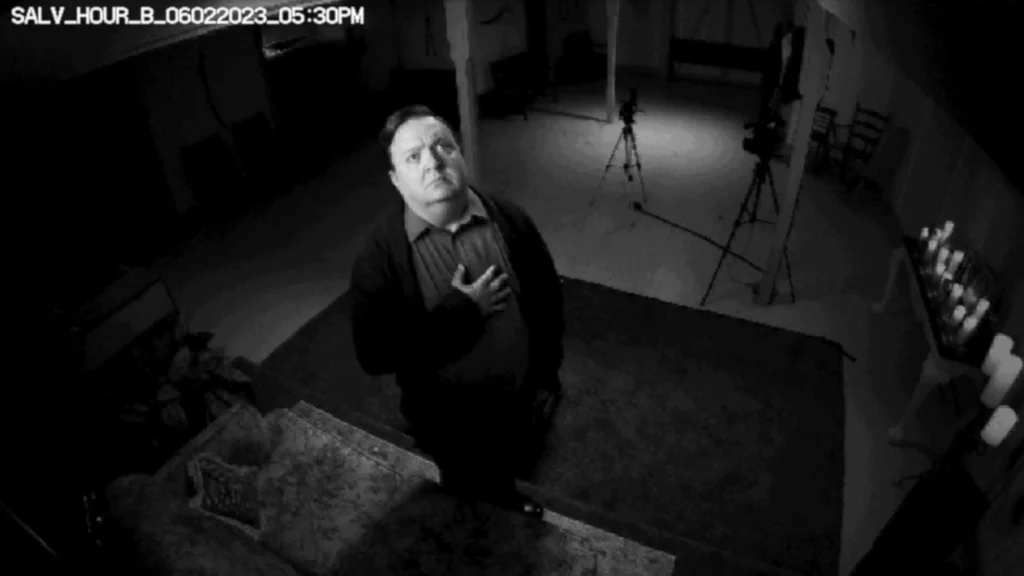
Hall: “Meredith Johns is an Emmy-nominated special effects and makeup artist. She still lives in Austin. She’s fantastic. [For the main creature gag,] she built different versions for what was needed in the film. As soon as we saw the puppeted rig of this small creature, we were like, ‘Oh, that’s awesome.’ The tricky thing about our production, and that she had to roll with as well, was that given our documentary style of filming, you can’t then just cut to the most ideal lighting circumstances for a certain effect, whether it’s a blood gag or the practical puppets. It has to play out in a wide shot. You can’t hide the seams. The trickiest part of most of the practical effects was that we couldn’t shoot with typical coverage angles that could only show as much as we wanted to show. In fact, for the finale in the Salvation Hour, we were shooting on a completely 360-degree set. Meredith did a brilliant job of coming up with ways to do things.”
How did you guys divide the directorial workload?
Hall: “There wasn’t actually as much division as you might think in the sense that it wasn’t like, ‘OK, Paul, you handle all the camera stuff. I’ll handle talking to the actors.’ We have such a collaborative process on the prep side of it, in writing the script and coming up with how we’re going to do each thing, that we all were fully overlapped on our takes of how we’re supposed to do things. So, there wasn’t a clear division there, but at the same time, we were a very, very small crew. And so there might be times where it would be necessary for us to split up. Paul is over in the kitchen setting up with David Coone, our DP, about the lights. And [actor] John Gholson has a question for me about how we’re going to approach a scene. It worked out really well where we could have a director who was essentially in two places at once to expedite that process. That was a real benefit to us. The actors, in particular, appreciated that they had access to a director to ask questions whenever they had any.”
For more on Man Finds Tape, see FANGORIA #31, on sale this January.