

1979. I am thirteen years old. I work in the C. R. Andersen Junior High School library in Helena, MT, for one perfect, glorious school period every day. (I also work at the public library on Saturday, and the used bookstore that pays me in books on Sunday.) Each week, the librarian and I sort through a stack of donations. Occasionally, she sets one or two aside, deemed “too adult” for middle school. One afternoon, that discard pile includes a red paperback, the cover a painting of a teenage boy wearing the number 47 on his shirt, staggering toward a pair of adult legs dressed in military fatigues. Behind him, another boy has collapsed, and further still, a tank rolls toward them. The Long Walk, by Richard Bachman.
I am a complete bookworm, reading well above my grade level, and mature for my age because I have to be. I’m submerged in horror fandom, a cocoon for a kid with few options that speak to him. The library is the one safe space at school where I’m allowed to be my true self. The librarian understands who I am, so when I ask if I can take this intriguing book home, a book that is, by her own standards, unfit for children to read, she agrees.
I read The Long Walk cover to cover that weekend. To live in that world is revelatory, and the prose feels very familiar. I’m eyeballs deep in Stephen King by then, having read The Stand (my first and still favorite King), Carrie, and The Shining. I’m reading books “too early” for their subject matter, thanks to horror-loving parents who are perfectly inattentive. A nerd consumed by fanzine culture (even “pubbed” my own “ish” called Grunge), I read a fellow zinester’s review of the book that calls out the similarity to King, and of course. Of course.
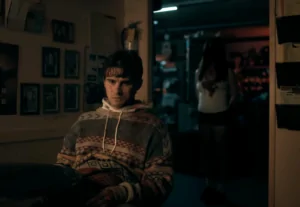
The Long Walk has been held in the hearts of many young men over the years. As a lonely gay kid in Montana, the book came perilously close to giving me exactly what I was desperate for on that first 1979 read. The story was as close to a romance between boys as I’d ever read. The pure friendships, the affection (necessarily non-sexual, courtesy of the circumstance), the raw emotion. Confessing secrets, making pacts, the Three Musketeers. One of the most compelling aspects of the book is how King presents masculinity in a context that includes emotional attachment and physical interaction between males. (All the more fascinating considering King’s absolutely dismal history of gay representation.) The Long Walk models male relationships in a way rarely seen or celebrated, and gives all men, straight or gay, the permission and safety to be that person while walking through the pages of the book.
I never wanted the Long Walk to end, and I’ve returned to walk those miles just to be with Garraty and McVries and Collie and Baker, and even Stebbins, almost a dozen times over the years. I hated Barkovitch, cried when McVries sat down, and when Garraty ran, I knew I could run, too.
But I would guess that most of us who discovered The Long Walk way too early never truly aspired to participate in the Long Walk if the event were to exist. I certainly didn’t. The idea was too brutal for any real teenage bravado. The reason I repeatedly kept pace with those 100 desperate young men was for the moment when I would stare into the middle distance and write my own chapter where I held hands with Garraty and told him we’d figure out a way to win this thing together. King’s descriptions of the boys having their heads blown off were too vivid for any of us to consider actually toeing up to that starting line.
Decades have passed. Those young advanced readers are now reading at their grade level, carrying the novel into middle age. But loving the book is almost a secret—how many conversations have you actually had about The Long Walk? The casual King reader rarely mentions the book. Sometimes even we, the devout, forget about the book until we’re having one of those conversations, ranking and rating King’s bibliography, and then, “Oh, right! The Long Walk! I love that book…”
And now we’ve been gifted with Francis Lawrence and JT Mollner’s excellent film adaptation, which feels cast from a decades-old mold stored in my memories. Their distillation of the story and execution of the visual appear so effortless, one wonders why the film has been stalled in development for decades. Despite being set on the open road, The Long Walk is claustrophobic in a perfect way, each scene fueled by pages from the book and nothing more. To experience the film as an early adopter of the novel is to read a movie.
Filling those frames to bursting are the truly excellent young actors, led by Cooper Hoffman and David Jonsson. Hoffman is the only performer who lines up with my mental image of King’s characters, but the rest have permanently altered how I will visualize the book on future reads. And Mark Hamill is brutally unrecognizable as the Major.
But the true gift of The Long Walk is Judy Greer.
We meet Mrs. Garraty in the first few moments of the film as she gives away her child to the Long Walk. Anyone who has casually glanced at the source paperback knows the end of the road for Garraty—it’s right there on the cover. And yet, as a mother who desperately wishes what she knows to be true to be false—the odds are absolutely against her son—Greer’s performance immediately relieves the audience of our passivity and our certainty. The actor’s raw truth requires us to participate on an emotional level—to not do so would require more effort than allowing her in. Mrs. Garraty can’t bring herself to believe her son will survive, and so convincing is Greer that, even knowing the ending, neither can we. Working together, Greer and Lawrence and Mollner cast doubt on the facts as we know them—that book cover is now in question. The true believers in the audience are given permission to consider that the filmmakers may have changed the ending of our aspirational diary.
Along with this doubt, Greer, Lawrence, and Mollner have provided us with something that, even after all these years and re-reads, I’d never realized was missing from King’s novel—an outside observer. The reader’s advocate in the novel is Garraty, and our sole experience is his entire experience on the Long Walk. Each time I’ve picked up the book, I’ve signed up for another devastating journey with Garraty and the other young men within his reach. I came back for those first few re-reads, hungry for the emotional connections I was starved for in a patriarchal culture that frowned on them. The book satisfied this hunger every time, without any outside influence to dilute the taste.
But in just three scenes (two present day, plus a flashback split into three parts), Mrs. Garraty becomes the audience advocate, a conduit for those of us who internalized the book to receive the film in a way we weren’t able to while wrapped in The Long Walk’s pages. As I watched the opening scene with Garraty and his mother, I cried for the first time of many during the film. I’m not a parent, but I am an adult, and I’ve experienced love and loss to a degree I never imagined as a 13-year-old in 1979. Through her raw and stellar performance, Greer led this young advanced reader out of his memories and into his adult present, bridging the gap between the teenager with a crush on a fictional character and the adult who realizes he might watch someone he has secretly loved for decades die horribly.
Despite offering an almost parallel narrative, Mollner’s additions to the story, while not infringing on the source material, tilt the perspective ever so slightly. Mrs. Garraty reveals herself to be the film’s protagonist, which, shockingly, forces Garraty into antagonist territory. And while not a villain, in retrospect, Garraty’s actions in the context of his backstory are a betrayal of both his mother and his father (mentioned briefly in the book, personified briefly in the film by Josh Hamilton). While entering the Long Walk lottery is hardly voluntary, given the societal pressure to do so, we realize that Garraty letting the “back out” day pass is a selfish act. The credits roll when the walk ends, so we aren’t privy to Mrs. Garraty’s reaction to her son’s actions at the end of the film. But we know her now. Without that image, we’re back in book-reading territory, imagining how she’d react when she found out, replaying endless variations on horror, grief, and a mother’s fury, filling in the spaces left blank when the theater lights come up.
The book is different now. The film has fused to the pages of the paperback. When I next re-visit The Long Walk (and I will), the film has guaranteed that I will read the book in a different way. What won’t change is the fact that loving The Long Walk says something about you. Holding the book in your heart for decades means you see what is possible, even if you can’t, or won’t, claim that for yourself. Even in the world of Stephen King, there are authentic human connections to be had, although as he tells it, you have to look death in the face to find what is true in another person.
Perhaps. Or maybe that’s accomplished by someone donating a book to their local middle school library, giving a lonely kid a true north he can walk to whenever he wants without even leaving his house.
