
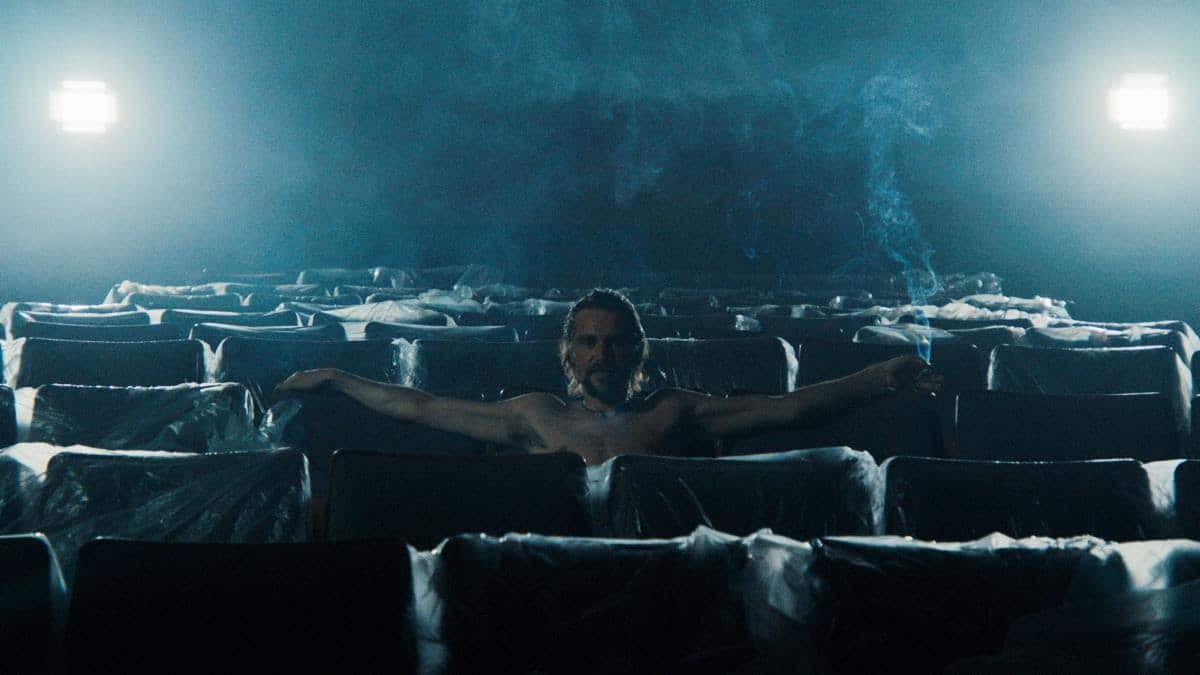
The American Southwest can easily become a scary place, and so it is in A Desert, now in select theaters from Dark Sky Films. It’s a grabber of a feature-film debut by director/co-writer Joshua Erkman, who discusses it with FANGORIA below.
Co-scripted by Bossi Baker, A Desert stars Kai Lennox as Alex, an old-school photographer on a picture-taking odyssey through forgotten corners and buildings of the Southwest. One night, he has the misfortune of staying in a motel next door to Renny (Zachary Ray Sherman) and his sister Susie Q (Ashley B. Smith), who at first are just distractingly noisy and then reveal more unpleasant sides of themselves.
As the movie inexorably shifts from gritty neo-noir to serious horror, Alex’s wife, Sam (A Wounded Fawn’s Sarah Lind), and a private detective (David Yow) also become caught up in the growing darkness, with the intense performances playing out against and inside stark and ominous real locations.
Are you a photographer yourself, and if so, how did that play into the creation of the story?
I do have a background in photography. I started taking photographs when I was in high school, I studied it at college while I was in film school and I’ve just been shooting for a long time. I knew I wanted to approach this project a little bit differently. I had an idea for this particular type of photographer character that I wanted to be in the movie, but I didn’t necessarily know what it was going to be about, or what would happen to them.
For a couple of years, I shot all these photographs, kind of like I was this character, and it informed what the film was about. It also kind of functioned as this fun way to do location scouting. As I found some of these places I was photographing, new ideas were sparked, and that was essentially how the script came together.
So you found the locations first and based the script around those?
Yeah, to a degree. But it was also just that ideas were popping up inspired by these locations. It wasn’t just like, oh, that’s a cool place to shoot. It was also that I was coming across all these abandoned movie theaters and old drive-ins, and I found an abandoned military base. Then there were all these…I don’t want to say antique stores, but junk shops and things like that. It got me thinking about American culture, our relationship to movies and all that, which definitely funneled into the themes of the script.
Were there any key locations that you had to find once you’d written the script, or was everything already there?
Everything was pretty much already there. There was one scene I really wanted to shoot in this abandoned movie theater I had found, but it was just not possible to film there because it required some…trespass [laughs], and it just was not a safe situation. Finding an abandoned theater that logistically made sense for our production, and that would allow us to shoot there, was a little challenging. But I ended up finding this great location, and it added another layer to the movie, so that was really cool.


Was Bossi Baker someone you’d worked with before, and how did you collaborate on the script?
Bossi and I had worked on a couple of other scripts previously; they have yet to be made, but we’re trying! He’s an amazing colorist, and we actually met when he was doing color on one of my earlier short films. We just got to talking and decided that we wanted to collaborate. We started writing together, and it was kind of like, “Hey, check out what I’ve been working on. I’m curious to hear what you think.” He helped me shape some of the scenes, and it was very cool to have his input on the project.
You both come from visually driven backgrounds, so how did you want the visuals to drive A Desert as a film?
That’s a great question. You know, one of the things I was really interested in was maintaining certain visual motifs throughout the movie. A good example would be that the photographer, Alex, shoots in a very specific aspect ratio. The photographs I was shooting were typically very close to a 1.85 film aspect ratio. It didn’t make sense for us to shoot in 2.39 or something wider, or a more traditional full-frame like 1.33. I wanted to have that visual continuity.
There are also some carefully composed shots that are almost like still photographs. I wanted to have that kind of stillness and slowness, that more contemplative approach in the visual style that’s reflective of our photographer. He shoots with a large-format camera, and it takes time to make those images, to set the camera and expose the film, and then you’ve got to take it out of the camera. It’s a one-by-one process; it’s a bit cumbersome. I wanted the pacing of the film to reflect that.
Alex is a traditionalist, and uses older equipment. Did you ever consider shooting A Desert on film?
I did. Within our budgetary constraints, it just didn’t necessarily seem feasible, but yeah, I did think about it. But I believe that the movie being shot digitally in some ways feels more appropriate, because while Alex is photographing on this 8 x 10 camera with analog film, there are other types of image capture featured in the movie. Like our private detective, he’s shooting on a digital camera. We have scenes where people are recording things on analog magnetic tape. I wanted there to be this hodgepodge of all different kinds of formats in it.
The movie has a slow-burn approach to the horror; it’s not really a horror film for a bit of the running time. Can you talk about that approach?
A lot of the movies I really enjoy, and I think just my general sensibility is, I like it when things are teased out. I like living in the world with the characters. And with those moments of horror that do happen in the movie, the intent was that if I built up to that goal, once I hit those moments, hopefully they would land harder than if it was just a constant barrage.
There are little hints about the horror to come dropped into the first half, which are very effective. Was that always part of the intent?
Yeah, yeah. I think there’s this percolating sense of dread throughout the whole movie. It doesn’t feel like there’s much of a breather for any sort of levity in there.
What was the production like, and how was it shooting on those very stark and remote locations?
I had an amazing, amazing team, and a bunch of them I’ve worked with before on music videos and short films I’ve done. It was great to be making something on a larger scale with some of my favorite people. However, because of the timing and schedules and all that, we ended up shooting A Desert in July, which is probably the worst possible time to be filming out there, because it’s so hot.
I think that adds to the movie, though, because there are certain scenes where it is so hot, and some of those areas are really windy, while they were challenging during production, I feel like they added something to the movie that we wouldn’t have been able to capture if the weather was more favorable, you know? However, there were days when we shot in like 111 degrees, and one day that was like 118, and it was so hot that our camera shut down. We’d have to put it back in an SUV and blast the air conditioning.
Whenever I see a small-budget film like this that shot at a motel, I always wonder, did you simply rent the rooms and shoot in them, or did you let the people who ran the motel know exactly what you were up to?
No, we rented out that entire motel. We shot there for about four or five days, and we lived there, basically. It was great, and I think it brought everybody together because most of our cast had scenes there, so they were there for a lot of the time. That was a great location.
How did you find the right people for these sometimes very intense roles?
I initially had some people in mind when I was writing the script: This person would be really cool for it, that person would be really cool for it, I might be able to directly talk to them. I personally reached out to people and shared the script with them, and they were on board and excited about the project and understood what we were trying to do. But there were a couple of important roles where I just didn’t know.
A good friend of mine and a fantastic casting director, Gayle Pillsbury, started going out with the project. That was how we found two key people in the movie, Zachary Ray Sherman and Ashley Smith, who play the couple that Alex encounters at the motel. I saw them on audition tapes, and Zach brought this weird darkness that people who had previously auditioned for it were just not bringing to the role. He did such an amazing job in the movie. He was so dedicated: He dropped weight, he really got into the character, and for a movie on the scale of ours, to have that with an actor is an amazing gift.
Then I saw Ashley’s tape, and in one of the scenes Susie’s supposed to be listening to this particular type of techno music. In her audition, not only did Ashley nail the look and the performance, but it was the exact kind of music I was thinking about. Music plays a big part in the movie, and there’s a very specific type of music in it, so with Ashley already on the wavelength of what I was going for, I knew she was right for the part.
The movie has a very striking look, so was it an especially long post-production to get the colors and exposure looking the way they do?
Well, going into it, my cinematographer Jake Keitel and I had this look established, so we were shooting it saying, “This is how it’s going to look.” Once we got into color correction, we were very meticulous; Bossi spent a lot of time on that. We really dug into it, but that was more about smoothing things out a little bit, changing the contrast, some of that work.
Then I worked with this terrific school in San Francisco that did the movie’s visual effects. It was cool to be able to work with these students. It was also pretty funny at first, because I was like, “All right, we’re going to start working on the movie, here it is.” I watched it with them over Zoom, and there wasn’t really a disclaimer of like, “Hey, this is what the movie’s about,” so I think they were really taken aback [laughs]. But then they really got into it, and worked very, very hard removing reflections and doing some of the more utilitarian fixes. They did a great job.
What’s next for you? Do you have any other horror films coming up?
Right now, the next project I’m working on getting made is an ecological sci-fi/horror movie about the end of the world. Another uplifting movie for the whole family!
A Desert is in select theaters May 2.