
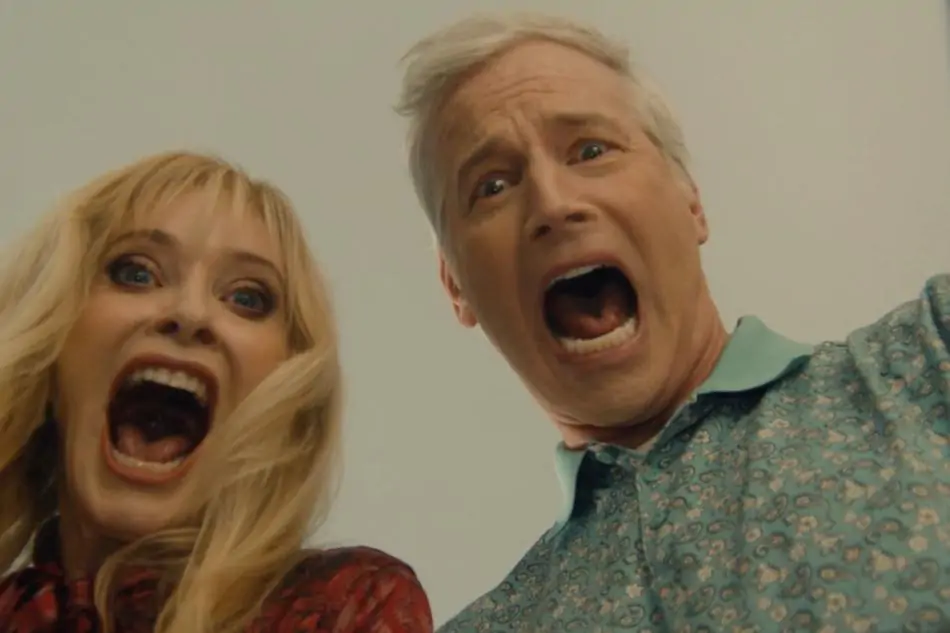
In discussing Jordan Peele’s Get Out, author Stephen Graham Jones described it as one of a few key 2010s horror creations which “told the world that this weird genre stuff it's always been able to ignore is actually in conversation with the world.” The film Grind, by the writing/directing team of Brea Grant and Ed Dougherty and director Chelsea Stardust, joins the chat on a subject that resonates with nearly all of us: workplace horror.
It’s a well-written serrated satire and the cast — including some notable comedy actors — deliver the laughs, giving the horror genre its eerie equivalent of Office Space. And while it could be argued Grind should be filed on the same shelf as comedies, there’s a truly unsettling undercurrent throughout: No matter how absurd the workplace scenarios get, they continue to ring true. That may be the scariest thing of all to the ranks of the employed.
Grind is a horror anthology in four parts. In “MLM,” Sarah (Jessika Van) is under pressure from her new bestie/boss/taskmaster Molly (Courtney Pauroso) to get in front of her ring light and sell, sell, sell or risk displeasing The Founder (Barbara Crampton) and facing the consequence – namely, the Axe Man. Meanwhile, Benny (Vinny Thomas) can’t make rent as a driver in “Delivery,” so he takes the lucrative tip offered by an anonymous customer, but the delivery instructions he’s obliged to follow might be the end of him. In “Content Moderation,” Joel (Christopher Rodriguez Marquette) has left his teaching career for his first corporate gig, weeding out the sickest online videos imaginable, but his new boss Andy (Rob Huebel) keeps inching the brass ring out his of reach, pushing Joel to the breaking point. And late-night at Neptulia Coffee, company loyalist Todd (Ify Nwadiwe) derides his crew as they lock down the shop for their first “Union Meeting” – but their corporate overlords have shipped in a nasty surprise. The anthology is bookended by “Warehouse Wonders” and “The Black Box,” which set up the ubiquitous online retail/supply chain conglomerate DRGN, and then deliver a defiant bon mot to a pair of its stakeholders.
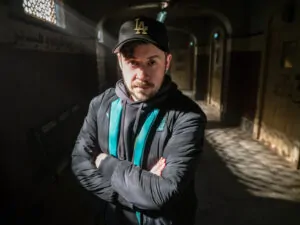
After the film’s March 12 premiere at SXSW, FANGORIA sat down with filmmakers Brea Grant, Ed Dougherty, and Chelsea Stardust, along with stars Rob Huebel, Barbara Crampton, and Christopher Rodriguez Marquette to discuss their ambitious project.
With the housing crisis, consumer prices on the rise, and the specter of AI and robotics eliminating a great swath of jobs, it seems like this film’s premiere couldn't have been better timed. Is this serendipity, or prescience on the part of the creators?
Brea Grant: I think that's what good horror does, right? It taps into the anxieties we're all feeling. And we started writing this a while ago, but this has been building for years. It's just showing exactly what we're all worried about.
Ed Dougherty: It becomes more relevant every day, and it's kind of a running joke that we get so many articles texted to us from people saying, “Hey, for Grind 2?”
Grind is a four-part anthology created between three filmmakers. How did the project spring to life and how did you work together?
Ed: So we started with the segment “MLM,” and at the very beginning we didn't have an ambition to do an anthology. But I’d always wanted to make a horror anthology and I really loved the “MLM” script. So I was like, this shouldn't just be a short. We started thinking about what kind of theme an anthology could have that would fit “MLM.” And then we got to the idea of Grind.
Brea: We mapped out the whole world before we even shot “MLM.” We knew what the rules of the world were going to be. And then we wrote the rest of it after we shot “MLM” and had an idea what the tone was going to be. So we wanted to feel cohesive.
Were there any anthology films that were especially instructive as models?
Ed: There are a lot of films that are anthologies that people don't identify as anthologies, like Pulp Fiction. But Trick ‘r Treat was a big one, written and directed by Mike Dougherty (no relation). Southbound was another one. We wanted to steal the way that they had like a zipper anthology format, handing off between the segments.
Brea: While we were shooting this we did a little behind-the-scenes movie podcast called Anthology Anthology, but we also watched anthologies because Ed is way more steeped in that world than I was. I learned a lot about anthologies in the making of this.
Ed: And we had a running ranking of anthology segments.
Brea: Not the movies themselves but of segments we thought were the best.
Do you remember your top couple segments?
Ed: Number one by far is “Nightmare at 20,000 Feet” from the Twilight Zone movie, directed by George Miller.
Brea: I don't remember what mine was, but I love [1985 horror anthology] Cat’s Eye.
Were any one of the four segments especially challenging to make, far more than the others?
Ed: “Content Moderation” was by far.
Brea: For Ed, because he directed it. But I think they were all hard to make. There were a lot of moving parts in all of them. It was like shooting four different movies. I would say “MLM” was probably the easiest because we shot it at Ed's house. And it was just us, even before Chelsea came on board. And then after that it was shooting three different segments with three different crews and three different casts.
Ed: Back to back to back.
Brea: Bless our production designer who had to make entirely different worlds. Each segment was tough, but “Content Moderation” had its own problems and issues because it contained so many videos.
Ed: And the effects. That was the most complicated part.
I was delighted to see creature performer V. Nixie make an appearance. I've been a fan of hers since the Hulu series Monsterland, based on the short stories of Nathan Ballingrud. How long did it take to get her into that full-body creature outfit and makeup?
Ed: Way too long. [We estimated] four hours…. And then it was like fourteen hours. And the funny thing is, I told the effects team, “The range of motion is going to be like this.” And they were like, we're not going to know the range of motion until she's done, we’ve never done this before. So it was fourteen hours of me thinking, If she can't even get on her knees, I don't know how this film is going to work.
Brea: But shout out to our special effects team. Sasha Glasser has been with us for years and years.
Ed: And she won't mind me saying this. But V. Nixie, I mean, I couldn't imagine. She had the best attitude for those fourteen hours. If it was someone who was freaking out, that would have been a complete disaster.
Brea: Also, on the one day we needed her, V was already booked on a short by our friend Megan Rosati. Luckily, all the women in horror know each other. So I called her and I was like, hey, we also need her on this day, can we move around? Megan worked with our schedule, which was so nice.
Rob Huebel: What kind of monster was she gonna be in that movie? I’m fascinated by that career.
Brea: I don't know. But she has a shaved head—
Chelsea Stardust: They had sculpted something with her already—
Brea: Yeah, so she couldn’t be replaced. Ours was, too, so both needed the same person on the same day, which was wild.
Creature performers have it rough; they have to be in a suit and can’t use the bathroom for twenty hours or something…
Barbara Crampton: Could she not go to the bathroom?
Brea: She knows that's coming. That's part of their job. They just don't eat or drink much throughout the day.
Christopher Rodriguez Marquette: And their senses sometimes have to go away. I worked with Doug Jones. He had to do a blind creature, there was no face. So he's in this thing all day with no ears and no face.
Barbara: I’m claustrophobic, so I’m getting nervous thinking about that.
Chris: I know. It's like, can you be in solitary confinement for a couple weeks?
Rob: I did get a mold of my head made one time for a sketch, they were gonna blow up my head. I had a freak out. Freak out. You know, they put in straws [in the actor’s nose] and they just pour [the mold material], and you’re like uh-uh-uh-uh.
Barbara: I had to have a bottle of wine once when they were sculpting my head. I was like, I have to get drunk because otherwise I can't do it. I'm gonna be too nervous. I remember at one point when they were doing that, I gestured for paper. It was covering my ears and everything, and I couldn't hear people talking. So I wrote down, talk louder, and then everybody talked louder, and then I was like, okay, I'm actually with people.
I read in the press materials that Grind explores topics like late-stage capitalism. Do you feel the film takes a strong ideological stance?
Brea: Yes.
Ed: Yeah.
Chelsea: Yeah.
Brea: As we all drink Starbucks.
Ed: It was the only option.
Brea: For sure. I mean, Ed and I actually both come from the punk scene in the ’90s and I think that, for us, politics and art just go together. For me, there's no separation when you're talking about making art, you're going to include your politics and your ideologies and it just came naturally to us. There's never been anything we've written where we weren't thinking about what it meant on a larger scale.
Horror, by definition, can scare, can evoke dread, but is there anything that the genre helps you do that other genres can't?
Brea: You can talk about these big issues, you can talk about capitalism, but you can do with a spoonful of sugar and it goes down just a little easier. I have trouble watching all the Oscar movies because they make me too sad. What's nice about horror is it's fun. You can have a fun time.
Chris: Talking about abuses and wounds but in a way that's digestible and different.
Ed: You engage on a symbolic level in an easier way. Dawn of the Dead can be about capitalism without being so direct, you know?
Barbara: For me, as a performer, horror is about being a survivor, overcoming obstacles in spite of your fear.
Barbara, in your segment “MLM,” what specific fear is it tapping into?
Barbara: These MLM companies… Back in the day, we had the Fuller Brush Man who went door to door, selling all different kinds of brushes. Brushes for your toilet, brushes for cleaning out your fireplace, hairbrushes, any kind of brush. Then we had Avon, and Mary Kay. I think this our segment is really about a cult, and that's what cults do. You're in my cult, and now you're gonna recruit other people into my cult. And you have to buy in.
Rob: People have to buy into a belief.
Brea: And MLMs particularly target women. There's a great book by Emily Lynn Paulson who was in an MLM titled Hey, Hun – because they always call you, hey, hun. And they target women, particularly mothers at home who are looking for another source of income and also they're lonely and they're looking for a community. It specifically targets a segment of women that are vulnerable.
I remember sitting around the kitchen table with my wife's sister and her husband who had just joined Amway. And they're trying to talk us into joining their team. It turns all of these relationships transactional, which is poisonous. That awkwardness is a kind of horror.
Barbara: Well, that's the two characters in “MLM” played by Jessika Van and Courtney Pauroso. That's their dynamic.
This film works because we're laughing through the entire thing, right? It's very funny. Grind does fit into the horror genre, but maybe not in the way most horror fare does. How do you describe the real horror that Grind taps into?
Chris: It all plays into just how desperate life can be on a day-to-day basis. You don't see in “Content Moderation” what my character’s life was like prior to this new venture. But the jokes are like, What do you do? He’s like, I'm a teacher. And it's like, What did you study in school? And he’s like, philosophy. There's a particular set of people that are gonna find themselves in, unfortunately, a really desperate position. I love this jump from someone who's gonna try to help the youth and do something super admirable, but who can't afford dental insurance and ultimately is gonna make some morally compromising decision just to have a quality of life that's fine.
Your character, in particular, has to watch videos that might violate some supposed video platform’s code of ethics. Tell me about the video clips and what you were actually seeing.
Chris: I was looking at the horrors of my childhood. (Laughter) I looked at a green screen and nothing else.
Barbara: You're such a good actor.
Chris: Straight up acting, straight up craft. Yeah, we had no idea. I think in the exposition there were little things written, pretty much just like, This is horrible, not a specific thing.
Barbara: There was an escalation in your performance as well.
Chris: That was one of the coolest parts to perform. I read this stuff you guys wrote, and it's like three quarters of a page of exposition, and I was like, okay, I'm gonna walk this through a process, from start to finish and make it like a little roller coaster.
Barbara, you said at last night’s screening that you enjoy playing bad guys. Are you, like Hugh Grant, finally coming into your villain era?
Barbara: I hope so.
Rob: You’re a great bad guy.
The imperious nature of your bad guys, I think, is wonderful.
Barbara: Thank you. I hope it continues for sure. I've been killed enough. Yes. I'm gonna do the killing.
Rob: How many times do you think you've been killed?
Barbara: Oh, I don't know, like, 30 times.
All: Wow.
Rob: I’m so sorry.
Grind has just been picked up by Yellow Veil Pictures. Release date to be announced.
