
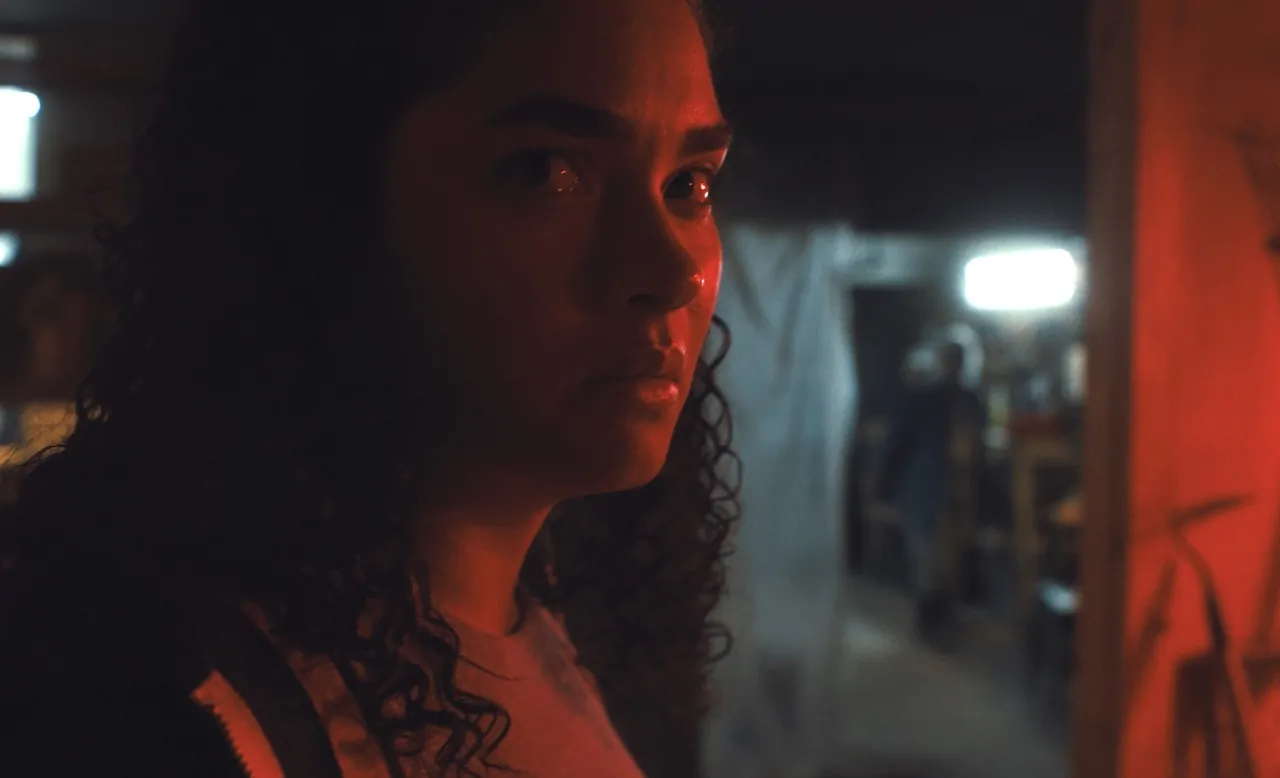
When In Our Blood world-premiered at Montreal’s Fantasia International Film Festival last year, it impressed with its combination of personal drama, serious scares, and topical concerns. As the movie arrives on VOD next Tuesday, December 2 from Utopia, its social themes hit even harder. Following that fest screening, Fango spoke to the team behind the movie, which has been in the works for a long time and is now coming out at just the right moment.
In Our Blood’s genesis dates back to the early 2010s, when screenwriter Mallory Westfall, then fresh out of film school, met producer Aaron Kogan, who pitched her the concept. “It was just a kernel of an idea at that point, and Aaron thought I might have the right sensibilities to pull off a script. I was 23 years old then, and I’m 36 now, so it’s been a really long journey.”
The eventual film stars Brittany O’Grady as documentary filmmaker Emily Wyland, whose latest subject is her own journey to reconnect with her estranged mother Sam. As we watch through the lens of her cameraman Danny (E.J. Bonilla), Emily returns to her hometown of Las Cruces, a small village in New Mexico near the Mexican border, and reunites with Sam (Alanna Ubach). The meeting doesn’t go well, and soon Sam has vanished—and she’s not the only one. Emily’s attempts to determine what has happened to her mom and others in Las Cruces lead to unsettling encounters and, ultimately, a revelation that spins In Our Blood from absorbing mystery to full-on horror.
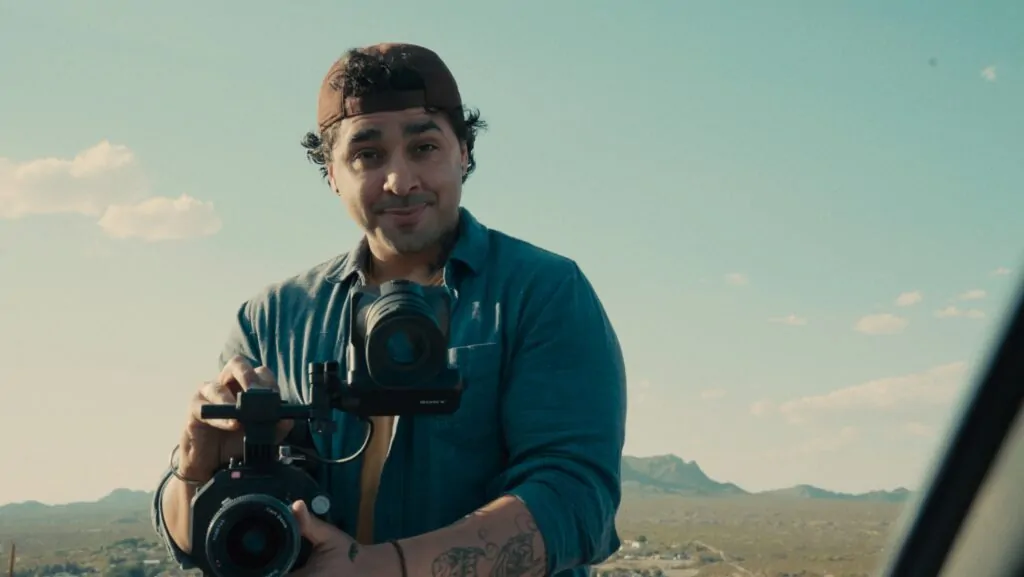
Chosen to helm In Our Blood was Pedro Kos, a Brazilian-American documentary filmmaker who had won an Emmy for editing 2013’s The Square and was Oscar-nominated (alongside co-director Jon Shenk) for the 2021 Netflix short doc Lead Me Home. That background made him perfect to tackle a vérité fright feature like this one.
“First and foremost, our guiding light was what we called the real deal,” he says. “We wanted to make everything feel as grounded as possible. And through Mallory’s prowess in putting the story together, where you’re always guessing where it’s going, the blueprint for creating the twists and turns was already there. Then it was about letting these beautiful actors guide us through every twist and turn and breathe humanity into everything they did. So when the film shifts into more of a genre space, hopefully it still feels like, ‘OK, where is this going?’ but at the same time, it never loses sight of that groundedness.”
While the horror elements take their time making themselves known, Kos notes that there are “Easter eggs” scattered throughout In Our Blood, which will not only help set audiences up for the eventual reveal but inspire them to see the film again once they’re aware of the endgame. “There are hints that something is wrong, if you look closely; something is not right in this world,” he says.
“One of the things about found footage is that it speaks to perspective. The way you’re looking at this world, it’s either through Danny’s eyes or Emily’s eyes, and you’re always within one of those perspectives. Emily is a very straightforward, no-bullshit kind of person who sees the world in a direct way, and Danny is a poet with a camera, who, because of where he’s from, never had the opportunity to be a big cinematographer.”
This mode of filming, which took place in the actual Las Cruces, helped the leads fully get into the vibe of the movie. “This felt so raw,” O’Grady says, “because all of it was on location and we were fully immersed in the spaces we were occupying. I felt like a part of the community; that was part of our daily process of going there, and being part of that environment and making friends with people who lived there. What made our bond [between herself and Bonilla] so special was that we had to work together and be flexible with one another to create that illusion. It was very freeing, and we were able to find some great, gritty, authentic moments. There was one scene where we’re at the motel and find something there, and I remember having this ‘a-ha’ moment of truly understanding what the film was going to be.”
“Normally when you shoot a film, there are multiple setups per scene, and you’re limited in the amount of pages you can shoot a day,” Bonilla notes. “We had a similar number of pages as a regular movie, but more time to explore the scenes and play. Also, Danny’s not on camera for three-quarters of the film, and I’ve never had that experience. Usually when you’re shooting, you feel like you’re constantly being watched. So there was a playfulness that Danny got to have, partially because there was less of that pressure. And getting to dance with Camilo [Monsalve], our cinematographer, was brilliant, because most of the time, it wasn’t like he was filming over there and I was just throwing my voice. We were moving together so that Brittany could still see me, and I could still be a part of feeling like I was filming her.”
The actor also points out the way In Our Blood stands apart from typical fright features: “The parts that get most petrifying are not necessarily like a traditional horror film. It’s not like there’s a literal ghost haunting us the entire time, but there is something in the air. And playing a character who’s like the voice of reason—the guy who, if they were watching the movie, would be like, ‘God, this is a bad idea…’ Getting to be that voice was a lot of fun, but it required honesty. Danny has been through enough trauma that he knows something’s going on, that this isn’t OK. He doesn’t know what it is, but there’s a scene in the church where he confronts Emily on, ‘You realize what you’re asking me to do. You’re asking me to jeopardize my entire life. I don’t get to have choices the way you do, not when I look like this.’ And he’s courageous for still going into the dark with his friend.”
Bonilla’s comment about Danny’s appearance speaks to one of In Our Blood’s key themes. Sam had been working with the homeless community in Las Cruces, and the movie incorporates on-camera interviews with a number of actual residents. These portions of the movie also address issues of immigration, which were already a much-discussed topic when the film was made and have become even more pronounced since.
“There was always this idea of playing with perspective, and doing something a little different with the found footage genre,” Westfall says, “dealing with people who are sort of outliers in our society. That was always there, from the beginning, but when Pedro came on board, it became about expanding that idea that there are many people who, for whatever reason, are pushed to the margins. And people who are not in the margins are sort of told to not look in their direction, or not listen to those people and not pay attention. That expanded to include the immigrant story, and it was very important to Pedro to set the movie in a border town.”
“I’m an immigrant myself,” Kos says. “I grew up in Brazil, and then I moved to the States, so I’ve always felt like an outsider, and carried that perspective in everything I do. In Our Blood is about so many things, and one of them is the unseen of our world, who we choose not to see, and how we in society are complicit in pushing things into the margins. What better place to explore a world where so much humanity has been disregarded than literally right next to the U.S.-Mexico border?
“Las Cruces is an incredible place,” he continues. “There’s so much beauty and life, but also a lot of obstacles. To me it feels very emblematic of America today, experiencing the housing crisis and homelessness, and you can also see the effects of the opioid crisis there. There’s so much inequality, and humanity that is being completely disregarded, like the waves of migrants who are looking for a better life. I wanted to look at that through the eyes of Emily and Danny, and give it that outsider’s perspective.”
Key to making this part of In Our Blood resonate was incorporating the on-camera talks with actual Las Cruces residents, allowing them to literally tell their own stories. “Those were among the most improvised parts of the movie, because they weren’t in the script,” O’Grady says.
“That came out of Pedro being in that place and getting a sense of the community and the people there, and seeing the importance of giving faces to people who don’t get a lot of screen time, and giving them a voice. When the dailies came in for those, I was blown away. There were beautiful interviews. We wanted to take this horror subgenre and push it to this new place, as realistic as we could get it, and having those people be a part of the story just took it to another level.”
“Las Cruces is an amazing place,” producer Kogan says, “and part of what drew Pedro to it was that there were a lot of people dealing with different issues and predicaments and tough circumstances there. It was important to him that we immerse ourselves in that.” The movie also deals with the dangerous sides of the area, and Kogan adds, “Thankfully, we were always safe as a production. We shot in places or adjacent to places where things that aren’t so good have happened, but we did it in a safe manner.”
The filmmakers emerged with a movie that is unsettling in several ways, tying together concerns and types of tension into one engrossing whole. “We wanted it to feel fully grounded in the documentary style, and it was always going to be a slow burn of a movie,” Westfall says. “It starts out simmering and ends up in a full boil. That pacing and structure really excited us. You know, this is not a movie that’s giving you jump scares every two seconds. It’s more about the tension and the dread that builds throughout and to that crescendo.”
In Our Blood is available on VOD December 1. Watch the trailer below.