
Last Updated on July 14, 2024 by FANGORIA Staff
Be it peeping toms, bewitched boyfriends, or psycho killers, obsession is one of horror’s most drawn-from wells of toxic inspiration. Like poison, it can be scentless and tasteless. Slow on the come up, so it’s already too late by the time anyone realizes there might be a problem. Obsession is abjection at its most abstract; how, when you repeat a word to yourself over and over again, tongue it smooth, the symbol of it falls apart. Ceasing to signify, each letter melts into meaningless ooze. The same can be done to a person, a people, a place.
The thing about obsession is that it’s never really about the object of attention (attention not always including affection). Rather, obsession is about looking and, more precisely, looking as eating. By definition, desire is the absence of satisfaction; the presence of hunger. The Shape is so-called because he epitomizes “the shape of evil.” But what does that actually mean? It’s his relentless, canonically senseless compulsion to kill that elucidates John Carpenter’s wicked geometry. Michael Myers is written to be a bottomless pit of deathhunger whose insatiable appetite for destruction becomes something more akin to religious devotion. “I am the shape you made me. Filth teaches filth” and all that.
Michael Myers embodies the filth of Haddonfield. Like Frankenstein’s Creature, he’s a monster born of rejection, whose hatred becomes its own religion. But obsession rooted in admiration oft-confused for love—this too is a breeding ground of monsters.
It goes without saying that the whole concept of fandom is both etymologically and spiritually derived from religious fanaticism: devotion in excess, where boundaries of self and other, real and imagined, dissolve. Where looking with good faith is not sustenance enough, one is compelled to seek communion.

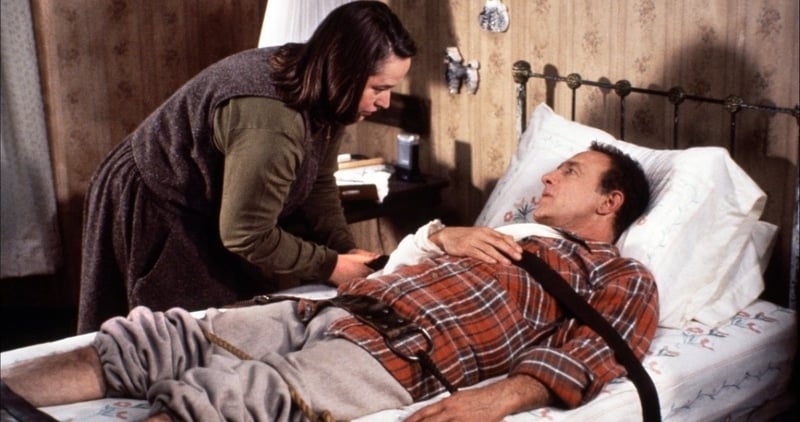
Annie Wilkes is probably the first name that comes to mind at the mention of horror, obsession, and fandom, and for good reason. She’s easily one of Stephen King’s most terrifying creations, not necessarily for her madness and cruelty, which are notorious amongst horror fans, but because of how precisely human she is. There’s no phantasmagoria in Misery; no elements of the fantastic or supernatural. But isn’t there?
Annie Wilkes is Paul Sheldon’s #1 fan. She’s read all his Misery books, knows them intimately, and knows the kind of details about him you’d now gather from Wikipedia, which is, of course, not the same thing as knowing a person. But for the time spent accumulating this knowledge, she believes she does know him and, further, that she knows what’s better for him than he does.
Her devotion is a rabid dog. And isn’t there something that feels supernatural about that alchemy? Any of us who’ve been online in the last decade can attest that a type of possession occurs when a person gives themselves over to their mutual adoration and hatred of a particular celebrity, internet persona, politician, or whomever one’s drug of choice turns out to be (sometimes even horror magazine editors). King has described Annie as the personification of his addiction, and what is addiction if not a fanatic’s compulsory impulse? While King signifies this through her use of painkillers to control and subdue Sheldon, Donald Glover takes a more ham-fisted, twenty-first-century approach to the matter in Swarm.
Drawing inspiration from the Beyhive- ostensibly the first “fan army”- as well as that time Beyoncé was inexplicably bit in the face at a party, Swarm centers on obsessed fan Dre, whose idolization and the trauma it masks begets heinous consequences for herself and those around her. Each episode of the series takes us through another chapter in her long-term development as the serial killer the world never expected: a member of “The Swarm” so devoted to Ni’Jah, the fictitious Beyoncé, that she would literally kill for her. And does. A lot. In a lot of different ways.
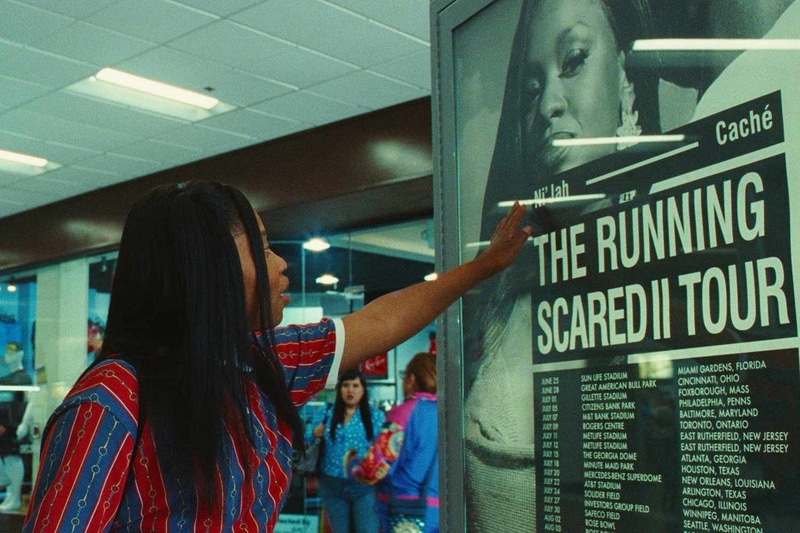
The unifying feature of these murders isn’t the murders themselves but how they begin and end. It starts with a criticism of Ni’Jah and ends with Dre ravenously devouring any snack she can get her hands on before promptly passing out. This pattern of kill-eat-sleep bears an uncanny resemblance to the “eaters” of Bones And All, also compelled to nap after the exertion of a meal. Much as the series works to satirize stan culture, it can’t accomplish this without critiquing consumer culture.
Viewers are introduced to Dre in a scene that sees her open a credit card to immediately charge $2k she definitely does not have for Ni’Jah tickets. Before anything else happens, we’re meant to understand her fandom as a compulsive behavior at odds with the reality of her life circumstances. But it also reflects a baseline lack of respect for fans as people and the economic conditions celebrities ask folks to participate in, then deride them for doing so. Why should a concert cost $2k in the first place?
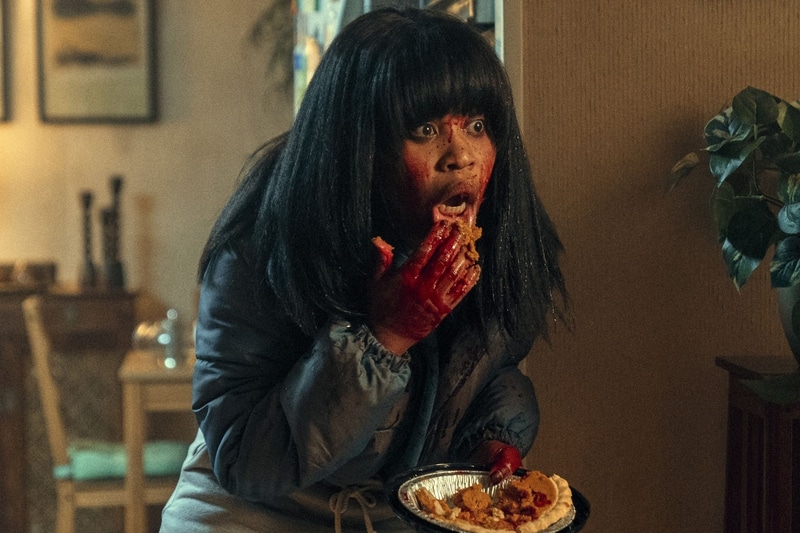
For everything Dominique Fishback brings to the character, Dre is ultimately a caricature; one that seems imbued with every mean thought or feeling Glover’s ever had about his or others’ fans, as well as women in general and Black women in particular. Despite the sympathetic backstory written into the text, and much as I personally view the character as intensely tragic, the show offers an individualist interpretation of a monstrousness that is ultimately collective, cultural, and spiritual in nature. Where it succeeds is in its presentation of parasocial relationships as an expression of looking-as-eating, but also looking-as-eating as self-avoidance.
To indulge in boundless obsession treats the object of fixation as a source of nutrition. Left unmitigated, such a practice inevitably becomes one of necrotic devotion; a sort of spiritual anorexia where perceived self-denial becomes a ritualized form of worship that can, in actuality, be incredibly self-indulgent. Such is the state in which we meet Simone, the narrator of Eckhart Schmidt’s 1982 West German feature, Der Fan.
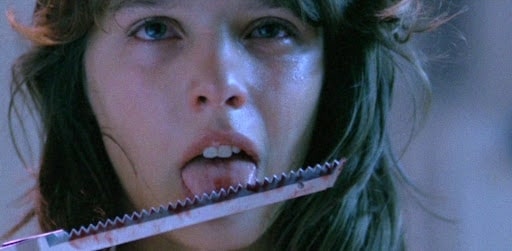
Before Swarm, before Misery, before the internet was even invented, Schmidt took on the subject of fandom as a practice of fanatical idolatry with fearless candor and still unmatched clarity of vision. Der Fan is one of those projects that feels totally contemporary and, as a result, can seem to possess eerie foresight. Contextualized however, the project represents an astute meditation on Germany’s then-recent past filtered through the post-war advent of “the screamers”: the hordes of teenage fans, most of them girls, who flocked for Elvis and The Beatles and hereby inspired a litany of studies on the pathogenic nature of fandom, approached as a type of hysteria.
It’s no coincidence that Misery, Swarm, and Der Fan are woman-led projects, even if their subjects aren’t all teenagers. But while Swarm is framed through an omniscient perspective and Misery centers Sheldon in opposition to Annie, Simone is the narrator of Der Fan. The film opens on a closeup of her eyes gazing in wait for the written response she’s certain is coming from her beloved, R, a new wave pop star to whom she poured her heart out three weeks prior and since spent every day skipping school to terrorize her local postal worker and daydream about imaginary dates. Olivia Rodrigo was right when she said, “Love is embarrassing as hell.”
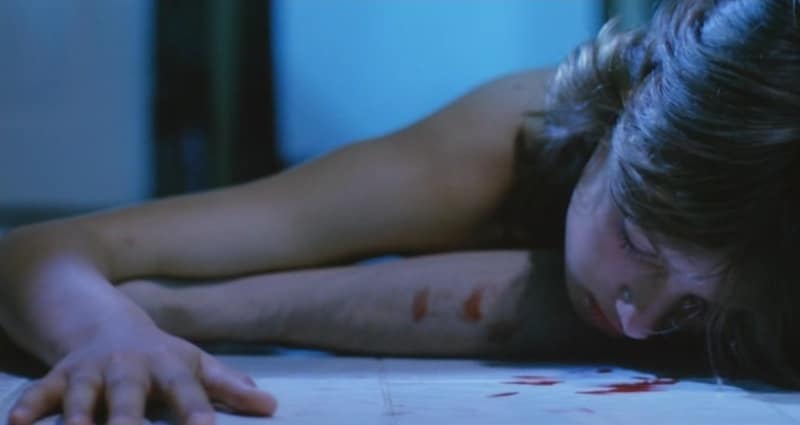
Simone’s obsession is totalizing. A perfect encapsulation of teen girlhood as a state of bone-deep yearning. Consumed with fantasies of the unobtainable, she relinquishes her daily life, leaves her parents’ house, and pursues the destiny she has absolute faith in—and it happens! From across a crowd, Simone and R’s eyes lock, the dreamwave score swells, and he chooses her.
Having spiritually starved herself in demonstration of her devotion, she plunges right in when the opportunity to indulge presents itself, as does he. The power dynamic between them isn’t just mythic but theologic in nature. Simone idolizes R, by which I mean, she turns him into a type of god. But R is just a dude and a shitty dude at that, a fact Schmidt makes sure viewers are completely aware of, even if Simone isn’t. “Every woman adores a Fascist,” wrote Sylvia Plath in “Daddy,” a poem that compares her relationships with her father and husband to the power dynamic between a Nazi and a Jew, a vampire and human. The poem is, in essence, the same artistic project Der Fan takes up, if framed through a different lens.
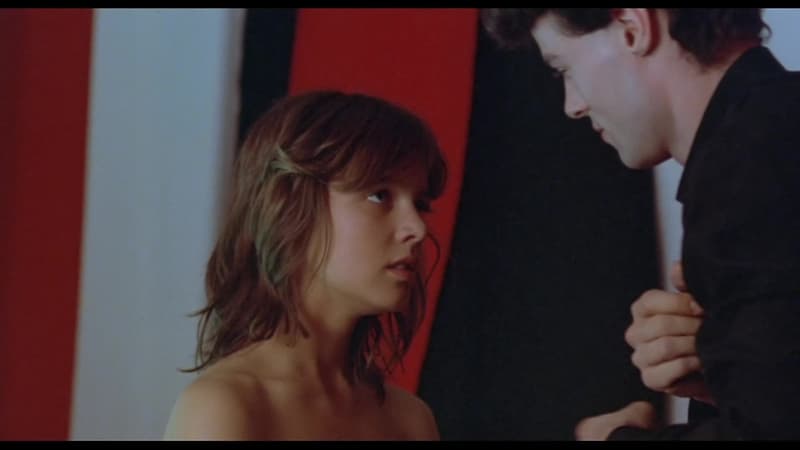
Where Plath negotiates her fluctuating perception of her father as “not God but a swastika” (i.e. a false idol), Schmidt draws similar comparisons through Simone’s adoration of R. In so doing, he likens the allegiance of German citizens to Hitler to the teen girls scorned by such cultures of repression. There’s a satisfying irony to this, of course, that the clearest elucidation of paternalism regards its acolytes as its most consistently maligned subjects, which is not to say such subjects are without power.
Even as Misery and Swarm understand and portray obsession as a practice of looking as eating, they signify this through symbolism (narcotics and fiction in Misery; snacks and Ni’Jah in Swarm). Der Fan takes an act of metaphysical cannibalism and makes it literal. If fandom is a practice of celebrity worship, Simone comes to demonstrate this devotion through an act of theophagy. Having projected divinity onto R, she then devours god by devouring him. The third act of Der Fan is an experience, to say the absolute least.
Much has been made in the last couple of years about the figure of the romantic cannibal, the libidinal overlap of hunger and desire, and its theological implications. Yes, eating god is Christianity’s most sacred ritual. Yes, we are animals, all of us capable of truly primal violence given the right set of circumstances. Yes, love feels like wanting to eat and be eaten. And the most important part is that we stop ourselves. Destruction in the name of love, in the name of devotion, is still destruction. “I beg you. Eat me up. Want me down to the marrow,” Hélène Cixous writes in “Love Of The Wolf.” “And yet manage it so as to keep me alive.”
