
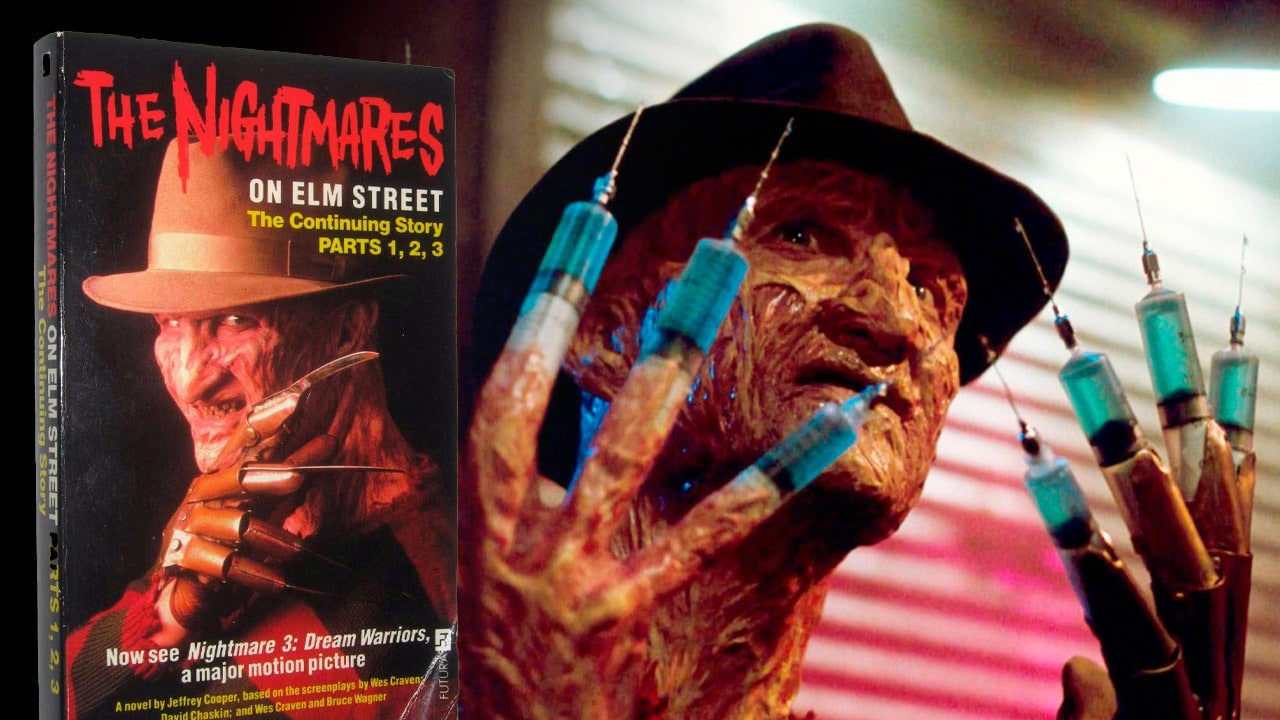
As any franchise fan knows, the novelizations of our anti-heroes’ misadventures tend to stretch your wallet pretty thin, even if they’re not exactly great reads. But at least the films always warranted their own individual releases, with the curious exception of Freddy Krueger. In 1987, a mere two weeks before the theatrical release of Dream Warriors, St Martin’s Press published The Nightmares on Elm Street Parts 1, 2, 3: The Continuing Story, which novelized the first three films as one volume.
The three stories, all written by Jeffrey Cooper, take up a combined 216 pages, making the book on the thinner side of such things even if it was just covering one movie (to compare, Freddy vs. Jason’s standalone novel runs 272 pages). It would take four and a half hours to watch all three films, but you can probably get through the book in half that time.
But you don’t even have to bother with doing that much. As you might expect given its later publication, the novelized takes on the first and second films don’t significantly differ from the finished films. Cooper’s account of Freddy’s debut offers the occasional bit of biographical information about Marge and Don Thompson, and he changes some dialogue here and there in Freddy’s Revenge, but that’s about it. He mostly races through these two entries’ events exactly as we saw them and doesn’t add much in terms of interior monologue or descriptions of the settings, making them pretty unsatisfying reads.
However, production on Dream Warriors was clearly still ongoing by the time Cooper started writing. In fact, the included dozen pages of photos (a novelization trend that has been more or less retired) are only from the first two entries, as they apparently didn’t even have a few publicity shots to share as of yet (shoutout to FANGORIA #62, released the same week, which sported a tuxedo-wearing Freddy on the cover and plenty of pics inside).

The movie credits included for all three films only list Wes Craven and Bruce Wagner as Dream Warriors writers, when the film itself rightfully has them sharing credit with Chuck Russell and Frank Darabont.
But in a way, that’s helpful because it makes it clear what the two men brought to the table as they reworked the Craven and Wagner draft that Cooper was working from. The main plot is the same; Nancy Thompson (a returning Heather Langenkamp, who was barely mentioned in Freddy’s Revenge) returns to Springwood in order to help a group of teens who have been committed to an institution for suicidal behaviors and pattern nightmares.

Chief among them is Kristen (Kirsten in the book) Parker, who seemingly has the power to pull people into her dreams. Despite skepticism from the other two doctors at the institute, Nancy helps Kristen control her powers in order to fight Freddy as he decimates the group one by one, culminating in a showdown that ends Nancy’s life along with his.
But when you look at the details, a LOT is different. For starters, while Nancy returns, her father Don (played by John Saxon) does not; Nancy says he disappeared after her mother died and that’s the only time he’s mentioned. Sr. Mary Helena, aka Amanda Krueger, is also MIA; at one point, Nancy (not Neil) does some digging and discovers that her home at 1428 Elm used to be a place for insane women called Hathaway House.
Through this research, she is given the “how Freddy was born” story that Neil got from Amanda in the movie, albeit with some changes. Krueger was still the product of repeated sexual assaults, but by fellow inmates of the county hospital Amanda was at before being sent to Hathaway, where she died in childbirth.

The group of kids we know and love are all accounted for, but there are some major differences, and some have swapped their traits. For example, Joey is the one who can’t walk, not Will (who is named Laredo here), and he is the one who gets acrobatic skills in his dreams instead of Kristen. Jennifer doesn’t mention wanting to be an actress and also survives much longer. In fact she’s still around when they have the “In my dreams I can _____” scene, in which she has the power to become a ghost of sorts.
And Taryn, who is said to be Black, can breathe fire instead of just being a badass. This scene ends with Freddy attempting an attack and the group using their powers against him all at once, something the movie never manages since Freddy only goes after Joey at this time and everyone gets instantly split up when they return.

The death scenes are a mixed bag; some, like Jennifer’s, are the same, while others are very different. Taryn’s drug addiction was part of the creative overhaul, so naturally, the “What a rush…” kill is absent. Instead, Freddy impersonates her grandmother and stabs her while they embrace (a moment more or less recycled into how Nancy dies in the finished film).
Will/Laredo’s death goes into full fantasy mode, as he shape-shifts from his warrior character into a dragon that momentarily has the upper hand before Freddy dispatches him with his own sword. Philip is still killed “sleepwalking” (with the Freddy “puppet master”), though he is directed in front of a speeding ambulance instead of dropped from a window. And Joey’s “tied to a bed/seduced by Freddy in disguise” scene is more or less recreated here, but he dies at the end of it instead of going into a coma.
Joey is not the only one originally killed only to survive the actual movie, thanks to rewrites. Kincaid is also taken out, as is the witchy Dr. Simms (originally named Dr. Maddelena, after Craven’s frequent producing partner), leaving Neil and Kristen as the only survivors. Max still survives, but his presence is so reduced that it’s easy to forget he was ever there to begin with (and the other orderly, Lorenzo, doesn’t appear at all here).
Kristen’s mom is also killed, in a sequence that apes Freddy’s Revenge pool party scene. Kristen’s power to pull people into her dreams works a little differently here – she is able to basically blend the dream world with the real one. So she and the others spend a good chunk of the climax teleporting around familiar locations (while sleeping), eventually appearing inside her own home as her parents throw a lavish party. As Freddy pursues them, he cuts her mother down along with some other guests before they all jump locations yet again.
It would have been an exciting sequence, but the concept crosses from “imaginative” to just plain confusing. As with Part 2’s weird take on Freddy, the “rules” for the dream world vs. the real one are left maddeningly unclear in this version of the story, so I’m glad Russell and Darabont scaled this stuff back and provided firm barriers between the two worlds, give or take a junkyard skeleton.
Darabont and Russell also gave Neil an overhaul. As in the movie, he butts heads with his colleagues and bonds with Nancy (they even sleep together), but he’s also kind of a jerk at times, skeptical until nearly the end. He’s actually new to the group as well; while the finished version had him clearly bonded with all of these kids for a while before Nancy arrived, the two introduce themselves to Kincaid and the others on the same day. Also, instead of teaming up with Don and going on a bone-burying mission, Neil enters the dream world and fights alongside Nancy, whereas, in the movie, they have their final moment together at the end of the second act.

My favorite reveal is that Kristen’s final line to Nancy actually made sense at one point, and we see how she fulfilled her promise. Again, her powers are different here, so when she says “I’m going to dream you into a beautiful dream, forever and ever,” it actually tracks what she can do, essentially directing other peoples’ dreams. It’s a nice line so I get why they kept it, but it’s amusing that it’s a remnant of older drafts. Anyway, she makes it so Neil can see Nancy in his dreams every night and be reunited with her, a nice little moment I wish the feature version had included in some way.
Honestly, it’s hard to say if this would be a better version. Amanda’s ghost wandering around and being visible only to Neil is a bit odd in retrospect, so I think I prefer the more straightforward version presented here, even if it gives the doctor less to do. I definitely prefer him having an established relationship with the kids (with Nancy as the new arrival), though I think I would have liked to see the group fighting Freddy as a unit, which the finished version lacks. Basically, for every right call they made, something good got lost as a result.
But the complete lack of John Saxon, as well as the moment that scared me the most as a kid (the roast pig coming back to life), ultimately leaves me in favor of what came to theaters. To date, it remains (and thus will probably always be) my favorite sequel. I’m not sure this version of Dream Warriors would have been able to top New Nightmare (my second favorite sequel) in my rankings. Power of Saxon!