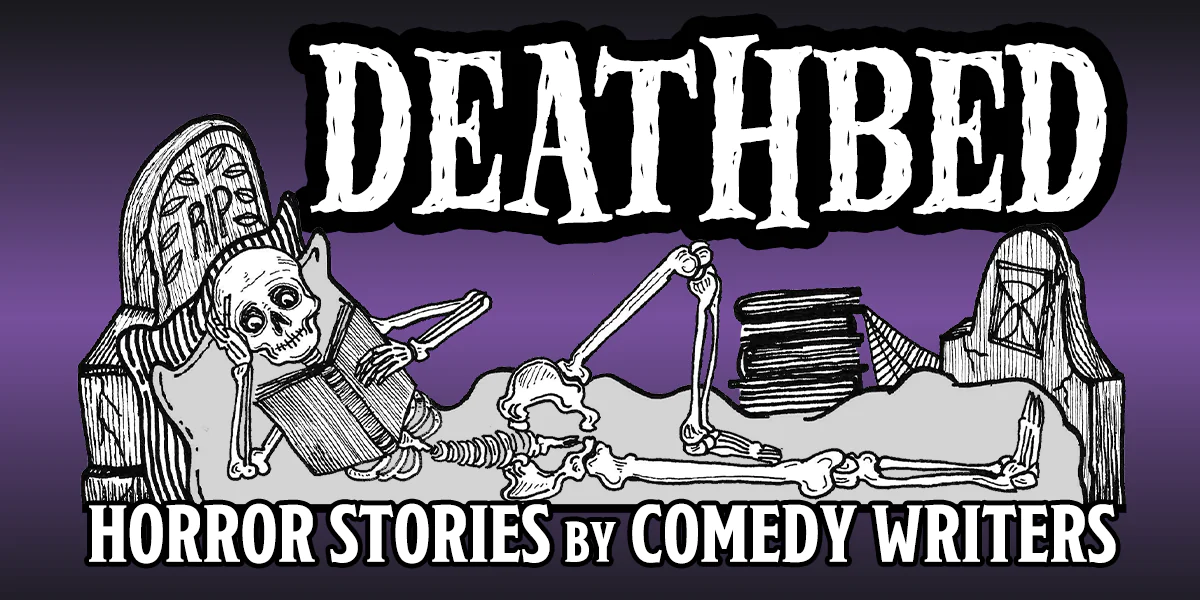
Earlier this month, Fango boss Phil Nobile Jr. drew my attention to the absolute wealth of hilarity and horror provided by Deathbed, an online publication and newsletter that launched in September of last year. The pitch is simple, very much my speed and probably yours: comedy writers like Matt Gourley (Conan O’Brien Needs a Friend), Janine Annett (McSweeney’s) and Brendan Hay (Robot Chicken) craft original horror short stories available to readers with a free subscription.
The site offers a true marriage of the two artforms: writing by some of the funniest people in comedy, delivering stories that aren’t afraid to, as editor-in-chief Ritch Duncan says in the site’s introduction, “go hard.” Phil spoke with Duncan and managing editor Ben Zelevansky to learn more about Deathbed’s mission, the future of horror comedy, and how we protect the pursuit of human storytelling in a society that perpetually devalues it.
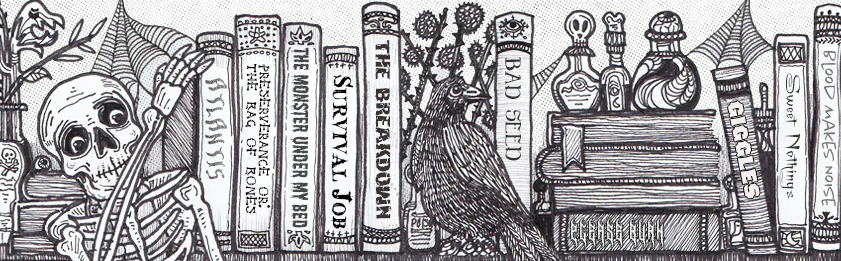
How did this idea begin? What got you thinking ‘Horror Stories By Comedy Writers’ could be its own subgenre, so to speak?
Duncan: It began when I read a straight-up horror story by a terrific comedy writer. It was called ‘COUNTER-CROSS,’ by writer and podcaster Dan McCoy, a friend of mine I’ve worked with for years. He had published it on his personal newsletter and said, ‘Here’s this thing I wrote, but there’s no real place for it.’ I instantly thought, ‘why not?’ I thought it could be a potential subgenre, because ‘Horror Stories By Comedy Writers’ sounded like a great hook. It sounds nonsensical, but rings true at the same time.
That’s what ‘Horror Stories by Comedy Writers’ is: a ridiculous contradiction, but if you look at the current horror landscape, also absolutely what’s happening. Some of the most exciting projects in horror are coming from comedy writers. That’s also why I chose the name Deathbed; it’s another comic contradiction. I mean, death… that sounds bad. But when you factor in the ‘bed’ part? Hey, that’s not SO terrible.
Zelevansky: From my viewpoint out here in Hollywood (yes, Deathbed is bicoastal!), things are weird. The hundred-year-old business model of making money by telling great stories has been replaced by a tech-infused mindset that prioritizes neverending exponential financial growth and pretty much nothing else. This Seth Rogen NYT interview sums it up well – this is someone who has delivered literally billions of dollars at the box office. If a guy like that can’t write his own ticket, what are we even doing anymore?
The silver lining is that a lot of interesting voices are, like life on Isla Nublar, finding a way. It reminds me of the indie film boom of the ’90s, except that now you don’t have to figure out how to use a 16mm camera and max out a bunch of credit cards just to tell a story.
The comedy-to-horror pipeline is FLOWING right now. Was that a factor in this endeavor? As a purveyor of such crossovers, what are your thoughts about the movement happening with filmmakers like Jordan Peele, Zach Cregger and Curry Barker? Why are comedy writers so good at horror?
Duncan: The fact that there is an existing path for comedy folks to succeed with horror projects probably helped me get more comedy writers to participate, but for me, the primary motivator was a love for the horror genre. I think that’s the case with most comedy people who work in horror. I mean, we all saw that viral picture of [Widow’s Bay creator] Katie Dippold dressed up like The Babadook, right? She’s not hopping on a trend because it’s hot right now; that’s a woman who obviously digs this stuff, worked to make it happen, and we’re living in a cultural moment that’s open to it.
If movies like Weapons or Get Out or Obsession weren’t big crossover hits, I’d be the genre fan out there on social media championing them. But what makes horror/comedy really exciting today is these projects aren’t just being embraced by former video store clerks like me – they’re finding a larger audience, and I love that. If I can help contribute stories to that pipeline, or bring new voices and perspectives to the genre, I’m happy.
As to why comedy writers are so good at horror, first off, there are obvious structural similarities. The post I wrote introducing Deathbed gets into it: horror and comedy depend on building tension, then releasing it to create an involuntary response, be it a scream or a laugh. But on a deeper level, both comedy and horror are societal mechanisms that help process the insanity of being human. So many funny people I know, myself included, have honed their senses of humor as defense mechanisms against trauma. So it’s a tone shift, but a lot of the same tools are used.
Conversely, I’d absolutely encourage horror writers to try comedy writing. A lot of horror is the idea that ‘This thing that the rules told me can’t be true, not only is true, but is right in front of me.’ That’s how a lot of comedy works, as well; there are rules and norms we accept as true, but when those same rules are applied to another situation, they are exposed as false or ridiculous.
Zelevansky: Another reason comedy people have a leg up is that improv, sketch and standup are second only to punk when it comes to the DIY ethos. Just ask any comic who’s had to do bringer shows or bark outside a club in exchange for stage time.
And while the lower barrier of entry is great, the loss of any trusted curation has thrown the signal-to-noise ratio all out of whack. That’s where Deathbed comes in: for every Curry Barker or Kane Parsons that breaks through, there are LOTS of ‘influencers’ who just haven’t worked in traditional showbiz, and may not have those chops.
What, in your experience, are comedy writers doing with their horror that sets it apart from more straightforward genre creators?
Duncan: Well, you can take the writer out of comedy, but you can’t take the comedy out of the writer. A lot of comedy writers ask me how funny these stories should be, and I tell them ‘just write a genre story. You’re funny, that part will happen on its own.’ For example, in Matt Gourley’s story, ‘Normal Like Me,’ there’s a scene where a garden party devolves into bloody mayhem, and a character accidentally sprints into a woodshed full of knives. Now, look – if you don’t already think that’s a little bit funny, I guess you and I have different senses of humor. But when we were working on a second draft, he delivered a new version where that scene came in tagged with the following line: ‘The result was the answer to an age-old question: How much blood could a woodshed shed, if a woodshed could shed blood? Quite a bit.’ In my opinion, that’s a top tier joke, and where else does a joke like that fit in, but in a horror story?
What’s the most unexpected story in your catalog, and why?
Duncan: Most of the submissions I get are either funny premises, played for horror, or horror premises that feature unexpected jokes or funny character moments. And those are great. But the story ‘Blood Makes Noise’ by Doug Bost was entirely different, just a hard, rugged horror story that really rattled me. Doug was a founding member of the sketch group Euphobia, a terrific part of the 1990s NYC alternative comedy scene, and he’s a fantastic writer who sent me this story about a guy who goes to the doctor with a clogged ear canal, and it’s just gnarly as all hell. I think it’s easily the scariest story Deathbed has published to date.
Is the inherent contract of Deathbed that the stories will be somewhat funny, or can the writers go anywhere they want in terms of tone? Talk about your curation process a bit.
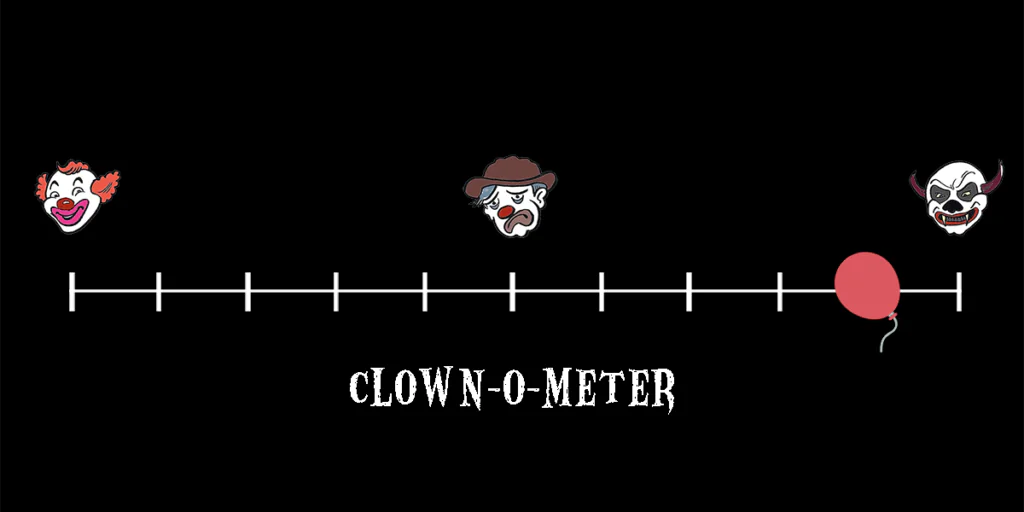
Duncan: At Deathbed, we allow for a wide range of vibes, from scary to funny, thanks to our highly scientific Clown-O-Meter, which was the brainchild of Dan McCoy, the podcaster and comedy writer whose horror story inspired this project. The Clown-O-Meter ranges from one – ‘spooky fun for Halloween’ – to ten – ‘Dear Lord, does the depravity have no bottom?’ Preconceived expectations can play a huge role in how much you enjoy any story, so while the Clown-O-Meter is mostly for fun, it does serve a purpose.
Deathbed really does strive to have all kinds of horror stories. In an age where everyone in our culture is staring at short videos on their phones, Deathbed is asking its audience to read, which is a tough ask, especially on a phone, when our stories are competing with a million things that are algorithmically designed to pull their attention away. So my curation really depends on flow and readability first. If it’s a funny genre story, great. If it’s terrifying and gross, even better. With the variety of stories we have on Deathbed, one individual reader might not love all of them, but almost every reader who enjoys horror or comedy will find something on Deathbed to love. And all our stories are short. And free. Take a chance on one!
Zelevansky: Scrolling through Reddit or YouTube to find the next great voice in horror is like looking for a needle in a haystack, whereas Deathbed is just a big ol’ pile of needles – razor sharp, possibly infected and ready to plunge deep into the brains of horror fans everywhere. Our writers are established pros with credits and awards. We all cut our teeth coming up under the old system, and are having a ball exploring and helping to shape the new one.
For Deathbed, that also means pushing back hard against the increasingly aggressive flirtation with AI as a way to tell stories without all that messy human experience, thought and emotion. This could be a whole column in itself, but suffice it to say that AI in any form is gonna be a no from us, dawg. We’re proud that all of our stories are written by funny, creepy, talented, flawed human beings.
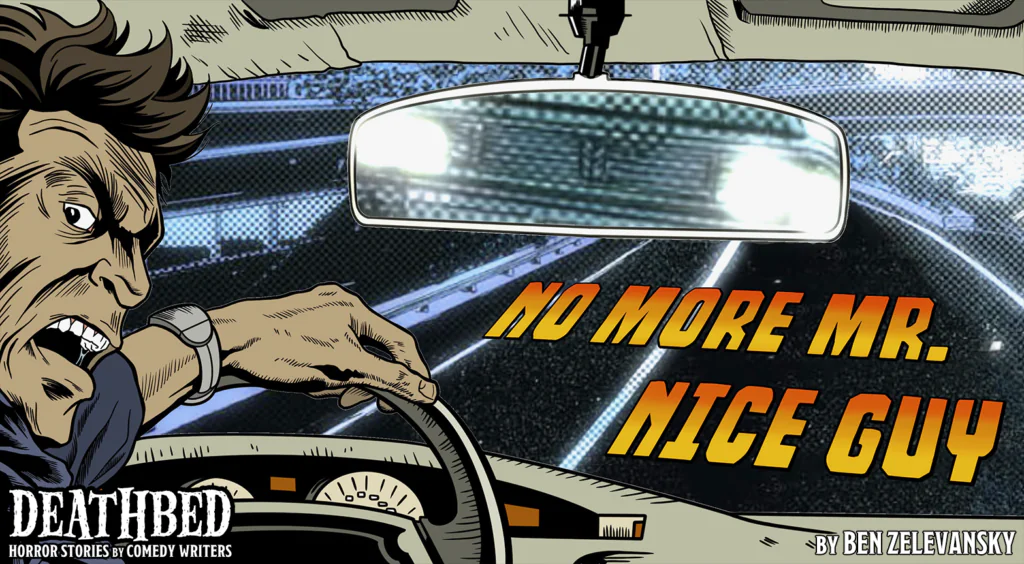
Same goes for the artwork – we chose the fantastic Becky Munich to create Deathbed’s visual style and Skully mascot, added the versatile Peader Thomas all the way from Australia as a staff illustrator, and have worked with other freelance geniuses like Mike Falcigno, whose original art for ‘No More Mr. Nice Guy’ is a love letter to the EC Comics covers of the 1950s that kept drawing so many of us to the genre decades after they first hit newsstands.
Dream contributor? What’s next for Deathbed?
Duncan: Dream contributor is such a hard question. Right or wrong, the first name that pops into my head is Dana Gould. Writer for The Simpsons, brilliant standup, bulletproof genre bona fides, he’d be an awesome Deathbed writer. Folks like Jordan Peele, Katie Dippold, Danny McBride, or Patton Oswalt would obviously be dreams come true. But there are also folks who don’t have direct ties to the genre who I think would be great. Jenny Slate wrote an amazing book of short pieces called Little Weirds, which weren’t horror stories, exactly, but were damn close. There are so many comedy writers whose work I admire that I’d love to see what they’d do in the genre if they wanted to try. Merrill Markoe, Bob Odenkirk, Jessi Klein, Todd Levin, Eric André, Jen Statsky, Megan Amram, Frank Lesser, Andrés du Bouchet, Todd Hanson, Emily Flake, Neal Brennan, Adam Felber, Colton Dunn, Dan Harmon, basically anyone whose humor writing is smart, sharp, and can extend a logical premise into the surreal and insane would be someone I’d love to work with on a Deathbed story.
Zelevansky: We’ve got some great stories coming down the pike in the next few weeks, including a spooky season finale set to drop on Halloween. It’s about an aging scream queen in trouble – the twist is that the story has two endings (Ritch and I are each writing one) and readers will be able to choose which fate they want to befall our heroine. Fango readers should subscribe (for free!) to read it.
This interview was edited for length and clarity.