
Last Updated on July 14, 2024 by FANGORIA Staff
Why don’t they just get out of this house? That is undoubtedly a question many horror fans have asked of characters over the years. The answers have varied, with some falling in the category of sheer stupidity, and others creating an emotional anchor as an adequate reason to stay. But in the years of asking this question, audiences have never been given a reason quite like the one Irish filmmaker Damian Mc Carthy provides in his feature film debut, Caveat.
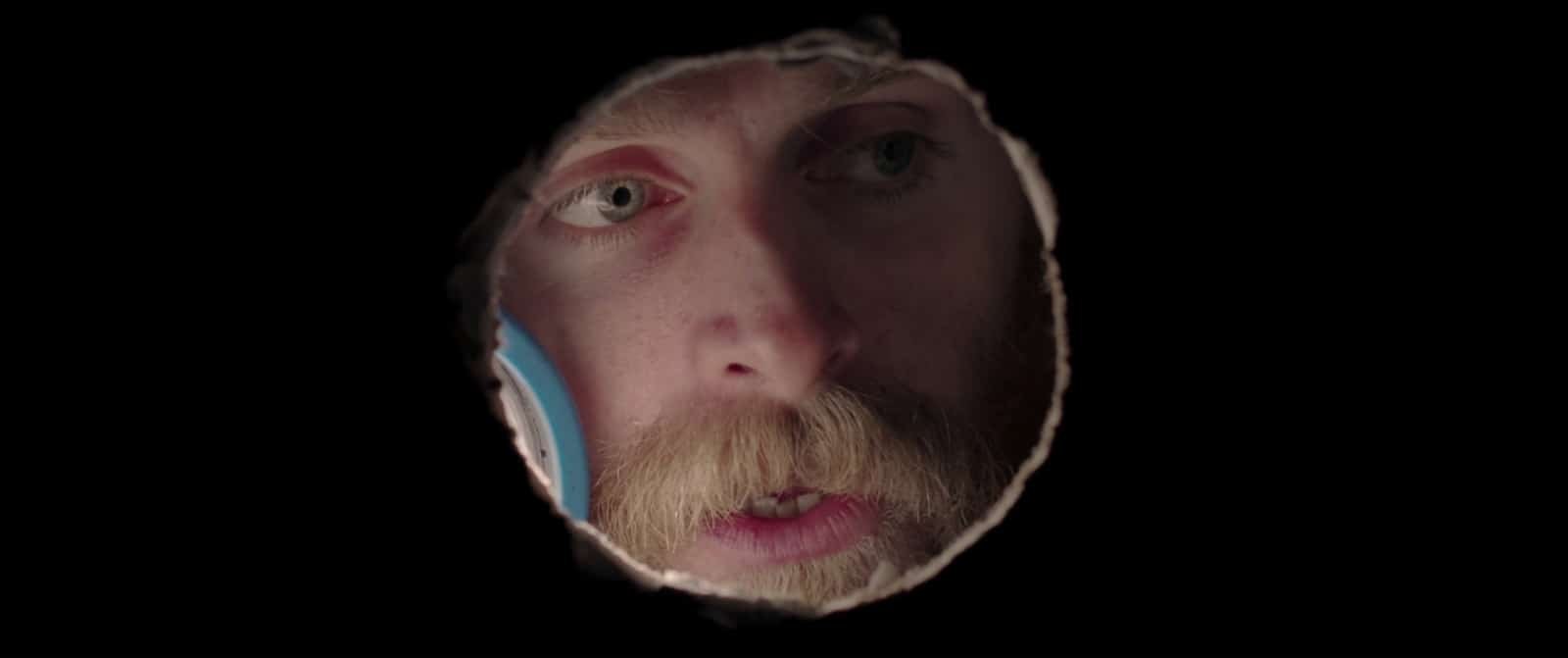
Caveat follows Isaac (Jonathan French), a man suffering from partial memory loss who accepts a seemingly simple job from his friend, Barret (Ben Caplan): to look after his orphaned niece, Olga (Leila Sykes), for a few days at her family home. Of course, the job isn’t quite that simple. Olga is psychologically disturbed, and the house is dilapidated and located on a secluded island circled by a pack of screaming foxes. With each revelation, Isaac feels less and less certain about taking the job, and less certain that Barret is truly a friend from his past. But all those conditions pale in comparison to the final one: for Olga’s peace of mind, Isaac must wear a harness with a chain attached and fixed in the basement, limiting his movement around the house and preventing him from crossing the threshold into Olga’s room where the only phone is. Chained and caged like a wild animal, and carefully watched by a crossbow-wielding Olga, Isaac begins to question the nature of his reality and the conditions under which Olga lost her parents.

FANGORIA talked to Mc Carthy about his film, which premieres on Shudder today, and how creative ingenuity and building a story off images allowed him to make a big statement with a small budget.
Caveat is your first feature. Did you direct shorts before this?
I made a lot of short films before this in film school. They weren’t very good. They’re all hidden or deleted at this point [laughs]. But in the last ten years of making short films, I made six or seven, and they all seemed to do fine in festivals. So, this is my first go at a feature.
What was the process for you of developing Caveat as a feature?
Long and painful [laughs]. Like most guys trying to get started making feature films, it does help to have made short films before. And that’s really just for yourself so you know how it works on the set and know that you’re prepared. But I guess the toughest thing was getting financing. Even though the short films had all done well, it’s so hard for somebody to take that chance on you and actually put that money on the table and invest in you. So, we had a longer script which was much more ambitious and had a lot more in it and we tried for about a year or so to get funding for that, but it was really never going to happen for whatever reason. But it was probably a good thing it didn’t, because I think the film was a bit too ambitious even for the money we were trying to raise. So, we’d more or less given up on it. Then a little bit of money came and was offered to us, and very quickly we said, ‘Yeah, let’s take this now before we lose the chance.' So we just started building sets straight away and hiring actors. Maybe not the best way to go about it in looking back, but it was pretty much taking the existing script and trying to find everything that I thought visually would be interesting. You try to think afterwards, ‘How would I sell the movie visually in terms of posters or trailers?' And it was pulling at all those elements that I thought would look cool and sort of building a new story around that.
There’s a lot to be said about having a great location, and that dilapidated house feels like a character of its own. Did you build that set or find it?
I’m from the Southwest of Ireland, in Bantry; it’s right down at the bottom. And there’s a house, a big tourist attraction, called Bantry House, and I’m friends with one of the family who live there. The house is beautiful. It’s so well-kept and it’s got all these old paintings and antiques and stuff. It never would’ve worked for location. Our story is set on an island in this old house, and the house is obviously battered, and dilapidated, and full of decay. So, even though Bantry House looked great we couldn’t really use it. But lucky for us, they have really big grounds. So, at the back of the house there were other smaller houses around the property. So we could take a room there and use that as our location because it was sort of rundown. But I’d say 70% of what you’re seeing on the screen is built from scratch. It’s built on the grounds in some of the much larger rooms that we used as a studio in a way. A lot of that was from old, salvaged timber and rotten floorboards to add to that rundown look of the house.
I’m curious about the harness and how that worked in the physical space of the set. Were your actors actually chained and working within those confinements?
Yeah, Jonathan French wears a harness for almost the whole movie, and it’s constantly restraining him from going to the bathroom, stepping outside the house, or going to Olga’s bedroom. For most of the time it was easy for him to hit his mark because I’d say just walk as far as you possibly can. There was either a crew member off-set hanging on to the end of the chain, or it was nailed to the floor. Usually when we broke for lunch we’d have to remind them to let Jonathan go and take him out of the harness [laughs].
I really enjoyed Jonathan’s performance. I know he, along with a couple of the other actors, are pretty recent to the scene. Could you talk a bit about your casting process?
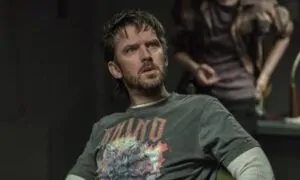
The casting, again, was very fast because this financing came along, and we had to get the script out to people pretty quickly. The guy who had the most experience was Ben [Caplan] who’s been acting for years. Band of Brothers was his first big break, and he’s been in everything from romantic comedies like Leap Year to the film he did before us, The Commuter, with Liam Neeson. He’s worked with lots of talented, successful directors, so it was great to have him on set as well. And he plays quite a tough guy in the film, so to have an actor that was that confident was just great for the part. Leila [Sykes] plays Olga and Jonathan [French] plays Isaac. They had less experience. They’d been in short films and bits and pieces like that. But what was important about their casting was there were long stretches of no dialogue. A lot of it is in the actor’s face, and in their eyes and their expressions. That was really more important than if they could deliver dialogue well. I got very lucky. They were great to work with. Jonathan really has to carry the film and you’re following him exploring the house for such a long time. His eyes are so expressive, and he’s hidden under this large beard for a lot of the movie, so once we shaved him off he becomes a completely different guy.
Did Leila have any crossbow skills beforehand?
No [laughs]. Even though it was a prop and was never going to hurt anybody, there was still that little bit of nervousness that comes from pointing a weapon at anybody. But no. I think it added to Olga a little bit because she’s quite reluctant to resort to the violence that does happen with her in the film. Leila used that nervousness quite well.
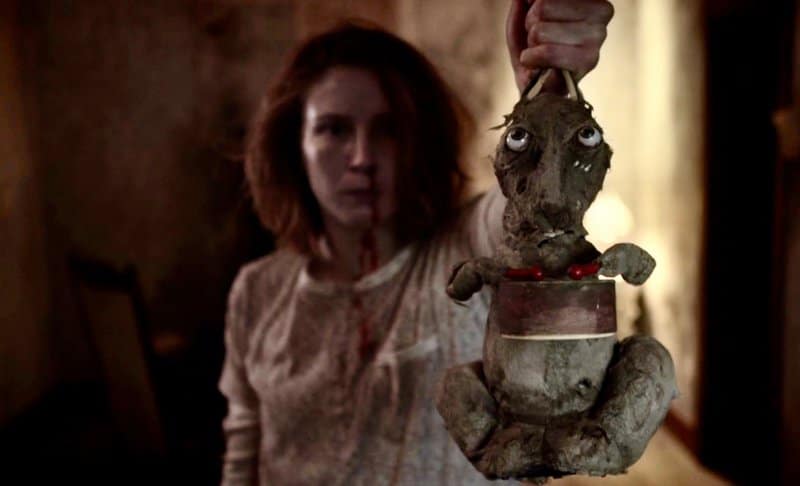
Olga’s stuffed rabbit is a great, creepy design, and has been central to the film’s marketing. How many iterations did it go through before you landed on that one?
It’s great! We did two. So basically, the first iteration was my attempt, which was terrible. I’d bought a cute drumming bunny online and I’d taken all the fur off of it and tried to do my own creepy version of it by changing the eyes and all that. And it just looked like [an] Ewok from Star Wars and was very cute and furry. So, here in Cork there’s a woman who works in theater, Lisa Zagone, and she’s an amazing prop builder and costume designer, and I brought her in my version along with all these images of old wind-up toys, and images from an old Czech Alice in Wonderland movie from the late '80s [Jan Švankmajer’s 1988 film Alice]. In that film, the director uses this really unsettling stop-motion for the rabbit that leads Alice down into Wonderland. It’s very creepy. It always stuck with me. So, Lisa went at it and two weeks later we had our guy. I actually have him here [laughs]. But yeah, that was all Lisa. She was great.
There are aspects of the film that exist just below the surface. The painting, the specifics of the familial relationships, the screaming foxes, all hint at a deeper history of this place. How did you balance these aspects of ambiguity with the more grounded nature of a guy coming to terms with his forgotten history?
The thing that we kept trying to keep in mind was to make the world believable. You mention the creepy painting, and if you look down the hallway you can see the dust stain outlines of where all these other paintings were hanging. The foxes outside that are continuously circling the house, are all to help sell every set we built and bring that world to life. All those subtle things that we’re trying to do will hopefully sell it and get people drawn into the film. You don’t want to be hitting people over the head too much by overexplaining things.
I like that there’s this psychological horror and then the hint of something supernatural that’s never outright explained.
Yeah, you’re following the story along with Isaac. He’s clearly not the most reliable narrator, either, because he’s missing gaps in his memory. And clearly, Olga has some psychological issues. Barret has some dodgy history. So really nobody in the film is really a solid person to lock onto. So, it just made sense to not overexplain everything. When I look at the original script, for example, everything is explained. Before they leave the house there’s a good ten minutes of dialogue of the actors going back and forth, and what it ended up as in the film is about 30 seconds to a minute and a half. Barret hires Isaac and they’re straight off to the island. I don’t know, I think it’s just better to not overexplain things.
I’m curious about the concept of the harness. It’s one of the coolest new elements I’ve seen in a horror film recently in terms of creating tension and keeping the film confined to one place. How’d you develop that idea?
I suppose the idea came from, ‘Well, the house is haunted, why don’t they just leave? If there’s some problem, why don’t they just leave?' I set it on the island and Isaac can’t swim which, that would be enough. But then I started thinking. I like Guillermo del Toro when he talks about the way he starts developing a project, and he says [to] start with images that you think will be really interesting and then build out from that. This film is just filled with stuff I thought would look interesting. A girl with a bloody nose being led around by a bunny, I thought that was quite good. And then the harness, I thought that would look quite interesting. A guy going about his day but he’s in this long chain. And that then took care of that issue of, ‘Well, why doesn’t he leave?’ I just thought it was a good way to build suspense. Don’t go to the island. And obviously don’t put on the harness, because obviously as soon as you do everything is going to go wrong. And clearly, horror films are just full of people who make nothing but bad decisions. That’s what horror films are. They’re a little bit absurd. There’s a very fine line between comedy and horror. I was taught that. What made this a little bit funny is that the actors do play it so straight, even with Jonathan at the end, dealing with moving corpses and so forth, and he’s still so focused.
What horror films or horror filmmakers inspire you?
My favorite horror film ever is John Carpenter’s The Thing. It’s just incredible. I watch it once a month and have done for twenty years. Evil Dead II, I saw when I was a teenager, and that’s the film that made me go, ‘I have to figure out how to make movies for a living, or become a writer.' Very inspirational. Probably the scariest, or most unsettling film I’ve seen is Hideo Nakata’s Ringu. The list goes on. I could sit here just rattling off horror films, but those three stand out most.
All of those films have a throughline of isolation, which is shared with Caveat. Is isolation something that frightens you?
Yeah, it would have to. And I suppose it’s also the fear of losing your mind. The short films I’ve made have all been about a guy who's suddenly faced with something very odd. I made a short film about a guy who lays an egg. And he’s completely on his own, waiting for this egg to hatch and see what’s going to come out of it. They’re all a little bit like this, a kind of absurd horror. So, I suppose there’s something to the idea that there’s safety in numbers and that if you do see something you can turn to the person next to you, and say, ‘Do you see that, too? Or am I just going crazy?’ But I guess what scares me is if I would find myself in a situation where I’m alone and see something I can't explain and am forced to question if it’s really there or am I losing my mind? I find that quite unsettling, and I try to explore that in stuff that I write. It’s all internal. It’s characters on their own, trying to process what’s happening to them. And then maybe it’s a way for the audience to get more involved with them because it’s just the audience and the character dealing with whatever’s happening to them. If the character’s out there and has got somebody with them, then it's just two characters trying to figure out this thing themselves, and it’s still entertaining but maybe a little less engaging.
What’s next for you? Are you looking to stay in the horror genre?
I write all the time. If I could start making films tomorrow, I have ten scripts that I would quickly do. I think what I’d like to do is maybe make another two horror films and then start doing, if I have the opportunity, science fiction and stuff. I’m a big action movie fan. But I always like to tell things through that lens of somebody that loves horror. If I ever got the chance to make a historical fiction movie, or an action movie, I’d always like to tell it as a horror filmmaker. I don’t know if you can really stay in horror filmmaking as a full career. I’m sure if I asked you that you could probably think of a bunch of filmmakers who’ve just made a lifelong career of horror. But I think there’s something about the genre that it almost seems to belong to a lower budget, and then filmmakers move on. Of course, James Wan and guys like that have done great horror films with large budgets. But maybe just in terms of where I am or the type of stories I like to tell, I think I’d do a couple of small horror films like Caveat.
The film I’m writing right now, we’re trying to get financing for it now, it’s a small film but it feels the same while taking all the stuff I’ve learned from Caveat. Like if I look at Caveat now, I guess like any filmmaker who’s made his first film, all I see are the things I’d love to change. Of course, you have to let it go and say, ‘It’s done, it’s out there, and people seem to like it,' and move onto the next one. On the next one I’ll take what I learned from this, and I’ll make a much scarier, [more] entertaining film. And then of course when I make my third film, I will have learned something else again and will have to make a better one than that. So, if I can hang onto that attitude, it’ll be good.
This interview has been edited for length and clarity.