
Last Updated on March 16, 2024 by Richard Newby
The 1930s marked a turning point for England. The country stood on the brink of war as the Nazi regime gave rise to fascism in Europe. But this rise didn’t suddenly appear in thin air. It began in the home, as religious repression beget inaction, and history that never should have been forgotten was banished into secrecy, dooming mankind to deal with the consequences of repeated sins.
These are the weighty concepts at the center of English filmmaker Chris Smith’s The Banishing, which follows a young vicar’s wife, Marianne (Jessica Brown Findlay), and her daughter Adelaide (Anya McKenna-Bruce), as they join repressive patriarch and preacher, Linus (John Heffernan), in England’s historic and storied Borley Rectory, known as “the most haunted house in England.” Blending urban legend and historical figures, like psychic researcher Harry Price (Sean Harris, here credited as “Harry Reed”), with an original story penned by David Beton, Ray Bogdanovich and Dean Lines, and born of modern day anxieties about the recent rise in fascistic government policies, Chris Smith delivers a haunting tale about time, religion, and evil’s escape from the home into the larger world.
FANGORIA talked with Smith about his new film, which was released on Shudder April 16th, and how it ties to his previous horror films Black Death (2010) and Triangle (2009).
In line with your filmography, there’s a lot to think about with The Banishing in terms of how it looks at history. I’m curious about how the film came about. What was your process for developing those central themes of religious suppression and fascism?
I read a script, probably about three years ago, which was written as more of a kind of Woman in Black, bigger budget movie, with a lot more traditional jump scares and so on and so forth. And as we developed it, I was very keen on the idea that it was set in 1936 and I thought it was important that we talk about the rise of fascism. There’s obviously many parallels between that period and what’s happening now, and I just wanted to dig into that, really. And that was completely not in the original, any of the sense of a gathering storm. It all kind of grew from there, really – the idea of a vicar’s wife who is looked down upon simply because she has a past. I always look at that period, certainly in this country, as being like America in the '50s. And then when you talk about this whole idea of Brexit and this idea of British identity, you have to realize that the 1930s here weren’t the good old days. It was a terrible time. But there’s a sort of pastiche to old England. And I think I just wanted to delve into that and give it a bit of a shakeabout and say, ‘Look, there was actually a lot of terrible stuff going on.'
Borley Rectory has quite a fascinating history. Admittedly, as an American, this was the first time I’d heard of it or Harry [Price]. How much of The Banishing is based on fact or the urban legends surrounding it?
The original script, and the story of the vicar’s wife, [are] all based on the story surrounding Borley Rectory – though I’m loath to call any of that fact. I’m not a believer in the supernatural even though I make movies about it [laughs]. But it certainly was about the true story of characters who believed and felt something had happened to them, so I was kind of digging into that side of it. I was keen not to make it an exact version of the story, which has been told numerous times. So, we leant into the character of Harry Reed. Sean Harris called me, and Sean was in my first film, Creep, and there was just a sense of wanting to do something quite colorful with this character. Reed was a colorful character anyway, and we pushed him to a slightly more that he was coming from the side of a good place. There were also dubious sides to that character. Was he tricking people? Was it all a con? But we wanted Sean to be almost a modern man, someone who isn’t judgmental, someone who could see that this wife is being put upon by her husband. So, The Banishing kind of grew out of an odd collaboration of not wanting to do what’s been done before and trying to find something interesting that me, Sean and Jess could sink our teeth into. I wanted to make it more about the period and the secrets, and the rise of evil in the world, as well as within the walls of this house. I basically wanted to say, ‘Look, the evil starts within each of you, within the prejudice, and dirty little secrets and opinions that people hold.'
I thought there were some really interesting parallels between The Banishing and Black Death in terms of how religion is used, and how it can corrupt society internally. Were those thematic ties something you were conscious of when filming this?
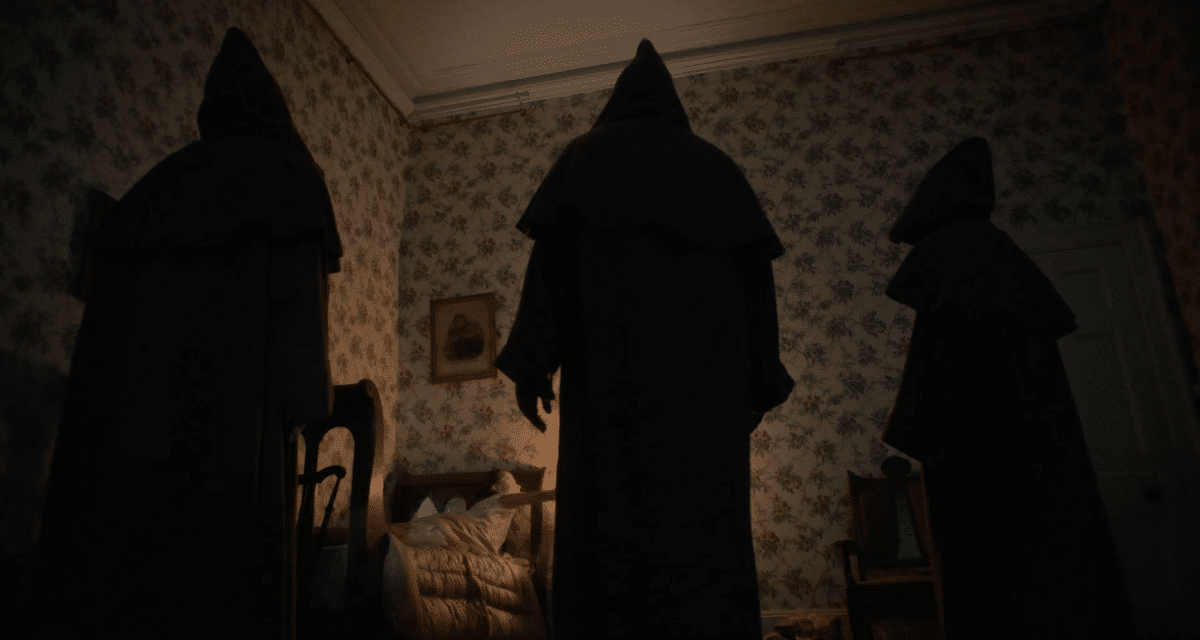
Yeah, it’s very much something I’m interested in. I’m not coming from a position of being an atheist or anyone who’s criticizing religion. I believe that people need faith. What I’ve always been against, and what scares me the most, is when faith is either turned against people, used in a bad way, or people use their faith as a way to judge others. So, that’s very much what I’m trying to expose because that stuff scares me. I’m scared of fundamentalism of any kind. So, I wanted to show that yes, there are these disgusting monks in this place, but there’s also a guy with pretty dour opinions about who Marianne is married to, and he’s the pillar of society. So, it’s just about scraping below the surface a bit. But yes, there are certainly similarities to Black Death. And there are also other similarities to my previous films. You can see the things I’m interested in. Time loops! [laughs]
That’s actually the next thing I was going to bring up. I’m a big fan of Triangle, and this idea of the self being the supernatural antagonist.
Oh, thank you! I always feel that that film is the one where loads of people have seen that film on YouTube but no one saw it at the cinema or on DVD [laughs]. I’ve got more stuff like that coming. It’s very interesting. It comes down to, with all of these films, looking inward at yourself. That’s ghost stories for me. Ghost stories are any one of us going into a house and each being haunted by different ghosts. We’re haunted by our own ghosts. That’s how I really strongly feel. That’s most realistic way I can look at supernatural events. It’s that place, wherever it is, that will trigger something in you. I think that’s what The Shining gets so right. Is it the place or is it Jack Nicholson? Are you in his head or are you in a hotel? That’s the stuff that interests me and makes me think.
It’s interesting how you use time within certain scenes of The Banishing. It got me thinking about how there’s this overarching theme of history repeating itself, and along with your comments about the rise of fascism, the similarities really hit me in terms of what’s been happening here in America. And just from what I’ve heard, those issues are also happening in the U.K. We’re in our own kind of time loop.
Absolutely. I’m hoping that the ugly side of what we’ve seen in America, and what we’ve seen here with Brexit, has exposed itself for the ugliness that it is. What worries me in either of those two cases is if there was someone intelligent and committed to that evil cause, what could be achieved in terms of the breakdown of government and the erosion of democracy. Both of us grew up in a country where we grew up as the good guys. We’re the guys who were in WWII, and there’s no way fascism could ever happen in our countries. But it absolutely could happen. It starts in the home. And you see things repeated over and over and over again. We’re simple creatures ultimately. We’re making the same mistakes in a cycle. Yeah, it’s Triangle. I’m making the same film over and over again [laughs].
I think this is a really interesting time for the horror genre because people are actively looking for social messages. Horror has always had social messages, but now I think because of where we are globally, horror is becoming our means to learn our history and perhaps connect with our better natures. What’s your opinion on the state of the genre right now? What’s exciting you?
I think horror has never been better. Get Out is a truly great film. It’s the kind of what I was trying to do and am still trying to do, not about race, starting with Severance. There’s not many films that can say as much as Get Out does and give you a rollicking good Saturday night out at the cinema. That’s what’s amazing about that film. It can give you a great night out, you can eat your popcorn and you’re actually thinking about stuff at the same time. That’s when cinema’s at its best. I think, looking back at the period of Black Death and Triangle, those films would’ve probably done better now than in that period. The genre has never been better, because it’s never been smarter. I think we want to lean towards films like Get Out where they’re still entertaining, as well, and not let the genre slip too far into just art house fare. We’ve got to try to remember that horror is ultimately meant to be a good night out with thrills and spills. Moving forward I’m going to be really keen to make sure we still keep that popcorn element there, but get messages through. When you do that you often get those messages through to a young crowd, and that’s the crowd you want be getting through to, not the converted choir. Make the young kids think, that’s the big thing. But that’s always been the way with horror. Definitely in the mid-2000s, it was more grindhouse in a way. But that period, I think like the slashers that responded to the Vietnam War, the slashers and torture porn of the mid-2000s were responding to what we were seeing in Afghanistan, Iraq and in the prisons. I think that now that there’s a so-called time of peace within our country, it’s more important than ever that we look inward.
Triangle plays with the slasher elements. Did the politics and war of the 2000s factor into the writing and direction of that?
Exactly. It was in that period. I started writing in about 2006, and it was post-9/11 and there were these ideas of people standing together while you gradually start to realize political decisions are being made and you no longer feel like your government is doing the right thing. Are we becoming a monster in order to defeat a monster? That’s what I was responding to inside with Triangle. Am I the bad guy? It’s not something I consciously did for those reasons. I came up with the twist, the first loop in 2004 or 2005, and I spent about two years just trying to think of a way to even remotely make that work, over and over again. It was torturous. It took ages to get the plot right, let alone the script. It’s the hardest thing I’ve ever written by a country mile [laughs].
It’s a brilliant film. I think it fits in quite well with Black Death and The Banishing. There’s a really interesting thematic trilogy that you’ve built here. I’m looking forward to what you have coming up next.
Thank you! The next horror is called Consecration and I’m hoping it’s going to be all of those and better. That’s the plan. Onto the next one. I always love what Prince said to, ‘What’s the favorite of your songs?' And he said, ‘The next one.' God, I miss Prince.
Me too.
But yeah, this next one is set in a nunnery and it’s very much about the idea of the intoxicating elixir of religion and how you can get pulled into it. And that goes for all of us. Human beings need something. It’s in our DNA. Even if you say you’re an atheist, that’s your tribe. If you walk around telling everyone you’re an atheist, so others out there know, then you’re part of a tribe and a belief structure. But to claim you’re not a part of any of it, that you’re not interested in any of it, I think that’s a lie. People are drawn to believing in something.
This interview has been edited for length and clarity.
The Banishing is now streaming on Shudder.