

Last Updated on October 21, 2024 by Phil Nobile Jr.
Fans of Blood Diner director Jackie Kong have ample reason to celebrate these days. Not only is the director’s work more visible and available than ever (thanks in part to her films being exposed to a new audience via Blu-ray, streaming and documentaries like the In Search of Darkness series), but the filmmaker has a new project, in a new medium: comic books!
Kong’s new comic Spend the Night (which has just been collected as a trade paperback, available here) continues the filmmaker’s continuum of horror, comedy and gore, as a group of friends experience a mishap at a sleepover that causes them to run afoul of a particularly nasty urban legend named One-Eyed Jenny.
To say more would spoil it, but we were excited to speak with Ms. Kong about this project, the legacy of Blood Diner, and what lies ahead.
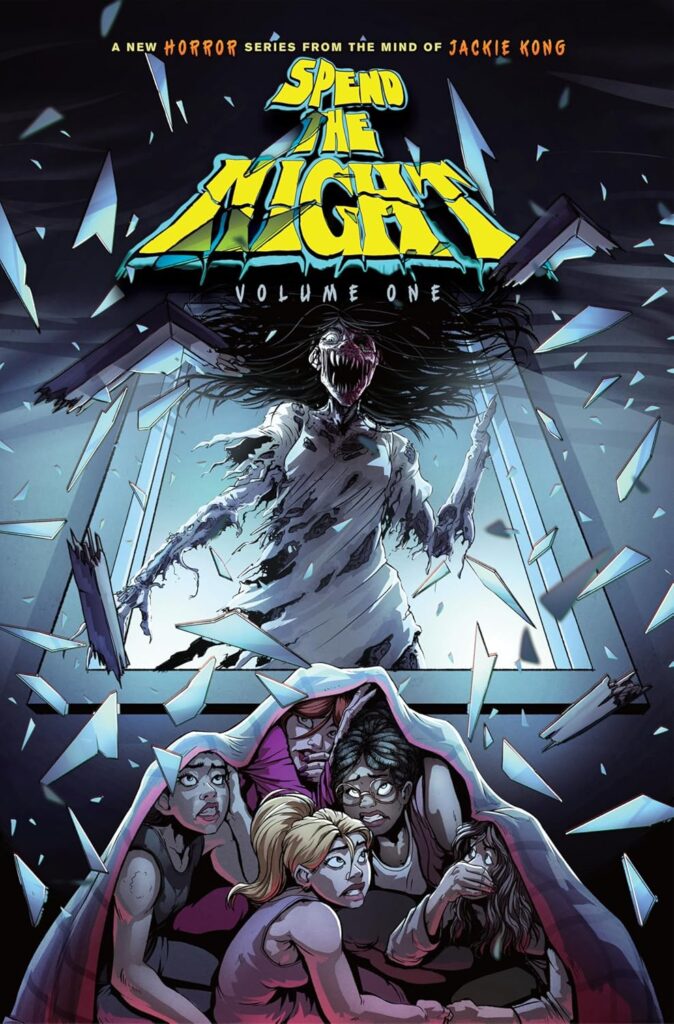
Spend the Night feels in a lot of ways like a classic ‘80s horror setup. Do you have a particular affinity for that era?
It's my era in horror, and yet when I made Blood Diner it didn't fit into that era. The device in Spend the Night may feel very ‘80s but like Blood Diner the execution is timeless. You can't really tell when Blood Diner takes place.
I love that the comic starts down a kind of slasher road setup, then takes a hard left turn into the supernatural. I’m curious about why the supernatural appeals to you in your work.

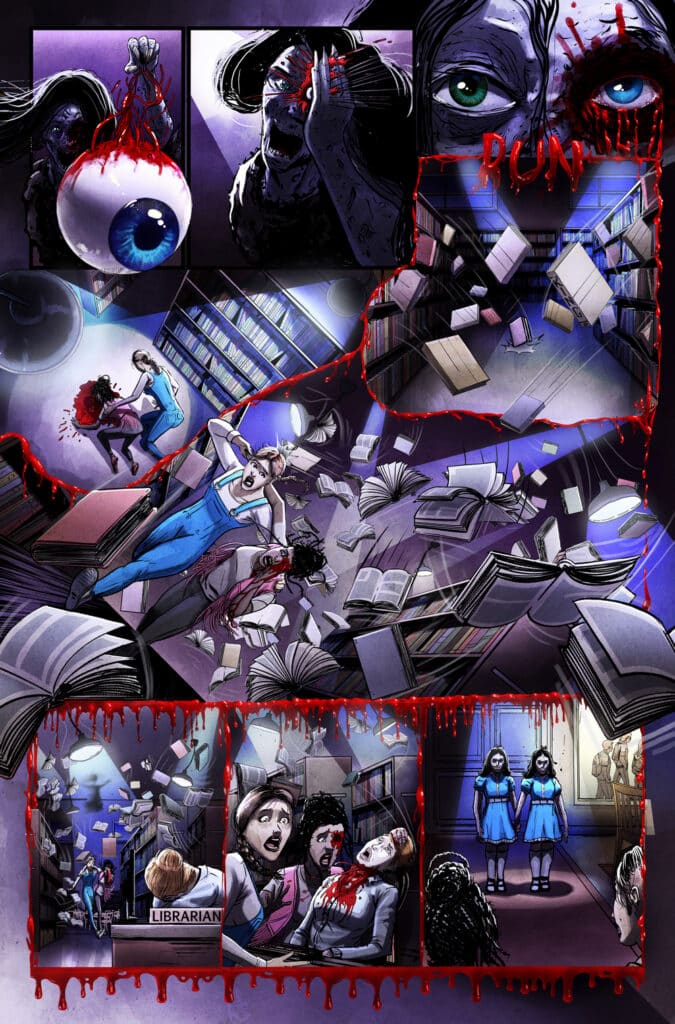
It’s very light-hearted at first before everything goes to horror slasher hell, and then supernatural when they summon the urban legend called One-Eyed Jenny. It's reflected in the story and in the color and lighting choices in the comic; pastels to oranges and red, then to dark film noir shadows and black and blue color schemes, all to create this mood shift. I love the comic book genre because the supernatural takes on very real possibilities.
Your story is centered around a horror character named One-Eyed Jenny. Tell us a bit about her.
She is an urban legend I created that the girls at a sleepover must summon to bring back their dead friend. To be bound to her is a choice they must make. These kinds of deals rarely turn out well. She She is inherently evil, and is hard to look at because of her one gruesome eye. You will find out more about her as the issues progress…
Comics and graphic novels are by nature very cinematic in their language. How did you find your skills as a director translated to a comic story? What was easier as a result, and what was harder?
In both, the storytelling is based on amazing images — one moving and one still. The challenge is how to tell the story in static panels. Imagine it's like poetry, creating an economy of words, but with images that move you and convey the story distilled to a series of panels. The process of Working to bring your vision to life on film and in comic books is very similar. Less people are involved — a seven-person team instead of 35-person crew on a set — but it's still constantly orchestrating the work at each at stage. I think my director skills translated to this medium easily and made me uniquely qualified to create a comic book.
As you say, like a film project, a comic book has a creative team, a “crew.”
I have an amazing team of artists who take the story to the next level. I wrote the scripts/story, and made the thumbnail sketches into panels. The layouts are then created from my thumbnail sketches. Those were done by accomplished comic book artists Kelly Williams and Don Cardenas.
Once locked, the ink artist Don Cardenas does detailed Black and white ink drawings of each panel on the page. This can take 4-5 passes. Once I approve them, the pages go to the colorist, Roman Gubskii. It is here we create the lighting, color and mood. Unlike many comics, I use a lot of shadows, lighting sources & hard blacks for mood. Again this usually takes 3-8 passes to get it just right.
Once I love it, the pages then go to the letterer, Joel Rodriguez, who adds the text I wrote into each of the panels. Once finalized, it can go to the printer.
You’ve come up with a very clever way to give your comic book its own soundtrack.
I hear the soundtrack music when I'm writing. So, I brought that music to the comic book series. Hidden (like Easter eggs) throughout the book are QR codes that when scanned by your phone, will play a fully orchestrated musical score or source music to be played while reading — activating all the senses, elevating the whole experience into a visceral one, and taking you deeper into the story.
You’ve been incredibly busy of late, partially thanks to renewed interest in your ‘80s films Blood Diner and The Being. What’s that experience been like, of folks rediscovering your older work and wanting to celebrate you?
Blood Diner played to a sold out crowd at Fantastic Fest last year, and it continues to play to sell-out crowds in theaters around the US. Blood Diner was elevated to cult status over the years by horror film aficionados who collected the hard-to-find DVD to share with friends.
The Blood Diner following has grown over the decades, and continued to build when Lionsgate launched the Vestron Series in 2016, kicking it off with Blood Diner. I agreed to do the commentary only if they would agree to a theatrical run which I spearheaded. The reaction was sell-out crowds, and enthusiastic audiences akin to a Rocky Horror show kind of frenzy. Many fans showed me Blood Diner tattoos on their bodies, and brought friends who hadn't seen it, just to see them react. I always say “If you haven't seen Blood Diner on the big screen, then you haven't seen it.” I have the best fans.
What’s the road ahead for this project? Is this a story that could live on screen?
I've already written 20 issues of Spend the Night and, like my films, there are great characters that will shock and surprise at every turn. Eight Issues will be completed by end of 2024, with 12 more beyond that on the way. It's a natural for a Netflix series. Don't you think?
You can get the Vol 1 TPB of Spend the Night here.