
Last Updated on March 16, 2024 by Lea Anderson
“It’s her. A cat. A crow. A raven. A great black dog. A wolf. She desires of my blood! She sends them upon me!” cries Caleb, the younger brother Thomasin is accused of “witching” in Robert Eggers’ settler horror film, The Witch. Of all species widely associated with the occult, no connection is perhaps more deeply entrenched than that between witches and cats—and black cats in particular. Within European cosmologies, their association can be traced as far back as the ancient Greeks, who depicted cats as familiars of Hecate, the Moon. These informed the pagan rituals and beliefs that were eventually demonized with feverish veracity during the Medieval Period and the rise of the Christian Church, though it may be more precise to describe this event- pagan demonization- as the event that enabled the rise of the Christian Church.
Cats are interesting as manifestations of The Swallowing for the implications of the similarities that exist in their portrayals, even in the folklore and mythology of cultural lexicons otherwise largely ambivalent toward them. Hinduism, for instance, doesn’t place much import on cats, albeit with a couple of exceptions. The goddess, Shashthi, associated with nurturance, fertility, agriculture, and a protector of children, is often depicted riding a cat. She is widely considered a softer aspect of Durga, her more ferocious, demon-fighting form associated with divine feminine strength, who rides a tiger or lion to signify this transformation. Despite these limited, if generally positive portrayals, black cats are nevertheless still widely regarded as bad omens.
Chinese and Japanese lexicons characterize cats by a dual nature. Li Shou, a Chinese deity who takes the form of a cat and represents fertility, for instance, stands in opposition to the nekomata, who appear in both Chinese and Japanese folklore as yokai (a supernatural force or entity) shapeshifters who dwell in the mountains and hunger for human souls. In Japan, it’s said that the older a domestic cat gets, and more so if they’ve been abused, the likelier they are to transform into a vengeance-seeking nekomata, capable of taking possession of people and controlling the dead. As such, films featuring monstrous or spectral cats represent an entire subgenre of Japanese horror, a movement popular during the mid-twentieth century and which includes Nobuhiko Obayashi’s House. The cats seen in these films again represent a stark contrast to the maneki-neko, who brings good luck and takes the form of a calico. Not dissimilarly, this dualism also appears in Nigeria, where, within Ifa, cats can bring good fortune, prosperity, and protection through their capacity to ward off malevolent spirits—but not always. Nevertheless, as demonstrated by the 1980 Hubert Ogunde film, Aiye, which portrays black cats associated with evil witches, the same superstitions persist.
You see, despite folktales about cat-siths and cath palugs and countless charges of witchcraft, cats and humans took to one another for materially symbiotic reasons. Cats control rodent populations, and as such, European settlers brought them along everywhere they went despite said folktales and despite said charges. In fact, a black cat on a ship was considered good luck in that specific context. Nevertheless, with the animals came the superstitions that surrounded them, exported via colonization.
Let’s backtrack a moment to consider the ancient Egyptians, who famously revered cats as manifestations of the divine. Ra, the Sun, takes the form of a cat in The Book of the Dead (notice the contrast to Greek Hecate), and several other deities- Bastet, Mafdet, Sekhmet, Isis- are also depicted in their likeness. But with Roman colonization came the introduction of Christianity to State culture and such reverence became an increasingly marginalized practice. Though not quite the same, a similar movement occurred centuries later in America.
The Salem Witch Trials illustrated the faith-based hysteria of settlers paranoid about young, white women being seduced by “black magic”— by which they meant, the magic prescribed to African and Indigenous medicinal and spiritual practices which, ontologically and rhetorically, became conflated with the superstitions prescribed to black cats. And though Indigenous nations have their own feline mythologies (many of which also consider cats to be creatures of deception, like, for instance, the Cherokee wampus cat), the establishment of an American national identity necessitated the formation of an American mythology, inevitably informed by the European mythologies carried over by settlers—a lexicon in which black cats feature prominently.
Though they continue to be associated with spellcraft and shapeshifting in the twentieth century, as is the case in other cultures, they’re far less likely to be regarded as purely malevolent. Consider Binx from Hocus Pocus or Salem in either Sabrina the Teenage Witch or The Chilling Adventures of Sabrina. But this was less the case in the earlier part of the century. What might engagement with classics like 1934’s The Black Cat or 1942’s Cat People reveal not so much about cats themselves, but what their coding suggests?
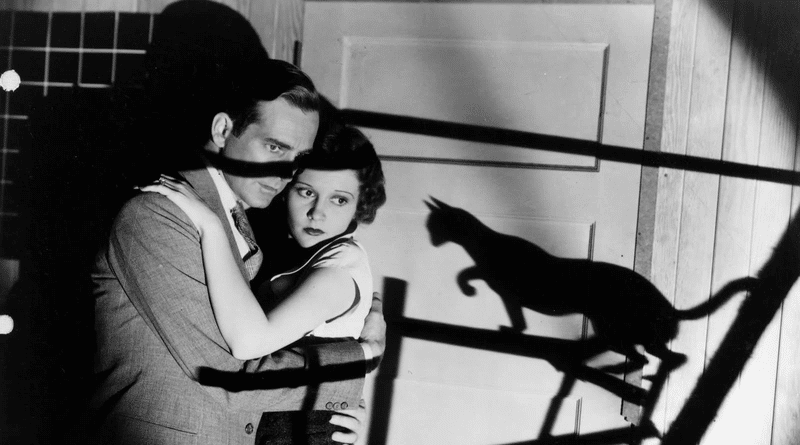
The Black Cat (1934) & The Black Cat (1941)
In Darkly: Black History and America’s Gothic Soul, Leila Taylor notes how Edgar Allen Poe’s 1834 short story, “The Black Cat” has been interpreted to reflect “the fear of slave insurgencies,” an anxiety indicated by the narrator’s maddened projections of villainy to his once-beloved pet, who he first mutilates and eventually murders via hanging. He is then haunted by the shadow of the noose, which is to say, his own behavior. Taylor makes a point to mention how Poe “constantly extols the color white to imply purity and black as monstrous,” a binary repeatedly demonstrated throughout the American literary canon, and which essentially distinguishes the supernatural associations between black cats and all other cats. It is their blackness that supposedly makes them evil, not that they are cats.
Neither Universal’s 1934 nor 1941 adaptations of Edgar Allen Poe’s “immortal classic” have much to do with the actual short story save in name. The former, in fact, has little to do with cats at all, but they are both preoccupied with the symbolism of the black cat. In the case of the 1934 film, it is their “deathlessness”- that they keep coming back- that inspires the film’s adaptation, concerned as it is with the seemingly eternal impact of the horrors of war and the evil it unleashes upon the world.
When Dr. Vitus Werdegast (Bela Lugosi) is involved in a car accident alongside Peter (David Manners) and Joan Alison (Julie Bishop), newlyweds on honeymoon in Hungary, he brings the couple to the home of his “friend,” Hjalmar Poelzig (Boris Karloff); a home built atop a fort that saw the deaths of thousands of soldiers commanded by Poelzig himself. While we learn Werdegast possesses “an intense and all-consuming horror of cats” when he abruptly murders Poelzig’s feline friend, we also soon learn Poelzig possesses a collection of embalmed corpses, kept in the catacombs beneath the house—women ritually sacrificed to Satan.
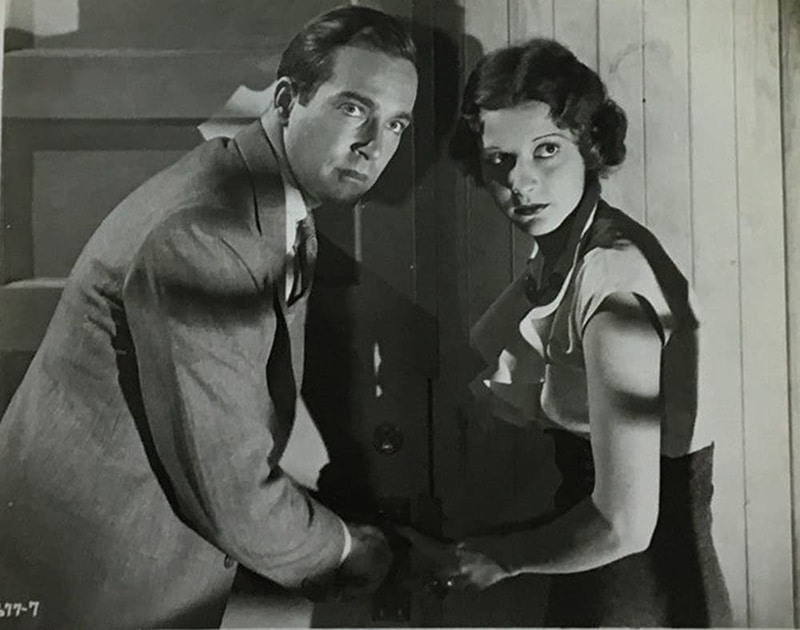
Werdegast reunited with Poelzig to seek vengeance for the years he spent imprisoned at Poelzig’s betrayal, but also because he believes Poelzig to have murdered his beloved wife, Karen (Lucille Lund). Scoffing at his rage, Poelzig asks, “Are we any the less victims of the war than those whose bodies were torn asunder? Are we not both the living dead?” Herein is the crux of the film’s concerns and the version of The Swallowing it actually puts forth: the endlessness of war’s implications, its traumas, and the fact of its happening. Poelzig is the monster who walks casually amongst us, and his affinity for black cats signifies this monstrosity.
Less than a decade later, Universal went on to make another adaptation “suggested” by the short story. Though Bela Lugosi takes a starring role in both films, the 1941 rendition is perhaps more classically gothic, concerned as it is with matters of estate and inheritance. It also possesses far more levity. The widow, Henrietta Winslow (Cecilia Loftus) is the mistress of a large estate where she lives alongside Abigail (Gale Sondergaard), her housekeeper, Eduardo (Bela Lugosi), the caretaker, and a great many cats. After a period of illness, her greedy and self-serving family gathers in hopes of a major payday. Apart from the cash they stand to inherit, a deal is brokered to sell the house, which Henrietta adamantly rejects. Unbeknownst to the family, she added an addendum to her will: “Nobody inherits a penny until Abigail and the cats are dead.”
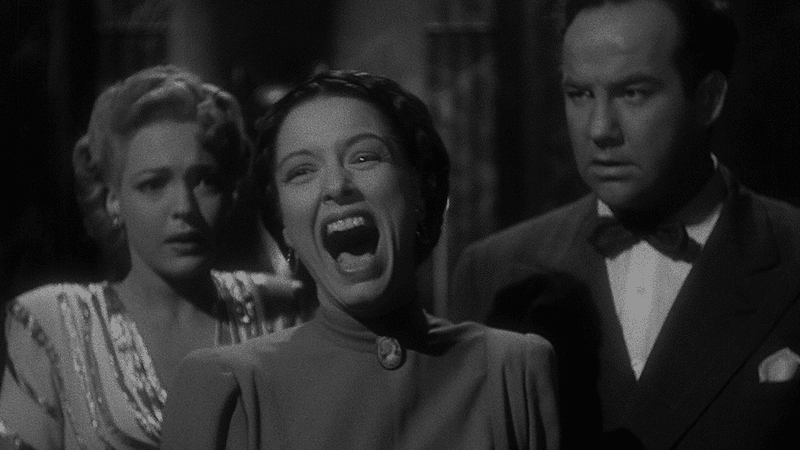
When Henrietta herself is found dead, a black cat is also found perched nearby. “Grandmother never allowed a black cat on the place,” her granddaughter, Elaine (Anne Gwynne), insists, which Abigail affirms. “Whomever a black cat follows, dies.” Apart from superstition, the film also taps into the trope of the Crazy Cat Lady, a rendition of the spinster or “old maid” whose undesirability often hinges on the presence of a beloved horde of cats (think Gayle in Bob’s Burgers or Angela from The Office). In the context of gothic horror, however, she is more often represented as a wealthy widow intent on spiting her family members by leaving her fortune to cats, also seen in later films like The Uncanny, in which the woman ends up devoured by her charges. This is not the case in The Black Cat, however, where the cat in question is redeemed by saving Elaine, hereby reflecting the consistent inconsistencies in their portrayal. Will they protect you or eat you?
Cat People (1942)
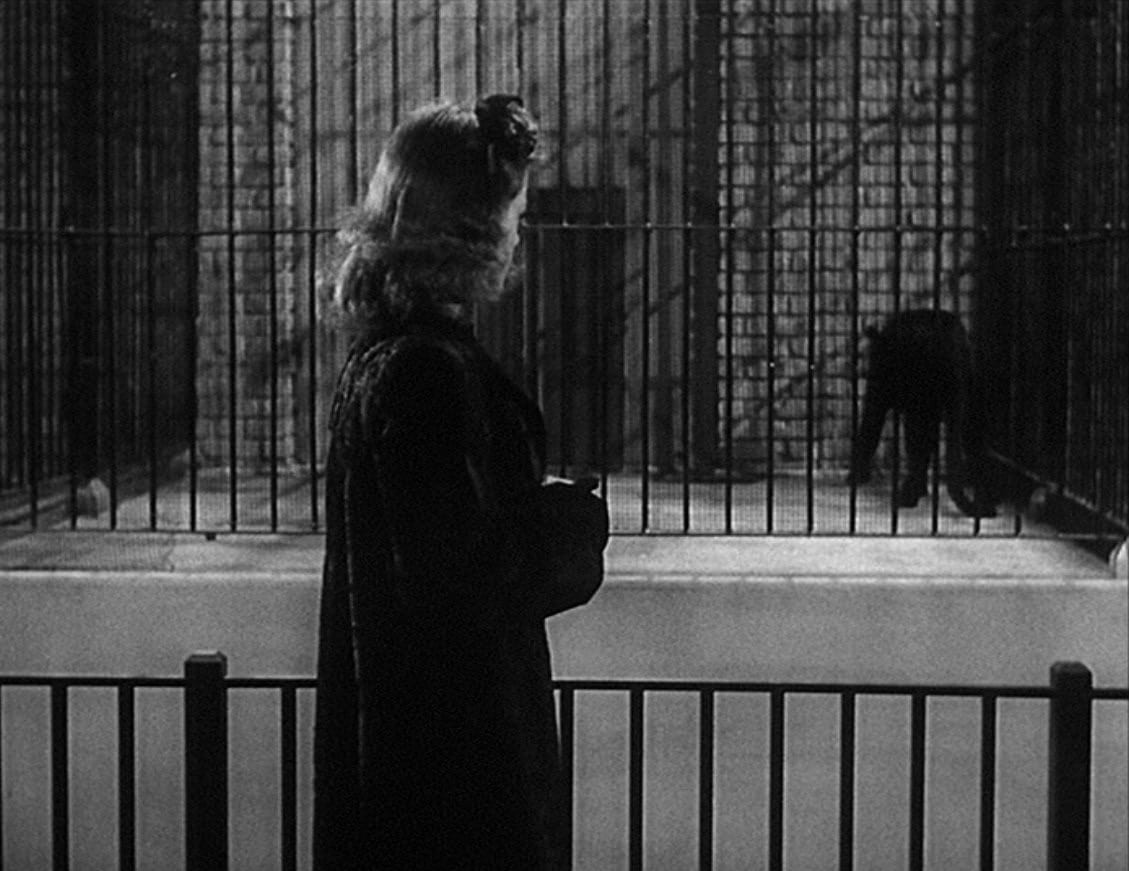
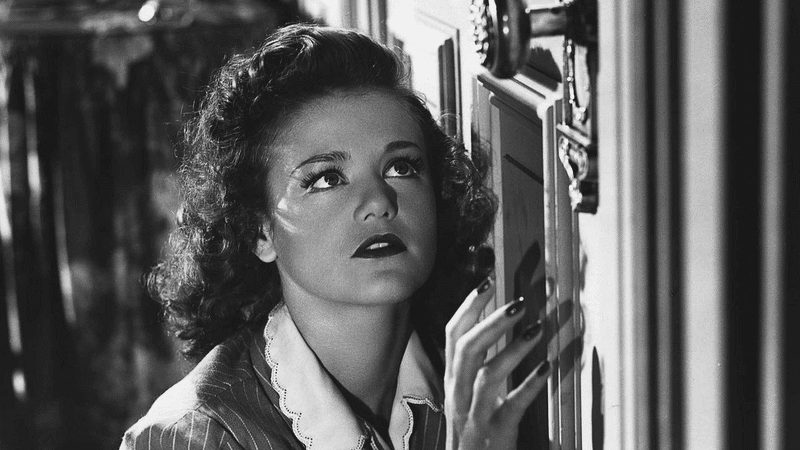
Jeffrey Jerome Cohen calls “fear of the monster…really a type of desire” and such is the case in Cat People, a classic of queer horror. A master class in how monstrous figures have been used to code deviant social identities, the 1942 film illustrates feminine sexuality- and queer feminine sexuality in particular- to be nothing short of pathologically feral, if not outright predatory. Irina (Simone Simon) is from Serbia and first encounters Oliver Reed (Kent Smith) at the zoo, where she claims to be sketching their black panther for work. Though their whirlwind romance culminates in confessions of love and marriage, Irina is a reluctant participant from the beginning, plagued as she is by anxieties born of the legends from her village:
“…the Mameluks came to Serbia long ago and they made the people slaves. Well, at first, the people were good and worshiped god in a true Christian way. But little by little, the people changed. When King John drove out the Mameluks and came to our village, he found dreadful things. People bowed down to Satan and said their masses to him. They had become witches and were evil. Well, King John put some of them to the sword but some, the wisest and the most wicked, escaped into the mountains…. Those who escaped, the wicked ones, their legend haunts the village where I was born.”
The legend tells of women- witches- who transform into large black cats when their deeper nature becomes aroused. As such, Irina fears consummating her marriage, or even just kissing Oliver, for her belief in the possibility that she will turn into a panther and kill him—which is to say, her belief that she is born of what the film’s epigraph describes as an “ancient sin.”
It goes without saying, Cat People is an overtly Christian film with very classic features of Christian storytelling. As in Dracula, Irina’s identity as a foreign national situates her Outside the American national body and, therefore, representative of a threat to said body. Her “ancient sin” recalls the concept of “original sin,” born of femininity’s corrupt desires. She’s attracted to the zoo’s big cats though the keeper reminds her the panther is an “evil critter” and cites Revelations to corroborate his statement. She “likes the dark” and finds it “friendly” and “[envies] every woman [she] sees on the street” because “they’re happy. They make their husbands happy.” Her inability to “please” her husband is treated as a failure on her part and paves the way for order to be restored when Oliver ends up with his co-worker and True Love, Alice (Jane Randolph), a “normal” woman who weeps at his being “unhappy.” “I know what love is,” she declares. “It’s understanding.” The statement connotes their Sameness, in contrast to Irina’s Otherness.
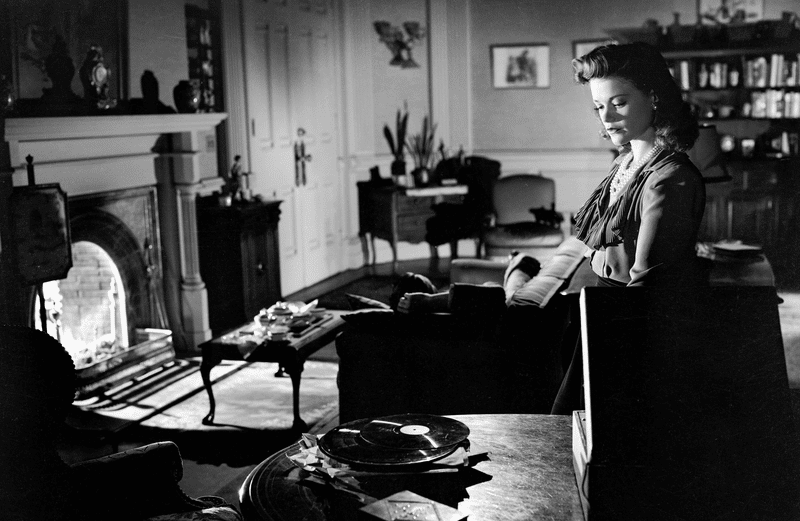
With the introduction of a psychiatrist, Dr. Judd (Tom Conway), Irina is outright pathologized and the question of her sanity is a major concern throughout the film, particularly as her fears and belief in the legends- previously dismissed- become Alice’s fears when the shadow of a large cat repeatedly stalks her. Though attributed to jealousy, you might otherwise interpret Irina’s fixation on Alice as a romantic one; that Alice is so attractive, she’s simply irresistible to everyone.
Through the occasion of The Swallowing, Irina is characterized as an essentially “good” person at war with a deeper, deviant nature, expressed as her capacity to shapeshift. But despite this form, in keeping with thousands of years of cat lore, her deviance is signaled not only by an affinity for the dark, but the rejection of actual cats and other animals. As the pet shop owner says, “You can fool everybody, but landie dearie me, you can’t fool a cat. They seem to know who’s not right, if you know what I mean.” Sympathy is produced, however, by her resistance to this “not rightness.” Though squarely the film’s antagonist by its end, she is repelled when Oliver holds up a cross and pleads, “In the name of god, leave us in peace.” By the film’s logic- and the lexicon in which it operates- Irina can only be redeemed in death. Bookended by epigraphs, the closing quote from John Donne expresses these precise sentiments: “But black sin hath betrayed/ to endless night/ My world, both parts, and/ both parts must die.”
