
Basements
You might have heard this nugget of wisdom before: a film gets written three times—once when scripting, the second when shooting, the third when editing. I don’t know that I fully understood the truth of this until I spent three chaotic days trying to get as many takes as I could… and then months reviewing the coverage and talking through the ways we might puzzle-piece hours and hours of flabby footage into a tight fifteen minutes of story. I had felt so much relief when production ended, not realizing that in a way our work had just begun.
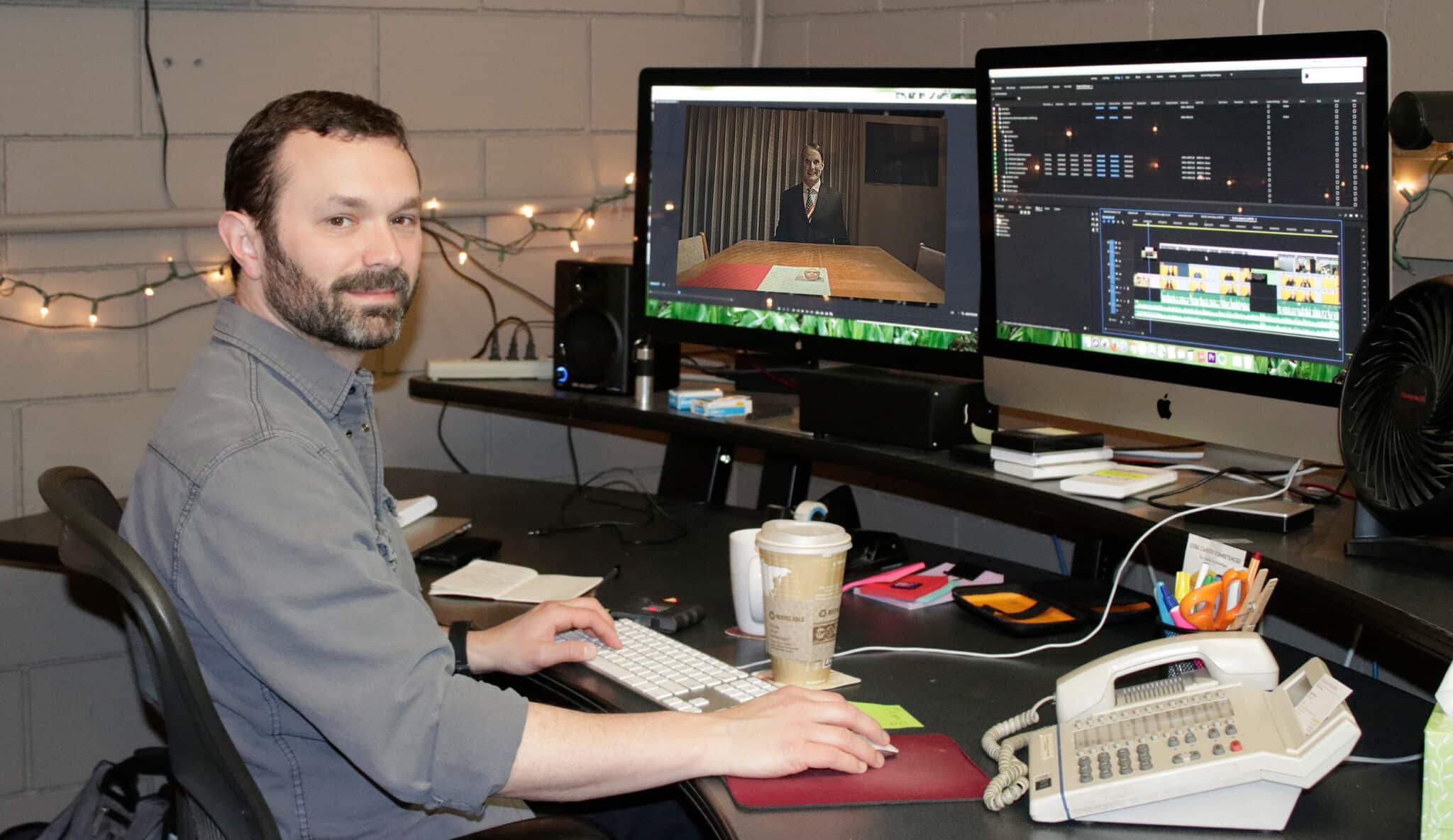
David Ullman—the editor of 13th Night—is a documentary filmmaker and a video producer at University of Minnesota. He’s an editing wizard, but relatively new to narrative film, so we were learning together. Thankfully he’s incredibly intuitive and loves all the same movies I do, so we speak the same language. I can kick off a conversation with “So I was thinking about Hellbound: Hellraiser II,” and he won’t hesitate to dive right in to a dissection of cenobite mythology. He also served as the assistant director and script supervisor on 13th Night, so he already had a strong sense of what we had and how it all fit together. Our storyboards and shot lists, too, were elaborate and served as a kind of road map… though a road map never shows you the roadkill or rainbows you might encounter along the way.
Sometimes he worked alone, and sometimes we worked together, always in a basement, usually with a cold can of IPA within reach. At my place, he would stretch an HDMI cable from the 66” flatscreen to my scarred-up coffee table, where he stationed his MacBook Pro and wireless mouse. At his house, there was a computer terminal surrounded by speakers and monitors and stacks and shelves of physical media (that proved to be as distracting and nostalgic as being transported into a 1997 Family Video).


Our early exchanges were mostly driven by the obvious question: “What do you think of this shot…versus this shot…versus this shot?” Sometimes we were debating an actor’s delivery or posture. Sometimes we were talking about the framing or angle. Sometimes it was the speed or focus or choreography of the take. Sometimes it was all of these things as we debated the shuffled arrangement of a few seconds here, a few seconds there.
If production is a frenetic war zone, editing is the painstaking aftermath when you assess victories and losses. This time-consuming, patience-defying process requires someone with a sharp eye, a precise, methodical mind, and an instinctual understanding of Premiere Pro and DaVinci Resolve. When navigating the software, David’s eyes flicked and his fingers clicked with the speed of an accountant calculating his 5,000th tax return.
This is what I expected. To, frame by frame, build our short film.
Here is what I didn’t expect: our rough cut was ten thousand tiny (but critical) decisions short of our final cut.
Essential Action
I don’t normally share my work until it is polished to a glow. I don’t belong to a writing group. I don’t bother my friends with early drafts. I try to deliver manuscripts and scripts to my reps and editors that are as strong as I can manage on my own. I rarely talk things out, when I’m developing an idea, as if exposing the concept to the air will somehow spoil it. But that solitary mindset doesn’t translate to directing—or editing. Film is a collective pursuit.
So—as vulnerable as it made me feel—I shared a rough cut of 13th Night with a few trusted individuals…before color grading, before sound and score, before VFX. I had to. Because every step to follow would depend on a stable structure: picture lock.
Still, I couldn’t help but feel like I was handing over a half-molded lump of Play-doh and asking people what they thought.
Their advice turned out to be essential.
Consider the first shot of the film. I had already received this early pointer from Andrew Peterson at FilmNorth: “Your opener needs to be impossible to ignore. Your short film will be one of hundreds, if not thousands submitted to a festival. If you’re in the slush pile—then that means a twenty-year-old intern might be the first person watching your film… and the last. If you don’t grab their attention immediately, they might hit mute, check social media, and let the film play out before logging their vote and clicking on the next submission in the queue.”
So I arranged for a cold open you couldn’t ignore. 13th Night would begin in the middle of a murder. Jacob—played by Benjamin Busch—would be swinging a sledgehammer, the mallet arcing down to impact the skull of his victim with a meaty crunch.
But editing is all about questioning and scrutiny. You lean forward and narrow your eyes, the way a scientist would at a microscope when studying something subcellular smeared on a glass slide. This is how Darrin Navarro spends his days, and he helped us recognize how to make our opener even stronger.
Darrin has edited shows like Euphoria and Outer Banks and movies like The Spectacular Now and Killer Joe. I first met him in 2014. He was working with my friend, the director James Ponsoldt, on The End of the Tour. Whenever I’m in LA, James and I get together, and on this occasion he invited me to drop in to the editing bay. I was only there a few hours, chatting with them as they worked, but it was clear how much Darrin noticed and how much he cared, fussing over the smallest minutia, his eyes like a bee’s, able to see in a spectrum unavailable to most. I remember him insisting that in this quarter second, Jason Segal’s eyes registered the emotion the scene required, and only then could they cut away.
A few years later, in 2021, I got to know Darrin a bit better when he edited Summering, a coming-of-age feature (with a tinge of horror and fantasy to it) that James and I co-wrote. He has a blade-sharp sense of analysis and a deep cinematic library stored in his brain. So I was thrilled when he not only agreed to watch 13th Night, but generously spent an hour on Zoom going through every single shot with me.
So: back to the opening, the sledgehammer murder.
I wanted to grab the audience by the throat, assault them with a blow to the skull. But in doing so, I had rushed the shot. Darrin encouraged us to slow things down and linger in the master twenty seconds longer. He appreciated our intent, but thought the attack was losing some of its impact (so to speak), because we hurried out of it so swiftly. Give the audience a beat, he told us, so that they could transport themselves from the reality of this world to the reality of the screen. Jacob should swing his sledgehammer—but to appreciate that violence, the audience needed to believe in it. That belief would come from the weed-choked lot where the murder was taking place. And from the rusted-out sheds in the background as well as the junk littering the alley between them. And the skeletal trees. And the sliver of the moon hanging in the paling sky.
The opening of a film is like the opening of a play. A curtain parts and… we take in the stage and the characters arranged on it… and we’re still not fully there. We remain in our seats, bothered by the pinch of our belt or the scratchiness of our shirt or the worry over whether we pumped enough money into the parking meter… and then the characters begin to chat and some trouble arises… and eventually we forget we exist at all. The stage is our world.
Darrin said we were asking our audience to process too much in too short of a time. So we lingered a beat longer in the hopes that the screen would become your world.
More scrutiny followed.
In the rough cut, we showed Jacob adjusting his grip, hefting the sledge, and bringing it down. Darrin asked us to consider a more active angle. What if we opened instead with the mallet already in motion, on its way down. He was right. The moment immediately activates and the image stops your breath.
This informed much of his advice: when to slow down, when to hurry up.
Mostly he focused on hurrying things up.
In the bathroom, Jacob cleans the blood from his hands. Then pools the water in his palms before splashing his face. Slowly he raises his head to take in his reflection in the vanity mirror. Haunted. Poisoned by what he’s done. Darrin encouraged us to enter the scene several seconds later and to exit the scene several seconds earlier. “We get it. He’s sick with regret. As soon as that emotion is translated, move on.”
Here is another point he emphasized again and again: “In film and TV, walking is deadly.” I wondered if Aaron Sorkin would agree… but Darrin’s point made more and more sense as he elaborated on it. “Don’t show people going in and out of rooms, unless it’s an essential action.”
I had felt a kind of responsibility to orient viewers in Jacob’s house—to show him leaving one room, entering another; going down a hallway, turning a corner, finding a staircase, reaching for a doorknob. But Darrin assured me that people would figure it out. “You’re not a real estate agent. I don’t need a tour of the property.”
He pointed out a moment when Jacob entered the garage and exited the garage, when he entered a closet and exited a closet, when he entered the dining room and crawled beneath the table. “Too much walking. Too much movement.”
He challenged me to articulate the essential action of a scene. In the garage, Jacob was hanging up the blood-drenched sledgehammer on his wall of weapons, but we were supposed to feel awe and terror for the size and scope of his arsenal. In the closet, Jacob was grabbing some fresh clothes, yes, but here’s what really mattered: we were supposed to notice the military uniforms hanging in his closet. In the dining room, Jacob was duct-taping a knife to the underside of the table—and that’s what mattered. That was the essential action.
I bring up three different moments here. There were many more. By staring hard at every shot, by asking ourselves what the essential action was, by trimming away the gristle on either side, David and I were able to cut almost two minutes from the film.
Ali Selim is a director and fellow Minnesotan. He’s worked on big-hearted indies like Sweetland and monstrous corporate properties like Secret Invasion (on Disney+). Whenever I’ve asked him for advice, he’s been kind enough to offer it. He’s been in the business for a long time—has survived every kind of war story—and he’s perfectly straightforward in his communication. There’s never anything but sincerity and truth.
He watched the same cut as Darrin and had a very similar message: “You’ve built an explosive device,” he said. “The trouble is, it’s not detonating yet, despite the fact that you have all the components in place. That’s because the fuse that you need to light is chopped up into pieces. You need to bring together the pieces. You need to eliminate those gaps. So that the energy transfers and the fuse can burn and the film can detonate.”
Which is a very poetic way of him saying, “No walking!”
Sounds About Right
If I love a film, I’ll study it from different angles. I’ll download the screenplay. I’ll search for “making of” documentaries or academic articles. I’ll seek out the book it was based on. I’ll rewatch it with the director’s commentary on. I’ll rewatch it with the volume muted.
This is especially educational. I’m able to focus more on story beats, the staging of action set pieces, the movement of the camera. I have a colder point of view, because sound packs a lot of emotion in it. The sad scenes aren’t so sad without that tremulous harp. The scary scenes aren’t so scary without that d minor chord struck heavily on the piano.
Art isn’t math, but I’d say 50% of the horror in a horror film is communicated through sound. In Psycho, I’m talking about the shrieking of the violins partnered with the raw-throated scream of Janet Leigh. In Jaws, I’m talking about the alternating pattern of E and F as a fin cuts the water. In The Babadook, I’m talking about the DOOM-DOOM-DOOM of someone knocking followed by the guttural, wheezy announcement of the title character’s name. In The Texas Chain Saw Massacre, it’s the revving of the saw and the squealing of pigs.
Every day, my friend Matt Bowers makes music in his head. He’ll sit on a plane, staring straight ahead, not watching anything, not reading anything, just pushing notes and lyrics around, and when the wheels hit the tarmac, he has a fresh song finished. He’ll step away from the dinner table to test out a few notes on a guitar. He’ll wake up in the middle of the night humming a tune he dreamed. He was the perfect partner on 13th Night—recording audio on set during production, experimenting with foley and ADR and sound effects and score during post.
Once again, we were in a basement. For foley and for ADR, he recorded on a Sennheiser MKH 50 Small-diaphragm Condenser Microphone. When a machete swung through the air, Matt created the swooshing cut with a stick. When a sledgehammer crushed a skull, Matt created a damp thwak with an apple. When feet marched through a leafy field, Matt created the swish-swish with cereal in a plastic bag. These were practical and fun steps that made the film come alive. But it was in the score that he created a sense of dread and unease and terror.

I shared music files with him from It Follows and Suspiria and Halloween. We talked about dissonance and minimalism and suppressing the melodic. We experimented with motifs to associate with our villain, the agent.
He sometimes composed on the piano, but otherwise worked in LogicProx, replicating an orchestra at times, creating otherworldly sounds at others with a tool called Native Instruments. In the evenings, I’d join him in his studio while he played. When a lamp switched off in the film, I wanted a sound of hopeless doom to follow. When our villain appeared in a closet doorway, Matt wondered if we should hit the audience with a thunderclap.
I asked for a big brassy Hans Zimmer effect when the murder board is revealed. Matt suggested a choral theme for the daughter to showcase a gentler side of Jacob. I asked for a tweak here, he wanted a boost there.
But one of my favorite audio moments in the short is… silent.
Or rather silence is used as punctuation within a noisy, complicated sequence.
In one of our set-pieces, Jacob wakes to the sound of someone breaking into the house. He rises from his chair. He grips his machete. He stalks forward. The lights sputter on and off, disturbed by a supernatural current. To accompany this, Matt created an electrical whine that makes your hair prickle and the taste of metal fill your mouth. This whine is interrupted by soft pops and static-y interference. Jacob turns a corner and sees the open door and a bass note throbs. He creeps closer and closer to the dark rectangle of the night, and as he does, all sound seems to swirl down the drain.
This. This is the moment I love. The silence of the foyer matches the blackness of the doorway. They ask you to lean into anticipation, to fill in a vacancy. You wonder if you see things moving in the night? You believe you might hear a whisper of wind or the scud of a foot? There is nothing, and in that nothing is a terrible invitation. Sound can bully you into shock or terror. But the lack of sound can be just as effective, if used smartly, in conjuring dread.
Here’s a true joke. Q: What’s the key to suspense? A: I’ll tell you later.
We linger in silence for seconds—and then…
Well, if I told you what happened next, I’d undercut my own argument.
The final installment of this series will release tomorrow on Fangoria.com.