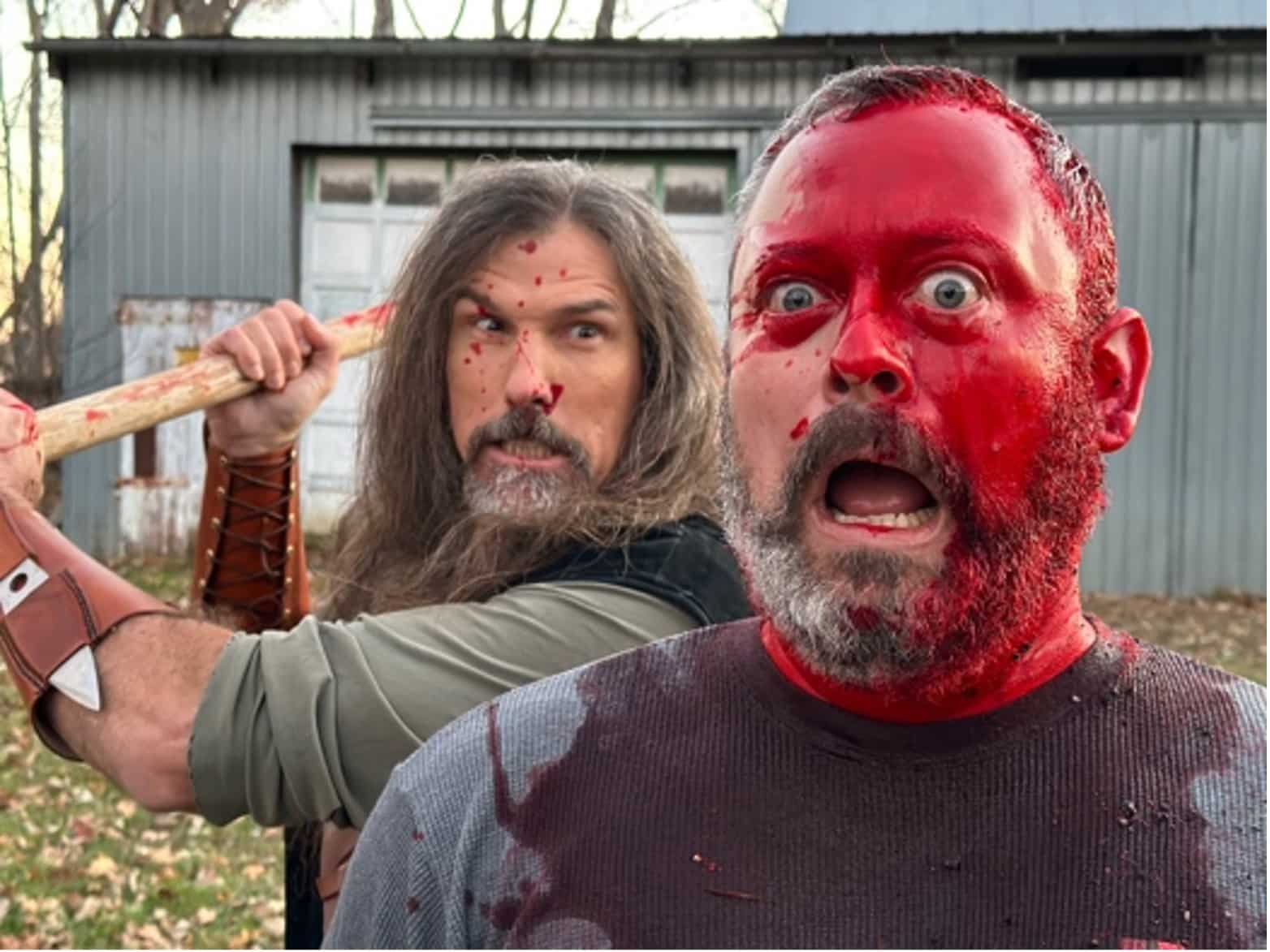
Revolt. It’s a word I’ve been chewing on lately, turning it over with my tongue, sampling its twin flavors. To revolt is to disgust, gross out, make somebody close their eyes and hold their breath and turn away. But to revolt is also to rebel, to battle back against an oppressive force. I am revolting.
By chasing this nightmare—by directing a short horror film—I am amassing all of my creative energy and channeling it into something that is meant to disturb you. That’s something the normals don’t understand. But anyone who would rather talk about Terrifier 2 than the Packers game knows what I’m talking about, and everyone who reads Fango has faced the question: “Why do you like that kind of stuff?”… the subtext of which is “What’s wrong with you?” We are outliers. Our tastes revolt others. Our embrace of the monstrous is an act of defiance.
Directing a short film, no matter the genre, is also a defiance. I am fussing over the dialogue, the coloring, the cut of a costume—the minute particulars of a project few people will see. I am putting hundreds of hours into a project that that will take my tiny audience fifteen minutes to watch. Maybe I can leverage this into future work, but that’s a big hairy maybe. There is no discernible reward—in the minds of many—to what I’m undertaking. Why am I about to ignore emails and miss deadlines and neglect yard work and pass on social events with friends and apologetically skip out on some dinners and game nights with my family?
For the same reason that Frank toys with the lament configuration in Hellraiser. For the same reason that Mia reaches for the ink-scribbled hand in Talk to Me. For the same reason that Heather Donahue wanders into the woods in search of the Blair Witch. “Don’t go in there!” the world cries, but I must. Because there is something out there in the night that’s calling me, and I am compelled to answer. I am not driven by money; I am losing money in the undertaking. And in this purely artistic and almost anarchic pursuit, there is joy.
Yes, not doing what everyone thinks you’re supposed to be doing can have that effect on you. I won’t grow a lawn, I’ll plant a prairie. I won’t wear a polo and khakis, I’ll pierce my nose and don a Misfits T-shirt. I won’t support your war, I’ll attend a protest. I won’t attend college for pre-med, I’ll go to art school. Whatever. People often think of joy as commensurate to sunshine and birdsong. But some of us know there is joy to be found in darkness and heavy metal. And now, with the prep underway on 13th Night, my joyous revolt has truly begun.
Regional Filmmaking
I love to visit New York and LA, but I have no desire to live anywhere other than here in Minnesota. Coastal prejudice is something I constantly face. A decade ago, my reps arranged for me to have coffee with a nepo baby screenwriter (who has since been cancelled). He rolled up in a d-bag sports car, said he was throwing a party for 10,000 dollars later that night, and informed me I would never make it in the business if I didn’t live in Hollywood. I found him so obnoxious that I made an oath to the dark gods to prove him wrong.

When I think about directors I want to model myself after, it’s the George Romeros and Larry Fessendens of the world. These regional filmmakers stubbornly, beautifully, horrifically made films in their own backyard—and then found a global audience. That’s what I wanted to do, but even with a project as small as 13th Night, I knew I couldn’t do it alone.
There’s a familiar sequence at the beginning of movies like Ocean’s 11, The Dirty Dozen, and The Magnificent Seven—when the crew of misfits assembles. That’s the task I was faced with now that I’d secured the funding for 13th Night. “I’m putting together a team,” I said in a series of coffee shops and bars and restaurants as I met with potential collaborators, the local talent willing to join forces with me on what would be a guerilla operation.

David Ullman was one of them. He’s a musician and a documentary filmmaker who also works as the video producer at the University of Minnesota. He can talk at great length about the Universal monsters, and in high school, over four years, as a passion project, he painstakingly adapted James O’Barr’s graphic novel The Crow. He’s my kind of weirdo, in other words. And he’s endlessly curious, wildly talented, and has a MacGyver attitude. We don’t have what we need? We can figure it out, no problem, with this flashlight, a jar of rubber cement, two green jelly beans, and a paperclip.
He would be editing the film, but this was an all-hands-on-deck situation, so almost no one did just one thing. Because he had so much experience shooting, and because he’s incredibly organized and has a meticulous eye for detail, he also became the assistant director and script supervisor. The fluidity of his role was true of so much of 13th Night. In a way, the credits should simply read, “Team.” During this critical prep period, he acted as a kind of sounding board. I could ask him, “What do you think of this?” or “How can we realistically accomplish that?” and he would have some valuable insight based on all the time he’s spent in the production trenches.

Matt Bowers was another essential collaborator. I referred to him in Part 1 of this series as a Swiss Army Knife of a person. He is equipped for and good at literally everything. He is also an endless, infectious fountain of energy who is never not smiling. The word I have heard him say more than any other might be, “Fun!” Matt will not only survive the apocalypse, he will find a way to enjoy it.


Over many, many weeks, I sat beside him at the kitchen table, talking through the script as he drew storyboards. But his role didn’t end there. He took an audio production class with me at FilmNorth and listened to a thousand podcasts and watched a million Studio Binder clips and decided he could manage sound on set. So he would mix and operate the boom. But that’s not all. Matt also knows his way around a tool bench, and he would build one of our major showpieces…
The Murder Wall
Jacob, the main character in 13th Night, is a killer who has been employed as an agent of Death. Though this isn’t explicitly stated in the script, you get the sense that he’s been around a long time. “A long, long time,” a line of dialogue reads. We note uniforms in his closet that date back to WWI. There’s a Spartan helmet on a shelf. And then there’s the arsenal in his garage—featuring antique and contemporary weapons—what we called the murder wall.

I didn’t want any guns on set. So Jacob would work with blades and bludgeons. That seemed to align with the reaper mythology. And I liked the implication of proximity. He would have to suffer the deaths of his victims—to smell their breath and blood—and that would take a brutal toll on him. He was a warrior who had become a weary, reluctant assassin.

The design for the murder wall was inspired by The Texas Chain Saw Massacre. For me one of the most indelible moments in any horror film comes when Kirk wanders into the Sawyer farmhouse, only to get smacked in the head by a hammer and dragged through a doorway by Leatherface. That doorway—at the end of a grimy, dimly lit hall—is spotlighted and painted a lurid red and features the taxidermy mounts of many animals.
I imagined something similar for Jacob’s weaponry. A display that felt almost like a holy altar. I imagined a clean, vivid, brightly lit red surrounded by the bare studs of a shadowy garage. The busy ornamentation of steel would reflect the light and dazzle the eyes.

Throughout the development of 13th Night, I made many mistakes. You already heard about a few of them in Part 1—when I, for instance, recklessly wrote a script without truly understanding how to crunch a budget. That was a major oversight I have since learned from. But even the tiny errors offer an education.
In the case of the murder wall, I had this notion in my head that it would be backed by red velvet, providing a lush juxtaposition to the cold knives and swords and axes, making them appear almost like morbid jewelry displayed in a gift box. Matt accompanied me to JoAnne Fabrics, and we pawed through the bins and hangers. A clerk approached us and asked if we needed help. This was Dan. Dan from JoAnne, we now call him.
He turned out, almost magically, to be a theater set designer. He immediately discouraged the fabric backdrop. Not only because that much velvet would cost a ridiculous amount of money, but because it was impractical. If we tried to screw hooks through the velvet, and into the board backing it, the fabric would twist and tear. “I’m losing money as I stand here and tell you this,” Dan from JoAnne said. “But you all need to get yourselves to Sherwin-Williams. Paint that murder wall a delicious red.”
So that’s what we did—snagging several cans of primer and flat paint—followed by a trip to Menard’s. We needed 4x4s for the foundation, 2x4s for the frame, two sheets of ACX premium sanded plywood for the display, and dozens and dozens of hooks and bolts for the weapons, lag screws for support. We misjudged or second-guessed every decision, and so many more trips to the hardware store followed.
Benjamin Busch—the actor who would play Jacob—has a massive war chest of weapons. Some he has purchased in his travels. Some he has earned as a Marine. Some he has forged himself as a blacksmith. Throwing stars, switchblades, katanas, scimitars, broadswords, rapiers, bayonets, bowie knives—we were going to hang as many as we could on the murder wall, what would amount to hundreds of pounds of steel. Matt was terrified the structure would collapse and pincushion someone, so he reinformed the hell out of the design. By the time he was finished, we probably could have hung a truck from it.

I’m giving you the granular details of this particular chore for a few reasons. Here’s the first. James Cameron worked every sort of job in film before getting behind the camera. He painted backgrounds. He built models. He developed special effects. He wrote scripts. I wanted—and I got—a junior-sized version of that experience on 13th Night. I was writing the screenplay and enlisting actors, but I was also lining up the caterer and forming an LLC and running to the hardware store to buy more screws for my murder wall. This was was boot camp, but it was also a lesson in humility.
Here’s the other reason I’m giving you the play-by-play on the murder wall. Stories require indelible moments. Moments that thrill. Moments that you can put in the trailer. Moments that you will gaspingly recall to your friends after you step out of the theater and into the sunlight. Moments like the rolling boulder in Raiders of the Lost Ark or the shower scene in Psycho or the Piccadilly Circus mayhem in An American Werewolf in London.
Sometimes weeks or months of headaches go into planning something that will only amount to a few minutes on the screen—but their power will sear your eyes and fossilize in your brain. Yes, 13th Night is a modest short film, but I knew the murder wall would make it grander and more imposing and—maybe, possibly, hopefully—unforgettable.
The Vision
When I was talking to directors and asking for their advice, several said some version of the following: get a great caterer, get a great actor, get a great D.P. My cinematographer proved to be the most elusive of the three. No doubt you’ve seen a film that was shot in the Minnesota heydays—whether The Mighty Ducks, Grumpy Old Men, Jingle All the Way, or Fargo—when Hollywood made regular visits to the Land of 10,000 Lakes.
Things are quieter these days, but because so many Fortune 500 companies are located here, the advertising sector remains busy. That’s a good thing, if you’re looking for talented local crew. And it’s a bad thing, if you’re not able to match Target or Best Buy’s commercial rates.
That’s what happened to me with two D.P.s. I bought them a meal. They read the script. They shared their vision for it. They talked about how much they missed doing creative projects. They said they were 100% on board. Then a commercial contract would pop up, and…they were out. One of them eventually admitted to me, “I think I’m actually finished with independent movies. I’ve got kids to raise, and I just want the 9-to-5 gigs.”

Thankfully I was introduced—by way of a theater group—to Ben Enke. His reels knocked me out. He was a horror and sci-fi nerd. He had access to equipment as well as a gaffer and focus-puller he worked with. And he understood exactly the aesthetic I was hoping for.
When I talked about the main character feeling trapped in a Faustian bargain—when I talked about the isolation of his life—when I talked about him getting lost in his own head, Enke translated that into a look book of startling beauty. He wanted to keep the lighting minimal, so that islands of light offered refuge from a surrounding darkness. He wanted to create frames within frames, via doorways and windows, so that Jacob appeared imprisoned.
I was reminded then—as I drooled over his discussion of James Wan’s camerawork and Rembrandt’s lighting—of something I had learned from comics. In 2014, after years of submitting pitches, I finally landed a gig at DC—a two-issue arc of Detective Comics. I was paired with the artist JP Leon.
This was my first time writing comics, but I sure didn’t want it to be the last, so I asked JP if he had any advice for me. He told me not to worry about close-ups or medium shots, foregrounds or backgrounds, not to get overly controlling with how every panel would be arranged. That was his job—to shoot the picture. It was my job to make him feel. To feel scared or thrilled or aroused or saddened or or or. If I could grab him emotionally, then he would translate that emotion into art.
To this day, I always include a note at the top of my comics scripts. “I’m unloading what’s in my brain. If you see it better, if you want to change anything, let’s talk. I trust your vision best.” That now carried over to film. I trusted Enke’s vision best, and I was so damn excited to join forces and get to work.
Calling in Favors
I couldn’t afford a line producer, so that left me (the guy who can barely calculate a tip at a restaurant) to sketch out a hazy sort of budget. Making a movie—even a fifteen-minute movie—is painfully expensive. I had won a grant to fund the project, but the dollars quickly swirled down the drain. I had to hire a lawyer to form an LLC, bring on an accountant to handle payroll, cough up for insurance, hire the DP, gaffer, focus-puller, rent the equipment and truck to haul it around in.
Then there was the make-up artist and the sound editor and the caterer. Especially the caterer. This was something every director buddy of mine drove home: I could not skimp on food. A spread of good grub would ensure everyone’s spirits remained full and their energy high.
If not for the generosity of friends—friends like David Ullman and Matt Bowers, who were volunteering their time to play critical roles in the production—I would have been screwed. Creatively, yes, but also financially. I don’t think I’m exaggerating when I say 13th Night could have cost ten times what it did.
And it warmed my cold, dead heart when others stepped in to help. The bookstore owners volunteered to put up the actors the apartment above their shop. My neighbor helped drill holes in a baseball bat to accommodate the lag screws barbing its end. My daughter’s dance instructor donated fog machines and my buddy built a swamp cooler for them. And—critically—our friends offered up their AirBnB home for a month. This was the greatest possible gift. Not just for the cost, but the planning and staging the nightmare to come.
Fix It in Prep
The house was an ordinary rambler. But it had golden wood floors, a spacious living room, a creepy basement, and a rustic garage that would serve the shoot perfectly. There was also a three-season porch for catering and a game area that we transformed into our production war room (where we laid out props on a ping-pong table and organized our shot list on the walls—something I’ll explain further in Part 3).
We had time. Over the course of a month, we cleaned out the garage and arranged the murder wall. We replaced the art. We cleared shelves of knick knacks. We removed family photos. We changed out the lamps. We hung up mirrors to help bounce light and encourage our theme of reflection. And we rejiggered scenes based on the layout of the rooms.
In the film, Jacob has a ten-year-old daughter. I collected stuffed animals and Taylor Swift records and fairy lights and books and a board games and blankets and arranged a space for her. During this time, my eyes kept dodging toward the bathroom, where a faucet dripped and pipes gurgled. That helped me reimagine a scene, so I returned to the script and manufactured a jump scare based on that dark doorway.
My D.P., Ben Enke, visited the house and we toured through it while studying the storyboards. He planned out every shot in advance, using an app that indicated the lens, lighting, and placement—shots we would print out and organize in a binder for our assistant director and a hang on a wall for our entire crew to study during the shoot.


Due to my own inexperience and insecurity, I overprepared every element and laid awake at night mapping out scenes in my head. Rather than fix it in post, I would fix it in prep. Because the real horror, for me, was something going wrong during production. We had three days, and no margin for error.
Part 3 of this journey—“ Your Movie is Only as Good as Your Monster”—will appear tomorrow on the FANGORIA website.