
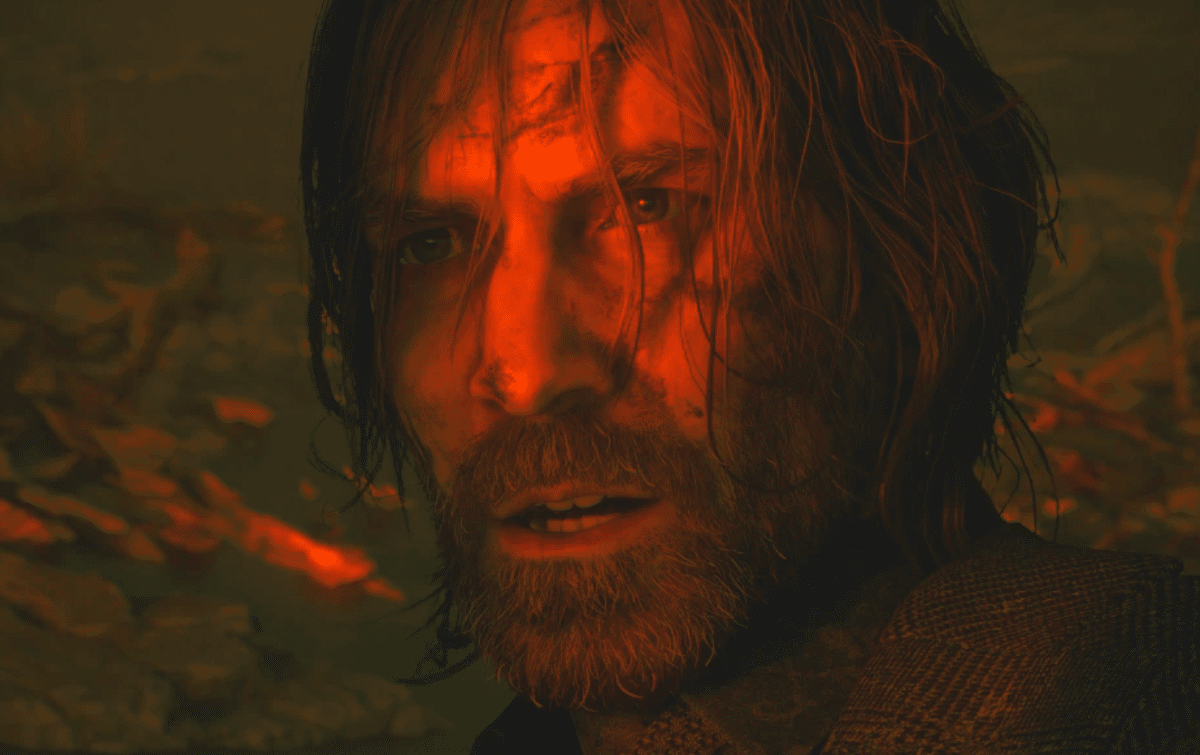
With October here, the spooky season is in full effect. All manner of creatures from the depths of the imagination are dredged up to terrorize the senses. While these fictional beings inflict thrills on the populace, there is always the comfort that, at the end of the day, these invented terrors are just that: fictional.
But what if they weren't? This isn't to argue the existence of ghosts, goblins, or ghouls, but to ask a deeper philosophical question: What if the imagined entities meant to chill and thrill were instead a conduit for the very real ideologies that terrorize many people every day? Games such as Remedy Entertainment's Alan Wake 2 explore the possibility that fictional writing can come to life through a concept called “Hyperstition.”
Hyperstition is the combination of two words: “Hyper” and “Superstition.” It is a postmodern theory coined by controversial philosopher Nick Land. It points out that there is a positive feedback loop between fiction and reality, in which popular culture serves as a component that creates self-fulfilling prophecies. Land explains: “Superstitions are merely false beliefs, but hyperstitions — by their very existence as ideas — function causally to bring about their own reality“.
In short, Hyperstition is the theory that ideas and fictions can bring themselves into reality. For Land, the theory functions primarily as a capitalist construct. For example, think of the current A.I. trend and how A.I. was created by corporations as a push to find the next step in our technological evolution, regardless of the impact it might have on everyday people and the planet. These companies create, market, and sell A.I. as the “future” in competition with other corporations to become the leader in a technological future that they themselves create.
In effect, they are hyping up this belief, this fiction, that A.I. is the future, and thus they are increasing the reality that the future they are prophesying will come true. I first learned about this theory from the art and philosophy podcast Weird Studies, which has several episodes dedicated to the concept. Understanding this interpretation of Hyperstition is key to its context within Alan Wake 2.

Alan Wake 2 is a multi-layered and narratively complex video game that utilizes Land's concept in various forms. But before that can be explored, it's worth trying to understand what Remedy's decade-in-waiting sequel is about. In the base game of Alan Wake 2, players switch between Saga Anderson and the titular Alan Wake as they attempt to stop the Dark Presence (an entity from another dimension called The Dark Place) before it rewrites reality via Wake's yet-to-be-published book, Return.
Saga's sections of the game, in particular, mix detective elements with her fights against the Taken (Dark Presence-possessed individuals). Dubbed the “Mind Place”, it exists as a visual and playable representation of Saga's thoughts as she pieces together clues gathered within the real world to further aid in her investigation. In her exploration around the town, Saga discovers missing manuscript pages from Wake's book.
These pages function quite literally as Hyperstitions as they foreshadow upcoming events in the story. This has a profoundly unsettling effect on Saga – from the discovery of the first manuscript page, her investigation (and by extension, the player's) is a harrowing descent into SCP-like madness, as well as its connection to her past, present, and potential future. The pages may briefly signpost certain set-pieces, Taken enemies, and more, but no matter what, Saga is resigned to see Return through one way or another as she is beholden to the rules and conventions of the horror story.

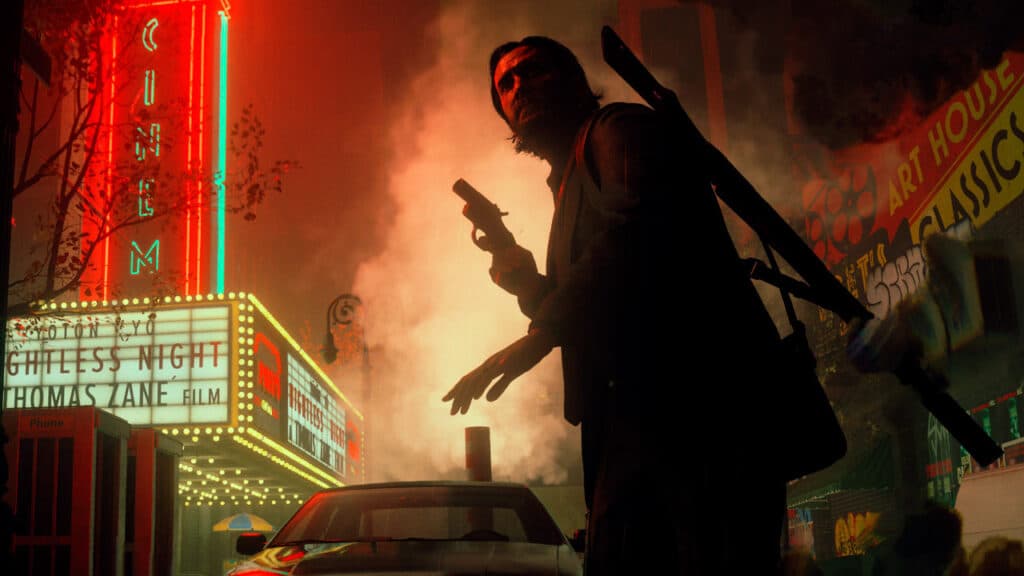
But Wake's sections of the game are perhaps the most interesting in how they tie into Land's construct. The majority of his gameplay takes place in a nightmarish neo-noir rendition of New York City within The Dark Place, and utilizes a similar gameplay space to the Mind Place, called the “Writer's Room”. When in the Writer's Room, Wake can rearrange the outline of chapters by altering specific details on the Plot Board to manipulate distinct spaces within New York City so that he can progress through his novel and eventually escape The Dark Place.
In this instance, the player acts as both facilitator and victim of Hyperstition as they manufacture the scenarios that will come to pass in order to progress. Further tying Wake and Hyperstition together are the specific enemies that he encounters, as they are not Taken but rather “Shadows”, which are insane copies of Wake that have since been edited out of Return. When players fail and reach the Game Over screen, Wake is ostensibly “rewritten” to return to the previous checkpoint before death, making this a cheeky handwave to explain why the player respawns later.
And this is just barely scratching the surface of the complex meta-narrative at play, as characters like FBI Agent Alex Casey exists in the real world of the game as Saga's partner, within The Dark Place as an invention of Wake's (whose dubious origin is such that it is hard to say whether the character or man came first), and the fact that the character is two degrees away from Remedy's famous Max Payne character who is acted by game director Sam Lake and voiced by the late, great James McCaffrey. In short, the game is brimming with Land's philosophical theory in gameplay, narrative, and presentation.
By calling attention to its narrative structure, in which players are at times both creator and victim of the stories and worlds they inhabit, the base game constantly pushes back and forth against the Campbellian loop the characters find themselves in as they craft a new story that isn't beholden to any one convention.
On its face, the base game deals with Hyperstiton in the literal fact that its titular character can bring his fictional writing to life. However, in the game's final DLC, titled The Lake House, the cost of Hyperstition is more direct due to the focus on its human villains. In this DLC, players control FBC (Federal Bureau of Control) Agent Kiran Estevez, whose story runs parallel to the main game as she investigates an FBC research facility that has gone dark.
Her investigation leads her to discover that the two head scientists, Jules and Diane Marmont, were competing with one another to access The Dark Place through the Cauldron Lake threshold. Their efforts were emboldened by the discovery of additional pages from Wake's manuscript, which foretold that they would achieve their goal. As a result, the two scientists' experiments became increasingly inhumane in their bid to access the threshold first. Diane attempted to do so by recreating Wake's writing on a large scale through a kidnapped playwright forced to replicate Wake's work, and a technology similar to generative A.I., utilizing automated typewriters.
Meanwhile, Jules' experiment pushed an imprisoned painter to his breaking point, long after the passion for his art had died out. The torture caused the painter to commit suicide, but not before pouring his anger and rage at his abuse into a self-portrait made of his own blood. He was then resurrected into a powerful entity that activated The Dark Presence energy seeping throughout the building, thus leading to the initial shutdown that Estevez stumbled upon. In essence, the Marmonts bring about their doomed reality because Wake's writing foretells their success.
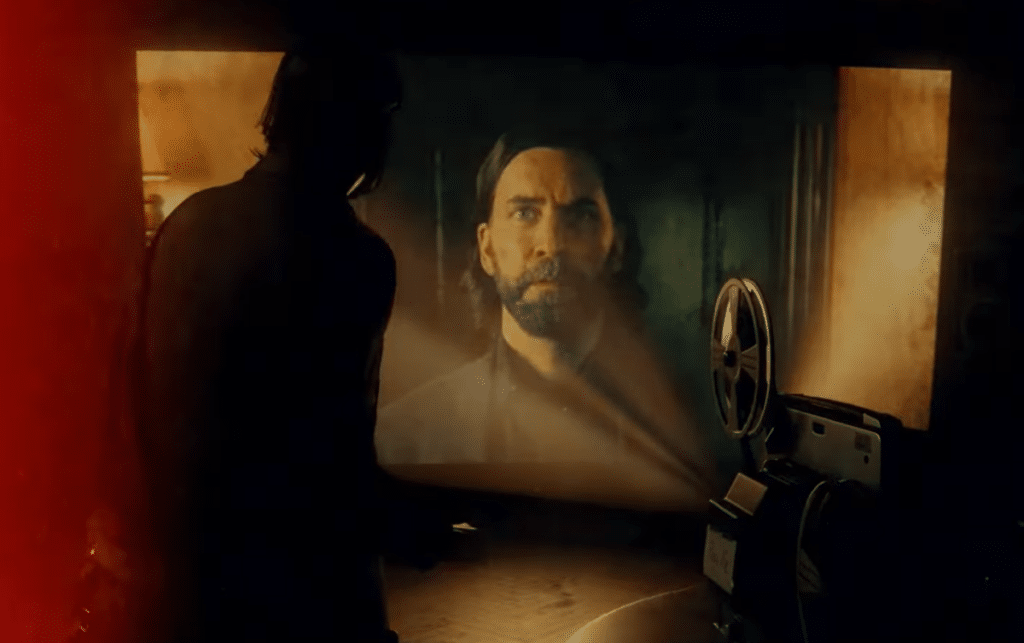
It is these experiments that further link the game and Hyperstition together, as the DLC represents the dangers of unchecked progress, no matter the cost. In this instance, the game connects to Land's theory that Hyperstition is primarily a tool of capitalism: the Marmont's relentless aim for success rather than scientific discovery. The capitalistic ideology of only seeking the reward of progress is what turned an exploratory scientific endeavor into a catastrophe that cost needless lives.
Economic wealth may not have been the end goal, but the exhaustive and callous conditions in pursuit of a singular goal are no less similar to the harm brought about by capitalistic ideals. Only here, these ideologies are twisted and perpetuated by the two Marmonts. Their abuse of artists, the destruction of genuine creativity, and the use of automation to replicate art, all of which are employed to pursue quantity over quality, are used to accomplish their goal by any means necessary. Wake's pages may inch the Marmonts towards their fate, but it is their selfishness, cruelty, and disregard for their fellow man that barrels them forward to the inevitable prophecy that ends them.
Ultimately, Hyperstition is an extension of an ideology that heightens the horror of Alan Wake 2. It may be riddled with creatures beyond imagination, but it is the usage of Hyperstitions that takes the horror to the next level. And capitalism, being the true evil that begets real and imagined terror alike, is no stranger to horror fiction.
From the Umbrella Corporation experimenting on the populace of Raccoon City for its bio-weapons division in the Resident Evil series, to the continued menace of the Weyland-Yutani Corporation sacrificing civilians and employees alike in the name of grander designs in the Alien franchise, horror is rife with the perils of unchecked capitalism. And yet, time and time again, organizations like Umbrella, the Marmonts, and many others have proven to fail eventually.
Their usage of self-fulfilling prophecies -like Hyperstitions- to create their own artificial success is temporary at best (as proven by Agent Estevez when she stops the FBC outbreak), and self-destructive at most (as showcased by both Wake and Anderson when they rewrite Return together to defeat The Dark Presence once and for all). The cycles can be broken. After all, as noted by Wake in the game's ending, it's not a loop, it's a spiral.