
Suitably, for a movie soon to leave its viewers with wet faces, it was raining when The Life of Chuck closed out the inaugural SXSW London, but that didn’t stop fans coming out in droves to three screens across the city to catch the latest feature from modern horror master Mike Flanagan, two of which were lucky enough to have the film introduced by Flanagan himself, along with stars Tom Hiddleston and Chiwetel Ejiofor.
No stranger to adapting the work of Stephen King, Flanagan mused on his reasons for wanting to adapt this particular tale, citing a feeling of watching the world fall down right outside of his window during the height of the COVID19 pandemic. In recent days, as Los Angeles fights for the freedom and safety of its civilians, and aid ships are stopped from bringing food to Gaza’s most vulnerable, that feeling of apocalyptic doom has only intensified, making Chuck’s message of simple humanistic empathy feel more necessary than ever.
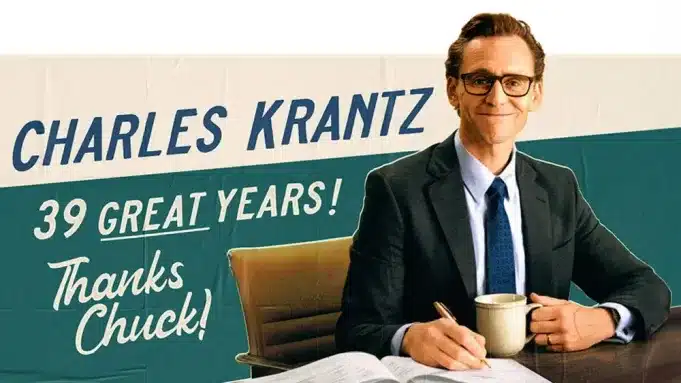
Following the three-act structure of its source material found in King’s 2019 novella If It Bleeds, The Life of Chuck recounts the life of Charles “Chuck” Krantz (Hiddleston/Benjamin Pajak/Jacob Tremblay), playing chronologically backwards from his death at the age of 39 from a brain tumour to his childhood growing up in a supposedly haunted house. The Life of Chuck starts with its strongest act, led by Chiwetel Ejiofor and Karen Gillan as Marty Anderson and Felicia Gordon, ex-lovers going through the motions of life in a world that’s teetering on the edge of oblivion. Scenes of natural disasters, civil unrest and widespread violence on a national scale of course feel eerily prescient, as does the depiction of quiet normalcy in the eye of the storm. Jobs must be worked, dinner must be made, and the mundanities of everyday life continue even in the face of the impending apocalypse. Among the chaos of a world crumbling around them, Marty and Felicia are all at once comforted and confused by what is seemingly the only constant in their tumultuous new reality – billboards, sky writing and TV commercials thanking Chuck for 39 great years. The specifics of those 39 years are explored further in the next two acts, as we learn more about Chuck and the ins and outs of his entirely normal, yet utterly magical, existence. Using Walt Whitman’s poem ‘Song of Myself’, and the infamous line “I contain multitudes”, to center Chuck’s story, Flanagan reminds us that every human on this planet, even a seemingly nondescript banker like Charles Krantz, has a unique and fruitful story to tell, if you’re willing to listen.

While introducing the film at SXSW London, Flanagan jokingly warned horror fans in the audience that they were going to be “disappointed” by his latest effort, to which I, respectfully, have to disagree. Sure, The Life of Chuck isn’t a traditional horror movie in the vein of other entries in Flanagan’s oeuvre (particularly in contrast to his other King adaptations like Gerald’s Game or Doctor Sleep) but The Life of Chuck examines, with sentimental honesty, that most human fear, the one embedded evolutionarily deep into our psyches from birth – the existential dread of the knowledge that one day you, and everyone you love, will die. And there is literally nothing you can do to stop it.
So yes, the horror is here, undoubtedly (the Hill House helmer can’t help but inject his mastery of creepy spaces into the scenes involving the Krantz family cupola especially) but in The Life of Chuck, Flanagan approaches this inevitability more with a blend of celebration and sadness. This is a beautifully shot film, full of rich, warm scenes that boast Flanagan’s signature visual polish while the usual crew of Flanagan supporting players – including Samantha Sloyan, Kate Siegel, Rahul Kohli and Mark Hamill – imbue each of their characters with life in a film that is so explicitly about death. It is Benjamin Pajak, however, as 10-year-old Chuck who steals the show even from his grown-up co-stars, perfectly capturing young Chuck’s innocent curiosity and awe at the world that make his adult counterpart’s eventual fate even sadder. He’s also got the moves to rival Hiddleston’s own, tearing up the floor in Chuck’s second dance number that will have even musical haters (guilty, as charged) tapping their toes in the aisle.
This scene, along with Chuck’s other stand-out set pieces like Hiddleston’s dance with “Little Sister” (Janice Halliday) or Marty and Felicia’s final moments spent staring in fear and veneration as the vast expanse of the universe blinks out of existence right above their heads, remind us why Flanagan works so well with King’s source material – among the monsters and murders that pepper their stories, both are creatives whose work, at its core, is keenly preoccupied with the unique blend of beauty and horror that comes from being a human being.
While fans of his hallmarks will undoubtedly come away with an even stronger reverence for his work, The Life of Chuck isn’t the film that’s going to bring any Flanagan doubters round. The monologues are meaty, the swelling Newton Brothers score is often overbearing in its cue-card insistence that now you must feel something (rather than letting the script or onscreen action speak for itself), and the thematic tissue doesn’t always quite connect. As an audience we actually get very little time with Hiddleston’s Chuck, with Nick Offerman’s Narrator left to fill in gaps of his life and aspects of his personality we should probably be shown, not told.
Much like our time on this mortal coil itself, The Life of Chuck is not perfect, but it does a damn good job at what it sets out to do – notably, to remind us that life is blisteringly cruel at its worst and heart-swellingly beautiful at best. Above all though, life is short. Of course, if you’ve chosen FANGORIA.com as your place to read this particular review, you’re probably already aware that The Life of Chuck holds a particularly strong significance for our team, and why it may be hard for any of us to provide a hugely objective view of the film. In May of last year, our friend and colleague Scott Wampler passed away unexpectedly, not long after he and THE KINGCAST co-host Eric Vespe visited the set of The Life of Chuck where they were able to perform as extras in one scene. I never got to meet Scott in real life, a regret that will almost certainly continue to manifest in unexpected ways at unexpected moments throughout the rest of my own life, and so it occurred to me while watching his cameo that this was now the closest I will ever get to seeing Scott in all his living glory. I like to think it’s a pretty accurate representation of him – smiling with his friends, mohawk high to the sky and somehow managing to pull focus in a scene centered on an A-lister like Tom Hiddleston even without saying a single goddamn word.
As his dedication followed the credits, the bittersweet irony was not lost on me (as I know it isn’t for my peers) that the story of a man taken from the world far too early but not before impacting just about everyone he came into contact with should now be so inextricably tied to Scott. Among the tsunami-strength outpouring of love and grief from our community, both from people who loved him personally and those who admired him parasocially, were hundreds of anecdotes telling of Scott’s impeccable, often deliciously evil, sense of humor, his effortless ability to charm his way into situations many of us could only dream of (as well as also using said charms to get himself out of trouble), his talent as a writer (and world-class shitposter), his refusal to stick around in any situation that wasn't bringing the best of vibes and, above all, his unwavering loyalty as a friend. All of these stories live on with enduring sanctity to remind us that Scott, like Chuck, like Walt Whitman, like all of us, contained multitudes. Your loved ones will die without warning. Treat them accordingly. And for 40 whole-ass, disgusting years, thanks Scott!