

The wise among us already know what’s coming the moment Remmick (Jack O’Connell) seems to drop out of the sky, blistered and bloodied, his skin smoking as he stumbles to Joan (Lola Kirke) and Bert’s (Peter Dreimanis) front door and begs them to let him inside. It’s too late by the time the Choctaw hunters arrive with the warning that “he’s not what he seems.” Even before his offer of gold, his whiteness had already imbued them with a false sense of safety.
In another more metaphysical sense, they had already invited the devil in long before the Celtic vampire materialized at their doorstep. It happened the moment they allowed themselves to be enticed by hatred. Fed it, afforded it hospitality, allowed it to take up space inside right until the very moment it devoured them. Right until the moment they became it.

Writer, director, and producer, Ryan Coogler gives so much space to these particular moments that cycle throughout the duration of his record-breaking feature film, Sinners, which is now available to stream with a physical release on the way in July (praise be). A solid percentage of the film occurs at the threshold of doorways, a variation of the image of the crossroads where Robert Johnson met the devil.
The suspense of these scenes derives from a distinctly unromantic “will they?/won’t they?” As in, will our heroes- Smoke, Stack (Michael B. Jordan), Annie (Wunmi Mosaku), Mary (Hailee Steinfeld), Sammie (Miles Caton), Delta Slim (Delroy Lindo), everyone, the whole community- succumb to the allure presented by the vampire Remmick, and his progeny?

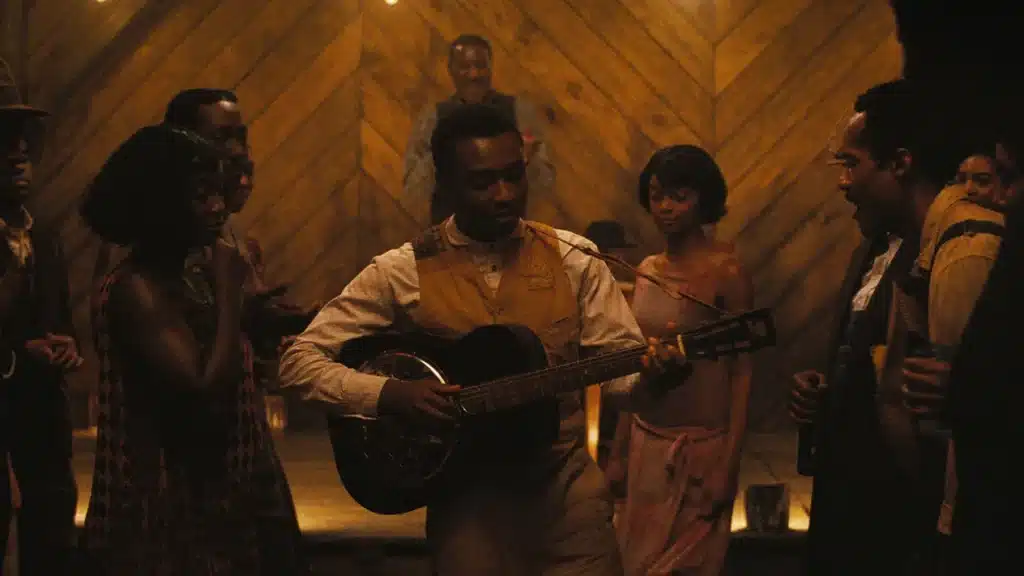
Jack O’Connell seems to glisten with a potent, threatening heat when he initially appears at Club Juke’s door, beckoned by Sammie’s music; its resonance, a magic that permeated the night and captured his attention, leading them all to that very moment on either side of the door. Flanked by Joan and Bert, the three never cease smiling.
He says all the right things about money to spend and his belief in equality and music. They play the banjo beautifully, soulfully, much to Stack’s amusement and everyone else’s surprise. But as the audience knows, it’s all a glamour; an attempt to pull the veil over the community’s eyes so no one notices his consumption of our music, our magic, our stories. Everything that makes us us.

The question of what enthralls, captivates, and seduces us is at the heart of Sinners; the very reason this story had to be a vampire story, as anxieties around illusion are one of the primary tensions definitively expressed by vampiric figures of the modern era. But as lovers of the immortal know (or were perhaps reminded by Nosferatu’s Orlok), desirability wasn’t always a factor.
The vampires of lore and legend were hardly as crushingly, breathtakingly seductive as those of more recent times. In stark contrast, the mythic and folkloric vampires that appeared throughout human history were rendered as repulsive revenants, terrifying demons, hags and baby-eaters. From figures of the ancient world like Babylonia’s Lilitu (more recognizable now as Lilith) and the Vedic vetala, all the way through to the strigoi, we have always told stories about blood-drinking demons who died and did not stay dead, but they were overwhelmingly characterized as purely abject entities.
Even as other monstrous figures throughout history made seduction a key aspect of their hunting methods, it was a feature more often associated with shapeshifters than undead blood-drinkers. Then, in the early nineteenth century, they suddenly changed. Why?
In England, in April of 1819, John Polidori published The Vampyre and unleashed the modern literary vampire upon the world. Polidori’s Lord Ruthven is considered the first definitively enthralling vampire; his wealth, desirability, and the intensity of his gaze being core aspects of his characterization that work to conceal- and then reveal- the cruel, predatory nature underneath.
That Polidori took inspiration from Franz Mesmer’s theories of animal magnetism in his construction of Lord Ruthven is widely accepted by Gothic scholars. The same can also be said for Joseph Sheridan Le Fanu’s Carmilla (1872) and Bram Stoker’s Dracula (1897), their title characters’ magnetic qualities written in allusion to Mesmer, who theorized that everything possesses an invisible “magnetic fluid” that can be manipulated to promote “healing” in an individual or group.
Naturally, the suggestion that one has the power to exert one’s will over another, to influence and compel them in such a way that robs them of their agency, holds profoundly sinister implications. Indeed, the history of magnetism and its attempted implementation as a management tool during the late eighteenth and early nineteenth centuries undeniably changed the course of human and horror history alike.
Magnetism arrived in Haiti (then, a French penal colony named St. Domingo) in 1784, a mere six years before the onset of the Haitian Revolution, via the Comte de Chastenet Antoine-Hyacinthe de Puységur, a naval officer, French aristocrat, and student of Mesmer’s now considered one of the forefathers of hypnotism for the technique he developed to induce “artificial somnambulism.”
During his time there, Antoine-Hyacinthe “treated” the enslaved using a set of practices and techniques designed to subdue the “patient” into malleable complacency. But to the enslaved, it was a practice of soul theft. Psychic enslavement. The man was in the business of making zonbi. And to be made a zonbi was the ultimate nightmare, the single most terrifying prospect to a people who lived under some of the most historically dire conditions this world has ever seen; that their minds might be invaded, their souls devoured, while their bodies were compelled to labor on in perpetuity. Death was welcome by comparison.
Ostensibly riding the coattails of The Vampyre‘s popularity, an American writing under the pseudonym Uriah Derick D’Arcy published The Black Vampyre: A Legend of St. Domingo in New York in late 1819, now widely considered the first American vampire story, as well as one of the first pieces of abolitionist fiction (I also wrote about it here). It tells of an enslaved child, a vampire, who murders the sadistic slave-owner that killed his family, kidnaps his infant son, and returns several years later to seduce, marry, and turn his wife.
The Haitian Revolution was the largest and most successful slave revolt in history, and it had basically just happened at the time the story was published. Haiti’s independence was haunting the white American psyche, so naturally they started telling monster stories about it.
Like Lord Ruthven, the title character of The Black Vampyre (unnamed except for the moniker, “The Prince,” which may or may not have been received as a joke to readers of the time) possesses this same characteristic of preternatural allure. But unlike the European vampires, the source of his mesmeric ability is Obeah, which is distinct from, but treated synonymously with Vodoun by D’Arcy.
African spiritual traditions like Vodoun, Obeah, Santeria, and hoodoo were a source of profound anxiety among slave traders and their sympathizers. Priests and practitioners held a power that rivaled their own and it was for this reason that they were drawn to mesmerism in the first place, to combat this perceived problem of influence when old faithful – violence – failed to keep folks suppressed. Our spiritual systems were categorically demonized through the technology of monsters and flattened into malevolent “black magic” instantly recognizable as one of American entertainment’s most enduring tropes; one that actually precedes the formation of the country itself.
The Black Vampyre thus illuminates the tensions of the psychic-spiritual battle between magnetism and Vodoun – supremacist control and African sovereignty – that characterized and was written through the monsters of the time, which have in turn shaped the monsters of our time.
Sinners resurrects the historical and cultural tensions that created the modern vampire in the first place to reclaim the interwoven narratives of African spiritualities colliding with vampirism. Annie’s rootwork protects and insulates the community on one side of the door; Remmick’s magnetism beckons from the other.
The transcendent resonance of Sammie’s guitar plays out from one side of the door; Remmick, enthralled, eager to bleed him dry on the other. The capacity to have a door in and of itself- Smoke and Stack’s ownership of the building- threatened by the Klan that would sooner burn it all down than allow the no of a closed door to ever exist. And later, Smoke and Annie, Stack and Mary, on either side of the door between living death and the release of true death.
Coogler is intensely preoccupied with Inside/Outside dichotomies. But he also demonstrates an acute understanding of the ways they’re entirely imaginary, entirely ephemeral, destined for dissolution no matter which side of the proverbial line you stand on. The Outside always finds a way in; the Inside will always seek a way out.
Remmick encapsulates the temptation and allure of the lie of white supremacy, but he is also a relic of a culture long since consumed by another, recognizing and seeking communion with an old shared magic: music, stories. When he describes Death – the Outside – as a space of freedom, he’s not altogether wrong and in this recognition is the well of grief that birthed the Blues and Black horror alike.
The monstrous is, by definition, a condition of infinite possibility; a protective, generative, creative energy as much as a terrorizing one. That a liberatory catharsis can be found in the act of becoming terrifying to that which terrorizes you accounts for much of the joy of Black, queer, and Black queer monsters alike. The jouissance of their refusal to be respectable; the freedom of the home they make of exile.
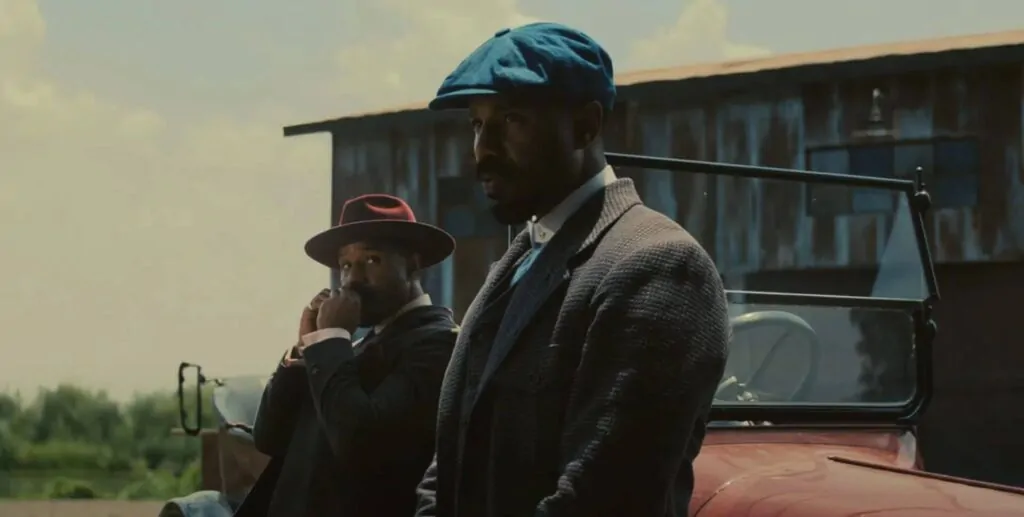
Smoke and Stack represent a single road diverging in two, not from hate, but love; oppositional perspectives that nevertheless harmonize to the extent that they’re able. Sammie’s experience of that night similarly delineates a clear inflection point between the path laid out by his father and his destiny as a musician: “the best day of his life” before the sun went down. For all three men, the nexus of this divergence coalesces around what compels their desire, captures their love, attention, and energy. Annie, Mary, Pearline. Family, freedom, guitar. A beat, a structure, the spine of something summoned from the ether, the past and future clapped and stomped into being, made to hum and sing.
If the eyes are the windows to the soul, as the saying goes, the door to Club Juke (and later, Pearline’s) is also a symbolic psychic-spiritual door to the souls of Black folk. Our music, our medicine, our stories, our monsters, and our love, all created in the image of one another and the worldly (and otherworldly) tensions that make up Black life, the strings of which we learned to pluck and play because being in this world has always meant learning how to dance with the devil without inviting him inside. And if you do, well, there’s always music to guide you home.