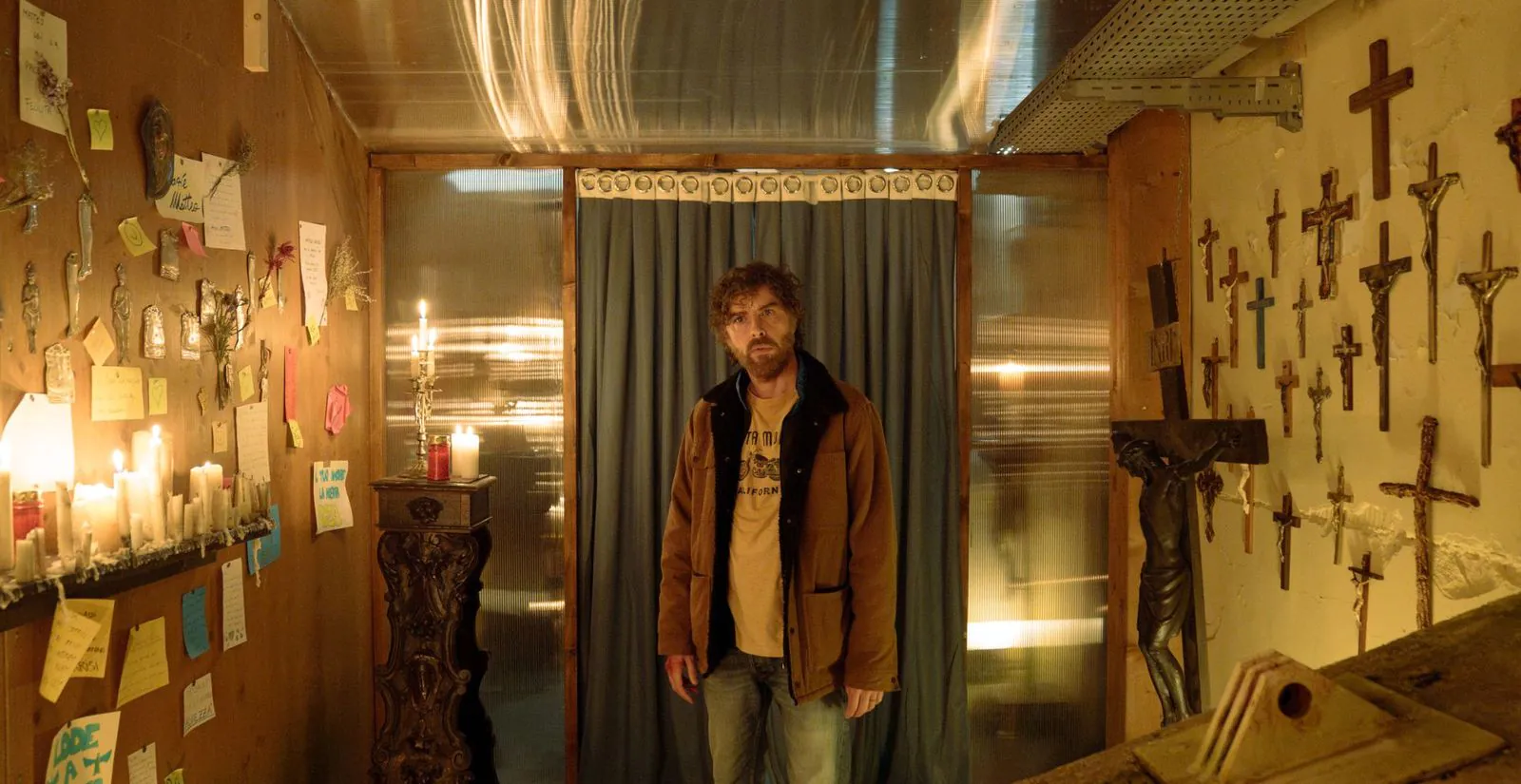
Empathizing with the rural mountain townsfolk who make up the secondary cast of Italian filmmaker Paolo Strippoli’s new movie, The Holy Boy, comes easily. Grief is transformative, not to mention agonizing, and so in the wake of a disaster, people look for ways to offload their sorrow and pain. Some are healthy, like participating in support groups; others are unhinged, like taking advantage of a teenager’s extraordinary healing touch rather than confronting their sadness.
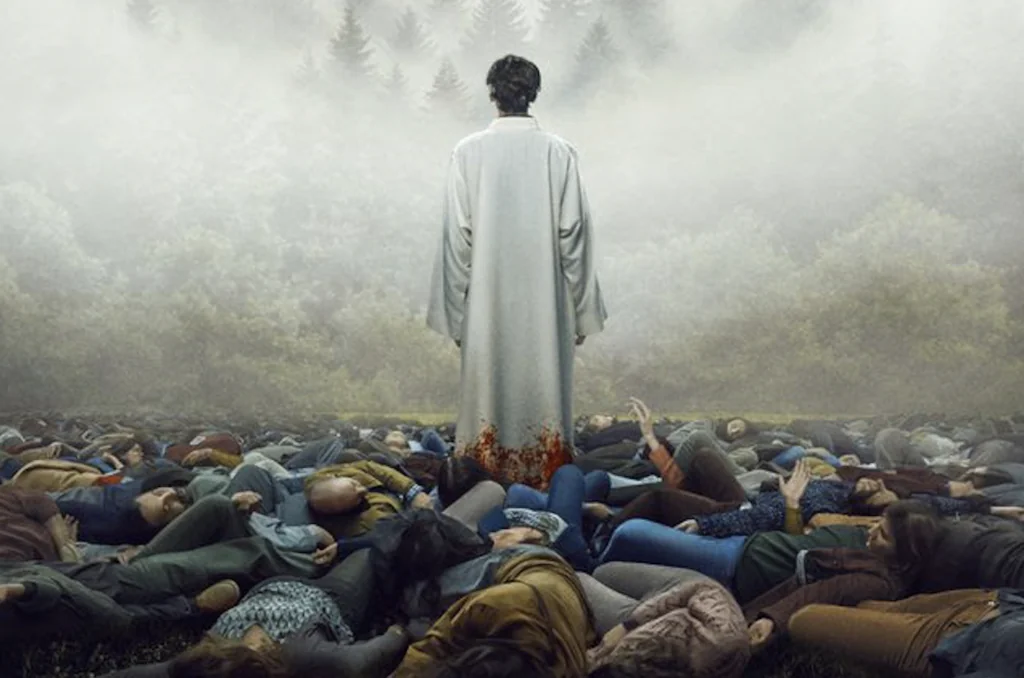
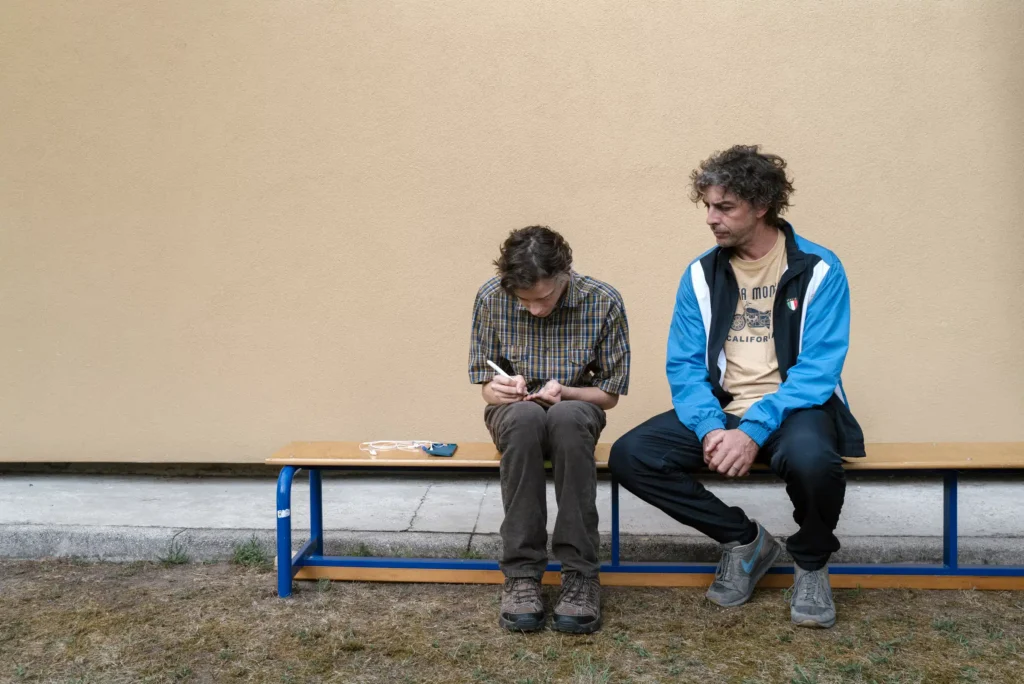
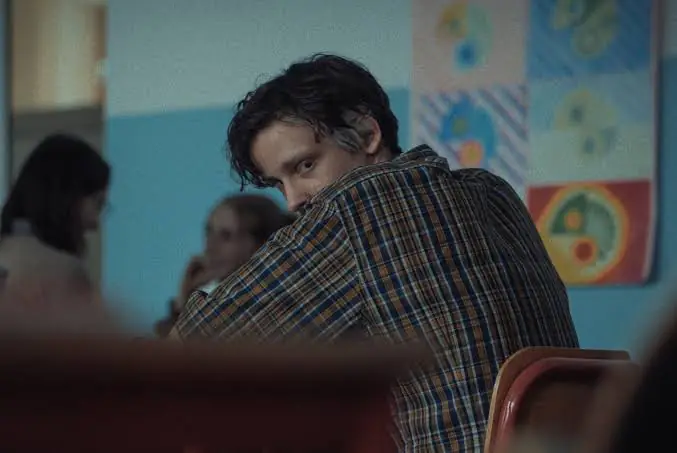
Strippoli focuses on the latter in the film, as a seemingly idyllic Alpine community, still recovering from a catastrophic train crash years prior to the story’s events, converges on the boy in question, Matteo (Giulio Feltri), blessed with the power to assuage people’s anguish with a single hug. In fact, that power is more like a curse, because Matteo’s life course is determined by his father, Mauro (Paolo Pierobon), who rigidly schedules his son’s meetings with locals for their regimen of salutary squeezes. Then comes along The Holy Boy’s protagonist, Sergio (Michele Rondino), once a national judo champion, now a husk of a man after the loss of his own son; he relocates to the village as its school’s new physical education teacher, then slowly comes to befriend Matteo and disrupts that metastasized abuser-victim relationship in the process, to an outcome as dreadful as the crash itself.
The Holy Boy puts folk horror into a context modern horror audiences aren’t quite used to; religious motifs aside, Strippoli’s interests lie in behavioral dynamics more than spiritual ones, as he explained in FANGORIA’s conversation with him ahead of the film’s release. WARNING: this interview contains mild spoilers for The Holy Boy.
My vague understanding is that while a high number of Italians are Catholic on the surface, there's an agnosticism movement going on in modern Italy. Does (The Holy Boy) speak to that gap between nominal religious identification and actual spiritual practice? The idea of people who believe, people who worship, versus people who merely describe themselves as Catholic–the film feels like it comes from that place.
It was never meant to be a movie about religion or spiritual practices, but a movie about the lengths we go to to free ourselves of our pain, and how sometimes we use religion to justify horrible behaviors we have and exploitations we make. It’s not about how bad religion can be. I admire people who truly believe and find themselves in religion, even though in this moment of my life, I don’t believe in dogmas and religious practices. I cannot find myself in that position. But I'm really scared of people who use religion for their own needs, like the community in this movie.
Sometimes we use religion when we are desperate, but religious belief should have nothing to do with desperation. It must be sincere. The community in this movie exploits this young boy; they say, “We are entitled to do that because someone sent him to us as compensation for what we lived [through].” This is how many people live their religion and religious beliefs, and that's just wrong. That hurts people.

That dynamic shows how scary religion can be. I don't get the sense that this community was dialed into faith until Matteo showed up and people understood what he could do; it seems this community started out in one place, and then the accident happened, then Matteo showed up, then they became something else entirely. Was it important for you (the audience) to understand how this community has changed? I think you and the film are trying to show what happens when a community latches onto something as a way of ignoring their problems.
You know, I don't know how much this community changed. I thought of this community as a religious community. It’s a mountain community, and of course the church is at the center of their community. But probably their vision of religion changed. I don't think they are religious anymore. They just use religion. It’s more about the blindness they developed. They are blind to their pain. They try to escape it, and they put it on this young boy. It's in the words of Mauro; at a certain point in the movie, he says that he tried to really understand what Matteo is, tried to look for Matteo in the sacred text, in the Bible, and he couldn't find him. But he had to fake it in front of his community.
He had to say that he's an angel sent by God to compensate them for the pain they suffered, because the community needed it. Nobody knows if Matteo is a spiritual figure, the holy boy sent by God to save this community. We don't know if he is something demonic. But this community needs to believe that he's there to save them, and this need—which, as I said before, is between need and desperation–blinds them. So I don't think it has anything to do with real religion and real belief. It's a blindness they accept in order not to suffer the horrible pain they felt after the catastrophe.
Do you think it's important for viewers to wonder about Matteo's spiritual identity, whether he's angelic or demonic? Sergio makes the point multiple times that he's a kid; I think he's ultimately what the community makes him into. This is ultimately a film, I think, about what happens to people when they're not allowed to decide for themselves who they get to be. As we talk about religion as a theme, I'm starting to see, more and more, all that matters is that he's a victim too. Is that a fair way to describe him?
That was my way into the character. That’s the whole point: he's a kid, and everybody in this community has their own opinion of who he is or what he is. The old community thinks he's the angel of Remis, and then there is Sergio's neighbor, Pichler, the outcast of this village because he thinks Matteo is not an angel at all, but the antichrist himself. So everybody has their own opinions. Then Sergio arrives and tries to affirm that (Matteo) is only a kid. It’s okay for people to wonder why he has these powers and what he really is.
But at the end of the day, the only thing they cannot see is the most evident: he's a boy, and nobody accepts it or treats him like one, and this leads to disaster. Sometimes we tend to see others for the roles they have, for the powers they have, and for the things they can do, but not for what they are, and this is exploitation in relationships, you know? We exploit something by trying to put a role on other people for our own good. When you do this with a teenage boy who's trying to find himself, if you try to put him in a cage, in the jail of roles, you're playing with fire. Eventually he will explode.
The exploitation angle is interesting. I wonder if you see (that theme) as integral to all of your work? I think there's a bit of it in A Classic Horror Story.
More than exploitation, the theme of control, the need to control others, and the need to control ourselves–to keep control and to lose control. It really scares me, because I'm a person who tries to have control of the things in my life, and when life happens, sometimes I'm not prepared, and then I'm left to cope with things I cannot cope with. This is what happens to this community. They are not prepared to grieve, and so in order to free themselves of this grief, they give up on a part of their identity. This movie is about people who are willing, even though they don't know it, to let someone have control over them in order not to suffer. For me, this means one thing: if we don’t accept that we can suffer in our lives, we give up our identity and our own personality. We become hollow, and this is what happens to this community.

I'm not getting the sense that religious horror is necessarily an influence for you. Watching The Holy Boy, I thought a lot about movies like Get Out and Smile 2; I thought about cult horror and body snatcher horror, in terms of the community becoming one organism, more or less, by the end. What fed into this film for you in terms of inspirations? There's so much in this that I can pick up on, but it's the kind of mix that feels uniquely you at the same time.
When I start to think of a story, I don't think about references, but of course things I love somehow enter the project I'm writing. We try to give back the movies we love, and we try to give back the feelings that made us feel good while watching them. Carrie, by Stephen King, could be cited as an inspiration for The Holy Boy, but also movies like Thelma by Joachim Trier and The Innocents by Joachim Trier’s co-writer, Eskil Vogt, his second film as a director.
But I would also cite a movie that I truly love, one of the best coming-of-age movies I can think of, Let the Right One In by Tomas Alfredson. It feels so honest in talking about that age. Of course, The Holy Boy is not a coming-of-age movie, but it has coming-of-age elements in it, so I tried to be as honest as Let the Right One In (in terms of) how this character develops his identity and sexuality. And then I really like movies where young kids are actually the danger. One of the movies I love the most about evil kids is Who Can Kill a Child by Narciso Ibáñez Serrador.
None of these films are literal references in The Holy Boy, but all of them, in a way, influenced me while writing and shooting it. Sometimes, I would like to forget that I watched movies and I loved movies, but I just cannot, because first and foremost, I am a spectator. I'm a filmmaker, of course, but I am a movie lover and a cinephile; I love movies so much.