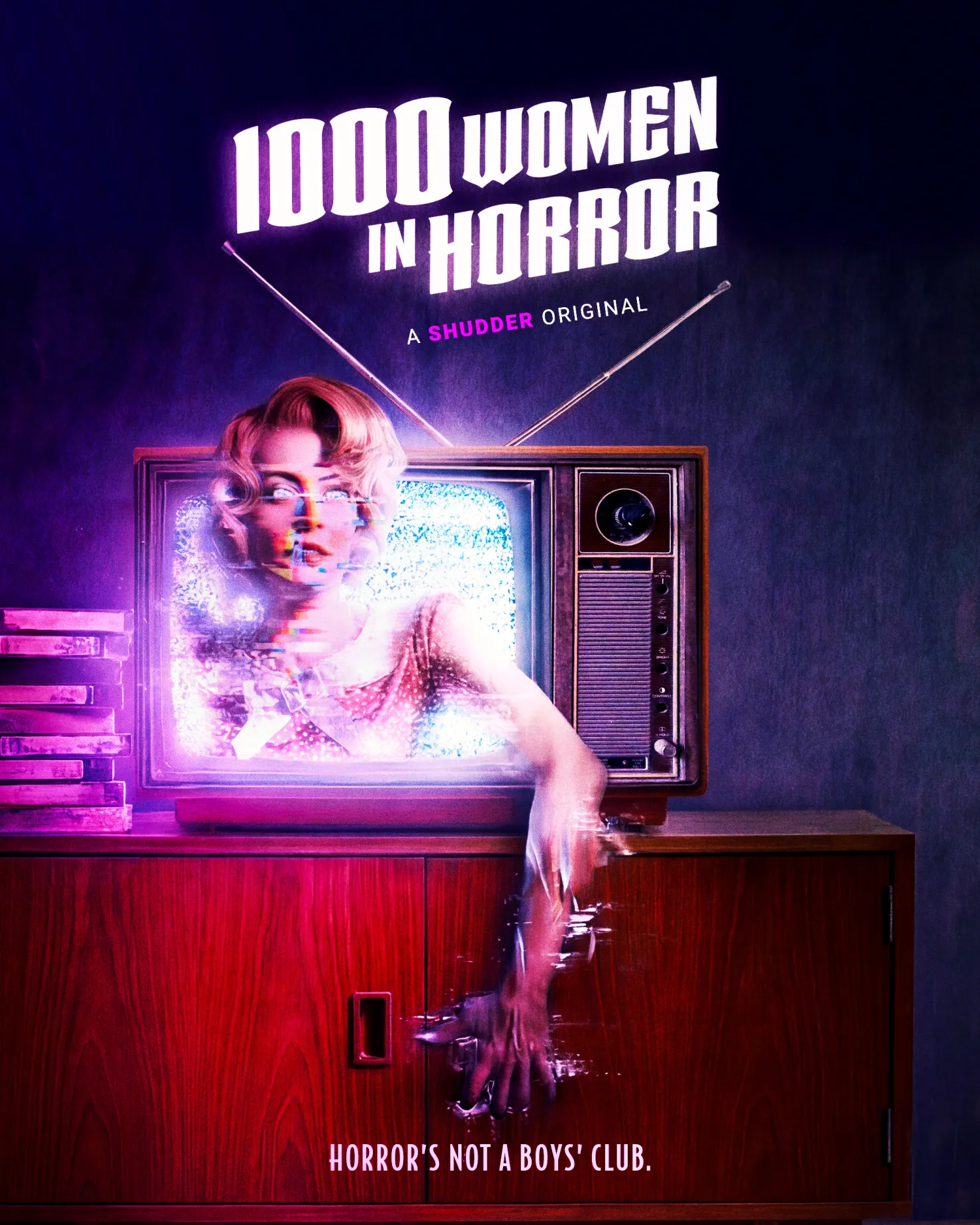
If horror movies are a balm for the crowded mind, then horror movie documentaries are an essential oil diffuser. The genre that refuses to be relegated to a misfit niche (hello, Amy Madigan and Sinners just ate up the Oscars) often speaks to the marginalized who have found solace and reflection in a medium that tells stories of real strife. It’s something Shudder has taken on before with their docs about Black and queer horror, and now they’ve made space for Alexandra Heller-Nicholas to examine women’s place in the canon.
Springing from her book of the same name, Heller-Nicholas teamed up with director Donna Davies to give viewers another array of talking heads discussing their connections to horror film, whether it be by way of the stories that made them, or the ones that they made. Through genre favorites like Brea Grant, Akela Cooper, and Mary Harron, 1000 Women in Horror provides fundamental insight into why women are so attracted to scary movies.
Heller-Nicholas starts the documentary off strongly by purporting to debunk the idea that women don’t like horror. She notes, not only do they like it; they also make it, star in it, and consume it (if we’re still talking Oscars, Frankenstein comes from the work of one of our best). For the runtime, she and her appointed brigade explore the experiences of women and drive home the point that horror is nothing without them. Horror, as she explains, questions and subverts social norms, and for a group of people expected to fit into a very specific mold, it becomes a perfect medium for their womanhood to be both contemplated and weaponized.

Framing the exploration with chapters corresponding with times in a woman’s life, the doc blasts through a journey of not just how women consume horror, but what women of those ages represent in it. As children, there’s the sense of innocence, as mothers, the sense of fear and strength, as aging women, the sense of rage. Innocence can be exploited for subversive fear (as exemplified by The Bad Seed), discomfort with female friendship can be exploited for confrontational terror (like in Poison for the Fairies or The Craft), sexual violence, pregnancy, growing old – all fears held by and about women that make for exceptional horror fodder. For those who’ve been banging the drum of “women in horror,” this conversation might feel familiar, but 1000 Women in Horror comes to feel like a place to find validation in female filmmakers who share a common hobby.
Much like the experiences chronicled in the other aforementioned documentaries, parts of being a woman are truly horrific. 1000 Women in Horror makes space for women to describe their real-life terrors and how the genre became a medium to explore them. Brea Grant — who had a busy year appearing in The Stylist about female friendship and obsession, writing and directing 12 Hour Shift which touches on what women can get away with when they’re underestimated, and writing and starring in Lucky which tackles the acceptance that women are always vulnerable to violent attacks — describes how her own experiences shaped her creations. She recalls a time speaking to a police officer after an attack and being told she was “lucky” it wasn’t worse, and how that became the inspiration for her through-the-looking-glass movie about the background hum of the threat of violence.
A stand-out moment of the doc is when Kate Siegel chronicles her experience giving birth and being pushed into a c-section. Over her gruesome play-by-play of the harrowing ordeal (made more plucky with multiple camera angles and her permission to curse), there are clips of horror films that capture such similar terror. It’s in these moments where the documentary shines, blending “showing and telling” to link the terrors on screen to the real-life traumas of women who are then meant to shake it off and carry on with their day. These women made movies about it.
Women are not a monolith, and the doc has fun exploring how each tackles their feminine experiences in horror. For some, periods are horror fodder (as exemplified by Carrie and its fandom and Toby Poser’s twisted fun with menstruation from the mouth) for others, it’s just everyday stuff as explained by April Wolfe and her nods to diva cups in Black Christmas. Women make up close to half the world population so it would be impossible to fully explore their place in this sprawling genre in about ninety minutes. As Natasha Kermani waxes near the end, “there’s a lot more to say on the topic.” “Women in horror” doesn’t start or end at this documentary, but it lays out the fundamentals, providing a gateway to the greater conversation that will leave the uninitiated with a helluva watchlist.
Watch the 1000 Women in Horror trailer here.