
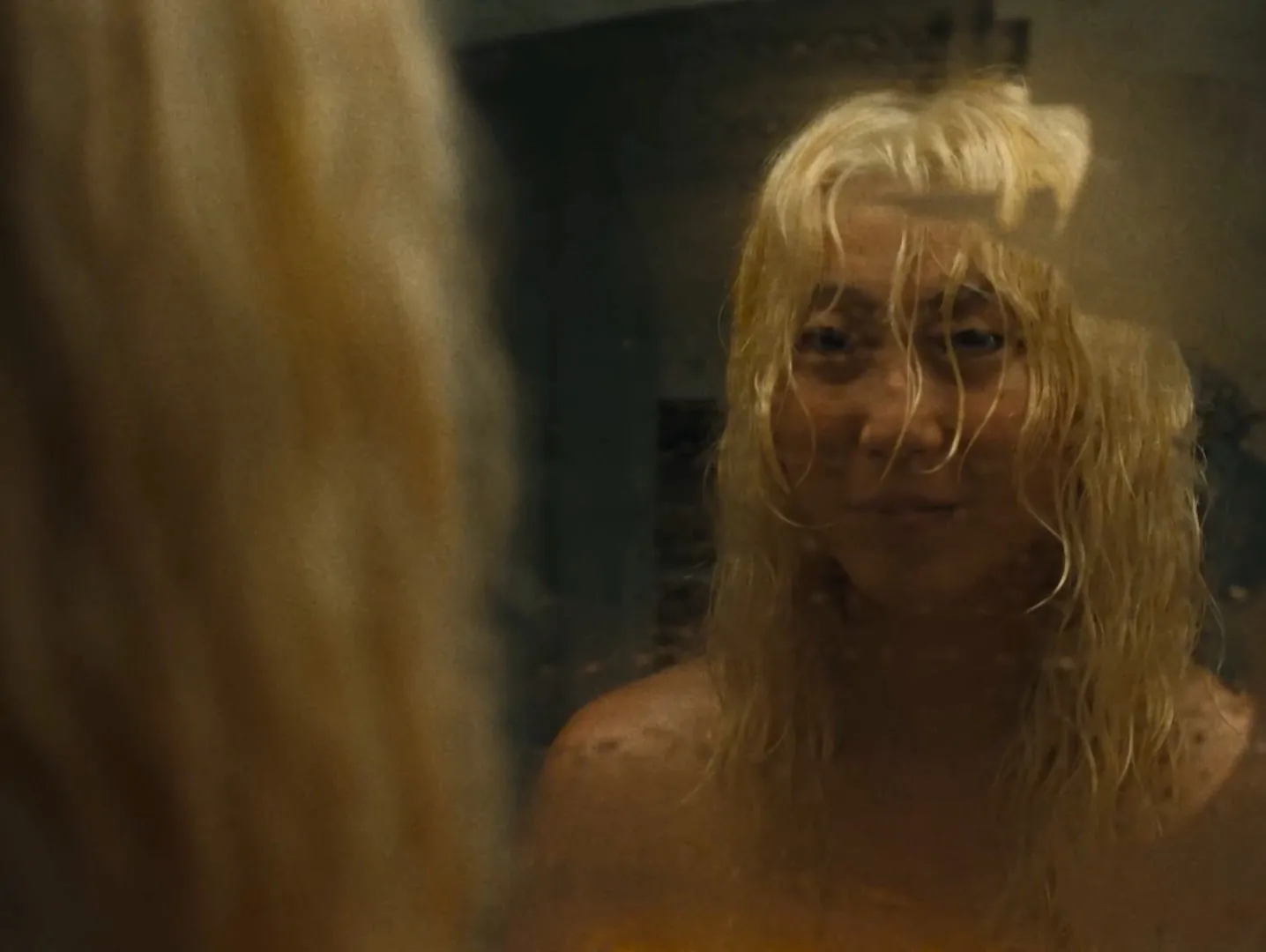
Australian-Chinese writer/director Amy Wang serves up a savagely satirical take on American nationalism, Western beauty standards, and societal pressures in her new teen body horror, Slanted. We sat down with Wang and the cast of the new horror comedy.
The immigrant experience in America, specifically, is an extra interesting and layered topic at the moment. Slanted shines a spotlight on that experience and also asks us to confront not just the question of what is beautiful and desirable, but also who defines that and how their definition colors our own answers to those questions. When teenage Joan Huang (Shirley Chen) has the opportunity to undergo an “ethnic modification” procedure, she sees it as a way to achieve her lifelong dream of becoming prom queen.
For writer/director Amy Wang, the story is heavily autobiographical. Growing up as a Chinese girl in Australia, she admits she wanted to look more like the people she was surrounded by as a kid. “I used to think I wanted to get a nose job and eyelid surgery and all that sort of stuff growing up, because I was surrounded by white Australians and they were the predominant race, the predominant culture and also the beauty standard that I feel like I had to match. When I was growing up, we had Instagram and Facebook, but in their early days. These days, there are fucking filters on everything to make you ‘prettier,’ to make you look more Kardashian. I don't know, I can't imagine growing up now what that would do to your perception of your own self-worth.”

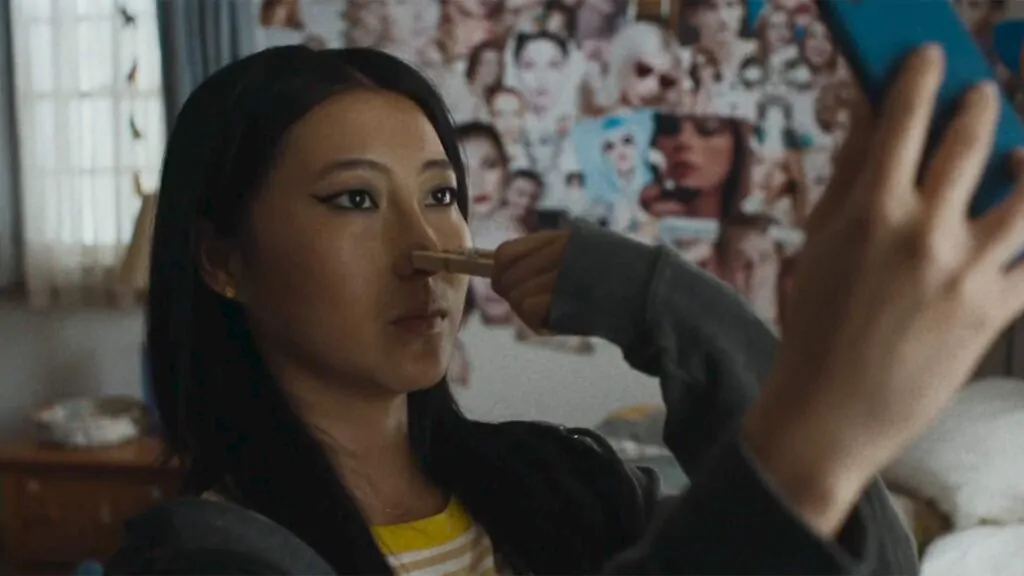
Slanted star Shirley Chen (Quiz Lady, Didi) grew up in Washington and shared that she inexplicably expected to undergo a transformation of her own on her sixteenth birthday. “There weren't many other Asian-American kids or Chinese-American kids. I genuinely, I don't know why, but I thought that when I turned 16, I would have blonde hair and blue eyes. I'd be pretty and have a boyfriend, and I don't know. You watch things, I guess you learn that messaging. Reading the Slanted script was crazy to be like, ‘Oh my gosh, I remembered when I thought this way, and I viewed myself in this way.’ But unlike Joan, I really found myself in high school. I went to a performing arts high school and was always encouraged to lean into the strange or lean into the weird.”
She’s able to laugh about it now, but the vast majority of the media we consume is depicted in a very specific way, which makes Chen’s naively sweet but slightly sad idea of teenage years not so outlandish after all.

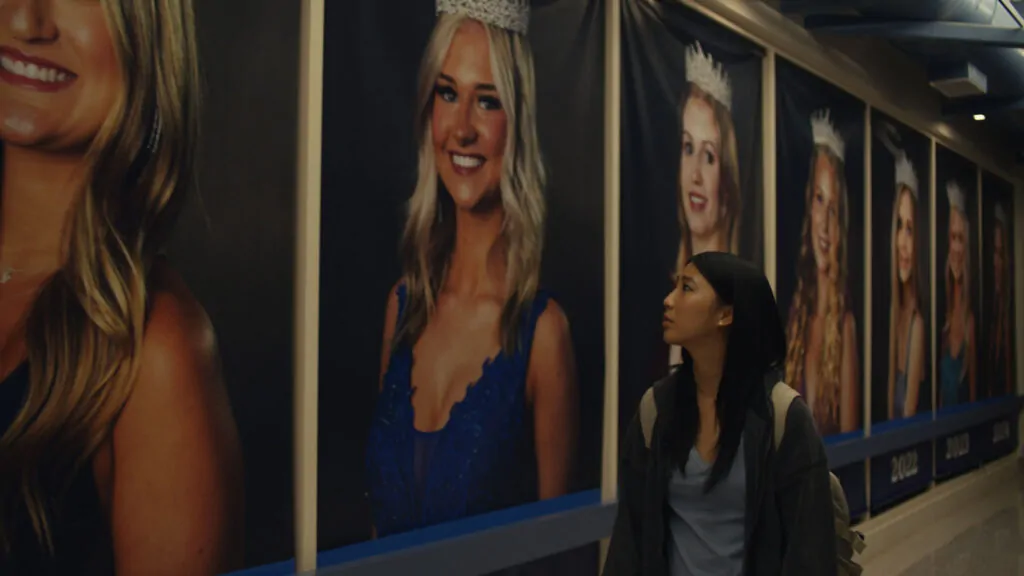
With Slanted, Wang depicts familiar scenes and scenarios we’ve seen a million times over and presents them in a new fantastical way. The coronation of a high school prom queen becomes a foreign, ethereal fantasy when viewed through the eyes of eight-year-old Joan. I’d never thought about the Prom Queen as a uniquely American experience, but Wang shared that this bit of Americana was one of the many reasons it made sense to set this particular story in the US. The image of that was something tangible for the protagonist, Joan, to cling to and pursue.
Aside from that, the iconography of American nationalism is certainly more prevalent in a way that is easy to poke fun at (Wang includes an absolutely unhinged karaoke video, along with little nods to some of the most frequented establishments in the country — Freedom Beans and All American Stripes Burgers). “I chose to set in America because I feel like America's just easier to satirize. I grew up watching American films and American television, and I just really understood the American tropes.”
The character of teenage Joan is played by two actors, Shirley Chen and McKenna Grace. Chen shared she was able to spend time a lot of time with Grace on set, “Amy brought us together and sat us down for these fun exercises where we would mirror each other's movements or we would listen to Sabrina Carpenter because at the time ‘Juno’ had just come out and I think there's a lot about that that we could both relate to in terms of this aspirational girl. We related a lot about core truths about being a young girl growing up and how you might feel about yourself, compare yourself to others, and I really remember that moment really fondly.”

Amelie Zilber plays mean girl, Olivia, the most popular (and powerful) girl in school. Olivia is essentially an avatar for the life Joan thinks she wants. There is more to the character beyond the veneer of the mean girl trope we are familiar with. When it came to bringing that to the character in an unspoken way, Zilber studied with an acting coach and delved into the character's motivations. Because, as admittedly unlikeable as Zilber found Olivia, she could not approach the character with any disdain.
“The most important thing that I needed to do in order to really play this character as an authentic human was understanding what motivated her to behave with such cruelty and with such malice,” she explained. “There was no world in which I could play a character that I personally found to be morally reprehensible, although I do. But in order to play her, I really had to put that aside, and I had to understand why she was doing what she was doing, because, at the end of the day, cruelty always comes from a place of sadness, and I had to understand where that was in her. One of the most poignant ways in which she is so insidious is by not thinking that she's doing anything wrong.”
As far as mean girl inspiration, Gossip Girl’s Blair Waldorf was a big inspiration for Zilber when it came to “how to command a room and be at the top of the social pyramid.”
Additional inspiration came from “Emma Roberts in Scream Queens, because her humor is such a huge part of her bullying, and that allowed me to feel free in being able to really bring out the comedy of my cruelty, more so at the beginning of the film than later on.”
Another major touchstone for Zilber was a particular Sharon Stone performance. “Sharon Stone in Basic Instinct really is this commanding, fierce presence, and Olivia needed to be this super confident, commanding character. I watched a lot of her scenes on repeat to see how she's carrying herself, how indifferent she is to the people around her. I had a lot of fun watching these really strong female characters be so awful to people around them, but in a way that was palatable, like a Gossip Girl.”
Maitreyi Ramakrishnan (Never Have I Ever) plays Joan’s best friend, Brindha. In contrast to Joan, Brindha offers a casual, cool balance. She gives off a strong sense of self and lives that unapologetically. When it came to finding inspiration for Brindha, Ramakrishnan said she often draws on the people she is surrounded by in real life. “All the characters that I play, I actually draw on the people around me, people I know, the friends I love, and the cousins that I hate, like the real people that I know, and I'm kind of just doing a lot of impersonations of just people in my life.”
In this case, Ramakrishnan had one cousin in particular in mind.“[Brindha’s] just cool, man. She's just cool. I’ve got one cousin of mine that's just really artistic and was kind of an edgelord when she was in high school. My cousin Banja, low-key, is a little bit of a Brindha, so she was my real-life inspo.”
There’s also a familiar fictional character in the mix, “With the more original draft of the script, where there's especially a lot of scenes with Brindha and Olivia, where Brindha is poking at Olivia, there was a little bit of a Janis Ian [Mean Girls] in that,” Ramakrishnan shared, before adding “I am in love with Amalie, so it does make sense. A little bit of a method.”
Ramakrishnan also shared that “There's definitely a bit of Maitreyi in Brindha when it comes to Joan, Brindha's like, ‘Yo, that's my best friend,’ just being two weird gals in the room. But thinking also about my relationship with my best friend, that's actually what informed that locker scene, asking that question of, ‘How do you view me? Do you think I'm ugly, too?’”
The scene Ramakrishnan is referring to is a poignant moment in which Brindha confronts Joan. A conversion between the two best friends that wasn’t in the original script. “That came about because I had a conversation with Amy, originally that line wasn't there. I just said, ‘Hey, if you're open to it, I'd like to incorporate this idea, Joan was unaware of what she’s saying about her friend.’ If my bestie did this to me, then had the audacity to say, ‘Oh, I'm prettier and I'm hotter,’ this concept of ‘I'm better basically just because I'm white,’ that's how I'd feel about it. I'd wonder, ‘How do you view me, dude?’”
Negative self-talk is prevalent, and Ramakrishnan notes, “It's just interesting the way that we treat ourselves versus how we treat our friends. Sometimes we are so much kinder to our friends. If we were just half as kind to ourselves, we would be a lot happier.”
Both Ramakrishnan and Zilber have high praise for director Amy Wang. Regarding the satirical comedy oozing from the screen, the duo shared that some of those elements were absent from the original script and developed during the process. Wang would get an idea in the moment, add it in, and run with it. “Amy's such a creative genius,” Zilber said. “They always say the funniest people are the smartest people, and that is Amy to a T,” added Ramakrishnan.
For anyone who may relate to Joan, Wang has the following advice:
“Give yourself grace because we all go through this journey. Nobody comes out of the womb just feeling absolute pride and rejoicing in who they are and everything about themselves, whether or not it's race or your face or your body, whatever it is, everybody is insecure about something. And the film and the journey takes you on this idea of, ‘Hey, what if we gave you what you wanted, but it's actually not what you think it is?’”
Wang’s hope is that audiences will watch Slanted and “Reflect and hopefully remember how each person is different and how much you should embrace and love every aspect of yourself, even if there are times when you don't love those aspects about yourself because of what society says or because of what the standard is. That's what I want to leave the audience with.”
“There’s this misconception that confidence comes from just loving who you are and being so proud and unabashed about it,” Shirley Chen added. “But actually, I think it comes from accepting the parts of yourself you don't like as truth. And that's just how it is. I am who I am, take it or leave it. I think that Joan's journey is definitely all about learning who you are because of learning who you're not, and that's just inevitable. You have to get through it and it sucks and it's hard, but you grow from it. It's just the part of growing up. It's essential to it.
Slanted is now in theaters.
